The best robotics sets for elementary students turn abstract STEM concepts into hands-on challenges. Children can build, code, test, and troubleshoot while developing problem-solving skills through play.
This roundup includes approachable robot mice, beginner coding toys, solar-powered builds, remote-control kits, and more advanced programmable sets for different ages, interests, and budgets.
Best 10 Robotics Sets for Elementary Students Picks for 2026
Best Entry-Level Robot

- Builds in about 15 minutes
- Learns Scratch and Arduino
- Supports expandable robot projects
Best For: Ages 8+ beginning hands-on robotics and coding
Best Screen-Free Starter
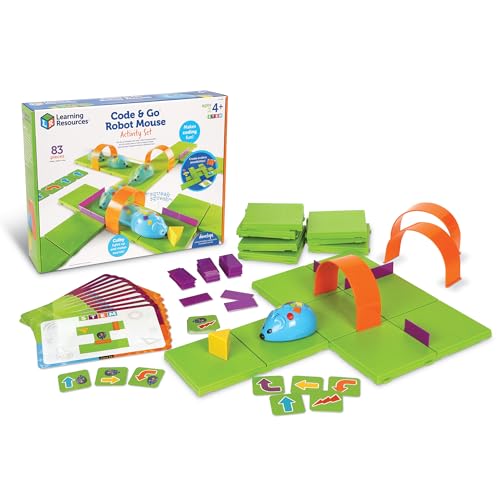
- Designed for ages 4+
- Uses coding cards and buttons
- Includes a reusable maze set
Best For: Early learners and classroom coding activities
Best Multi-Project Value

- Includes six build projects
- Practices construction and problem-solving
- Comes with a screwdriver and guides
Best For: Ages 8–12 wanting varied hands-on experiments
Best Solar Challenge
Sillbird 12-in-1 Solar Robot Kit

- Builds 12 models from 190 parts
- Explores solar-powered movement
- Includes step-by-step instructions
Best For: Ages 10+ interested in engineering and renewable energy
Best Multi-Project Pick

- Five build projects, including three vehicle-style robots
- Step-by-step instructions and mini screwdriver included
- AA batteries required and sold separately
Best For: Variety-focused family or classroom STEM activities
Best Programmable Option
5-in-1 Remote-Control Robot Kit
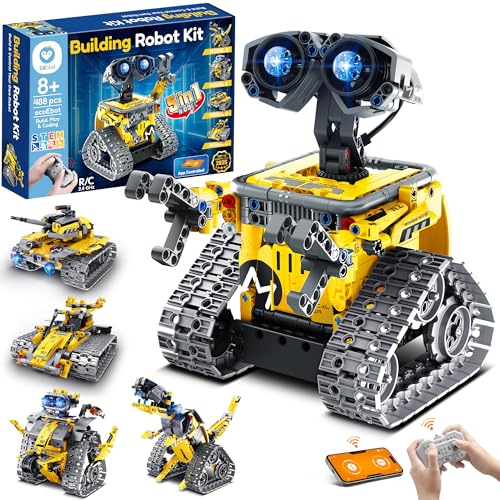
- App and remote control modes support interactive play
- 488 pieces build five progressively challenging models
- Rechargeable battery offers up to 40 minutes of play
Best For: Children exploring programming and remote-controlled robots
Best Science-Experiment Variety

- Six activities include a reptile robot and circuit projects
- Detailed instructions and mini screwdriver included
- AA batteries and bubble solution are required separately
Best For: Collaborative science experiments and classroom STEM projects
Most Versatile Pick

- Builds five robot and vehicle designs
- Remote and app control with programming modes
- 408 pieces support hands-on STEM learning
Best For: Kids who want varied builds and multiple control options
Best Mechanical Project

- Introduces motors, circuits, and mechanical movement
- Wooden build includes a detailed tutorial
- No soldering required; batteries are not included
Best For: Patient builders who enjoy a focused engineering project
Best for Build Variety
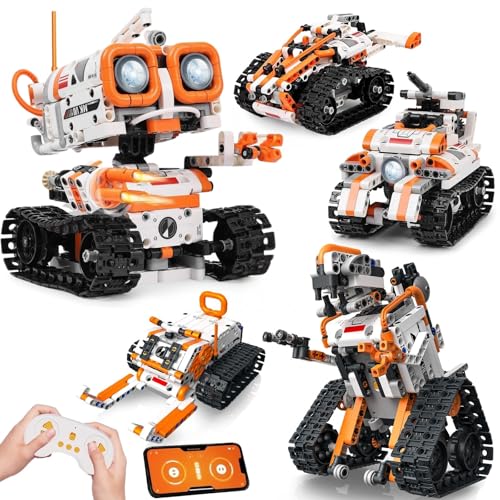
- 560-plus pieces create five different designs
- Remote and app-based coding control
- Numbered bags and color-coded blocks aid assembly
Best For: Kids who enjoy repeatable builds and introductory coding
Best Entry-Level Robot – mBot Coding Robot Kit
For families seeking robotics sets for elementary students ages 8 and up, the Makeblock mBot offers a practical introduction to electronics, construction, and programming. Its guided build can be completed in about 15 minutes, then expanded through Scratch, Arduino, apps, and add-on components.
Best For: Elementary students ready to move from basic building into hands-on coding and programmable robot projects.
Pros:
- Supports a gradual learning path from Scratch to Arduino.
- Quick assembly with clear building instructions.
- Includes line-following, obstacle-avoidance, and remote-control functions.
- Open-source design works with additional Makeblock modules and LEGO parts.
Cons:
- Four AA batteries and a CR2025 battery for the remote controller are not included.
- Its broader programming and expansion features may require adult guidance for beginners.
The mBot is a strong choice when you want one robotics set that starts simply but can support increasingly ambitious coding and electronics projects.
Best Screen-Free Starter – Code & Go Robot Mouse
The Code & Go Robot Mouse is one of the more approachable robotics sets for elementary students, especially younger learners who are beginning to understand sequences and directions. Children program the mouse with buttons and coding cards while building reusable maze layouts without a screen.
Best For: Early learners ages 4 and up, classroom STEM centers, and small-group coding activities.
Pros:
- Introduces sequencing and programming through screen-free play.
- Includes maze grids, walls, tunnels, coding cards, and activity cards.
- Supports repeatable classroom and small-group activities.
- Hands-on trial and error reinforces logic and directional understanding.
Cons:
- Requires three AAA batteries, which are not included.
- The manual button-based system is aimed at early coding rather than advanced programming.
This set is best viewed as an introductory coding activity rather than a construction kit, making it particularly useful for younger children and structured learning environments.
Best Multi-Project Value – 6-in-1 Robotics STEM Set
Families comparing robotics sets for elementary students may appreciate this six-project kit for its variety. Children can build models including a reptile robot, balance car, bubble machine, fiber lamp, and sliding plane while practicing construction, problem-solving, and basic motorized assembly.
Best For: Ages 8–12 looking for multiple build-and-experiment activities to share with family or use in classroom projects.
Pros:
- Provides six separate robot and science experiment projects.
- Encourages construction, creative thinking, hand-eye coordination, and problem-solving.
- Includes a screwdriver and step-by-step instruction manuals.
- Offers opportunities for family collaboration and shared project time.
Cons:
- The supplied notes do not identify specific coding software or programmable controls.
- Some builds may need adult help with reading instructions or assembly.
This is a practical pick when variety matters more than software-based coding, giving children several mechanical and electronic builds instead of a single robot project.
Best Solar Challenge – Sillbird 12-in-1 Solar Robot Kit
The Sillbird 12-in-1 kit adds renewable-energy exploration to the robotics sets for elementary students category. With 190 parts and 12 possible models, children can progress from simpler builds to more challenging robots and vehicles while learning through solar-powered play.
Best For: Ages 10 and up who enjoy model variety, engineering challenges, and screen-free exploration of solar power.
Pros:
- Offers 12 buildable models with increasing difficulty.
- Uses sunlight or a strong artificial light source instead of batteries.
- Large solar panel is designed to capture more sunlight.
- Clear step-by-step instructions support independent or family building.
Cons:
- Solar operation depends on sufficient sunlight or a strong artificial light source.
- The manufacturer recommends the kit for ages 10 and up, making it less suitable for younger elementary students.
This kit stands out for children who are ready for a more involved build and are curious about how renewable energy can power moving models.
Best Multi-Project Pick – 5-in-1 STEM Robotics Kit
For families comparing robotics sets for elementary students, this kit offers five different build projects rather than a single robot. Children can assemble a solar-powered car, wind-powered car, obstacle-avoidance robot, transmission tank, and glider while practicing basic STEM and problem-solving skills.
Best For: Elementary-age children who enjoy variety, hands-on family projects, or science-fair-style builds.
Pros:
- Includes five distinct science and engineering projects.
- Step-by-step instructions and a mini screwdriver support assembly.
- Can be used for family activities or classroom STEM projects.
- Gift-ready packaging suits birthdays and holidays.
Cons:
- AA batteries are required but not included.
- The kit may be better suited to children who can follow detailed assembly instructions.
This is a practical choice when you want one affordable-looking package with several introductory builds. Its variety encourages repeated use, although adults may need to help younger children with assembly.
Best Programmable Option – 5-in-1 Remote-Control Robot Kit
This Sillbird set stands out among robotics sets for elementary students with programmable controls, app connectivity, and a rechargeable battery. Its 488 pieces can be assembled into multiple forms, including a robot, dinosaur, car, or tank, giving children a progressive building and play experience.
Best For: Kids ages 8 and up who are ready to explore remote control, basic programming, and more involved construction.
Pros:
- Offers app-based Bluetooth control and a separate remote.
- Five buildable models provide varying levels of difficulty.
- Includes 488 pieces and colorful step-by-step instructions.
- Rechargeable design provides up to 40 minutes of play per charge.
Cons:
- The larger piece count may require more patience and adult support.
- Some functions depend on charging and app or remote setup.
Choose this kit if programming-style play and motorized control matter more than the simplest assembly. The rechargeable design avoids frequent battery replacement, while multiple models help maintain interest as building skills improve.
Best Science-Experiment Variety – 6-in-1 Robotics STEM Kit
For shoppers seeking robotics sets for elementary students with a broad mix of activities, this six-project kit combines robotics, circuits, and simple machines. Builds include a reptile robot, balance car, bubble machine, fiber lamp, and buzzer wire game, making it useful for guided family or classroom exploration.
Best For: Children ages 8-12 who enjoy science experiments and adults looking for collaborative STEM activities.
Pros:
- Provides six STEM activities covering robots, circuits, and mechanical projects.
- Detailed instructions and a mini screwdriver are included.
- Designed for family bonding, classroom work, or science-fair projects.
- Includes a lifetime warranty against manufacturer defects.
Cons:
- AA batteries and bubble solution are not included.
- Several projects may benefit from adult guidance during assembly.
This kit is a strong fit when educational variety is the priority. It expands beyond robot building into circuits and interactive experiments, but buyers should plan to supply the required batteries and bubble solution.
Most Versatile Pick – Opmind 5-in-1 RC Robot Kit
For families comparing robotics sets for elementary students, the Opmind kit combines hands-on construction with remote and app-based play. Its 408 pieces can be assembled into five designs, offering a flexible introduction to building, control, and basic programming for children roughly ages 8 and up.
Best For: Kids who want multiple vehicle builds and several ways to control their creations.
Pros:
- Five build options, including a robot, racing tank, and tracked cars.
- Remote control supports directional movement, rotation, and a range of more than 20 meters.
- App offers driving, path, gravity-sensor, and programming modes.
- Supports concentration, creative thinking, engineering skills, and hand-eye coordination.
Cons:
- The recommended ages vary across the supplied listing information, so younger children may need help.
- Building and operating the set may be more involved than a simple robot toy.
With multiple models and control modes, this is a strong choice when you want one robotics set to support repeat building and progressively more interactive play.
Best Mechanical Project – DIY Wooden Robot Arm Kit
This wooden robot arm is a focused option for families seeking robotics sets for elementary students who enjoy detailed assembly. The kit combines wooden construction pieces, motors, a PCB microcontroller board, and wiring to introduce mechanical movement and basic circuit concepts without soldering.
Best For: Older elementary students, tweens, and beginners who prefer a challenging, single-project build.
Pros:
- Combines a 3D puzzle-style build with motors, circuitry, and mechanical movement.
- Includes a precise assembly tutorial and the components needed to assemble the arm.
- No soldering is required.
- Encourages problem-solving, patience, logical thinking, and motor skills.
Cons:
- Six AA batteries are needed and are not included.
- It offers one robot-arm project rather than multiple interchangeable models.
- The detailed assembly may require adult guidance for younger builders.
This kit is less about fast remote-controlled action and more about the satisfaction of completing a mechanical engineering project, making it a good fit for patient builders.
Best for Build Variety – 5-in-1 Coding Robot Kit
The 5-in-1 coding robot kit gives families looking for robotics sets for elementary students a large, colorful building project with interactive controls. With more than 560 pieces, five designs, a remote, and app-based coding control, it offers several ways to explore construction, movement, and programming logic.
Best For: Kids ages 6 and up who enjoy colorful, repeatable builds and guided entry-level coding play.
Pros:
- Builds five designs, including a machine gun robot, armored vehicle, cannon tank, snowmobile, and mechanical dinosaur.
- Provides both 2.4GHz remote control and app-based coding control.
- Numbered bags, color-coded blocks, detailed instructions, and a brick separator support assembly.
- Includes a one-year warranty against manufacturer defects.
Cons:
- Children aged 6 or younger builders may need partial parent assistance.
- The larger 560-plus-piece build can take time and patience to assemble.
- The listing includes differing age information, so check the child’s experience level before buying.
Its combination of five models, stable remote control, and app coding makes this a particularly engaging option for children who may outgrow a single beginner build quickly.
How We Picked These Robotics Sets for Elementary Students
We focused on kits that combine meaningful building or coding activities with age-appropriate instructions and repeatable play. The selection spans screen-free programming, app-based control, remote-control robots, solar projects, robot arms, and multi-model construction kits. We also considered component variety, likely adult assistance, durability, expandability, and how well each set can grow with a child’s skills.
Because product listings and included parts can vary, check the current package contents, recommended age, software requirements, and assembly instructions before buying.
Quick Comparison
| Set Type | Best For | What to Check |
|---|---|---|
| Robot mouse activity set | First coding concepts and younger learners | Grid size, activity cards, and included accessories |
| Programmable robot kit | Children ready for coding and sensors | App compatibility, programming method, and battery needs |
| Remote-control robot | Fast, interactive building and driving | Controller range, motor setup, and construction complexity |
| Solar or multi-model kit | Creative builders who enjoy variety | Lighting conditions, gear quality, and model instructions |
| Robot arm kit | Older elementary students and engineering practice | Assembly precision, controls, and adult guidance |
Key Buying Factors
Age, Patience, and Supervision
Use the age range as a starting point, not a guarantee of independent play. Younger children may need help sorting parts, following diagrams, and troubleshooting motors or wiring. A simpler kit that gets used regularly is usually a better choice than a complex set that remains unfinished.
Building Versus Coding
Some children prefer assembling gears and mechanical parts, while others enjoy giving commands and seeing an immediate response. Look for a construction-heavy kit for hands-on engineering, a screen-free activity set for sequencing practice, or an app-enabled robot when a child is ready to explore programming.
Control Options and Technology
Remote controls offer quick, low-friction play. Apps and block-based coding can provide more depth but may require a compatible phone or tablet. Verify operating-system support, Bluetooth or wireless requirements, and whether batteries or charging cables are included.
Parts, Instructions, and Replay Value
Multi-model kits can provide variety, but more pieces also mean greater sorting and assembly demands. Favor clear diagrams, sturdy connectors, replacement-part availability, and projects that can be rebuilt rather than used only once.
Who Should Buy Which Robotics Sets for Elementary Students?
Choose a robot mouse activity set for a young beginner learning sequencing without screens. Pick a straightforward building kit for children who enjoy crafts, gears, and tangible projects. Solar kits suit kids curious about renewable energy, while remote-control models work well for builders who want immediate movement and interactive play.
For children ready to connect programming with physical results, choose a programmable robot with sensors, app control, or block-based commands. Older elementary students and confident builders may get more from a robot arm or a higher-piece-count multi-function kit. If you are buying a gift, prioritize the child’s current interests and available adult support over the largest part count or most advanced feature list.