Choosing robotics sets for classrooms means balancing student engagement with durability, instructional value, setup time, and the number of learners each kit can support.
This roundup compares 10 options ranging from beginner-friendly coding robots and craft-based builds to structured LEGO Education and multi-robot classroom packs.
Best 10 Robotics Sets for Classrooms Picks for 2026
Whole-Class Edison Coding
Edison Educational Robot Kit Set of 20

- 20 Edison robots for group activities
- Focused on coding skills
- Includes expansion kit and EdComm cable
Best For: Larger classes needing individual coding robots
Flexible STEAM Projects
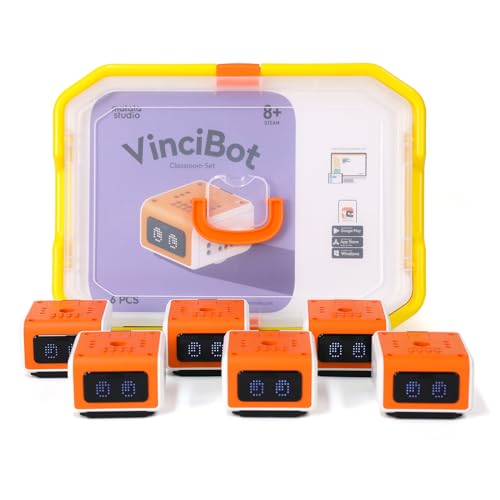
- Six robots for grades 2-7
- Scratch and Python programmable
- Includes 75 activities and storage bin
Best For: Guided, hands-on programming and AI projects
Hands-On Mechanics
LEGO Education BricQ Motion Prime

- 564-piece construction set
- Supports motion and building lessons
- Curriculum-aligned hands-on learning
Best For: Construction-focused STEM instruction
Screen-Free Foundations

- Two robots with two activity sets
- Screen-free coding for ages 5+
- Supports sequences up to 150 steps
Best For: Early elementary coding centers and rotations
Best Multi-Project Value

- Six different build-and-experiment projects
- Includes instructions and screwdriver
- Designed around hands-on STEM skills
Best For: Elementary STEM stations and small-group projects for ages 8–12
Best Classroom Coding Pack
Cooper STEM Robot Classroom Pack

- Four rechargeable robots for group use
- Screen-free sequencing and coding challenges
- Includes lesson plans and storage
Best For: Beginner coding rotations for learners ages 5–7
Best Programmable Build

- Builds in about 15 minutes
- Teaches Scratch and Arduino coding
- Expandable with Makeblock modules and parts
Best For: Ages 8+ learning robotics, electronics, and programming
Best Classroom Doodling Robot Pack
4-Pack STEM Doodling Robot Kits

- Four complete kits for small-group projects
- Combines robot building with creative drawing
- Designed for ages 8 and up
Best For: Small classroom groups and art-integrated STEM activities
Best Bulk Classroom Set
Outus 12 Pack Newton's Color Disc Kits

- Provides 12 kits for simultaneous student work
- Supports mechanics, circuits, and spatial reasoning
- Includes English instructions; batteries excluded
Best For: Full-class science activities and school clubs
Best Circuit-Building Starter Set

- Four kits for teams or classroom stations
- Introduces circuits, motors, mechanics, and engineering
- Includes interactive googly-eye robot projects
Best For: Beginner small-group robotics and circuit lessons
Whole-Class Edison Coding – Edison Educational Robot Kit Set of 20
For schools seeking robotics sets for classrooms, the EDIBOT-20 provides a 20-count Edison educational robot kit focused on coding skills. Its EdComm cable and simple download approach support device-based classroom activities, while the included Edison Expansion Kit adds room for broader STEM exploration.
Best For: Schools planning coding activities for larger groups or whole-class instruction.
Pros:
- Includes 20 Edison educational robots for group learning.
- Designed around coding skills and robotics education.
- Includes an Edison Expansion Kit and EdComm cable.
- Compact kit dimensions support organized storage.
Cons:
- The supplied information does not specify the exact included expansion activities.
- The listed age description is “Adult,” so teachers may need to determine student suitability.
Choose this set when quantity is the priority. With 20 units in one kit, it is particularly practical for classrooms that want students working with individual robots rather than sharing a small number of devices.
Flexible STEAM Projects – VinciBot Classroom Set
The VinciBot Classroom Set is one of the more feature-rich robotics sets for classrooms, supplying six coding robots for grades 2-7. Scratch and Python programming, AI capabilities, 75 activity cards, online tutorials, and a classroom storage bin give teachers a structured way to introduce programming and robotics.
Best For: Grades 2-7 classrooms seeking programmable robots with guided STEM activities.
Pros:
- Includes six VinciBot coding robots for small-group work.
- Supports Scratch and Python programming.
- Offers 75 activities, study cases, and online tutorials.
- Supports functions such as line tracking, obstacle avoidance, voice control, and color detection.
Cons:
- Six robots may require rotations in larger classes.
- The broad feature set may require more teacher setup than simpler introductory robots.
- The manufacturer recommends the set for ages 8-12.
This is a strong choice for teachers who want robotics to extend beyond basic movement. Its programming options, building compatibility, and guided resources support progressively more creative projects while the storage bin helps keep classroom materials organized.
Hands-On Mechanics – LEGO Education BricQ Motion Prime
LEGO Education BricQ Motion Prime takes a construction-centered approach to robotics sets for classrooms. With 564 pieces, durable materials, hands-on learning, and curriculum alignment, it is suited to lessons that connect building with motion, transportation, critical thinking, and construction skills.
Best For: Classrooms teaching construction, motion, and hands-on STEM concepts.
Pros:
- Includes 564 pieces for varied building activities.
- Supports construction skills and critical thinking.
- Features curriculum alignment and hands-on learning.
- Uses durable, classroom-oriented plastic components.
Cons:
- This is listed as one set rather than a multi-robot classroom pack.
- The supplied notes do not identify programming or coding features.
- Teachers may need to plan sharing or small-group use around the single set.
BricQ Motion Prime is best viewed as a build-and-investigate STEM resource rather than a conventional programmable robot kit. Its large piece count and curriculum-focused design make it useful when physical construction and motion are central to the lesson.
Screen-Free Foundations – Botley 2.0 Classroom Set
Botley 2.0 is a practical entry point among robotics sets for classrooms, especially for early elementary learners. The set includes two coding robots and two 78-piece activity sets, allowing teachers to run rotations, obstacle courses, small-group labs, or after-school challenges without requiring screens.
Best For: Ages 5-7 and beginner-friendly, screen-free coding activities.
Pros:
- Includes two Botley 2.0 coding robots and two activity sets.
- Teaches sequencing, logic, problem-solving, and programming without screens.
- Robots can be programmed for up to 150 steps.
- Supports obstacle detection plus light and sound sequences.
Cons:
- With two robots, larger classes may need scheduled rotations.
- The set uses AAA batteries, which require ongoing replacement or charging management.
- Its recommended starting age is 5 years and up, so it may be less suitable for advanced programming classes.
Botley 2.0 stands out when accessibility and simplicity matter most. Its screen-free controls and activity-based format make it easy to introduce coding concepts to young learners, while two complete activity sets support team-based classroom use.
Best Multi-Project Value – 6-in-1 Robotics STEM Set
For classrooms seeking robotics sets for classrooms with several hands-on activities, this six-project kit offers variety in one package. Students can build models including a reptile robot, balance car, bubble machine, fiber lamp, and sliding plane while practicing construction, problem-solving, and coordination skills. A screwdriver and step-by-step instructions are included.
Best For: Elementary STEM stations, small-group building activities, and classrooms wanting multiple projects for ages 8–12.
Pros:
- Includes six separate science and robotics projects.
- Supports construction, creative, logical-thinking, and problem-solving skills.
- Instructions and a screwdriver are included for guided assembly.
Cons:
- Projects are better suited to individual or small-group use than a full class at once.
- The manufacturer’s recommended age range begins at 36 months, while the product is primarily described for ages 8–12; teachers should match activities to student readiness.
This is a flexible choice when variety matters more than a dedicated coding curriculum. It can support rotating project stations, though teachers may need to provide their own lesson structure and classroom management plan.
Best Classroom Coding Pack – Cooper STEM Robot Classroom Pack
Cooper is purpose-built for robotics sets for classrooms, with four rechargeable robots for screen-free coding practice. The pack supports sequencing, logic, and early programming through guided challenges, making it practical for STEM rotations, group coding labs, and collaborative activities with younger learners.
Best For: Teachers working with beginner coders ages 5–7 in classrooms, after-school programs, STEM labs, and maker spaces.
Pros:
- Includes four rechargeable robots for group instruction.
- Offers screen-free activities focused on sequencing, logic, and coding.
- Comes with lesson plans, USB charging cords, and built-in storage.
Cons:
- Its early-learning focus may be too basic for advanced elementary students.
- The pack is centered on guided coding challenges rather than open-ended robot construction.
Among these options, Cooper is the most directly classroom-ready. Rechargeable units, storage, and lesson plans can simplify setup and distribution, while the screen-free format keeps instruction focused on foundational coding concepts.
Best Programmable Build – Makeblock mBot Coding Robot
For classrooms wanting robotics sets for classrooms that connect building with programming, the Makeblock mBot provides an expandable entry point. Students can assemble it in about 15 minutes, then explore Scratch and Arduino through tutorials, coding cards, apps, and mBlock software. It also supports line-following, obstacle avoidance, and remote-control activities.
Best For: Robotics and coding lessons for students ages 8 and up, especially classes ready to progress from guided activities to programmable projects.
Pros:
- Combines electronics, mechanical construction, and coding.
- Supports Scratch and Arduino learning with tutorials and software.
- Expandable through Makeblock add-ons, including more than 100 electronic modules and 500 parts.
Cons:
- Only one robot kit is included, so additional units may be needed for group work.
- AA batteries for the robot and a CR2025 battery for the remote controller are not included.
mBot is a strong fit for a structured progression from assembly to programming. Its metal-and-plastic build and open-source expansion options can support recurring projects, but teachers should plan for battery purchases and determine how students will share a single unit.
Best Classroom Doodling Robot Pack – 4-Pack STEM Doodling Robot Kits
For teachers seeking robotics sets for classrooms, this four-pack combines basic construction with creative drawing. Each kit is designed for children ages 8 and up and includes the components needed to build a doodling robot, making it suitable for hands-on STEM activities, small-group projects, or take-home learning.
Best For: Elementary and middle-grade classroom activities, STEM clubs, party projects, and lessons that connect engineering with art.
Pros:
- Includes four complete doodling robot kits for group use.
- Encourages construction, problem-solving, spatial thinking, and creativity.
- Designed for children ages 8 and up with non-toxic, durable materials.
- Works as both a classroom activity and an individual project.
Cons:
- Four kits may not cover a full class without additional sets.
- The supplied notes do not indicate that batteries are included.
This is a practical choice when you want a manageable set of buildable robots with an artistic outcome. Its four-unit format fits small groups, though larger classes may need multiple packs.
Best Bulk Classroom Set – Outus 12 Pack Newton's Color Disc Kits
This 12-pack is one of the more classroom-oriented robotics sets for classrooms, with enough kits for students to work simultaneously. The Newton’s color disc project uses assembly, motion, and color exploration to support group science activities, school clubs, and guided STEM experiments.
Best For: Full-class activities, science clubs, collaborative experiments, and teachers who need a larger quantity of individual projects.
Pros:
- Includes 12 complete kits for larger groups.
- Supports lessons involving assembly, spatial reasoning, basic mechanical principles, and circuit knowledge.
- Sturdy, non-toxic plastic is intended for repeated assembly and experiments.
- English instructions are described as clear and suitable for beginners.
Cons:
- Batteries are not included.
- The manufacturer-recommended age is 12 and up, despite other age references in the listing.
- The project is a Newton’s color disc kit rather than a conventional programmable robot.
Choose this set when quantity and collaborative learning matter most. It offers strong coverage for a classroom or club, but teachers should plan separately for batteries and confirm that the recommended age suits their students.
Best Circuit-Building Starter Set – 4 Set Bulk Craft Robot Kits
For teachers comparing robotics sets for classrooms, this four-kit package focuses on simple electrical and mechanical concepts. Students assemble a robot with a DC motor and can use the project for classroom activities, STEM challenges, science fairs, or introductory circuit lessons.
Best For: Small-group elementary projects, beginner robotics lessons, science fairs, STEM competitions, and students ages 8 to 13.
Pros:
- Includes four individually complete kits for group activities.
- Introduces electrical circuits, motors, mechanics, and engineering principles.
- Fun googly-eye details and motorized movement add an interactive element.
- Suitable for classroom projects, STEM challenges, and science exhibitions.
Cons:
- Four kits are best suited to a small group unless several packs are purchased.
- The supplied notes do not confirm that batteries are included.
- The listing contains varying age references, so teachers should review fit for their class.
This set is a good entry point for hands-on circuit and motor lessons without requiring a large class-wide purchase. Its four-pack format works especially well for teams, stations, or project-based learning.
How We Picked the Best Robotics Sets for Classrooms
We focused on classroom usefulness rather than novelty alone. The selected kits represent several teaching approaches, including screen-based coding, hands-on construction, robotics challenges, STEM demonstrations, and creative engineering projects. We also considered age range, classroom quantity, rechargeability, expandability, setup demands, and whether a teacher can use the kit for repeatable lessons.
Because classrooms vary widely, there is no single best kit for every group. A set designed for six teams may be more practical than a 20-robot pack for a small club, while a bulk craft kit may work better for a one-day activity than a full coding unit.
Quick Comparison
| Best For | Look For |
|---|---|
| Introductory coding | Simple controls, visual programming, and clear lesson progression |
| Full-class instruction | Multiple robots, shared components, and manageable charging |
| Engineering and physics | Buildable mechanisms, motion challenges, and reusable parts |
| Creative STEM activities | Craft materials, quick assembly, and accessible project prompts |
| Long-term programs | Durable construction, expansion options, and curriculum support |
Key Buying Factors for Robotics Sets for Classrooms
Student-To-Robot Ratio
Decide whether students will work individually, in pairs, or in larger teams. More robots can reduce waiting, but smaller groups may provide better hands-on access to sensors, motors, and programming controls.
Age and Learning Curve
Check the recommended age against your actual class. Younger learners often benefit from tangible coding commands and short build cycles, while older students may need programmable sensors, more complex challenges, and room to modify designs.
Durability and Maintenance
Classroom equipment must survive repeated handling. Favor sturdy components, replaceable parts, clear storage, and rechargeable power when the kit will be used frequently. Confirm whether batteries, chargers, or proprietary accessories are included.
Teaching Support
Lesson plans, guided challenges, printable instructions, and app compatibility can significantly reduce preparation time. Also verify device requirements, internet needs, software support, and whether students can progress beyond the introductory activities.
Project Flexibility
A kit is more valuable when it supports multiple lessons instead of one demonstration. Look for opportunities to explore sequencing, loops, sensors, design iteration, measurement, teamwork, and problem-solving.
Who Should Buy Which Robotics Sets for Classrooms?
Choose a multi-robot classroom pack when you need consistent activities for a full class or several small groups. Select a structured education platform such as LEGO Education when curriculum alignment, construction challenges, and long-term reuse matter most. Beginner-friendly coding robots are a strong fit for elementary introductions and short programming lessons.
For maker days, after-school clubs, or limited budgets, bulk craft robot kits can provide an accessible way to teach design and creativity without requiring advanced software. Rechargeable packs are especially practical for programs that meet often. Before ordering, match the kit’s quantity, age level, lesson support, storage needs, and device requirements to your classroom routine.