Choosing the right test instrument can make DC power, battery, and charger validation faster and far more reliable. The best programmable electronic loads give you repeatable control over current, voltage, resistance, and power for cleaner bench testing.
Below, we focus on practical picks for lab work, repair benches, and production testing, with an eye on capacity, modes, precision, and interface options.
Best 10 Programmable Electronic Loads Picks for 2026
Precision Lab Load

- CC, CV, CR, and CP modes for flexible testing
- 15kHz dynamic mode for transient response checks
- LAN, USB, RS232, and SCPI automation support
Best For: lab testing, battery discharge work, and automated power-supply validation
Automated Bench Tester

- 0-300V, 0-20A, 300W operating range
- USB, RS232, RS485, and SCPI support
- 5kHz dynamic testing plus battery charge/discharge curves
Best For: automated test benches, battery analysis, and dynamic load simulation
Budget Front-Panel Load
120W DC Electronic Load Tester

- CC, CV, CR, CP, and short-circuit modes
- WH and AH measurement for battery testing
- Simple LED front panel with manual controls
Best For: basic battery, supply, and resistance testing on a tighter budget
Sequenced Test Load

- CC, CV, CR, and CP operation modes
- List mode supports up to 100 steps
- USB PC control with dynamic, scan, and short-circuit tests
Best For: R&D, QC, and battery testing that benefits from step programming
Precision Bench Option
MATRIX PEL8300 150V/60A 300W Programmable Load
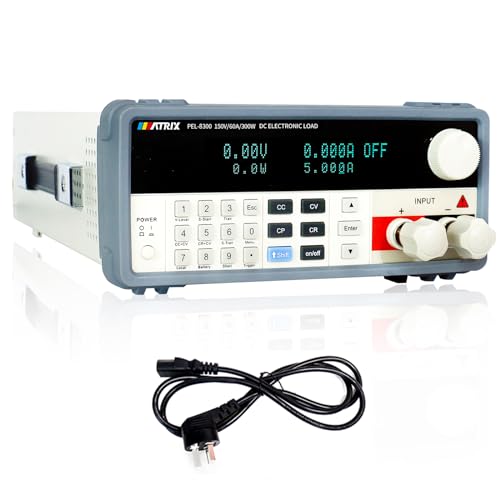
- 0.1mV/0.1mA resolution with stated 0.03% basic accuracy
- 150V, 60A, 300W single-channel design
- CC, CV, CR, CP, short circuit, and dynamic modes
Best For: High-accuracy DC power and battery testing on a single bench channel
Budget-Friendly Tester
YERTAI ET5406A+ 200W Programmable DC Load

- 200W, 0-120V, 0-30A single-channel tester
- USB remote control with SCPI support available
- Battery, dynamic, list, and short-circuit test modes
Best For: General charger, battery, and power supply testing with remote-control support
Automation-Ready Pick
OWON OEL1520 300W Programmable Load

- USB, RS232, and RS485 control with SCPI support
- 5kHz dynamic mode for transient testing
- Integrated battery charge/discharge testing
Best For: Automated lab and production testing with fast dynamic load changes
Precision Bench Tester
ET5410A+ 400W Single-Channel Load

- High-resolution 1mV/1mA measurement steps
- 12 modes for battery, LED, and load testing
- 2.8-inch TFT screen with key lock and protections
Best For: Bench users who want a straightforward, high-precision load for batteries, chargers, and power supplies.
High-Accuracy Discharge Tool

- CC, CV, CR, and CP modes for flexible testing
- Battery discharge, capacity, and resistance functions
- 2.8-inch color display with key lock and protections
Best For: Battery, LED, and power-supply testing where precision and controlled discharge matter.
Dual-Channel Analyzer

- Two independent 200W channels, 400W total
- CC, CV, CR, CP, CC+CV, and CR+CR modes
- USB and RS485 connectivity with protections
Best For: Users who need dual-channel testing for batteries, chargers, power supplies, or electronic components.
Precision Lab Load – Rigol DL3021 150V 40A 200W
For buyers comparing programmable electronic loads, the Rigol DL3021 stands out as a bench-friendly option for battery discharge work, power-supply testing, and automated lab setups. Its CC, CV, CR, and CP modes give you the control needed for practical test workflows, while the 15kHz dynamic mode helps evaluate transient response more aggressively than basic loads.
Best For: Engineers and lab users who need a programmable DC load for battery testing, transient checks, and SCPI-based automation.
Pros:
- Supports CC, CV, CR, and CP modes for flexible DC testing.
- 15kHz dynamic mode with adjustable rising speed for transient response work.
- LAN, USB, and RS232 control with SCPI support for automation.
- 4.3-inch TFT display shows multiple parameters and curves in real time.
Cons:
- 200W rating may be limiting for higher-power DUTs.
- Best suited to bench or lab use rather than portable field testing.
Overall, this is a strong choice if you want a programmable electronic load focused on accuracy, speed, and integration. The protection features also make it a safer fit for long-term prototype and production testing.
Automated Bench Tester – OWON OEL3020 300W 5kHz
If you need programmable electronic loads for lab or production workflows, the OWON OEL3020 offers a wide operating range and good control options in a compact bench format. It supports CV, CC, CR, and CP modes, plus dynamic switching up to 5kHz, making it useful for checking how supplies and components handle changing load conditions.
Best For: Test benches and production environments that need remote control, battery testing, and dynamic load simulation.
Pros:
- Wide 0-300V, 0-20A, 300W operating range.
- USB, RS232, and RS485 connectivity with SCPI support.
- 5kHz dynamic mode with adjustable current rise rate.
- Battery charge/discharge testing with PC software and curve output.
Cons:
- 2.8-inch display is smaller than some competing bench models.
- Single-unit 300W capacity may not suit higher-power applications.
As a programmable DC electronic load, this model is built around automation and practical test coverage rather than extra-large power handling. The safety protections and fine readout resolution make it a solid fit for repeatable engineering work.
Budget Front-Panel Load – 120W DC Electronic Load Tester
This programmable electronic load is a straightforward pick for users who want core DC testing modes without a more complex bench instrument. It covers CC, CV, CR, CP, and short-circuit testing, and it adds WH/AH measurement functions for battery and power-supply checks.
Best For: Buyers who want an affordable desktop load tester for basic battery, supply, and resistance measurements.
Pros:
- Includes CC, CV, CR, CP, and short-circuit testing modes.
- Measures watt-hours and amp-hours for battery evaluation.
- Clear LED display with real-time voltage and current readings.
- Simple front-panel controls with mode buttons and adjustment knobs.
Cons:
- 120W maximum power is modest for larger loads.
- Fewer advanced automation features than higher-end programmable loads.
For basic lab use, this model focuses on essential functionality and ease of operation. It is a practical choice if you mainly need manual control and simple test readouts rather than full remote integration.
Sequenced Test Load – East Tester ET5406A+ 200W USB
For buyers shopping programmable electronic loads with stronger test sequencing features, the East Tester ET5406A+ adds more automation than a basic bench unit. It supports CC, CV, CR, and CP operation, along with battery discharge, dynamic waveforms, list mode, short-circuit checks, and scan testing for broader evaluation work.
Best For: R&D and QC teams that need USB-controlled load testing with step programming and scanning functions.
Pros:
- Supports CC, CV, CR, and CP load modes.
- List mode can program up to 100 load steps.
- Dynamic, short-circuit, and scan tests expand its use cases.
- USB PC control fits lab and production testing.
Cons:
- 200W limit may be too low for heavier power tests.
- Detailed interface specs beyond USB are not highlighted in the supplied notes.
This model is a good fit when you need more than steady-state loading and want sequential or waveform-based testing in one unit. Its feature set is especially useful for battery analysis and power-device validation in controlled environments.
Precision Bench Option – MATRIX PEL8300 150V/60A 300W Programmable Load
If you need programmable electronic loads for DC supply testing, the MATRIX PEL8300 is built for precise bench work. It offers 0.1mV and 0.1mA resolution, a stated 0.03% basic accuracy, and multiple operating modes for checking power supplies, batteries, and other DC-powered devices.
Best For: Engineers and technicians who want a high-accuracy single-channel load for lab testing, calibration-focused work, and general DC power validation.
Pros:
- 150V / 60A / 300W capacity covers a broad range of DC test tasks.
- Supports CC, CV, CR, CP, short circuit, and dynamic operation.
- High-brightness VFD screen makes readings easy to see in low light.
- Includes protection for over-voltage, over-current, over-power, over-heat, and reverse polarity.
Cons:
- Single-channel design limits you to one DUT at a time.
- Larger and heavier than compact bench loads at 10.8 pounds.
- Advanced features may be more than casual users need.
Overall, the PEL8300 stands out when accuracy and measurement detail matter more than portability. Its display, protections, and broad mode set make it a capable programmable electronic load for serious bench testing.
Budget-Friendly Tester – YERTAI ET5406A+ 200W Programmable DC Load
The YERTAI ET5406A+ is a practical choice if you want programmable electronic loads for everyday charger, power supply, or battery checks without stepping up to a heavier-duty unit. It provides common test modes, useful protections, and USB control support for users who may want computer-based operation later.
Best For: Users who need a straightforward programmable load for charger testing, battery checks, and general DC bench work.
Pros:
- 200W, 0-120V, 0-30A range suits many common DC testing jobs.
- Offers CC, CV, CR, CP, battery test, dynamic, tran test, list test, and short circuit modes.
- USB communication is supported for remote control and SCPI software use.
- Includes overcurrent, overvoltage, overpower, and overtemperature protection.
Cons:
- Lower power rating than 300W bench models.
- Computer software and SCPI are available through the supplier rather than bundled details in the listing.
- LCD segment display is less premium-looking than color TFT alternatives.
In practice, the ET5406A+ makes sense for buyers who value mode variety and remote-control options in a simpler package. It covers the essentials well and adds enough flexibility for repeatable DC load testing.
Automation-Ready Pick – OWON OEL1520 300W Programmable Load
For automated test setups, the OWON OEL1520 brings the connectivity and speed that programmable electronic loads are often chosen for. It supports USB, RS232, and RS485 with SCPI control, plus fast dynamic switching up to 5kHz for checking transient behavior in power supplies and components.
Best For: Lab and production users who need PC-controlled testing, dynamic load steps, and battery charge/discharge workflows.
Pros:
- USB, RS232, and RS485 interfaces with full SCPI protocol support.
- 5kHz dynamic operation with adjustable current rise rate for transient testing.
- Supports CV, CC, CR, and CP modes plus integrated battery charge/discharge testing.
- 1mV/0.1mA readback on a 2.8-inch TFT color LCD.
Cons:
- 20A output limit may be narrower than some higher-current alternatives.
- At 300W, it is powerful but not intended for very high-load applications.
- Connectivity and automation features may be more than basic users need.
The OEL1520 is the strongest fit when test automation and transient characterization are priorities. Its interface options, fast dynamic response, and battery testing support make it especially useful in R&D or production environments.
Precision Bench Tester – ET5410A+ 400W Single-Channel Load
If you need a programmable electronic load for general-purpose bench work, this ET5410A+ is built around precise measurements and a wide operating range. It suits charger, power supply, and battery testing, with enough modes to cover common discharge and validation tasks without feeling overly complicated.
Best For: Bench users who want a straightforward, high-precision load for batteries, chargers, and power supplies.
Pros:
- 1mV/10mV and 1mA/10mA resolution for fine adjustment
- 12 test modes, including battery, LED, dynamic, scan, list, and short-circuit testing
- 2.8-inch TFT LCD with an intuitive interface and key lock
- OVP/OCP/OPP/OTP protection plus intelligent fan speed control
Cons:
- Single-channel design limits simultaneous testing
- 400W / 0-150V / 0-40A rating may be more than hobby use requires
Overall, this is a capable programmable DC electronic load if you want precise control and a broad feature set in one channel. Its strength is versatility, especially for users who regularly test batteries, chargers, and power supplies.
High-Accuracy Discharge Tool – ET5420A+ Pro Load Tester
This ET5420A+ is a programmable electronic load aimed at users who need accurate discharge testing across power supplies, batteries, and components. It combines CC, CV, CR, and CP modes with battery and LED-focused functions, making it a practical choice when you need one tester to cover several workflows.
Best For: Battery, LED, and power-supply testing where precision and controlled discharge matter.
Pros:
- 1mV/10mV and 1mA/10mA resolution for precise adjustments
- CC, CV, CR, and CP modes for flexible load scenarios
- Dedicated battery discharge, capacity, and internal resistance testing
- 2.8-inch TFT display with Chinese/English interface and key lock
Cons:
- Single-load design, so it is not meant for simultaneous dual-channel testing
- Listed at 400W/150V/20A, which may exceed lighter test needs
For a lab or workshop that cares about controlled discharge and repeatable measurements, this model offers a strong mix of accuracy and testing flexibility. The built-in battery and LED functions make it especially useful if those are your main applications.
Dual-Channel Analyzer – ET5420A+ Dual 400W Load
If you want programmable electronic loads with more flexibility than a single-channel unit, this dual-channel ET5420A+ is built for simultaneous or parallel testing. Each channel is independent, and the wider mode selection plus USB and RS485 connectivity make it a strong fit for organized bench setups.
Best For: Users who need dual-channel testing for batteries, chargers, power supplies, or electronic components.
Pros:
- Two independent 200W/20A channels, 400W total
- Supports CC, CV, CR, CP, CC+CV, and CR+CR modes
- Battery discharge, capacity, internal resistance, and LED tests
- USB and RS485 interfaces plus 2.8-inch TFT display
Cons:
- Dual-channel capability may be unnecessary for simple single-device testing
- More advanced than basic load testers, so setup can be less minimal
This version stands out when you need to compare two outputs or run parallel tests without switching leads. It keeps the same high-precision load tester approach while adding useful communications and dual-channel flexibility.
How We Picked the Best Programmable Electronic Loads
We compared Programmable Electronic Loads by their usable voltage and current range, power rating, supported operating modes, dynamic response, control interfaces, and suitability for common bench tasks. We also considered whether a model is better suited to battery testing, power-supply validation, or higher-throughput lab workflows.
Quick Comparison
If you need a compact general-purpose unit, lower-wattage models are often enough for hobby and repair work. For heavier testing, look for 300W to 400W capacity, stronger current handling, and faster transient performance. Dual-channel or higher-resolution models are better when you need more flexibility or tighter measurement control.
Key Buying Factors for Programmable Electronic Loads
Power, Voltage, and Current Headroom
Match the load to the highest voltage and current you expect to test, then add margin. Buying too close to your maximum rating can limit usefulness and may shorten service life under demanding conditions.
Operating Modes
Most Programmable Electronic Loads support CC, CV, CR, and CP modes. CC is the most commonly used for battery discharge and power-supply stress testing, while CR and CP can help simulate more realistic load conditions.
Dynamic Performance and Control
Faster dynamic response matters when you are checking regulation, transient behavior, or protection circuits. USB or RS232 control is helpful if you want remote automation, repeatable test scripts, or data collection.
Resolution and Usability
Finer display and setpoint resolution make it easier to dial in accurate test conditions, especially for low-current work. A clear front panel and sensible interface can save time during repetitive bench testing.
Who Should Buy Which Programmable Electronic Loads?
For light bench use and occasional component testing, a 120W to 200W unit is usually sufficient. For battery packs, supply burn-in, and more serious lab work, 300W-class models are a better fit. If you need higher throughput or test multiple sources at once, look for dual-channel designs or higher-current platforms with stronger automation support.
In short, the best Programmable Electronic Loads are the ones that match your real test range, offer the modes you will actually use, and provide enough performance headroom for reliable results.