Choosing the right physics kit can turn abstract lessons into memorable, hands-on discoveries. These sets cover core topics such as electricity, magnetism, motion, forces, light, and simple machines.
We selected options for different ages, interests, budgets, and learning environments, from structured experiment boxes to open-ended engineering kits. Use the guide below to match the kit’s content, safety features, and level of challenge to the student.
Best 10 Physics Experiment Sets for Middle School Students Picks for 2026
Best Overall Mechanical Physics Kit

- 38 models and 37 experiments
- Covers five mechanical physics chapters
- Includes a detailed 104-page manual
Best For: Comprehensive, hands-on mechanical physics learning
Best Electricity and Magnetism Lab Kit
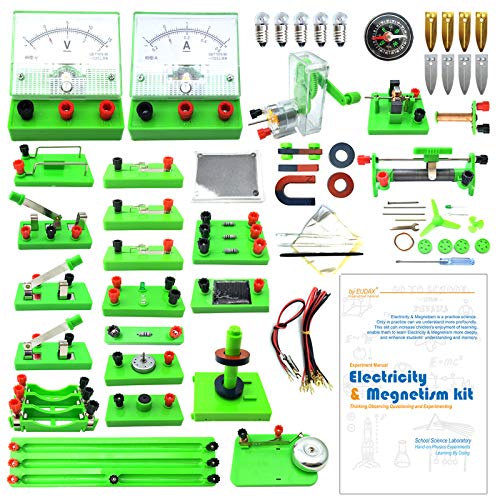
- Includes 79 listed components and tools
- Builds circuits, electromagnets, and generators
- Explores Ohm’s law and Oersted’s experiment
Best For: Guided electricity and magnetism projects
Best for Motion-Law Builds

- Builds six working physics models
- Focuses on inertia, friction, and circular motion
- Includes theory, experiments, quizzes, and a 3D app
Best For: Creative learners who enjoy construction-based motion lessons
Best Middle School Electromagnetism Set
Electrical and Magnetic Experiment Box

- Designed for grades 7–11
- Builds series and parallel circuits
- Explores Ohm’s and Ampere’s laws
Best For: Focused introductory circuit and magnetism activities
Hands-On Mechanics

- 26 model-building exercises cover six classic simple machines.
- Spring scale supports hands-on force measurements.
- Illustrated 32-page manual guides each activity.
Best For: Young learners exploring levers, pulleys, gears, and mechanical advantage.
Electromagnetism Explorer
Electricity and Magnetism Lab Kit

- Includes over 50 hands-on experiments.
- 55 components support circuit and magnetism projects.
- Storage case and illustrated manual aid organized learning.
Best For: Older students building practical skills in electricity and electromagnetism.
Light Lab
Optical Physics Experiment Set

- Explores refraction and several forms of reflection.
- Includes lenses, prism, acrylic tile, reflector, and light source.
- Compact kit comes with an English color-page manual.
Best For: Older students learning introductory optics and light behavior.
Mechanics Lab Pick
Physics Mechanics Experiment Kit

- 26 experiments covering core mechanics concepts
- Includes pulleys, balance, gauge, trolley, and ramp
- Manual and storage box support organized lab use
Best For: Older middle school students, classrooms, and mechanics study
Electricity Builder

- Designed for grades 7–11 and ages 14–17
- Builds series, parallel, magnetic, and generator projects
- Requires two AA batteries to get started
Best For: Circuit and electricity projects in classrooms or at home
Optics Discovery Pick
Teenii Physics & Optics Science Kit

- Offers 15+ hands-on experiments about light
- Includes lenses, mirrors, prisms, blocks, and light emitters
- Designed for ages 8–16 with a full-color manual
Best For: Optics lessons, visual demonstrations, and guided STEM projects
Best Overall Mechanical Physics Kit – Physics Workshop
For shoppers comparing physics experiment sets for middle school students, the Thames & Kosmos Physics Workshop stands out as a broad, build-focused option. Its 38 models and 37 experiments cover mechanical physics topics including gravity, simple machines, gears, pendulums, and centrifugal force.
Best For: Middle school learners who want a comprehensive, screen-free mechanical physics kit for independent study, homeschooling, or classroom enrichment.
Pros:
- Includes 305 pieces for building 38 models and conducting 37 experiments.
- Covers five connected physics chapters, from gravity and inertia to energy transfer and centrifugal force.
- Offers a 104-page, full-color manual with equations, explanations, examples, and data charts.
- Designed for ages 8+ and aligned with Next Generation Science Standards.
Cons:
- Its focus is mechanical physics rather than electricity and magnetism.
- The large number of builds may require substantial time and organization.
This is the strongest all-around choice when you want one kit to introduce several mechanical physics concepts through progressive construction and experimentation.
Best Electricity and Magnetism Lab Kit – EUDAX School Physics Labs
The EUDAX School Physics Labs kit is a practical pick among physics experiment sets for middle school students who are ready to explore circuits and electromagnetism. It includes components for series and parallel circuits, Ohm’s law, electromagnets, generators, and related investigations.
Best For: Students interested in introductory electricity and magnetism projects, especially those working with an adult or progressing toward high-school-level lab activities.
Pros:
- Includes 56 electricity items, 21 magnetism items, repair tools, and a color manual.
- Supports projects such as series circuits, parallel circuits, fruit batteries, electromagnets, and electric bells.
- Introduces Ohm’s law, Oersted’s experiment, Ampere’s force, and hand-crank generation.
- Components are supplied in a storage bag.
Cons:
- Requires three AA batteries, which are not included.
- The listed experiments are aimed at grades 9–11, so younger middle school students may need guidance.
Choose this set when electrical and magnetic concepts matter more than mechanical model building, but plan for battery setup and supervision as needed.
Best for Motion-Law Builds – Engino Physics Laws
Engino Physics Laws offers a compact, construction-centered way to study inertia, friction, and circular motion. For families seeking physics experiment sets for middle school students, its six working model options combine building with short theory sections, experiments, quizzes, and an interactive 3D app.
Best For: Creative learners ages 9+ who understand concepts best by building working models and testing how motion laws affect everyday situations.
Pros:
- Builds six models, including a rocket launcher, crash test rig, and sharpening wheel.
- Includes 12 pages of theory, experiments, facts, and a four-page quiz section.
- Provides an interactive 3D app for virtual building and exploration.
- Targets inertia, friction, and circular motion with award-winning components.
Cons:
- Its physics scope is narrower than kits covering multiple branches of physics.
- With six model options, it offers fewer builds than the larger Physics Workshop kit.
This is a good fit for students who prefer a focused introduction to motion laws and want both physical construction and optional digital support.
Best Middle School Electromagnetism Set – Electrical and Magnetic Experiment Box
This electrical and magnetic experiment box is designed specifically around introductory electromagnetism for students in grades 7–11. It gives learners a way to build series and parallel circuits while exploring hand generators, Ohm’s law, Oersted’s experiment, and Ampere’s law.
Best For: Students ages 14+ or younger learners in grades 7–11 who have adult support while assembling and testing basic electrical experiments.
Pros:
- Targets middle-school and early high-school electrical and magnetic concepts.
- Supports series circuits, parallel circuits, hand generators, and electromagnetism investigations.
- Encourages hands-on exploration, experimentation, and guided learning.
- Can provide an interactive project activity for students and parents.
Cons:
- The supplied notes provide fewer details about included components and instructions than some competing kits.
- The recommended age guidance of 14+ may limit suitability for younger middle school students without help.
This set is worth considering when you want a focused circuit-and-magnetism activity and value an age range that extends into early high school.
Hands-On Mechanics – Simple Machines Physics Set
This simple-machines kit is a practical choice for families and educators looking for physics experiment sets for middle school students. It combines 26 model-building activities with six classic machines—levers, pulleys, wheels and axles, inclined planes, screws, and wedges—and includes a spring scale for exploring force.
Best For: Students ages 8 and up who learn best by building and measuring mechanical systems.
Pros:
- Covers all six classic simple machines through 26 hands-on exercises.
- Includes a spring scale to measure changes in force direction and magnitude.
- Offers step-by-step guidance in a 32-page, full-color illustrated manual.
- Modular pieces are compatible with other Thames & Kosmos construction kits.
Cons:
- Focuses primarily on mechanics rather than electricity, magnetism, or optics.
- The plastic construction pieces may be less suitable for students seeking advanced experiments.
This is a focused introduction to mechanical advantage and force. Its combination of models, measurement, and clearly guided activities makes it a strong starting point for classroom or home physics exploration.
Electromagnetism Explorer – Electricity and Magnetism Lab Kit
For students ready to move beyond basic demonstrations, this kit is one of the more expansive physics experiment sets for middle school students interested in electricity and magnetism. It includes more than 50 experiments, 55 components, and modules such as an LED light control, magnetic switch, and Joule’s first law experiment.
Best For: Students ages 13–18 who want a broad, project-based introduction to circuits and electromagnetism.
Pros:
- Provides more than 50 suggested DIY experiments.
- Includes 55 items covering circuit-board and magnetism activities.
- Illustrated manual explains both what to do and why the experiments work.
- Solid storage case keeps components organized and portable.
Cons:
- Its manufacturer-recommended age range of 13–18 may be advanced for younger middle school students.
- The kit uses an alkaline battery, so battery-related requirements should be checked before use.
- The large number of components may require careful organization after each project.
With its wide experiment count and dedicated modules, this is a versatile choice for learners who want to spend substantial time investigating circuits and magnetic effects. The storage case is especially useful for clubs, classrooms, or portable study.
Light Lab – Optical Physics Experiment Set
This optical kit gives students a hands-on way to study light behavior, making it a useful option among physics experiment sets for middle school students and older learners. Its lenses, prism, mirrors, reflector, and three-way light source support demonstrations of refraction, reflection, and image formation.
Best For: Students ages 14 and up studying introductory optics through visual demonstrations.
Pros:
- Supports experiments with refraction, plane and diffuse reflection, and curved mirrors.
- Includes three biconvex lenses, concave and convex lenses, a prism, and an acrylic tile.
- Three-way linear light source can be adjusted for light direction.
- Compact set includes an English color-page manual and storage box.
Cons:
- The manufacturer-recommended age is 14 and up, so it may not suit younger students.
- Requires two AAA batteries, which are not included.
- The set is intended for indoor, manual demonstrations rather than automated experiments.
This is a specialized choice for learners whose curriculum includes optics. The range of lenses, mirrors, and prism experiments can make abstract light principles easier to observe, while the compact format suits individual study.
Mechanics Lab Pick – Physics Mechanics Experiment Kit
For shoppers comparing physics experiment sets for middle school students, this 26-experiment mechanics kit offers a broad collection of hands-on tools for exploring forces, motion, pressure, buoyancy, and simple machines. Its age recommendation of 14 and up makes it especially suitable for older middle school students and introductory high school work.
Best For: Classroom labs, independent study, and family exploration of classical mechanics.
Pros:
- Includes a balance, pulleys, lever ruler, pressure gauge, dynamometer, trolley, and ramp.
- Covers Newton’s Laws, kinematics, gravity, friction, pressure, and buoyancy.
- Comes with a detailed manual and organized storage box.
- Metal and plastic components are designed for repeated use.
Cons:
- The recommended age is 14+, so it may be too advanced for younger middle school students.
- The kit focuses primarily on mechanics rather than electricity or optics.
This is a strong choice when you want one substantial set for structured mechanics instruction. The range of included equipment supports demonstrations as well as guided experiments, though younger students may need close supervision and instruction.
Electricity Builder – EUDAX Circuit Experiment Set
Among physics experiment sets for middle school students, this EUDAX kit is geared toward grades 7–11 and focuses on learning electricity and magnetism by building working models. It is ready to use with the addition of two AA batteries and includes a transparent storage box for the components.
Best For: Students learning basic circuits, magnetism, and hands-on STEM construction.
Pros:
- Supports simple, series, and parallel circuit projects.
- Includes switches, wires, bulbs, LEDs, and other circuit parts.
- Projects include an electromagnet, hand-crank generator, wind-power car, and traffic light.
- Full-color manuals explain basic electricity and magnetism principles.
Cons:
- Two AA batteries are required but not included.
- The manufacturer recommends it for ages 14–17, which may limit use by younger students.
This set is a practical option for learners who understand concepts best by wiring and testing their own designs. Its project variety encourages experimentation, while the included storage case helps keep the 27 components together between lessons.
Optics Discovery Pick – Teenii Physics & Optics Science Kit
This Teenii set stands out among physics experiment sets for middle school students who are interested in light and visual demonstrations. With 15 or more experiments, lenses, mirrors, prisms, transparent blocks, light emitters, and a 32-page guide, it introduces reflection, refraction, image formation, and color effects for ages 8–16.
Best For: Younger and middle school students exploring optics through guided home, classroom, or homeschool activities.
Pros:
- Includes more than 25 components for 15+ optical experiments.
- Explores reflection, refraction, rainbows, color mixing, and image formation.
- Provides concave and convex lenses, mirrors, prisms, optical blocks, and light sources.
- The 32-page full-color manual offers step-by-step instructions.
Cons:
- Its focus is optics rather than mechanics, electricity, or magnetism.
- Some experiments may require careful setup of stands, screens, and light sources.
This is a good fit when visual results can make physics more engaging. The broad optics component set and accessible age range make it versatile for demonstrations and guided projects, while the manual helps students connect what they see with fundamental light concepts.
How We Picked These Physics Experiment Sets for Middle School Students
We looked for kits that support meaningful, repeatable experiments rather than one-off demonstrations. Key criteria included coverage of middle school physics concepts, clarity of the included instructions, variety of activities, component quality, age guidance, and suitability for independent or supervised use.
Because the selection includes electricity, magnetism, mechanics, optics, and engineering-focused sets, we also considered how well each kit fits different learning goals. A broad kit may be better for exploration, while a focused set can provide deeper practice in circuits or light.
Quick Comparison
| Best For | Look For |
|---|---|
| Broad STEM exploration | Large component count and multiple physics topics |
| Electricity and magnetism | Reusable circuit parts, magnets, switches, and clear diagrams |
| Mechanics | Pulleys, force gauges, balances, gears, and motion activities |
| Optics | Prisms, lenses, mirrors, light sources, and measurement guides |
| Engineering practice | Build-focused projects with room for testing and redesign |
Key Buying Factors
Learning Scope and Experiment Quality
Check whether the activities match the student’s current coursework. A kit covering several topics offers variety, but a specialized electricity or optics kit may be more useful when a class is studying one unit. Prefer instructions that explain the principle behind each result, not just the assembly steps.
Age, Supervision, and Safety
Age ratings are useful starting points, but reading ability and prior experience matter just as much. Younger students may need help following sequences or recording results. For circuit kits, confirm that the activities use low-voltage components and follow the recommended power source. Small parts, sharp edges, magnets, and glass-like optical components also require appropriate supervision.
Parts, Durability, and Storage
Count the included components and consider whether replacements are available. Clearly labeled pieces and a storage case reduce setup time and lost parts. Kits with reusable connectors, sturdy bases, and standard components generally provide better long-term value.
Instructional Flexibility
Look for experiment variations, questions, diagrams, and suggestions for changing one variable at a time. These features help students move from following directions to forming predictions and analyzing evidence.
Who Should Buy Which Physics Experiment Sets for Middle School Students?
Choose a broad physics workshop or engineering kit for a beginner who wants to sample several concepts. Select a simple-machines or mechanics set for students interested in forces, motion, gears, and practical building. Circuit and electromagnetism kits are best for learners focused on current, series and parallel circuits, magnets, and switches.
Optics-focused sets suit students curious about reflection, refraction, lenses, and color. Teachers and homeschool families should prioritize durable parts, organized storage, and enough experiment variety for repeated lessons. For a gift, match the kit’s complexity to the child’s patience and reading level rather than choosing solely by the number of pieces.