Hands-on experiments can make abstract physics concepts easier to understand, especially when students can build, measure, and test ideas for themselves.
We selected 10 physics experiment sets for homeschool covering electricity, magnetism, forces, motion, energy, simple machines, mechanics, and optics across several age and skill levels.
Best 10 Physics Experiment Sets for Homeschool Picks for 2026
Best Electromagnetism Lab
EUDAX Electricity & Magnetism Kit
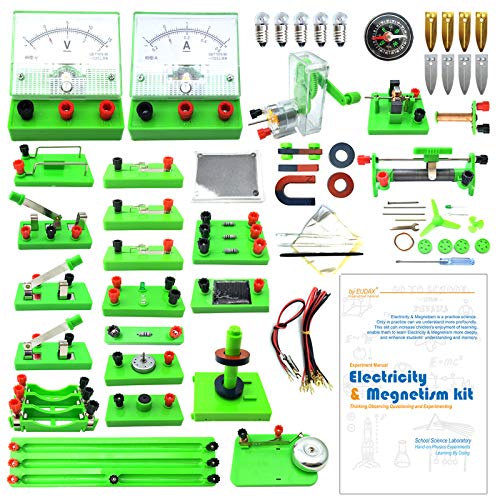
- 79-piece set for electricity and magnetism
- Includes circuits, electromagnet, and generator projects
- Color manual and storage bag included
Best For: Grades 9–11 homeschool physics labs
Best Motion-Building Set
Engino Inertia, Friction & Circular Motion

- Build six working physics models
- Covers inertia, friction, and circular motion
- Includes theory, experiments, quizzes, and a 3D app
Best For: Hands-on learners ages 9 and up
Best Simple Machines Set

- Includes 26 model-building exercises
- Covers all six classic simple machines
- Spring scale supports force measurements
Best For: Beginning mechanics lessons for ages 8 and up
Best Portable Circuit Kit
Mysterystone Electricity & Magnetism Lab

- Offers more than 50 hands-on experiments
- Includes circuit, LED, and magnetism modules
- Components store in a portable case
Best For: Older students ages 13–18
Best All-Around Physics Kit

- 20 experiments cover forces, motion, and energy
- Includes models, spring scale, and building parts
- Lesson plan aligned to NGSS standards
Best For: Ages 8–14 building a broad foundation in physics
Best for Mechanics Labs
Physics Mechanics Experiment Kit

- Includes equipment for 26 mechanics experiments
- Covers forces, pressure, buoyancy, and simple machines
- Designed for learners ages 14 and up
Best For: Older students studying classical mechanics hands-on
Best for Electricity Basics

- Includes seven hands-on electricity modules
- Explores circuits, conductivity, and energy conversion
- Reusable snap-together design with instruction manual
Best For: Ages 8–15 learning introductory electricity at home
Best Budget Circuit Kit

- Builds series and parallel circuits
- English instructions included
- Storage box included; batteries sold separately
Best For: Grades 7–9 introductory electricity lessons
Best Comprehensive Electricity Kit

- Explores electricity, magnetism, and energy conversion
- Includes meters, generator, and solar panel
- Illustrated manual and storage case included
Best For: Ages 8–16 studying electricity and magnetism
Best Optics Kit

- Includes 15+ hands-on optics experiments
- Lenses, mirrors, prisms, and light sources included
- 32-page illustrated experiment manual
Best For: Ages 8–16 studying light and optics
Best Electromagnetism Lab – EUDAX Electricity & Magnetism Kit
For homeschoolers seeking physics experiment sets for homeschool, the EUDAX kit provides a hands-on introduction to electricity and magnetism. Its 79 pieces, color manual, and project range support simple circuits, electromagnets, Ohm’s law, and related investigations for older children and teens.
Best For: Homeschool students in roughly grades 9–11 who want a broad electricity and magnetism lab.
Pros:
- Includes 56 electricity items, 21 magnetism items, and repair tools.
- Supports projects such as series and parallel circuits, fruit batteries, electromagnets, and a hand-crank generator.
- Comes with a color-page manual and storage bag.
Cons:
- Requires three AA batteries, which are not included.
- The large project scope may be more suitable for guided study than very young learners.
Overall, this is a substantial choice for families building a dedicated electricity and magnetism unit, especially when students are ready to connect experiments with core physics principles.
Best Motion-Building Set – Engino Inertia, Friction & Circular Motion
Among physics experiment sets for homeschool, Engino stands out for combining model building with lessons on inertia, friction, and circular motion. Children can construct six working models while using the theory book, experiments, quiz section, and interactive 3D app to reinforce concepts.
Best For: Children ages 9 and up who learn physics best through building and testing models.
Pros:
- Builds six models, including a rocket launcher, crash test rig, and sharpening wheel.
- Includes 12 pages of theory, experiments, facts, and a four-page quiz.
- Offers an interactive 3D app for virtual building and includes a two-year limited warranty.
Cons:
- Focuses on a narrower group of motion topics rather than electricity or general physics.
- Plastic construction may appeal more to builders than students seeking traditional lab equipment.
This set is a good fit for an active homeschool lesson where students can assemble a mechanism, observe how it works, and then connect the result to motion laws.
Best Simple Machines Set – T&K Physics & Engineering Kit
The T&K Simple Machines set is one of the more approachable physics experiment sets for homeschool, using model building to explain how forces can be redirected or reduced. Its 26 exercises cover all six classic simple machines and include a spring scale for measuring force.
Best For: Children ages 8 and up beginning a practical unit on forces, machines, and engineering.
Pros:
- Explores wheels and axles, levers, pulleys, inclined planes, screws, and wedges.
- Includes a spring scale for measuring changes in force direction and magnitude.
- Provides a 32-page illustrated manual with step-by-step instructions and science explanations.
Cons:
- Its focus is simple machines rather than electricity, magnetism, or broader physics topics.
- Model construction requires keeping track of multiple plastic building pieces.
For families introducing mechanics, this kit offers a clear progression from familiar objects such as seesaws and wheelbarrows to measurable force experiments.
Best Portable Circuit Kit – Mysterystone Electricity & Magnetism Lab
For families comparing physics experiment sets for homeschool, the Mysterystone kit offers more than 50 electricity and magnetism experiments in a portable case. The 55-piece set is designed to help students explore circuit boards, electromagnets, magnetic switches, LED controls, and other introductory STEM projects.
Best For: Students ages 13–18 who want a portable electricity and magnetism starter lab.
Pros:
- Provides more than 50 DIY experiments with 55 included items.
- Includes specialized projects such as light-control LED, magnetic switch, and Joule’s first law modules.
- Uses a solid storage case with fixed places for the components.
Cons:
- The manufacturer recommends it for ages 13–18, limiting its suitability for younger children.
- Its concentration on electricity and magnetism may not cover mechanics or motion topics.
This is a practical option when portability and experiment variety matter, particularly for older students who want to extend classroom circuit concepts through guided hands-on work.
Best All-Around Physics Kit – Forces, Motion & Energy
For homeschoolers seeking physics experiment sets for homeschool, this kit offers a broad introduction to forces, motion, and energy for learners ages 8 and up. Its 20 hands-on experiments and model-building activities connect abstract ideas to visible results.
Best For: Elementary and middle-school learners exploring core physics concepts through guided STEM activities.
Pros:
- Covers acceleration, velocity, mass, gravity, friction, inertia, Newton’s laws, and more.
- Includes hands-on models and real-time experiments for visual learning.
- Comes with a ready-to-use lesson plan aligned to NGSS standards.
- Includes useful components such as a spring scale, building parts, and rubber bands.
Cons:
- Its recommended age range is 8–14, so it may be less suitable for advanced high-school study.
- The set is focused on forces, motion, and energy rather than electricity or broader laboratory mechanics.
This is a strong choice when you want one approachable kit covering many foundational physics topics. The lesson plan is especially helpful for structured homeschool instruction.
Best for Mechanics Labs – Physics Mechanics Experiment Kit
For older students comparing physics experiment sets for homeschool, this mechanics lab set provides equipment for 26 experiments. It is designed around practical investigations of force, motion, pressure, buoyancy, and simple machines, with a professional-style manual for guidance.
Best For: Homeschool students ages 14 and up who are ready for more formal classical mechanics experiments.
Pros:
- Includes a tray balance, pulleys, lever ruler, pressure gauge, spring dynamometer, trolley, and ramp.
- Explores Newton’s laws, kinematics, gravity, friction, pressure, buoyancy, pulleys, and levers.
- Provides 26 experiments with operation steps and principle analysis.
- Durable metal and plastic components come in an organized storage design.
Cons:
- Recommended for ages 14 and up, making it unsuitable for younger beginners.
- The larger equipment set may require more storage and setup space than a compact introductory kit.
Choose this set when your homeschool curriculum calls for hands-on mechanics rather than simple demonstrations. Its range of lab equipment makes it better suited to structured, higher-level study.
Best for Electricity Basics – STEM Circuit Experiment Kit
Families looking for physics experiment sets for homeschool with an electricity focus can use this seven-module circuit kit with learners ages 8–15. Activities include series and parallel circuits, conductivity testing, fruit and saltwater batteries, fiber-optic lighting, and manual power generation.
Best For: Children and teens learning basic circuits, conductivity, and energy conversion through repeatable activities.
Pros:
- Offers seven electricity experiments with clear, visible results.
- Includes a full-color, step-by-step manual for independent learning.
- Integrated components snap securely together and are designed for repeated use.
- Suitable for both home practice and classroom instruction.
Cons:
- Two AA batteries are required but are not included.
- Its scope centers on electricity and circuits rather than mechanics or motion.
This kit is a practical pick for introducing electrical concepts without requiring extensive equipment. The guided modules and reusable circuit board make it approachable for independent homeschool sessions.
Best Budget Circuit Kit – EUDAX Basic Electricity Lab
For homeschoolers seeking approachable physics experiment sets for homeschool, the EUDAX Basic Electricity Lab focuses on foundational circuit building. Students can assemble series and parallel circuits while reinforcing textbook concepts about current and practicing hands-on problem-solving.
Best For: Homeschool learners in roughly grades 7–9 beginning a unit on electricity, circuits, or basic STEM projects.
Pros:
- Supports both series and parallel circuit experiments.
- Includes English instructions for guided assembly.
- Compact plastic storage box keeps the 17 pieces organized.
- Useful for home study, science fairs, clubs, and teaching aids.
Cons:
- Two AA batteries are not included.
- The basic set is focused primarily on introductory electricity rather than a broad range of physics topics.
This is a practical choice when your homeschool lesson needs a simple, focused introduction to electrical rules and circuit construction. Plan to supply the batteries separately before starting.
Best Comprehensive Electricity Kit – 71-Piece Magnet Physics Lab
This 71-piece set is one of the more expansive physics experiment sets for homeschool, combining circuit work with magnetism and energy conversion. Its components support experiments with meters, electromagnets, electric bells, a hand-crank generator, and a solar panel for learners ages 8–16.
Best For: Families wanting a reusable electricity-and-magnetism lab that can grow from elementary demonstrations into more advanced middle- and high-school activities.
Pros:
- Covers electricity, magnetism, and mechanical or light energy conversion.
- Includes an ammeter, voltmeter, generator, solar panel, electromagnet, and electric bell.
- Illustrated, step-by-step manual supports independent learning.
- Portable storage case and durable, non-toxic components suit repeated use.
Cons:
- The large component assortment may require more setup and organization than a basic circuit kit.
- The supplied notes do not specify the complete battery requirements for every experiment.
Choose this set if you want a broad electricity and magnetism unit rather than a single-topic activity. The generator and solar panel add especially useful opportunities to discuss energy transformation and renewable energy.
Best Optics Kit – Teenii Light Experiment Lab
For homeschool science focused on light, the Teenii Optics Lab offers a dedicated alternative to general physics experiment sets for homeschool. Students investigate reflection, refraction, image formation, rainbows, and color mixing through more than 15 guided experiments using lenses, mirrors, prisms, and transparent blocks.
Best For: Ages 8–16 studying optics, light behavior, geometry of rays, or hands-on demonstrations for a homeschool physics unit.
Pros:
- Offers more than 15 experiments centered on practical optics concepts.
- Includes concave and convex lenses, mirrors, prisms, and several transparent blocks.
- Three light sources and screens support demonstrations of projection and image formation.
- 32-page full-color manual provides step-by-step guidance.
Cons:
- Its subject range is concentrated on optics rather than electricity, mechanics, or magnetism.
- Some activities may need careful setup to position the light sources, stands, and screens.
This is a strong match for a dedicated light-and-optics unit, especially when students benefit from seeing refraction and image formation directly. Its specialized components make it less suitable as an all-purpose physics kit.
How We Picked These Physics Experiment Sets for Homeschool
We focused on kits that support active learning rather than simple demonstrations. The selection spans core homeschool physics topics, including circuits, electromagnetism, magnets, force, motion, energy, mechanical advantage, inertia, friction, circular motion, and optics.
We also considered age range, experiment variety, component usefulness, opportunities for repeated testing, and how easily each kit can fit into a lesson plan. Because product contents vary, check the current package list before buying and plan to provide common extras such as batteries, paper, water, or a ruler when required.
Quick Comparison
| Best For | Look For |
|---|---|
| Electricity beginners | Clear circuit components, battery connections, switches, and safe wiring activities |
| Magnetism and electromagnetism | Magnets, coils, compasses, and experiments that connect electricity with magnetic fields |
| Mechanics learners | Pulleys, balances, force gauges, levers, and materials for measuring results |
| Engineering projects | Reusable construction parts and open-ended builds involving motion or machines |
| Light and optics | Prisms, lenses, mirrors, and experiments that show reflection and refraction |
Key Buying Factors
Age and Supervision
Choose a kit that matches the student’s reading, dexterity, and mathematical readiness. Younger students may need an adult to assemble circuits, explain variables, or supervise small components, while older students may benefit from less scripted investigations.
Curriculum Coverage
Decide whether you need one broad introductory set or a focused kit for a specific unit. Circuit kits work well for electricity lessons, mechanics sets support force and motion, and optics kits are useful when studying light. A specialized set may provide deeper experiments than an all-in-one kit.
Measurement and Repeatability
The strongest homeschool activities encourage students to change one variable, record observations, and compare results. Look for included measuring tools or components that make quantitative testing possible. A kit with many parts is not automatically better if the experiments lack clear learning objectives.
Build Quality and Replacement Needs
Inspect connector durability, wire insulation, moving parts, storage, and the availability of instructions. Small pieces can be misplaced, so a labeled organizer or a simple inventory checklist is valuable for regular homeschool use.
Who Should Buy Which Physics Experiment Sets for Homeschool?
For a first introduction to circuits, choose an electricity-focused kit with straightforward wiring and visible results. Students interested in how electricity and magnets interact should select a set that includes coils, magnets, or electromagnetism activities.
For physics and engineering lessons, simple-machine, forces-and-motion, or mechanics kits are better choices because they support building, measuring, and problem solving. Choose an optics set for learners specifically studying light, lenses, mirrors, and prisms.
If you teach multiple ages or want flexible project work, prioritize reusable components and a broad experiment range. Families seeking more structured instruction should favor clear activity guides, defined learning goals, and age-appropriate explanations over the largest part count.