Choosing particle counters for filter testing comes down to more than just particle-size ranges. Accuracy, channel count, calibration, and ease of logging all affect whether a unit is truly useful in the field or in a controlled environment.
This roundup focuses on practical, buyer-friendly options for monitoring airflow, filtration performance, and dust levels without overpaying for features you do not need.
Best 10 Particle Counters for Filter Testing Picks for 2026
ISO-Grade Cleanroom Counter
Temtop PMD331 7-Channel Handheld

- ISO 21501-4 oriented for professional cleanroom use
- Seven simultaneous particle channels from 0.3µm to 10µm
- 2M+ records, USB export, and RS-485 Modbus
Best For: Cleanroom certification, pharmaceutical spaces, and HVAC filter testing
Filter Efficiency Checker
Fluke 985 Indoor Particle Counter

- Built for filter efficiency checks and source locating
- 6-channel particle counter for indoor air quality work
- +/-0.5% accuracy with one-year warranty
Best For: HVAC techs and indoor air quality specialists checking filters
Dual-Detection Monitor
Temtop PMD371 Professional Analyzer
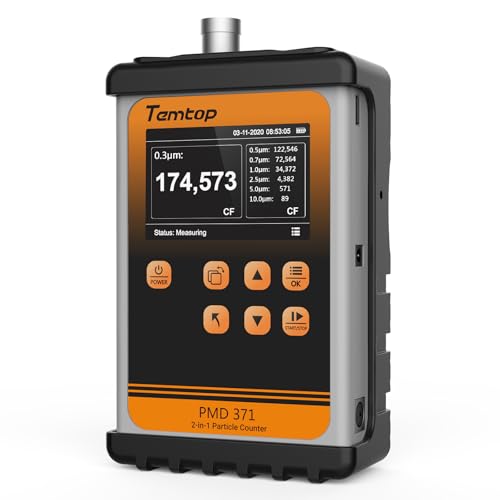
- Measures both particle count and PM mass values
- 8GB storage with USB and RS-232 Modbus transfer
- 5-year warranty plus 2-year free calibration service
Best For: Professional teams needing count and PM data in one analyzer
Budget 8-Channel Tester

- Six particle sizes plus PM2.5 and PM10 readings
- Stable 2.83 L/min pump sampling with alarms
- 2M+ records and USB Type-C export
Best For: Technicians doing routine filter checks and general air inspections
Cleanroom-Ready Basic Counter
Professional Particle Counter 0.3 µm, 2.5 µm, 10 µm

- Measures 0.3 µm, 2.5 µm, and 10 µm particles
- 1L/min flow rate with handheld portability
- Exports PDF reports and stores 999 records
Best For: Cleanroom checks, filter inspections, and on-site particulate troubleshooting
Multi-Channel Inspection Meter
Air Particle Meter for Air Quality Testing

- Tracks six particle sizes from 0.3 to 10 µm
- Built-in pump samples at 2.83 L/min
- Adds alarms, storage, and temp/humidity readings
Best For: Routine air testing, contamination checks, and comparing cleaning effectiveness
Certified Precision Counter
Temtop PMD331 Portable Particle Counter

- Detects seven sizes from 0.3 to 10 µm
- Includes ISO 21501 and NIST-compliant calibration certificate
- Stores 2,000,000 records with multiple transfer options
Best For: Cleanrooms, laboratories, healthcare facilities, and calibration-conscious testing
Compact 3-Channel Pick
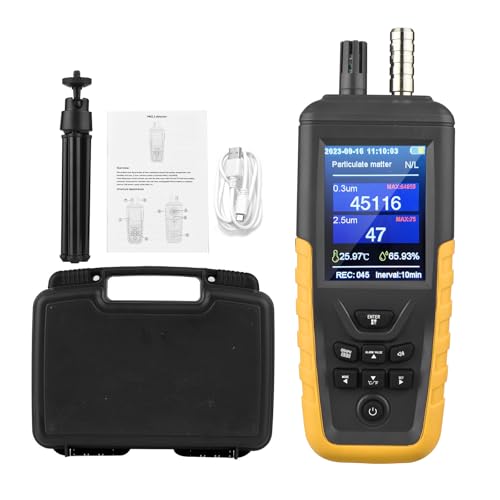
- Tracks PM0.3, PM2.5, and PM10
- Stores 999 records with curve viewing
- Rechargeable battery lasts up to 9 hours
Best For: Routine filter testing and portable dust checks
Cleanroom Inspection Choice

- Laser-scattering detection for 0.3um and 2.5um
- 999 records with curve viewing
- Battery or USB powered
Best For: Clean-room checks and filter seal inspection
Most Detailed Option
6-Channel TC-8200 Particle Counter

- 6-channel detection from 0.3um to 10um
- PM2.5 alarm with 999 stored records
- Tripod support and 9-hour battery
Best For: Broader particle-size coverage in filter testing
ISO-Grade Cleanroom Counter – Temtop PMD331 7-Channel Handheld
If you need particle counters for filter testing in controlled spaces, the Temtop PMD331 is built for high-stakes checks where repeatable readings matter. It monitors seven particle sizes at once, supports ISO 21501-4 use cases, and includes onboard logging plus Modbus output for facility workflows.
Best For: Cleanroom certification, pharmaceutical areas, surgical suites, and HVAC filter testing that needs ISO-oriented reporting.
Pros:
- ISO 21501-4 compliant design with calibration support for professional verification work
- Tracks seven sizes simultaneously from 0.3µm to 10µm for broad particle visibility
- Over 2,000,000 stored records plus USB export and RS-485 Modbus connectivity
- Includes a protective case, calibration certificate, filter tube, USB drive, and AC adapter
Cons:
- Heavy 9-pound build is less convenient than lighter handheld units
- Individual ISO calibration certificates are optional and may require a custom quote
For teams that prioritize standards-based particle testing over casual spot checks, the PMD331 offers a strong mix of compliance features, data capacity, and field-ready accessories. It is a specialized choice, but a practical one when filter validation and audit documentation are part of the job.
Filter Efficiency Checker – Fluke 985 Indoor Particle Counter
For particle counters for filter testing in indoor environments, the Fluke 985 focuses on practical measurement and source tracking. Its 6-channel particle count, accuracy spec, and cleanroom-screening use make it a straightforward tool for evaluating air quality and comparing conditions before and after filtration work.
Best For: HVAC technicians, indoor air quality specialists, and teams checking filter efficiency or locating particle sources.
Pros:
- Specifically notes use for measuring filter efficiency and monitoring industrial cleanrooms
- 6-channel particle counting supports pre-screening and source-location workflows
- Compact indoor air quality focus with a one-year warranty
- Reported measurement accuracy of +/-0.5%
Cons:
- Fewer channels than some newer 7- or 8-channel competitors
- Less emphasis on onboard storage and connectivity than more data-heavy models
The Fluke 985 is a practical pick when the job is to verify filtration performance or identify where particles are coming from. It is not overloaded with extras, but it covers the core tasks many filter-testing workflows need.
Dual-Detection Monitor – Temtop PMD371 Professional Analyzer
If you want particle counters for filter testing with both particle count and particulate mass data, the Temtop PMD371 is the most feature-rich option here. It measures common PM sizes and particle counts simultaneously, adds a German Furgut pump, and is aimed at cleanrooms, labs, hospitals, and industrial settings.
Best For: Professional particulate testing where teams want both count data and PM readings in one instrument.
Pros:
- Dual detection measures particle count and PM1/PM2.5/PM4/PM10/TSP values together
- ISO 21501 and NIST-aligned positioning for professional monitoring work
- 8GB storage, USB and RS-232 Modbus transfer options, and a 4-inch display
- Full metal construction, 8-hour battery life, and 5-year warranty with 2-year calibration service
Cons:
- More elaborate than basic filter-checking tools if you only need simple pass/fail readings
- Optional ISO certificates may add extra cost
This model stands out when filter testing is part of a broader environmental monitoring program. If your work needs flexible reporting, high storage capacity, and multiple particle views, it is a strong professional-grade choice.
Budget 8-Channel Tester – JD-3000 Air Particle Counter
The JD-3000 is a practical choice among particle counters for filter testing when you want particle counts plus PM2.5 and PM10 readings in one handheld unit. It combines six particle sizes, stable pump-driven sampling, and large storage for routine inspections in HVAC, lab, and industrial settings.
Best For: Technicians who want a versatile handheld monitor for filter checks, room comparisons, and routine air inspections.
Pros:
- Shows six particle sizes plus PM2.5 and PM10 mass concentrations
- Stable 2.83 L/min sampling with laser-scattering technology and internal pump
- Stores over 2 million measurement groups and exports data through USB Type-C
- Includes temperature, humidity, alarm thresholds, and both single and continuous sampling modes
Cons:
- Calibration report is noted only for PM2.5 and PM10 mass-concentration measurements
- Brand is listed as generic, which may matter for buyers who prefer established instrument lines
For users who want a broad feature set without moving into the most specialized lab-grade category, the JD-3000 covers a lot of ground. It is especially appealing when filter testing needs to be paired with general environmental checks.
Cleanroom-Ready Basic Counter – Professional Particle Counter 0.3 µm, 2.5 µm, 10 µm
If you need particle counters for filter testing in a portable format, this handheld unit covers the common 0.3 µm, 2.5 µm, and 10 µm checkpoints. It combines real-time particle counts with temperature, humidity, and trend tracking, so it works well for quick inspections and documentation at the same time.
Best For: Cleanroom checks, filter inspections, and on-site particulate troubleshooting.
Pros:
- Measures 0.3 µm, 2.5 µm, and 10 µm particles.
- Includes a 1L/min sampling flow rate for handheld testing.
- 3.2-inch color display shows live data, temperature, humidity, and trends.
- Supports PDF report export and stores up to 999 records.
Cons:
- Uses a smaller channel set than 6-channel models.
- Best suited to straightforward inspection tasks rather than advanced multi-size analysis.
Overall, this is a practical entry-level option for users who want simple particle counting plus easy reporting. The tripod mount and compact body make it especially useful for longer on-site measurements.
Multi-Channel Inspection Meter – Air Particle Meter for Air Quality Testing
For particle counters for filter testing that need broader visibility, this 6-channel meter tracks 0.3, 0.5, 1.0, 3.0, 5.0, and 10 µm particles. The built-in pump draws air at 2.83 L/min, and the device adds temperature and humidity readings, making it a strong fit for routine contamination checks and comparing before-and-after cleaning results.
Best For: Routine air testing, contamination checks, and comparing cleaning effectiveness.
Pros:
- 6 particle channels provide more detailed size coverage.
- Active pump sampling at 2.83 L/min supports real-time readings.
- Adjustable alarms for all six channels help flag threshold breaches.
- Includes temperature and humidity monitoring plus multilingual menus.
Cons:
- Less specialized certification detail than higher-end calibration-focused models.
- Large feature set may be more than needed for very basic spot checks.
This is a well-rounded choice if you want a portable counter that does more than just count particles. The storage, alarms, and clear display make it useful for repeat testing in workplaces and labs.
Certified Precision Counter – Temtop PMD331 Portable Particle Counter
If accuracy and traceability matter most in particle counters for filter testing, the Temtop PMD331 is built for that role. It detects seven particle sizes from 0.3 µm to 10 µm and includes an ISO 21501/NIST-compliant calibration certificate, making it a strong match for cleanroom and lab environments where documented reliability is important.
Best For: Cleanrooms, laboratories, healthcare facilities, and calibration-conscious testing.
Pros:
- Detects 0.3, 0.5, 0.7, 1, 2.5, 5, and 10 µm particles.
- Includes ISO 21501 and NIST-compliant calibration documentation.
- Large 4-inch screen and handheld design improve on-site usability.
- Supports up to 2,000,000 records and USB/RS-232/RS-485 data transfer.
Cons:
- More advanced than needed for simple single-size spot checks.
- May be overkill if you do not need certified calibration support.
In practice, this model stands out when documentation and measurement confidence are part of the job. The included accessories and broad communication options also make it easier to integrate into established workflows.
Compact 3-Channel Pick – PM2.5/PM10 Dust Meter
If you need particle counters for filter testing, this compact 3-channel meter gives you a practical way to track PM0.3, PM2.5, and PM10 along with temperature and humidity. It also includes a 3.2-inch TFT color display, data curve viewing, and 999 stored records, which makes it useful for repeat checks in industrial or lab-style environments.
Best For: Basic filter testing, clean-air checks, and industrial air-quality monitoring where 3-channel particle data is enough.
Pros:
- Detects PM0.3, PM2.5, and PM10 particle sizes.
- Stores up to 999 records and shows data curves on a 3.2-inch TFT display.
- Rechargeable 2000mAh battery runs up to 9 hours.
- Tripod mounting holes help with hands-free testing.
Cons:
- Only a 3-channel design, so it is less detailed than 6-channel models.
- Included notes do not mention a clean-room class readout.
For filter seal detection, particulate source checks, or routine dust monitoring, this model covers the key particle sizes without adding extra complexity. It is a straightforward pick if you want a portable tester with data logging, backlight support, and an easy way to stabilize measurements on a tripod.
Cleanroom Inspection Choice – TC-8100 Dust Particle Counter
For buyers comparing particle counters for filter testing, this TC-8100 model focuses on laser-scattering detection of 0.3um and 2.5um dust plus temperature, humidity, and AQI grade readings. It also offers 999 data records, a 3.2-inch full-color display, and dual power options, making it suitable for repeat inspections and quick field checks.
Best For: Filter seal inspection, clean-room level monitoring, and general industrial air-quality testing.
Pros:
- Laser-scattering design detects 0.3um and 2.5um particles.
- Includes 999 data records and a data curve view.
- Works on rechargeable battery power or external USB power.
- 3.2-inch TFT full-color display with real-time date and time.
Cons:
- Bullet points only mention 0.3um and 2.5um detection, not a broader particle list.
- Notes include a confusing CO2 meter reference in the packing list.
This is a practical option when you want a portable tester with logging and display features built around routine inspection work. The clean-room and filter inspection focus makes it a sensible choice for electronics, optics, food, medicine, and other controlled environments.
Most Detailed Option – 6-Channel TC-8200 Particle Counter
If you want particle counters for filter testing with more measurement detail, this TC-8200 option adds 6-channel detection for 0.3um, 0.5um, 1.0um, 2.5um, 5.0um, and 10um sizes. It also measures PM2.5, PM10, temperature, and humidity, and it includes 999 records, a curve graph view, a PM2.5 alarm, and a backlit 3.2-inch TFT screen.
Best For: Users who need broader particle-size coverage for clean-room checks and filter testing.
Pros:
- 6-channel design covers more particle sizes than 3-channel units.
- Includes PM2.5 alarm, data records, and curve graph viewing.
- Built-in 2200mAh battery offers about 9 hours of use.
- Tripod support helps with stable, hands-free operation.
Cons:
- The notes list the model as TC-8200 in features but TC-8100 in one line, which is confusing.
- No warranty is listed in the supplied details.
Compared with simpler meters, this one gives you more particle-size bins, which can be helpful when checking filtration performance in more demanding settings. The alarm, logging, and tripod support make it a strong pick for repeatable inspections and controlled-environment monitoring.
How We Picked These Particle Counters for Filter Testing
We prioritized models that are relevant to Particle Counters for Filter Testing, with an emphasis on measurable performance rather than marketing claims. Key factors included particle-size channels, lower detection limits, certification or stated calibration standards, display readability, portability, and whether the unit is suitable for cleanroom or indoor air monitoring workflows.
We also looked for a balanced mix of handheld and bench-style options so buyers can match the tool to the job, whether that means spot-checking filters, verifying work areas, or tracking particulate changes across multiple test points.
Quick Comparison
For most buyers, the best choice depends on how much detail you need. More channels can help you see particle distribution more clearly, while simpler meters may be enough for basic dust or PM monitoring. If you need documented verification, prioritize certified or professionally calibrated models. If you need mobility, choose a compact handheld unit with a fast response time and an easy-to-read screen.
Key Buying Factors for Particle Counters for Filter Testing
Particle Size Range and Channel Count
Look for a counter that covers the sizes most relevant to your application, commonly 0.3, 0.5, 1.0, 2.5, 5.0, and 10 microns. More channels provide a better picture of filter performance and can help identify whether a filter is reducing fine particles or only larger dust.
Accuracy, Certification, and Calibration
If you are using Particle Counters for Filter Testing in professional settings, calibration traceability matters. ISO-related certification or a documented calibration process can improve confidence in your measurements and reporting.
Sampling Speed and Portability
Fast sampling is useful when you need to compare multiple locations or verify a system quickly. Handheld models are better for on-site checks, while larger units may offer easier viewing and more continuous monitoring features.
Data Display and Logging
Clear on-device readings, backlit screens, and simple data export options can save time. If you need to document trends or share results, logging support is more valuable than extra cosmetic features.
Who Should Buy Which Particle Counters for Filter Testing?
Cleanroom and quality-control users should lean toward certified, multi-channel instruments with stronger documentation. HVAC and facility teams may prefer a rugged handheld unit that balances speed and versatility. For basic filter checks and general air-quality screening, a simpler particle meter can be the most cost-effective option. If your goal is consistent, repeatable verification, choose the most accurate model your workflow and budget allow.