Choosing the right laboratory UV light meter can make a big difference in accuracy, safety, and repeatable testing. Whether you are measuring UV output for research, quality control, or lamp verification, the best tool depends on wavelength range, sensor type, and how you plan to use it.
Below, we compare 10 strong options for 2026 to help you quickly narrow down the right meter for your workflow.
Best 10 Laboratory UV Light Meter Picks for 2026
Best Compact Lab Meter
Extech UV505 Pocket UV-AB Light Meter

- Measures UVA and UVB in one portable unit
- Peak hold, min/max, and display hold for tracking changes
- Backlit LCD and pocket-size design suit lab and field use
Best For: Researchers, safety teams, and educators needing a portable UV-AB meter for quick checks.
Best for Traceable Calibration

- Traceable calibration to NIST/NML standards
- Automatic or manual range selection
- Fast 0.5-second response time
Best For: Labs and technicians who need UV measurements with documented calibration
Best for UV Index Tracking

- Instant UV Index readings from 0 to 199.9
- Simple handheld design with one-button use
- NIST traceable and made in the USA
Best For: Users who want portable UV Index monitoring for sunlight, lamps, and exposure checks.
Best for UV A/B Measurement
Triplett UVLT150 UV AB Light Meter

- Measures UVA and UVB in one compact meter
- Selectable µW/cm² or mW/cm² output
- Zero, data hold, and backlit LCD
Best For: Labs and technicians who need a simple UV A/B meter for routine testing and safety checks.
Best for UVB/UVC Calibration

- Reads UVB, UVC, and UVA sources
- Calibrated for lab-style repeat testing
- Logs point-by-point UV distribution
Best For: Users who need one meter for UVB/UVC calibration checks and irradiance mapping.
Best for UVC Verification
Solarmeter Model 8.0 UVC Lamp Meter
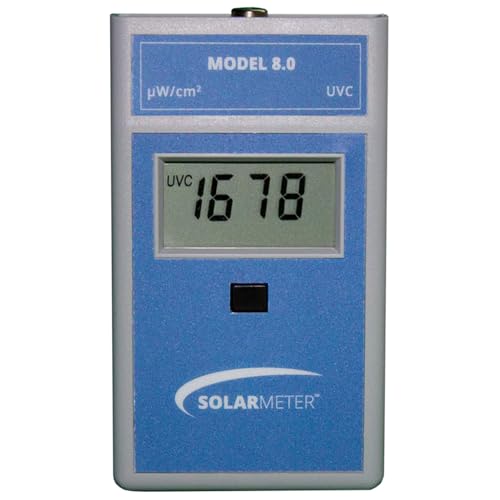
- UVC measurement range: 0-1999 μW/cm2
- Checks lamps, leakage, and UV-blocking eyewear
- Handheld design with NIST traceable accuracy
Best For: Facilities and labs that need a dependable UVC meter for lamp verification and maintenance.
Best for PAR & UVA Mapping

- Measures PAR and UVA in one device
- Shows blue, green, and red PAR breakdown
- Stores 100 readings for light mapping
Best For: Growers who want spectrum-aware readings and simple light distribution mapping.
Best for UV Lamp Monitoring
Solarmeter Model 5.7 UVA/UVB Meter

- Measures total UVA and UVB from 0 to 1999 μW/cm²
- Compact handheld design with simple one-button use
- NIST traceable accuracy for dependable UV checks
Best For: People who need a reliable handheld meter for UV lamps, transmission checks, and exposure monitoring.
Best for Reptile UV Index Checks
Solarmeter 6.5R UV Index Meter

- Reads 280–400 nm with UV Index output
- Ferguson Zone chart supports reptile use
- Compact handheld design with NIST traceable accuracy
Best For: Reptile owners and UVB-focused labs that need quick, practical UV Index readings.
Best Compact Lab Meter – Extech UV505 Pocket UV-AB Light Meter
If you need a laboratory UV light meter that’s easy to carry between benches, classrooms, and field sites, the Extech UV505 is built for quick UV-AB checks without a lot of setup. It measures both UVA and UVB, adds peak hold and min/max tracking, and uses a backlit display that’s readable in bright or low light.
Best For: Researchers, safety teams, and educators who want a compact UV-AB meter for portable lab and field monitoring.
Pros:
- Measures both UVA and UVB for broader UV monitoring
- Pocket-sized body is easy to carry for lab or field use
- Peak hold, min/max, and display hold help capture changing readings
- Backlit LCD improves visibility in varied lighting conditions
Cons:
- Not a full-featured benchtop meter for advanced lab workflows
- Best suited to quick checks rather than highly specialized analysis
For buyers who want a straightforward laboratory UV light meter that can move from indoor testing to outdoor monitoring, the UV505 offers a practical balance of portability and core measurement features. It’s especially appealing when ease of use matters more than a large instrument footprint.
Best for Traceable Calibration – PerfectPrime UV Light Meter
If you need a practical laboratory UV light meter for checking UV output with documented calibration, the PerfectPrime Light Meter is a strong fit. It covers a wide UV range, offers automatic or manual range selection, and is aimed at users who want straightforward readings with traceable standards behind them.
Best For: Labs, QC teams, and technicians who need UV measurements backed by traceable calibration documentation.
Pros:
- Traceable calibration certified to NIST or NML standards
- Wide UV measuring range with automatic/manual range selection
- Fast 0.5-second response time for quick spot checks
- Compact, lightweight handheld design
Cons:
- Single calibration wavelength is centered at 365 nm
- No advanced data logging or app connectivity
- More specialized for UV work than general light measurement
For buyers who care more about calibration credibility than extra software features, this laboratory UV light meter covers the essentials well. It is a sensible choice when repeatable UV readings and traceable certification matter more than bells and whistles.
Best for UV Index Tracking – Solarmeter 6.5 UV Index Meter
If you need a reliable laboratory UV light meter for checking UV Index in the field or on-site, the Solarmeter Model 6.5 is a straightforward handheld option. It reads 280-400 nm, gives instant UV Index values, and is easy to use for quick safety checks around sunlight, UV lamps, and outdoor exposure.
Best For: Buyers who want a compact, NIST-traceable UV Index meter for practical exposure monitoring, lamp comparison, and routine testing.
Pros:
- Instant UV Index readings from 0 to 199.9 for quick safety checks
- Simple one-button operation with an easy-to-read LCD
- Useful for sunlight, reptile lamps, UV lamp aging, and exposure tracking
- Made in the USA with NIST traceable accuracy
Cons:
- Focused on UV Index measurement rather than broader lab photometry
- Requires a 9-volt battery, which may not suit every setup
- Not designed as a full-featured data-logging instrument
For shoppers comparing a laboratory UV light meter to a general-purpose UV checker, this Solarmeter stands out for fast, dependable UV Index readings and proven field use. It’s a practical choice when you need portable measurements more than advanced lab controls.
Best for UV A/B Measurement – Triplett UVLT150 UV AB Light Meter
The Triplett UVLT150 is a practical laboratory UV light meter for users who need to measure both UVA and UVB in sunlight or in controlled industrial and medical applications. It offers switchable µW/cm² or mW/cm² readings, a backlit display, and a zero function for more dependable measurement setup.
Best For: Labs, technicians, and safety teams that need a straightforward UV A/B meter for curing, sterilization, welding-hazard checks, or research work.
Pros:
- Measures both ultraviolet A and B rays for broader testing coverage
- Selectable µW/cm² or mW/cm² units make readings easier to interpret
- Zero, data hold, and backlit LCD features improve usability
- Includes batteries, carrying case, and a 1-year warranty
Cons:
- Not a specialty high-end instrument for advanced photometry workflows
- Small display and basic feature set may feel limited for some lab users
- Best suited to routine UV checks rather than continuous monitoring
For buyers who want a compact laboratory UV light meter that covers both UVA and UVB without unnecessary complexity, the UVLT150 is a solid fit. It leans toward practical field and lab use, making it a useful option for everyday UV measurement tasks.
Best for UVB/UVC Calibration – AH-UVCBA UV Light Meter
If you need a laboratory UV light meter that can read multiple UV bands, the AH-UVCBA is built for testing UVB, UVC, and UVA sources with calibrated sensors. It can measure UV index and irradiance for UVB fluorescent lamps, UVB LEDs, UVC mercury lamps, 255nm LEDs, and UVA 365–380nm LEDs, making it useful for cross-checking different lab and hobby setups.
Best For: Users who need one meter for UVB/UVC calibration checks, irradiance readings, and point-by-point distribution mapping.
Pros:
- Measures UVB UV index plus UVC and UVA irradiance
- Calibrated for UVB fluorescent, UVC mercury, and LED sources
- Records distribution at different points for comparison
- CE certified and designed for long-term use
Cons:
- UVC irradiance testing is not for sunlight
- More specialized than a simple general-purpose UV reader
- Feature set may be more than casual users need
This is a strong fit if your work demands a laboratory UV light meter that goes beyond basic UV index checks and handles multiple controlled light sources. Its calibration focus and distribution logging make it more practical for repeatable testing than a simple handheld UV checker.
Best for UVC Verification – Solarmeter Model 8.0 UVC Lamp Meter
If you need a laboratory UV light meter for checking UVC output, the Solarmeter Model 8.0 is a practical handheld option for verifying lamp intensity, spotting aging bulbs, and confirming UV-blocking eyewear performance. It is built for quick field checks, with simple one-button operation and a clear digital readout.
Best For: Facilities, labs, and maintenance teams that need a reliable way to measure UVC lamp performance and detect output loss over time.
Pros:
- Measures UVC intensity from 0-1999 μW/cm2 with NIST traceable accuracy
- Useful for testing lamps, equipment leakage, and UV-blocking glasses
- Compact handheld design with easy one-button operation
- Made in the USA and powered by an included 9V battery
Cons:
- UVC-only meter, so it is not a general-purpose UV tool
- Better suited to verification than advanced lab data logging
- More specialized than basic consumer UV testers
For buyers who want a straightforward laboratory UV light meter focused on UVC verification, this Solarmeter stands out for its practical accuracy and narrow, useful purpose. It is a strong fit when the goal is to confirm disinfection lamp output rather than capture broad-spectrum UV readings.
Best for PAR & UVA Mapping – AH-Quantuv PAR Meter
If you need a practical laboratory UV light meter for grow-light checks, the AH-Quantuv gives you both PAR and UVA readings in one compact unit. It also breaks PAR into blue, green, and red contribution, which makes it easier to judge spectrum balance instead of relying on a single intensity number.
Best For: Growers and testers who want to measure PAR, UVA, and spectral distribution across a grow area.
Pros:
- Measures PAR and UVA, making it more versatile than basic grow-light meters.
- Displays blue, green, and red PAR breakdown for better spectrum analysis.
- Records up to 100 readings to help map light distribution and hotspots.
- HOLD mode and multiple screens make day-to-day use straightforward.
Cons:
- Designed for grow-light analysis, so it is not a full general-purpose lab instrument.
- The interface is functional rather than especially advanced.
For buyers comparing a laboratory UV light meter against standard PAR meters, this model stands out for giving more spectrum context without making operation complicated. It is a strong fit when you need readable UV and PAR data plus enough logging to evaluate light distribution across plants or benches.
Best for UV Lamp Monitoring – Solarmeter Model 5.7 UVA/UVB Meter
If you need a laboratory UV light meter for checking lamp output, shield transmission, or general UV exposure, the Solarmeter Model 5.7 is a practical handheld option. It measures total UVA and UVB in a simple, durable format, making it a smart pick for labs, therapy lamps, and UV-related safety checks.
Best For: Users who need a reliable handheld meter for monitoring UV lamps, filtering materials, and exposure levels.
Pros:
- Measures total UVA and UVB from 0 to 1999 μW/cm²
- Compact, easy-to-use handheld design with single-button operation
- NIST traceable accuracy and includes a 9V battery
- Useful for lamp aging, eyewear checks, and transmission testing
Cons:
- Not a full-featured data logging or research-grade system
- Specialized use makes it less useful outside UV testing tasks
For buyers comparing a laboratory UV light meter, this Solarmeter stands out for straightforward UV monitoring rather than advanced analytics. It’s a dependable choice when accuracy, portability, and quick readings matter more than complex features.
Best for Reptile UV Testing – Reptile UVI Radiometer Smart UV Meter
If you need a practical laboratory UV light meter for reptile lamp checks, this Reptile UVI Radiometer is built around UVA/UVB measurement and smart data logging. It covers a 280nm-400nm range, making it useful for monitoring bulb output and comparing readings over time rather than just taking a quick spot check.
Best For: Keepers, breeders, and hobbyists who want to verify reptile lamp UV output and log measurements for repeatable setup checks.
Pros:
- Measures a broad 280nm-400nm UV range for reptile lighting
- Smart data logging helps track changes in lamp performance
- Useful for UVA/UVB verification during setup and maintenance
Cons:
- More specialized than a general-purpose light meter
- Focused on UV testing, so it may be overkill for casual users
For reptile enclosures and UVB lamp management, this is a straightforward laboratory UV light meter choice if you want measured readings instead of guesswork. Its strength is repeatable testing and logging, not broad multi-purpose lighting analysis.
Best for Reptile UV Index Checks – Solarmeter 6.5R UV Index Meter
If you need a laboratory UV light meter for reptile enclosures or UVB lamp verification, the Solarmeter 6.5R is a compact handheld option built around UV Index measurement. It reads 280–400 nm with a 0–199.9 UV Index range, and the Ferguson Zone guide on the front panel makes it easier to match readings to species needs.
Best For: Reptile keepers, breeders, and labs that want a portable UV Index meter with species-oriented guidance and straightforward one-button use.
Pros:
- UV Index readings are erythemally weighted to align with reptile vitamin-D action spectrum needs
- Ferguson Zone chart on the meter helps with quick reference during setup and checks
- Compact, durable handheld design with simple single-button operation
- NIST traceable accuracy and Made in USA build add confidence for repeat measurements
Cons:
- Focused on UV Index, so it is less versatile than meters that report broader lab metrics
- Best suited to UVB/reptile use rather than general-purpose lighting analysis
As a laboratory UV light meter, the 6.5R stands out when your main goal is fast, repeatable UVB assessment rather than all-in-one photometry. It is a smart fit if you want a reliable field tool that translates UV output into practical reptile husbandry decisions.
How We Picked These Laboratory UV Light Meters
We focused on meters that are relevant to lab, field, and equipment-testing use cases, with an emphasis on wavelength coverage, measurement consistency, portability, and display/readout quality. We also considered whether a model is better suited to UVA, UVB, UVC, or broader UV inspection tasks.
Because the best choice depends on your application, we favored a mix of pocket meters, radiometers, and specialized UV testers rather than only one category.
Quick Comparison
In general, choose a broader-spectrum meter if you need flexible UV validation across multiple lamp types. Pick a wavelength-specific model if your work centers on a narrow band such as UVC sterilization lamps, reptile lighting, or UV index monitoring. For repeated measurements, data logging, peak hold, and min/max functions are especially useful.
Key Buying Factors for a Laboratory UV Light Meter
Wavelength Range
Start with the exact UV band you need to measure. A Laboratory UV Light Meter designed for UVA may not be ideal for UVC, and vice versa. Check whether the meter covers 280-400 nm, 320-400 nm, or a narrower specialized range.
Accuracy and Repeatability
For lab work, consistency matters as much as the raw reading. Look for clear calibration information, stable sensor response, and a display that makes it easy to capture repeatable measurements in the same position.
Measurement Units and Readout
Some users need UV index, while others need irradiance in W/m² or mW/cm². Make sure the meter reports the unit your workflow uses, especially if you are comparing lamp output or documenting results.
Portability and Workflow Features
Handheld meters are often the most practical choice for bench testing and field validation. Features like backlit screens, peak hold, min/max tracking, and data logging can save time and reduce reading errors.
Who Should Buy Which Laboratory UV Light Meter?
If you need a general-purpose Laboratory UV Light Meter, choose a model with broad UV coverage and easy-to-read output. If your work is focused on UVC equipment verification, a dedicated UVC meter is the better fit. For reptile, grow-light, or UV index monitoring, select a meter tailored to that specific application so you get the most relevant readings with less guesswork.