Choosing the right laboratory light meter depends on what you measure, how precise you need to be, and whether you are tracking general illuminance or plant-light metrics.
Below, we focus on practical options for lab work, indoor testing, and specialty lighting applications so you can match the meter to your workflow with confidence.
Best 10 Laboratory Light Meter Picks for 2026
Best for Fast Readings
Dr.meter LX1330B Digital Illuminance Meter

- 0-200,000 lux range for broad light checks
- FC/LUX switching for flexible use
- PEAK mode captures brief high-intensity bursts
Best For: People who want a quick, affordable meter for plants, indoor lighting, and general brightness checks.
Best for DLI-Based Sun Mapping

- Classifies sunlight into plant-friendly categories
- Tracks 10 days of DLI history
- No-setup design starts measuring automatically
Best For: Gardeners and landscape planners who need simple DLI-based sunlight evaluation.
Best for Wide-Range Readings
BTMETER BT-881D Digital Light Meter
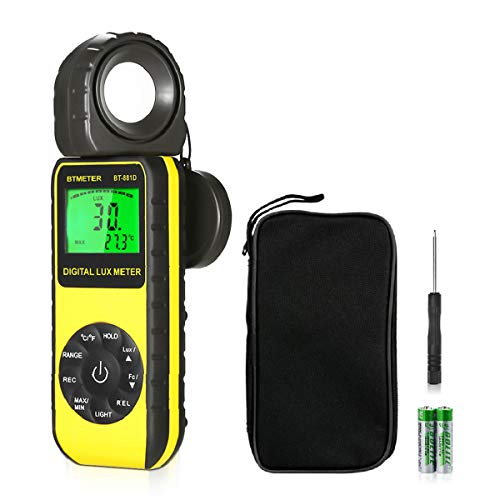
- 0.01 to 400,000 lux measurement range
- 270° rotating sensor for flexible aiming
- Stores readings and supports relative mode
Best For: People who need a versatile light meter for labs, grow lights, and general illuminance checks.
Best for Spectrum Breakdown

- Measures PAR and UVA together
- Displays blue, green, and red PAR split
- Logs up to 100 points for mapping
Best For: Growers who need spectrum-aware PAR readings and light distribution mapping.
Best Split-Sensor Pick
MT-92H Light Meter with Split Sensor
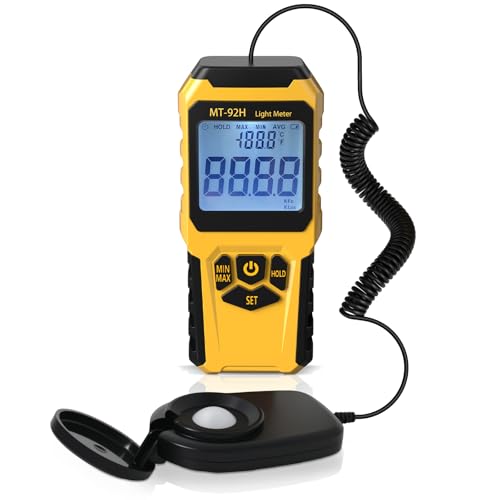
- Up to 200,000 Lux with ±3% accuracy
- Fast 0.5-second refresh for changing light
- Lux/Fc and ℃/℉ modes in a compact body
Best For: Lab technicians and professionals who need fast, flexible illuminance checks with a compact meter.
Best for High-Range Readings
Digital Illuminance Light Meter Tester 200,000Lux

- Measures up to 200,000 lux / 18,500 FC
- MAX/MIN, hold, backlight, and auto power-off
- LUX/FC unit switching for flexible readings
Best For: People needing a simple high-range lux meter for everyday brightness checks.
Best for PAR Tracking
Quantum PAR Meter Full-Spectrum PPFD Tester

- 400-700nm PAR range with 0-5000 μmol/m²/sec measurement
- Stores up to 100 readings for simple tracking
- Tripod socket and portable design improve measurement consistency
Best For: Growers and researchers who need portable PAR readings with basic data logging.
Best Value Portable Meter

- Measures Lux and FC up to 199,900 lux
- Compact body with backlit LCD and simple controls
- Handy Max/Min, data hold, and auto shutoff features
Best For: Users who want a budget-friendly, portable light meter for routine illuminance checks.
Best High-Range Pick
Mcbazel Digital Illuminance Light Meter

- Measures up to 200,000 lux for bright-environment testing
- Switches between LUX and FC with max/min and data hold
- Backlit LCD and auto shut-off make it easy to use
Best For: Buyers who want a versatile, high-range light meter for labs, plants, and indoor lighting checks.
Best for Bluetooth Logging
UNI-T UT383BT Digital Light Meter

- Bluetooth app for recording and export
- Wide Lux/FC range for many lighting checks
- Compact, backlit meter with data hold
Best For: People who want a portable light meter with app-based logging for labs, studios, and plant care.
Best for Fast Readings – Dr.meter LX1330B Digital Illuminance Meter
If you need a practical laboratory light meter for quick illuminance checks, the Dr.meter LX1330B is a straightforward option with a wide 0-200,000 lux range, FC/LUX switching, and fast 2x-per-second updates. It’s a good fit for comparing indoor lighting, checking grow lights, or verifying sunlight levels without spending on a more specialized instrument.
Best For: Users who want an affordable, easy-to-read light meter for plants, indoor spaces, and general light testing.
Pros:
- Fast response with readings updated twice per second
- Switches between FC and LUX for flexible measurement
- PEAK mode helps capture brief high-intensity light events
- Useful for indoor, outdoor, and grow-light checks
Cons:
- Requires a 9V battery, which adds ongoing upkeep
- Not aimed at lab-grade calibration or advanced data logging
For shoppers who want a simple laboratory light meter style tool for everyday brightness testing, the LX1330B offers solid versatility and quick results. It stands out more for convenience and range than for professional-grade precision.
Best for DLI-Based Sun Mapping – EVO-20 DLI Light Meter
If you need a practical laboratory light meter for comparing real-world growing conditions, the EVO-20 stands out for its DLI-based approach. Instead of giving a one-shot brightness reading, it tracks daily light accumulation and translates it into clear sunlight categories, making it easier to place plants with confidence.
Best For: Gardeners, greenhouse users, and landscape designers who want an easy way to measure full sun, partial sun, partial shade, and shade over time.
Pros:
- Classifies light into full sun, partial sun, partial shade, or shade
- Shows DLI readings directly on the display with no math required
- Stores up to 10 days of history for quick condition checks
- Simple no-setup design starts measuring as soon as it is placed
Cons:
- Not an instant light meter, so results build over time
- Best suited for DLI tracking rather than quick spot checks
The EVO-20 is a smart choice if your version of a laboratory light meter needs to tell you more than just current brightness. Its strength is helping you evaluate whether a location consistently gets enough usable light for plants, which is especially useful for garden planning and grow-light setups.
Best for Wide-Range Readings – BTMETER BT-881D Digital Light Meter
If you need a practical laboratory light meter for checking LEDs, grow lights, classrooms, offices, or general indoor/outdoor illumination, the BTMETER BT-881D gives you a broad measurement range and quick readings without much setup. Its rotating sensor makes it easier to capture light from different angles, which is helpful when testing fixtures or comparing positions.
Best For: Users who want a versatile, easy-to-read light meter for lab work, plant lighting, and everyday illuminance checks.
Pros:
- Measures a very wide range from 0.01 to 400,000 lux
- 270° rotating sensor helps with awkward angles and fixture testing
- Fast 0.4-second response with 2–3 samples per second
- Can store readings and compare relative measurements
Cons:
- More of a general-purpose meter than a specialized lab instrument
- No advanced data export or PC connectivity
- Accuracy is solid, but not elite for highly controlled calibration work
For buyers who want a straightforward laboratory light meter with strong range, quick response, and flexible positioning, this BTMETER model is a reliable pick. It is especially useful when you need repeatable light checks across multiple environments rather than a highly specialized research setup.
Best for Spectrum Breakdown – AH-Quantuv PAR Meter
If you need a laboratory light meter that goes beyond a single PAR reading, the AH-Quantuv is built for more detailed grow-light analysis. It measures PAR and UVA, separates blue, green, and red contributions, and can log readings for mapping light distribution across a grow area.
Best For: Growers and testers who want spectrum-aware PAR readings plus UVA monitoring for plant lighting setups.
Pros:
- Measures PAR (400–750nm) and UVA (320–400nm) for broader light analysis
- Shows blue, green, and red PAR breakdown instead of a single total only
- Records up to 100 measurements for light distribution mapping
- Simple display modes with HOLD function for steadier readings
Cons:
- More specialized for grow lights than general-purpose lab use
- Not the most advanced option for full spectral characterization
For buyers comparing a laboratory light meter for horticulture work, this model stands out for showing both spectrum balance and spatial variation. It is a strong fit when you care about how light is distributed, not just how much light is present.
Best Split-Sensor Pick – MT-92H Light Meter with Split Sensor
If you need a laboratory light meter that can track changing illuminance quickly and accurately, the MT-92H is a strong fit. Its split-sensor design helps keep readings stable while giving you flexibility in positioning, and the 0.5-second refresh rate makes it useful for checking fluctuating light sources in test areas, workstations, and inspection setups.
Best For: Lab technicians, photographers, and facility teams who want a compact light meter with fast readings, dual Lux/Fc units, and basic temperature monitoring.
Pros:
- Measures up to 200,000 Lux with ±3% accuracy and 0.1 Lux resolution.
- Split sensor design supports flexible placement without sacrificing measurement integrity.
- Switches between Lux/Fc and ℃/℉ for broader testing and environmental checks.
- Backlit display stays readable in dark rooms or bright conditions.
Cons:
- Temperature measurement is a bonus feature, not a full environmental monitor.
- 3xAAA battery setup is practical, but not rechargeable out of the box.
For buyers who want a practical laboratory light meter without jumping to a more expensive professional system, the MT-92H hits a useful balance of speed, range, and portability. It’s especially appealing if you need quick spot checks across different lighting conditions rather than a bench-style instrument.
Best for High-Range Readings – Digital Illuminance Light Meter Tester 200,000Lux
If you need a practical laboratory light meter for bright environments, this S8608 illuminance meter is built for quick visible-light checks with a wide 0-200,000 lux range and an easy-to-read display. It’s a simple pick for comparing light levels in classrooms, workspaces, grow areas, and other indoor or outdoor settings.
Best For: Users who want a straightforward, high-range lux meter for general brightness measurements and everyday inspections.
Pros:
- Measures up to 200,000 lux / 18,500 FC for bright-light applications
- Includes MAX/MIN, data hold, backlight, and auto power-off features
- Switches between LUX and FC for flexible reading formats
- Large screen makes results easy to check at a glance
Cons:
- Designed for basic illuminance testing rather than advanced lab calibration
- No mention of data logging or app connectivity
- Best suited to visible brightness measurements only
As a laboratory light meter, this model stands out more for range and simplicity than for precision features, so it fits buyers who need fast, reliable brightness readings without extra complexity. For routine lighting checks, it covers the essentials well.
Best for PAR Tracking – Quantum PAR Meter Full-Spectrum PPFD Tester
If you need a laboratory light meter for plant research, grow-room tuning, or greenhouse checks, this Quantum PAR meter is built around the 400-700nm PAR range and gives you a practical way to measure photosynthetic light levels with confidence. It suits users who want a portable PPFD tester with recording features and a simple setup.
Best For: Growers, researchers, and indoor gardeners who need portable PAR measurements and basic data logging.
Pros:
- Measures PAR from 400-700nm with a 0-5000 μmol/m²/sec range
- Stores up to 100 readings and shows recent values on the display
- Tripod socket helps keep measurements stable and consistent
- Compact, lightweight design is easy to move between test locations
Cons:
- Tripod is not included
- More specialized for PAR than for general-purpose light testing
- Best suited to photosynthetic light work rather than broad lab use
Overall, this is a focused laboratory light meter for anyone tracking plant-available light rather than ambient brightness. Its logging features and portable form make it a solid fit when repeatable PAR readings matter more than extra bells and whistles.
Best Value Portable Meter – UNI-T UT383 Light Meter
If you need a practical laboratory light meter for quick lux and foot-candle checks, the UNI-T UT383 is a compact option with a wide 0 to 199,900 lux range, backlit display, and simple one-hand operation. It’s built for everyday brightness testing in labs, studios, offices, plant rooms, and other spaces where fast light-level verification matters more than advanced analysis.
Best For: Buyers who want an affordable, portable light meter for general-purpose illuminance measurements and routine spot checks.
Pros:
- Measures both Lux and FC with a broad range up to 199,900 lux
- Compact design with a large backlit LCD for easier reading
- Useful everyday functions like Max/Min, data hold, overload indication, and auto shutoff
- Good fit for labs, photography, plants, and general lighting checks
Cons:
- Not intended for advanced calibration or highly specialized testing
- Accuracy is solid for the price, but not class-leading
- Best suited to spot measurements rather than continuous logging
Overall, the UT383 makes sense if you want a straightforward laboratory light meter that balances range, portability, and value. It won’t replace more advanced instruments, but it covers the essentials well for routine brightness measurements.
Best High-Range Pick – Mcbazel Digital Illuminance Light Meter
If you need a practical laboratory light meter for checking everything from grow lights to indoor workspaces, this Mcbazel model stands out for its very wide range and simple readout. It measures up to 200,000 lux, switches between LUX and FC, and adds useful functions like max/min, data hold, and backlight visibility for everyday testing.
Best For: Buyers who want an affordable, high-range light meter for labs, plants, photography, or general brightness checks.
Pros:
- Measures up to 200,000 lux, making it useful for bright environments and grow-light testing
- Includes LUX/FC conversion, max/min tracking, and data hold for easier logging
- Backlit LCD and fast sampling help readings stay clear and responsive
- Automatic shut-off and low-battery indicator add convenience
Cons:
- AAA batteries are required but not included
- Accuracy is solid for general use, but not aimed at specialized calibration work
As a laboratory light meter, this Mcbazel unit is a strong value pick if you want broad measuring headroom without complicated setup. It’s especially appealing for users who need a versatile tester that can handle both hobby and professional brightness checks.
Best for Bluetooth Logging – UNI-T UT383BT Digital Light Meter
If you need a practical laboratory light meter for quick illuminance checks and simple data tracking, the UNI-T UT383BT is a strong value pick. It reads in Lux or foot-candles, covers a wide range, and pairs with a mobile app for recording, exporting, and reviewing measurements.
Best For: Users who want a compact light meter with Bluetooth app support for labs, studios, plants, and general lighting audits.
Pros:
- Measures up to 199,900 Lux / 18,500 FC for a broad range of lighting tasks
- Bluetooth connection with iENV app for logging, export, and analysis
- Portable design with backlit LCD, data hold, max/min, and auto shutoff
- Useful for photography, offices, agriculture, and lab-style brightness checks
Cons:
- Not a specialized high-end lab instrument for advanced calibration work
- App-based workflow may be unnecessary for users who only want instant readings
For buyers who want a straightforward laboratory light meter with app-enabled recordkeeping, the UT383BT hits a useful middle ground between portability and functionality. It is especially appealing if you need repeatable readings without moving up to a more expensive professional setup.
How We Picked These Laboratory Light Meters
We prioritized measurement range, sensor design, display readability, response speed, and whether the meter supports lux, foot-candles, PAR, or PPFD. We also looked for models that make sense for real-world use, including handheld lab checks, grow-light verification, and photography or lighting setup work.
A good Laboratory Light Meter should be easy to read, stable in repeated measurements, and suited to the light source you are evaluating. Some meters are best for general illuminance, while others are better for plant-focused spectral readings.
Quick Comparison
If you need simple ambient light readings, a standard lux meter is usually enough. For horticulture or controlled growing environments, choose a PAR or PPFD meter instead. If you want flexibility, look for a model that switches between lux and foot-candles or includes a rotating sensor for easier positioning.
Key Buying Factors for a Laboratory Light Meter
Measurement Type
Start with the unit you actually need. Lux and foot-candles are ideal for general lighting analysis, while PAR and PPFD matter more for plants and photosynthetic light. A Laboratory Light Meter used for research or QA should match the lighting standard you plan to document.
Range and Resolution
Check both the maximum range and the smallest step the meter can detect. Higher range is useful for bright LEDs and daylight testing, while finer resolution helps in low-light environments and comparative measurements.
Sensor Layout and Usability
Separate sensors, rotated heads, and backlit screens can make readings easier in tight spaces or awkward angles. For repeatable lab measurements, stable sensor placement matters as much as raw specs.
Calibration and Consistency
For serious work, prefer a meter that offers dependable repeatability and documented accuracy. If your measurements support reports, audits, or cultivation decisions, consistency is more important than extra features you may never use.
Who Should Buy Which Laboratory Light Meter?
Buy a standard lux meter if you need fast, affordable checks for rooms, workbenches, classrooms, or general lighting. Choose a PAR or PPFD meter if you are measuring grow lights, plant-canopy output, or spectral effectiveness. If you need one meter for mixed tasks, pick a model with a wide range, easy unit switching, and a clear display.
For film, photography, and lighting control, a compact digital illuminance meter can be the most practical choice. For horticulture professionals and advanced users, a specialized plant-light meter will usually deliver the most meaningful data.