The best illuminated solar system models make astronomy easier to see, explain, and remember. Whether you need a classroom teaching aid, a school project kit, or an engaging bedroom display, the right model balances accuracy, durability, visibility, and age-appropriate interaction.
We compared 10 options ranging from glow-in-the-dark planetariums and ceiling kits to orbital models with lights, sounds, and included learning materials. Use the guide below to narrow the choices by purpose, learner age, setup, and budget.
Best 10 Illuminated Solar System Models Picks for 2026
Best Glow-in-the-Dark Pick

- Nine glow-in-the-dark planets
- Over 200 removable adhesive stars
- No batteries required
Best For: Kids’ bedrooms and introductory STEM décor
Best Interactive Learning Model

- Demonstrates rotation and revolution
- Explores seasons and eclipse principles
- Interactive three-sphere design
Best For: Astronomy lessons for ages 12 and up
Best Creative Project Kit

- Includes foam planets and craft supplies
- 12 paints, brushes, and palette included
- Supports science and art activities
Best For: School projects and family crafting
Best Advanced Orbital Demonstrator
Illuminated Sun Earth Moon Orrery
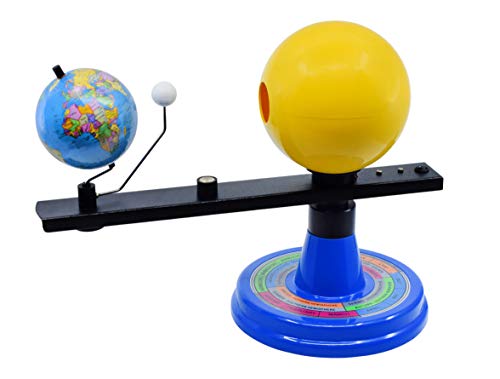
- Gear-driven orbital motion
- 12V illuminated Sun
- Month-labeled base and three activities
Best For: Adult astronomy study and STEM demonstrations
Best Glow-and-Build Pick
National Geographic Solar System Model

- Builds and paints all eight planets and the Sun
- Movable arms support adjustable display positions
- Includes glow paint and astronomy learning materials
Best For: Hands-on space decor and STEM activities for kids 8 and up
Best Wall-Mounted Project
Pllieay Solar System Model Kit

- Includes 63 pieces for a complete DIY project
- Felt backdrop and hooks support wall display
- Builds astronomy and coordination skills through crafting
Best For: School projects and space-saving wall decorations
Best Quiz-Focused Planetarium
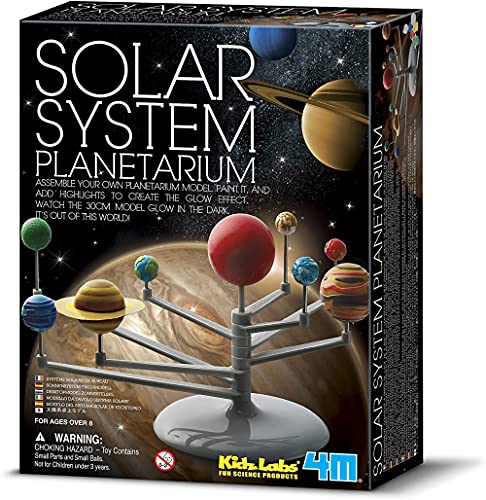
- Includes glow paint, rods, string, and planet pieces
- Adds a wall chart and 10 sets of quiz questions
- Battery-free project for ages 8 and up
Best For: Glow-in-the-dark astronomy learning and review
Illuminated Study Pick

- Illuminated 5.9-inch sun
- Month-based planet positions
- Includes illustrated study guide
Best For: Home learning, classrooms, and science decor
Projector Learning Pick
Science Can Talking Solar System

- Projects planets and space slides
- Bilingual English/Spanish facts
- LED dome doubles as night light
Best For: Interactive STEM learning and bedtime astronomy
Orbit Demonstration Pick

- Shows seasons and eclipses
- Demonstrates moon phases and orbits
- Includes seasonal information plate
Best For: Earth science lessons and school projects
Best Glow-in-the-Dark Pick – 3D Solar System Ceiling Kit
For shoppers seeking illuminated solar system models as room décor, this ceiling kit combines nine glow-in-the-dark planets with more than 200 adhesive stars. It requires no batteries and is designed for children ages 5 and up.
Best For: Kids’ bedrooms, space-themed décor, and introductory STEM learning.
Pros:
- Includes nine planets, over 200 stars, and a solar system guide.
- Glow effect can function as a gentle night light.
- Adhesive pieces are designed to remove without damaging walls.
- Different star sizes add visual variety.
Cons:
- It is a ceiling décor kit rather than a movable orbital model.
- The manufacturer lists a recommended age of 5 years.
This is a strong choice when the priority is an easy-to-install, glow-in-the-dark space display with a small educational component rather than mechanical demonstrations.
Best Interactive Learning Model – Sun Earth Moon Orbital Model
This illuminated solar system model is built around the Sun, Earth, and Moon, giving older children and families a hands-on way to examine rotation, revolution, seasons, moon motion, and eclipse principles.
Best For: Astronomy lessons, family learning, and children ages 12 and up.
Pros:
- Illustrates Earth’s rotation and revolution around the Sun.
- Helps explain seasons and the Moon’s movements.
- Interactive three-sphere design supports hands-on exploration.
- Compact listed dimensions make it suitable for tabletop use.
Cons:
- The manufacturer recommends it for ages 12 and up.
- It focuses on the Sun-Earth-Moon system rather than the full solar system.
- No manufacturer warranty is listed.
Choose this model if demonstrating celestial relationships matters more than having a decorative display or a complete set of planets.
Best Creative Project Kit – 64-Piece Solar System Model
For a hands-on alternative to preassembled illuminated solar system models, this 64-piece kit lets children paint and build their own display. It includes foam pieces, paints, brushes, a palette, craft sticks, flags, and instructions.
Best For: School projects, family crafts, and children developing early astronomy and art skills.
Pros:
- Includes 12 paint colors, two brushes, a palette, and instructions.
- Foam surfaces are designed to be easy to color.
- Encourages hand-eye coordination, focus, creativity, and science learning.
- Suitable for classroom themes or home activities.
Cons:
- It is a build-and-paint kit, not an illuminated display.
- The manufacturer recommends ages 6 to 12, despite the title referencing younger children.
- Foam construction may be less substantial than a metal orbital model.
This kit makes sense for buyers who value an active project and customization over ready-to-use lighting or mechanically accurate orbital movement.
Best Advanced Orbital Demonstrator – Illuminated Sun Earth Moon Orrery
This illuminated solar system model is designed for detailed demonstrations, pairing a 12V light bulb with gear-driven orbital motion. Its month-labeled base and included activities help connect celestial movement with eclipses, moon phases, and the calendar year.
Best For: Adult learners, advanced STEM demonstrations, and tabletop astronomy study.
Pros:
- Gear-driven mechanism simulates orbital motion.
- Illuminated Sun supports demonstrations of light and eclipses.
- Month-labeled base connects positions to the calendar year.
- Includes a study guide with three structured activities.
Cons:
- The manufacturer recommends it for adults ages 18 and up.
- It models the Sun, Earth, and Moon rather than all planets.
- Its listed 14-inch height and metal construction may require dedicated tabletop space.
This is the most demonstration-oriented option in the group, especially for buyers who want mechanical motion, illumination, and guided activities in one educational instrument.
Best Glow-and-Build Pick – National Geographic Solar System Model
For kids who want an interactive addition to space-themed decor, this National Geographic kit is one of the more engaging illuminated solar system models. Children build and paint all eight planets and the Sun, then use the movable arms to adjust the display and see it glow in the dark.
Best For: Kids ages 8 and up who enjoy painting, hands-on STEM projects, and movable bedroom displays.
Pros:
- Includes planets, Sun, paints, glow-in-the-dark accent paint, brush, palette, decals, and an educational poster.
- Movable arms allow the planetary arrangement to be adjusted.
- Combines construction, creativity, and astronomy learning in one project.
Cons:
- Assembly and painting require hands-on time before the model is ready to display.
- The glow effect depends on the included glow-in-the-dark paint rather than powered illumination.
This is a strong choice when the goal is more than a static craft. Its movable design, included supplies, and glow accents make it especially suitable for a child’s room or an astronomy-themed learning activity.
Best Wall-Mounted Project – Pllieay Solar System Model Kit
This Pllieay kit takes a craft-focused approach to illuminated solar system models, using foam planets, paint, stars, and a felt backdrop for a wall display. Its hanging format helps conserve space while giving children a structured school or home astronomy project.
Best For: Students ages 8 to 17 completing a classroom assignment, science project, or compact space-themed decoration.
Pros:
- Includes 63 pieces, including foam hemispheres, felt background, paints, brushes, hooks, labels, and instructions.
- Wall-mounting keeps the finished project from taking up extra desk or shelf space.
- Supports hands-on practice with planet names, orbital positions, color recognition, and coordination.
Cons:
- The supplied notes describe a painted foam-and-felt craft rather than a powered lighting system.
- Foam components may provide less durability than a rigid plastic model.
Choose this kit when display space and project structure matter most. It is particularly practical for classrooms, back-to-school activities, and children who want to create a labeled wall-mounted solar system.
Best Quiz-Focused Planetarium – 4M Solar System Planetarium
The 4M Solar System Planetarium combines model-building with astronomy review, making it a useful option among illuminated solar system models for children who learn through activities. Kids assemble and paint the planets, add glow paint, and use the included wall chart and quiz questions to reinforce space facts.
Best For: Kids and teens ages 8 and up who want a glow-in-the-dark planetarium project with added learning materials.
Pros:
- Includes planets, stencils, glow paint pen, rods, string, assembly instructions, and a fact-filled wall chart.
- Ten sets of Kidz Quiz questions add a review component to the craft.
- Requires no batteries, with eight planets included and Pluto excluded.
Cons:
- The kit requires assembly and painting before it can be displayed.
- It does not include Pluto.
- The supplied notes identify glow paint rather than battery-powered lighting.
This kit is a good fit for families seeking a classic assemble-and-learn activity. The chart and quiz questions give it more educational structure than a model intended only for decoration.
Illuminated Study Pick – Eisco Solar System Model
If you want illuminated solar system models for hands-on learning or science-themed decor, the Eisco model combines labeled month-based positions with a built-in light socket. Its plastic construction and included study guide make it a practical display for classrooms or home learning, though the bulb and power supply must be purchased separately.
Best For: Home learning, classroom demonstrations, and educational science decor.
Pros:
- Illuminated 5.9-inch sun adds a useful visual element.
- Month-based labels help explain planetary movement.
- Includes an illustrated study guide.
- Outer planets extend up to 18 inches from the sun for a more spacious layout.
Cons:
- Light bulb and power supply are not included.
- Its extended layout may need a fairly large display area.
The Eisco is a strong choice when physical scale, labeled learning, and an illuminated centerpiece matter more than portability. Confirm you have room for its approximately 22 x 13.5 x 11-inch footprint and the required lighting accessories.
Projector Learning Pick – Science Can Talking Solar System
Among illuminated solar system models, this Science Can kit stands out for turning astronomy lessons into a room-filling activity. It combines an eight-planet model with a projector, bilingual talking features, 24 space slides, and an LED dome that can serve as a night light.
Best For: Children ages 3 to 12 who learn through projection, audio, and interactive play.
Pros:
- Projects planets and space images onto walls or ceilings.
- Offers educational facts in both English and Spanish.
- Includes three disks with 24 full-color slides.
- LED dome works as a night light or flashlight.
Cons:
- Requires three AA batteries, which are not included.
- Projection clarity depends on adjusting the top knob.
- Requires assembly before use.
This is the most feature-rich option for a child who wants astronomy to feel like an activity rather than a static display. Choose it if projection and bilingual interaction are priorities; choose another model if you want a simpler, permanently arranged classroom model.
Orbit Demonstration Pick – Sun Earth Moon Orbital Model
For shoppers comparing illuminated solar system models with more focused mechanics, this Sun-Earth-Moon kit emphasizes orbital motion and light-based demonstrations. Its rotating components are designed to explain seasons, moon phases, and solar and lunar eclipses, making it especially useful for structured science lessons.
Best For: Earth science teaching, school projects, and children over age six.
Pros:
- Demonstrates Earth’s orbit, moon phases, and seasonal changes.
- Can illustrate both solar and lunar eclipses.
- Includes a seasonal plate with dates and traditional Chinese solar terms.
- Compact footprint measures approximately 15.2 x 7.87 x 11.02 inches.
Cons:
- Assembly requires multiple screws, gears, and alignment steps.
- Focuses on the sun, Earth, and moon rather than a full eight-planet display.
- The notes do not identify a built-in illumination feature or included power source.
This kit is best treated as a teaching apparatus for orbital relationships rather than a decorative full solar system. It offers strong lesson value for seasons and eclipses, provided the buyer is comfortable following the assembly and alignment instructions.
How We Picked These Illuminated Solar System Models
We focused on models that provide more than a static set of planets. The selections represent several useful formats: lighted Sun, Earth, and Moon orbital demonstrations; glow-in-the-dark displays; build-your-own school project kits; and interactive models designed for younger learners. We also considered stated age ranges, educational purpose, assembly requirements, included accessories, display size, and whether each product is better suited to supervised lessons or independent play.
Because “illuminated” can mean either electrically lit or glow-in-the-dark, check the product format carefully before buying. A battery- or socket-powered model generally offers clearer demonstrations, while glow products are easier to mount and use without cords.
Quick Comparison
- Best for bedroom display: Glow-in-the-dark ceiling kits and planetariums provide a simple, space-themed visual experience.
- Best for classroom demonstrations: Orbital models showing the Sun, Earth, and Moon make relative movement and relationships easier to explain.
- Best for school projects: Multi-piece kits offer hands-on painting, assembly, and presentation opportunities.
- Best for younger children: Interactive or talking models can add guided facts and encourage independent exploration.
- Best for older students and adults: Larger illuminated orreries and study-oriented models emphasize demonstration and reference value.
Key Buying Factors for Illuminated Solar System Models
Lighting and Power
Determine whether the planets glow through phosphorescent material, LEDs, or a light socket. Glow-in-the-dark designs need exposure to light before use, while powered models may need batteries, an outlet, or adult supervision. Confirm what is included and whether replacement batteries or a bulb are required.
Age, Scale, and Realism
Age labels matter because small parts, paint, tools, and assembly can make some kits unsuitable for younger children. Also consider whether you want a simplified educational display or a more substantial model with orbital movement. Most tabletop products are teaching aids rather than true scale representations, so prioritize clarity over exact proportions.
Assembly and Durability
DIY kits are valuable for STEM learning but may require painting, drying time, or help with instructions. For frequent classroom use, choose sturdy components and a stable base. For occasional projects, a lower-cost kit may offer better value even if it is less polished.
Learning Materials and Interaction
Look for study guides, labels, activity suggestions, audio facts, or moving parts if structured learning is important. Interactive features are helpful, but they should support accurate content rather than distract from it.
Who Should Buy Which Illuminated Solar System Models?
Choose a ceiling or glow-in-the-dark planetarium for a child who mainly wants an attractive space display. Select a buildable project kit for students who need a hands-on science assignment. A Sun-Earth-Moon orbital model is the better choice for explaining eclipses, phases, seasons, and basic celestial relationships. For a classroom, tutoring space, or serious home study area, prioritize a stable illuminated model with a guide and clearly differentiated planets. Families seeking independent exploration should consider an interactive model, while buyers wanting a compact reference display should favor a simpler, powered tabletop design.