The best hot air rework stations give you controlled heat and airflow for removing components, reflowing solder, and repairing crowded PCBs. A 2-in-1 model can also replace a separate soldering iron station for many bench tasks.
Our roundup compares 10 hot air rework stations across power, temperature control, included accessories, presets, ergonomics, and workspace needs, so you can choose the right setup for hobby repairs or regular electronics work.
Best 10 Hot Air Rework Stations Picks for 2026
Versatile 2-in-1 Pick

- Combined soldering and hot-air station
- PID control with ESD-safe design
- Includes 10 tips and four nozzles
Best For: DIYers and general electronics repair
High-Power Performance Pick

- 1300W rapid-heating design
- Four memory settings and adjustable airflow
- Includes six nozzles and quick-change holder
Best For: Frequent SMD and device repair
Complete Starter Kit
- Two-in-one soldering and hot-air station
- Includes tips, nozzles, tweezers, and pump
- Sleep and hot-air standby modes
Best For: Beginners and hobby electronics work
High-Temperature Hot-Air Pick

- 932°F maximum stabilized temperature
- Three preset channels for repeat work
- Includes mat, tweezers, and three nozzles
Best For: Dedicated hot-air rework with saved settings
Best All-in-One Kit
WEP 882D 2-in-1 Hot Air Rework Station

- Combines hot air and soldering functions
- Adjustable 212–896°F hot air range
- Includes extensive starter accessories
Best For: Users wanting a compact dual-function electronics rework station
Best High-Power Option
ATTEN ST-862D 1000W Hot Air Station
- 1000W heating power
- Airflow reaches 120 L/min
- LCD and quick-access controls
Best For: PCB and SMD repair requiring strong heat and airflow
Best Compact Design
WEP 8858-V Hot Air Rework Station

- Palm-sized station with integrated holders
- PID control and adjustable airflow
- Includes three nozzles and two tweezers
Best For: Space-conscious users doing electronics repair and rework
Best All-in-One Pick
YIHUA 862BD+ 2-in-1 Rework Station
- Combines hot air rework and 75W soldering
- PID temperature control with digital displays
- Includes nozzles, tips, solder, and repair tools
Best For: Complete bench setups needing hot air and soldering
Best for Preset Workflows

- Four preset channels speed repeat tasks
- Adjustable temperature and air volume
- Auto-standby and detachable heat gun
Best For: Repeatable repair workflows and bench technicians
Versatile 2-in-1 Pick – YIHUA 8786D I
For shoppers comparing hot air rework stations, the YIHUA 8786D I stands out as a combined hot-air and soldering setup with separate controls, dual displays, and a broad accessory package. Its PID temperature control and ESD-safe design make it a practical choice for general electronics rework.
Best For: DIYers and repair technicians who want soldering and hot-air functions in one station.
Pros:
- Combines a soldering station and hot air rework station.
- PID control supports fast temperature compensation and stability.
- Includes 10 soldering tips, four hot-air nozzles, an extractor, pump, and solder wire.
- Fail-safe protection cuts heater power if airflow stops unusually.
Cons:
- Designed for 110–127V operation with a US-standard plug.
- Its 896°F maximum temperature is lower than some higher-powered models.
The 8786D I is a well-rounded option when accessory value and two-in-one functionality matter more than maximum hot-air output.
High-Power Performance Pick – SUGON 8620DX
The SUGON 8620DX is one of the more powerful hot air rework stations in this roundup, using a 1300W system for rapid heating and adjustable airflow. Its memory presets, temperature calibration, and quick-change nozzle holder are useful for repeated SMD repair work.
Best For: Frequent rework on phones, tablets, laptops, PCBs, and other SMD assemblies.
Pros:
- 1300W power heats to 592°F in approximately two seconds, according to the supplied specifications.
- Offers four memory settings, three temperature displays, and °F/°C selection.
- Adjustable airflow ranges from 1 to 200 and includes six nozzles.
- Quick-change nozzle holder avoids waiting for the nozzle to cool before changing it.
Cons:
- It is a hot-air station rather than a combined soldering-iron station.
- Its 6.46 kg weight makes it less convenient to move frequently.
- Limited to 110V alternating-current operation.
Choose the 8620DX if fast heating, strong airflow control, and repeatable saved settings are priorities for a busy repair bench.
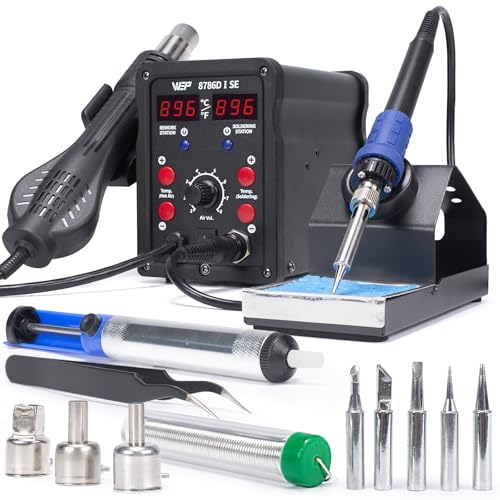
Complete Starter Kit – WEP 8786D-I SE
The WEP 8786D-I SE gives shoppers a compact two-in-one option among hot air rework stations, pairing adjustable hot air with a soldering iron and useful starter accessories. Its sleep and standby modes are designed to reduce unnecessary heating during pauses.
Best For: Beginners and hobbyists who want an immediately usable soldering and desoldering kit.
Pros:
- Combines hot-air rework and soldering functions with separate digital temperature readouts.
- Includes solder wire, tweezers, a desoldering pump, five tips, and three nozzles.
- Both functions use PID stabilization for controlled temperatures.
- Sleep and hot-air standby modes help reduce wear when the tools are idle.
Cons:
- Includes fewer soldering tips and nozzles than some competing kits.
- Designed for 110–127V USA specifications and should not be connected to 220V.
The WEP is a sensible value-focused choice for light-to-moderate electronics work where a complete accessory bundle and compact footprint are important.
High-Temperature Hot-Air Pick – YIHUA 959D
The YIHUA 959D focuses on hot-air rework rather than combining a soldering iron with the station. It offers three preset channels, airflow output up to 120L, a 932°F maximum stabilized temperature, and safety-oriented cooling when the gun is returned to its holder.
Best For: Users handling varied components who want saved hot-air settings and higher temperature headroom.
Pros:
- Three preset channels make frequently used settings easier to recall.
- Reaches a maximum stabilized temperature of 932°F with up to 120L of hot air.
- Includes a heat-resistant silicone mat, ESD-safe tweezers, and three nozzles.
- In-holder standby and fail-safe functions support safer operation and tool longevity.
Cons:
- Does not include a separate soldering iron function.
- Its listed temperature stability is 18°F, less precise than some models in this group.
- Designed for 110–127V operation with a US-standard plug.
The 959D is a strong fit for dedicated hot-air work when higher temperature capability, preset channels, and included workspace accessories are more useful than a two-in-one design.
Best All-in-One Kit – WEP 882D 2-in-1 Hot Air Rework Station
For shoppers comparing hot air rework stations, the WEP 882D stands out by combining a soldering iron and hot air station in one compact unit. Separate LED displays and controls let you adjust soldering temperature from 392–896°F, hot air temperature from 212–896°F, and the air volume independently.
Best For: Electronics users who want one compact station with both hot air and conventional soldering capabilities, plus a broad starter accessory set.
Pros:
- Combines soldering and hot air functions in one compact body.
- PID temperature control, calibration, sleep mode, and automatic shutdown support more consistent work.
- Includes solder wire, five soldering tips, three hot air nozzles, tweezers, a brass wool cleaner, and a desoldering pump.
Cons:
- The unit is rated for 110–127V USA power and should not be connected to a 220V outlet.
- Its 1.1 kg weight and compact controls may be less suited to larger production setups.
The WEP 882D is a practical choice when workspace efficiency and included accessories matter as much as hot air performance. Its dual-function design also makes it more versatile than a hot-air-only station.
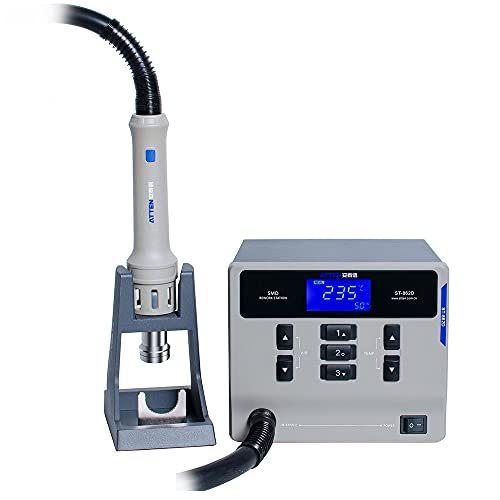
Best High-Power Option – ATTEN ST-862D 1000W Hot Air Station
The ATTEN ST-862D is a high-power choice among hot air rework stations, with a 1000W heater, 100–480°C temperature range, and maximum airflow of 120 L/min. Its LCD, menu-style controls, quick-access settings, and temperature stabilization are designed for efficient PCB and SMD repair.
Best For: Users who prioritize strong heating performance, high airflow, and fast access to commonly used temperature and air-volume settings.
Pros:
- Powerful 1000W design with airflow up to 120 L/min.
- Temperature stability is specified at ±1.0°C / 3°F.
- Includes a hot air gun, bracket, four nozzles, ground wire, and English manual.
- Silicone gun cable is designed to remain flexible in colder conditions.
Cons:
- This is a hot-air-only station rather than a combined soldering and hot air unit.
- It is rated for 110V AC, so power compatibility should be checked before purchase.
Choose the ST-862D when power and airflow are more important than an all-in-one workstation. Its stabilization feature and three quick-access key sets make it particularly appealing for repeated repair tasks.
Best Compact Design – WEP 8858-V Hot Air Rework Station
The WEP 8858-V is a space-conscious option for shoppers comparing hot air rework stations. Its palm-sized main unit includes an integrated gun holder and nozzle holder, while a simple control panel lets you adjust temperature and air volume without navigating a secondary menu.
Best For: Hobbyists and electronics repair users working in limited spaces who want straightforward controls and organized accessory storage.
Pros:
- Compact 3.5-by-4.6-by-2.4-inch design with integrated holders.
- PID temperature monitoring helps maintain consistent heat.
- Includes three additional nozzles plus bent and straight tweezers.
- Offers °F/°C conversion, digital calibration, and a hot-air fail-safe.
Cons:
- It is a hot-air-only station without a separate soldering iron function.
- The product is rated for 110–127V USA specifications and should not be connected to 220V power.
The WEP 8858-V makes a strong case when bench space and ease of storage are priorities. Its integrated holders and accessible controls keep the setup tidy while still providing adjustable heat and airflow.
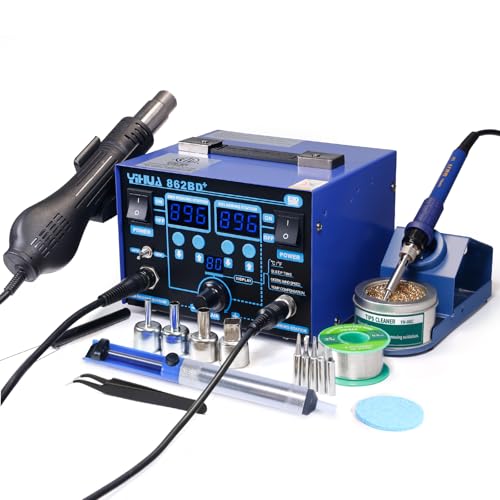
Best All-in-One Pick – YIHUA 862BD+ 2-in-1 Rework Station
The YIHUA 862BD+ is a practical choice if you want hot air rework stations with both a hot air gun and a 75W soldering iron in one unit. Its PID temperature control, dual digital readouts, adjustable sleep mode, and broad accessory bundle make it suitable for varied bench work.
Best For: Users who want a combined soldering and hot air rework setup with extensive included accessories.
Pros:
- Combines hot air rework and 75W soldering functions in one station.
- PID control helps stabilize the soldering iron temperature.
- Includes four hot air nozzles, five iron tips, tweezers, solder, and desoldering tools.
- Detachable tools can be replaced without replacing the entire station.
Cons:
- The unit is designed for 110–127V US power.
- Its broad accessory set may be more than needed for users seeking a hot-air-only station.
Choose this model when flexibility and included equipment matter most. The dual-function design offers a fuller repair setup, while the digital displays and sleep timer add useful day-to-day convenience.
Best for Preset Workflows – WEP 2009D-II Hot Air Station
The WEP 2009D-II is a focused hot air rework station built around repeatable settings and straightforward controls. Four preset channels, adjustable air volume, PID stabilization, and automatic standby make it useful for repair work that involves recurring temperature profiles.
Best For: Technicians who want quick access to repeatable hot air settings and an automatically cooling gun.
Pros:
- Four preset channels reduce repeated manual adjustments.
- Temperature ranges from 212–896°F with air volume adjustable from 1 to 10.
- Auto-standby cools the gun to 212°F when placed in its holder.
- Includes cool-air mode, three nozzles, ESD-safe tweezers, and an IC extractor.
Cons:
- Rated for 110–127V USA specifications and should not be connected to 220V.
- The included nozzle selection is limited to three sizes.
For users who value efficient, repeatable operation, the preset channels and clear LED status information are the main attractions. The detachable heat gun also helps control long-term replacement costs.
Best Simple Hot-Air Option – YIHUA 959D-I Digital Rework Station
The YIHUA 959D-I is a streamlined choice among hot air rework stations for SMD reflow and general repair. It offers fast heating, PID temperature monitoring, adjustable airflow up to 120L/min, and automatic standby when the gun returns to its holder.
Best For: Users who need a dedicated hot air station for electronics, appliance, smartphone, and computer repair.
Pros:
- Heats quickly when the hot air gun is lifted from its holder.
- PID control monitors and compensates for temperature changes in real time.
- Adjustable temperature spans 212–896°F, with airflow up to 120L/min.
- Includes three nozzles and two pairs of ESD-safe tweezers.
Cons:
- It has one channel rather than multiple preset channels.
- It is designed for 110–127V US power.
- It does not include a separate soldering iron function.
This model makes sense when you want a dedicated hot-air tool without the extra controls or soldering hardware of a combination station. Its automatic standby and rapid reheating are especially convenient for frequent stop-and-start work.
How We Picked These Hot Air Rework Stations
We focused on stations that offer practical control for SMD rework rather than judging them by wattage alone. The selection includes 2-in-1 stations with soldering irons, dedicated hot air models, compact kits, and higher-powered units for more demanding boards.
We compared temperature ranges, airflow adjustment, display readability, memory or preset functions, nozzle selection, ESD-safety features, included soldering accessories, and the overall usefulness of each package. Build quality, footprint, and ease of handling also matter because rework often requires precise positioning over small components.
Quick Comparison
| Best For | Look For |
|---|---|
| General home electronics repair | 2-in-1 station, adjustable airflow, multiple nozzles |
| Frequent SMD rework | Fast heat recovery, stable temperature, memory presets |
| Large ground planes and lead-free solder | Higher power and strong, controllable airflow |
| Small workbenches | Compact housing, integrated holder, detachable or flexible gun |
| Production or sensitive components | ESD-safe design, accurate display, repeatable settings |
Key Buying Factors for Hot Air Rework Stations
Temperature and Airflow Control
A wide temperature range is useful, but stable adjustment is more important than the highest advertised number. Independent airflow control helps prevent blowing small components off the board and lets you use gentler settings on delicate parts.
Power and Heat Recovery
Higher wattage can help a station recover heat quickly when working on boards with large copper areas or lead-free solder. For occasional repairs, moderate power may be sufficient and can make the unit easier to control.
Nozzles and Soldering Accessories
Check the included nozzle sizes and whether replacements are easy to find. A selection of round nozzles supports different component sizes, while included iron tips, solder wire, tweezers, and brass wool can reduce additional setup costs.
Presets, Displays, and Safety
Digital displays and memory channels make repeat jobs faster. Look for clear temperature readings, Celsius/Fahrenheit switching if useful, automatic cooling, a stable tool holder, and ESD-safe construction when working with static-sensitive electronics.
Who Should Buy Which Hot Air Rework Stations?
Choose a 2-in-1 model if you want one station for both hot air and conventional soldering. It is usually the most practical choice for hobbyists, repair benches, and general DIY electronics work.
Choose a higher-powered digital station if you regularly service lead-free assemblies, multilayer boards, or larger components. A compact dedicated unit is better for limited bench space or occasional desoldering, while a model with memory presets suits technicians who repeat the same repair processes.
Whichever station you choose, pair it with suitable nozzle sizes, ventilation, eye protection, and a temperature setting appropriate for the component and board. Practice on scrap boards before working on valuable electronics.