The right engineering building set can turn a science-fair assignment into a practical investigation. These kits help students explore structures, motion, force, hydraulics, robotics, and mechanical systems through hands-on construction.
We selected options across age ranges, skill levels, project types, and budgets so you can choose a set that supports a clear demonstration as well as an engaging build.
Best 10 Engineering Building Sets for Science Fairs Picks for 2026
Architectural Design Pick

- Build 26 structural and building models
- Flexible pieces mimic steel frames
- Includes a 44-page illustrated manual
Best For: Ages 8–14 exploring architectural design and original structures
Classroom Bridge Pick

- Build 13 functioning bridge replicas
- Covers seven major bridge types
- Includes a teacher’s guide and storage tray
Best For: Grades 3–5 classrooms and small-group bridge projects
Physics Motion Pick
Physics Laws: Inertia, Friction & Circular Motion

- Build six working physics models
- Covers inertia, friction, and circular motion
- Includes experiments, theory, quizzes, and a 3D app
Best For: Ages 9+ creating hands-on motion and physics demonstrations
Structural Engineering Pick
Structural Engineering: Bridges & Skyscrapers

- Build 20 bridge and skyscraper models
- Explores load, compression, tension, and force
- Includes 287 pieces and a 36-page experiment manual
Best For: Intermediate ages 8–14 studying structural forces
Best Working Engine Model

- 703-piece working V8 engine model
- USB-powered visible piston movement
- Designed for ages 14 and up
Best For: Engine, mechanics, and physical-science projects
Best All-Around Engineering Set
PATHFINDERS Engineering Maker Set

- 156-piece real wood construction kit
- Covers hydraulics, gears, levers, and pulleys
- Includes 10 builds and 15 challenge cards
Best For: Classrooms, maker spaces, and open-ended projects
Best Hydraulic Robotics Project

- Water-powered six-axis robotic arm
- Rotates up to 270 degrees and grips objects
- Designed for ages 12 and up
Best For: Hydraulics, physics, and robotics demonstrations
Structural Discovery
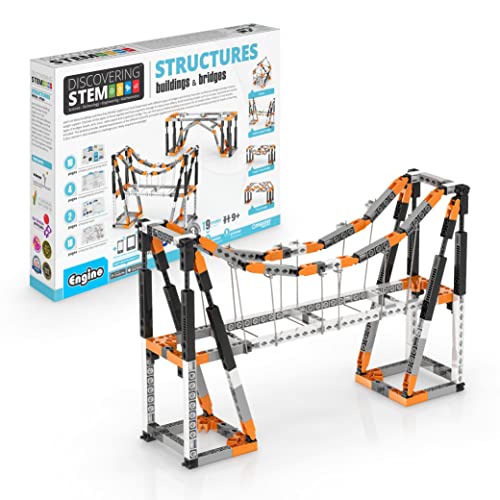
- Build nine structure and bridge models
- Includes theory, experiments, and quiz materials
- Designed for ages 9+ and science-fair projects
Best For: Young builders exploring structural engineering
Hydraulic Mechanics Lab

- Build a lift, crane, excavator arm, and platform lifter
- Demonstrates force, motion, and levers
- Requires no batteries or special tools
Best For: Hands-on hydraulics and physics projects
Powered Motion Workshop

- Build a wooden motorized robot arm
- Introduces circuits and mechanical movement
- No soldering required; six AA batteries needed
Best For: Robotics and electrical engineering projects
Architectural Design Pick – Architectural Engineering
For shoppers comparing engineering building sets for science fairs, this architectural kit offers a broad introduction to structural design. Builders can create 26 models, beginning with trusses, arches, and domes before progressing to scaled-down real-world buildings.
Best For: Young builders ages 8–14 who want to explore architectural design and invent their own structures.
Pros:
- Includes models of structural elements and real-world buildings.
- Flexible pieces mimic steel frames, while the plastic parts work with other Thames & Kosmos engineering and physics kits.
- Includes a 44-page, full-color manual with building exercises.
Cons:
- Its focus is architectural modeling rather than dedicated bridge-testing experiments.
- The kit is recommended for ages 8–14, so it may not suit younger children.
This is a versatile choice when a science-fair project benefits from comparing structural forms or developing an original building design. The guided progression from basic elements to buildings gives it useful range for repeat projects.
Classroom Bridge Pick – Intro to Structures: Bridges
Among engineering building sets for science fairs, this K’NEX Education kit stands out for its focused study of bridge design. Its 207 rods, stems, and connectors can be assembled into 13 functioning bridge replicas, making it practical for comparing structural types.
Best For: Grades 3–5 students, classrooms, or small groups studying real-world bridge infrastructure.
Pros:
- Covers truss, arch, cantilever, beam, suspension, movable, and cable-stayed bridges.
- Includes building instructions and a teacher’s guide with lessons and experiments.
- Portable storage tray supports cleanup and organization.
- Designed for two to three people to work on each set.
Cons:
- The project focus is primarily bridges rather than a wide range of engineering subjects.
- The supplied notes do not specify the full contents of the included guide beyond the teacher’s materials.
This is a strong option for a collaborative science-fair display comparing bridge structures. The range of bridge types gives students a clear foundation for discussing design differences and how each model functions.
Physics Motion Pick – Physics Laws: Inertia, Friction & Circular Motion
This Engino set gives engineering building sets for science fairs a physics-centered direction. Instead of concentrating on buildings, it lets children ages 9 and up construct six working models that demonstrate inertia, friction, and circular motion.
Best For: Budding engineers who want a hands-on project connecting working models with motion and physics concepts.
Pros:
- Builds six working models, including a rocket launcher, crash-test rig, and sharpening wheel.
- Includes theory, experiments, a quiz section, and easy-to-follow instructions.
- Offers an interactive 3D app for virtual-reality building.
- Targets concentration, critical thinking, construction, and STEM skills.
Cons:
- It focuses on motion laws rather than architectural or structural engineering.
- The supplied notes do not identify specific science-fair testing materials or measurement equipment.
Choose this kit when the project needs visible demonstrations of motion rather than static structures. Its working models and supporting theory can help turn a build into an explainable physics presentation.
Structural Engineering Pick – Structural Engineering: Bridges & Skyscrapers
For science-fair builders who want to study how structures handle forces, this Thames & Kosmos set provides 20 models of bridges and skyscrapers. The 287 interchangeable pieces support lessons about load, compression, tension, and building materials.
Best For: Intermediate builders ages 8–14 investigating structural forces through bridge and skyscraper models.
Pros:
- Builds 20 different structural models.
- Explores force, load, compression, tension, and related concepts.
- Includes more than 285 interchangeable plastic building pieces.
- Provides a 36-page illustrated experiment manual and assembly guide.
Cons:
- The set is labeled intermediate, which may require more guidance for beginners.
- Its supplied models center on bridges and skyscrapers rather than general architectural design.
This is a particularly relevant choice for a science-fair project built around structural behavior. The combination of multiple models, interchangeable parts, and an experiment manual gives students room to compare how designs respond to different engineering principles.
Best Working Engine Model – V8 Engine STEM Building Kit
For older students and car enthusiasts, this V8 model is one of the more specialized engineering building sets for science fairs. Its 703-piece build recreates visible engine components, while the USB-powered motor demonstrates piston movement and gives a project display a working element.
Best For: Teens 14 and up, adults, and science-fair projects focused on engines, mechanics, or physical science.
Pros:
- Transparent cylinder heads make piston movement easy to observe.
- USB-powered motor runs without conventional batteries.
- Large 703-piece build encourages detailed assembly and mechanical exploration.
- Includes an instruction manual and uses ABS plastic.
Cons:
- Recommended for ages 14 and up, so it is not suited to younger builders.
- The model focuses specifically on V8 engines rather than multiple engineering topics.
This kit is a strong choice when the goal is a visually engaging, functioning engine demonstration. Its specialized theme makes it less versatile than a general mechanics set, but the moving internal parts can add interest to a science-fair presentation.
Best All-Around Engineering Set – PATHFINDERS Engineering Maker Set
The PATHFINDERS Maker Set is a versatile option among engineering building sets for science fairs, combining hydraulics, gears, levers, and pulleys in one reusable kit. Builders can follow 10 guided challenges, then use 15 challenge cards to develop their own machines and test engineering concepts.
Best For: Kids 8 and up, classrooms, maker spaces, and open-ended science-fair investigations involving mechanical advantage or hydraulic pressure.
Pros:
- Includes 10 step-by-step builds and 15 open-ended challenge cards.
- Demonstrates hydraulics, gears, levers, pulleys, and gear ratios.
- Real wood components are designed for repeated builds and experiments.
- Supports both guided learning and independent invention.
Cons:
- Manual operation means it does not provide powered or automated movement.
- Some hydraulic builds may require troubleshooting air bubbles and water pressure.
With multiple mechanisms and room for redesign, this is the most adaptable pick in the group. It can support a straightforward demonstration or a more original investigation based on testing, redesign, and the engineering design process.
Best Hydraulic Robotics Project – TEACH TECH Hydrobot Arm
The TEACH TECH Hydrobot Arm offers a focused robotics project for students looking for engineering building sets for science fairs. Builders assemble a water-powered robotic arm with six axes, a 270-degree range of rotation, and a controllable gripper for demonstrating fluid power and mechanical movement.
Best For: Builders ages 12 and up who want a hands-on physics, hydraulics, or robotics demonstration.
Pros:
- Uses water-powered hydraulics, so no batteries are required.
- Six axes and up to 270 degrees of rotation provide observable movement.
- Levers control a gripper that opens, closes, and can use suction components.
- Detailed assembly creates a substantial multi-hour STEM project.
Cons:
- Assembly requires patience and careful attention to the instructions.
- Its single robotic-arm design offers less variety than a multi-project maker set.
- Recommended for ages 12 and up.
This kit works well when a science-fair display needs a clear, interactive demonstration. Its dedicated hydraulic-arm format makes the project easy to explain around fluid pressure, control, rotation, and gripping, though it offers fewer alternative build paths.
Structural Discovery – STEM Buildings & Bridges
For students seeking engineering building sets for science fairs, this Engino kit offers nine model options focused on structures and bridges. Builders can explore houses, pyramids, beam bridges, arch bridges, truss bridges, cable-stayed bridges, and suspension bridges while using the included theory, experiments, and quiz materials.
Best For: Kids ages 9+ who want a guided introduction to structural engineering and architecture.
Pros:
- Builds nine real-world structure and bridge models.
- Includes easy instructions, theory pages, experiments, and a quiz.
- Snap-fit components support complex 3D construction.
- Suitable for home use, schools, STEM programs, and science fairs.
Cons:
- Focused primarily on structures and bridges rather than electronics or robotics.
- AA batteries are listed as required, although the set operates manually.
Its combination of multiple builds and explanatory content makes this a strong choice when a science-fair project should demonstrate structural concepts, not just produce a finished model.
Hydraulic Mechanics Lab – 4-in-1 Hydraulic Machines
This PATHFINDERS kit is a practical option among engineering building sets for science fairs, letting kids build four water-powered machines: a scissor lift, platform lifter, crane, and excavator arm. The projects demonstrate levers, force, motion, and basic hydraulics without batteries or special tools.
Best For: Kids ages 8–14 working on hands-on physics, mechanics, or engineering demonstrations.
Pros:
- Offers four functional hydraulic machine projects in one kit.
- Uses simple water-based hydraulics with no batteries required.
- Supports lessons in force, motion, levers, and mechanical engineering.
- Made from FSC natural untreated wood and designed to meet ASTM toy safety standards.
Cons:
- The projects use water, so builders need an appropriate workspace.
- Recommended age range is narrower than some kits, at 8–14 years.
Because each model demonstrates a related hydraulic principle, this set gives science-fair students several ways to explain how water transfers force and creates mechanical movement.
Powered Motion Workshop – DIY Robot Arm Kit
For science-fair builders interested in robotics, this wooden robot arm kit combines mechanical assembly with circuits and motorized movement. It includes motors, PCB microcontroller boards, wires, and assembly instructions, giving kids and older makers a practical way to investigate how electronics control a mechanical arm.
Best For: Kids ages 8+, teens, adults, and students exploring introductory robotics and electrical engineering.
Pros:
- Combines a wooden mechanical build with motors, wiring, and circuit components.
- Introduces electronic control of mechanical movement.
- Requires no soldering and includes the accessories needed for assembly.
- Can support school classes, science projects, and family STEM activities.
Cons:
- Requires six AA batteries, which are not included.
- The assembly is more involved than a simple snap-together building set.
- Its single robot-arm design offers less model variety than multi-project kits.
This kit is a good fit when a project needs visible motion and a clear electronics angle. Builders can present both the construction process and the relationship between circuits, motors, and mechanical movement.
How We Picked These Engineering Building Sets for Science Fairs
We focused on kits that offer more than a one-time assembly. The strongest choices provide multiple models, repeatable experiments, adjustable designs, or visible mechanisms that students can test and explain. We also considered age guidance, construction complexity, educational value, project flexibility, and how easily each kit could support a measurable science-fair question.
The selection spans structural engineering sets, bridge and skyscraper models, hydraulic machines, robotic arms, mechanical systems, and a working engine model. That range makes it easier to match a kit to a student’s interests and the requirements of a specific project.
Quick Comparison
| Project type | Best for | What students can investigate |
|---|---|---|
| Structures and bridges | Young builders and classroom projects | Load, stability, balance, and design changes |
| Hydraulics | Demonstrations with visible motion | Pressure, force, mechanical advantage, and control |
| Robotic arms | Interactive engineering projects | Levers, joints, range of motion, and precision |
| Engines and mechanisms | Older students and advanced displays | Energy transfer, friction, inertia, and moving parts |
Key Buying Factors for Engineering Building Sets for Science Fairs
Project Flexibility
Prefer kits with several models, challenge cards, or configurable parts. A flexible set allows students to compare two or more designs instead of simply presenting a finished object.
Age and Construction Level
Check the recommended age, piece count, and expected adult assistance. Younger builders often benefit from guided structure kits, while teens may prefer hydraulic, robotic, or engine-based systems with more complex troubleshooting.
Measurable Results
Choose a kit that supports data collection. Useful variables include the load a bridge holds, the distance a mechanism moves, the time required to complete a task, or how friction and weight affect performance.
Display Value
Moving parts and visible mechanisms can attract attention, but the model should remain explainable. Make sure the student can describe the underlying principle, identify variables, and demonstrate a fair comparison.
Parts, Tools, and Instructions
Before buying, confirm whether batteries, tools, fluids, or additional craft materials are required. Clear instructions and durable connectors can make a major difference when a project must be rebuilt or transported.
Who Should Buy Which Engineering Building Sets for Science Fairs?
For elementary students or first-time builders, bridge and introductory structure kits are usually the easiest starting point. Students interested in architecture should look for sets focused on buildings, bridges, and structural elements. Hydraulic kits are a strong choice for demonstrations involving pressure and mechanical advantage, while robotic arm sets suit projects about movement, control, and real-world automation.
Older students and advanced hobbyists may get more from a working engine model or a physics-focused construction set. If the science-fair goal is open-ended experimentation, choose a multi-model maker kit rather than a narrowly focused build. The best option is the one that matches the student’s skill level while leaving enough room to ask a question, change a variable, record results, and defend a conclusion.