The best electronic component kits with storage cases make it easier to start projects, find the right part, and keep a growing electronics bench organized. This roundup compares 10 assortments ranging from compact starter sets to large boxes with thousands of components.
Use the buying guide below to match component variety, included tools, organization, and project scope with your experience level and budget.
Best 10 Electronic Component Kits with Storage Case Picks for 2026
Largest Assortment

- 5,228 pieces across a wide range of component types
- Includes breadboard, solder, cutter, wires, and PCBs
- Sorted into separate boxes inside a large protective carton
Best For: High-volume electronics benches and broad project variety
Arduino-Friendly Pick
2830-Piece DIY Electronics Kit
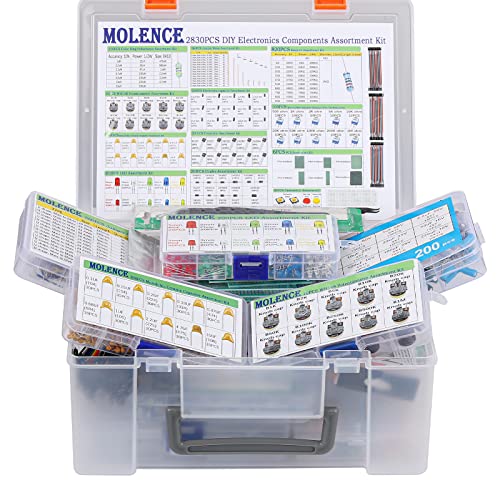
- Includes 2,830 components and prototyping supplies
- Compatible with Arduino, Raspberry Pi, PLC, and microcontrollers
- Packed in a reusable storage case
Best For: Beginners and microcontroller-based DIY projects
Compact Essentials
1390-Piece Electronics Component Kit

- Focuses on six core component categories
- Resistor values are stamped for easier identification
- Compact 6.42 x 4.61-inch package weighs 11.2 ounces
Best For: Compact benches and common through-hole replacement parts
Best for Breadboarding
1530-Piece Electronics Lab Starter Set

- Includes an 830-tie solderless breadboard
- Provides Dupont leads and pre-formed jumper wires
- Parts are organized by type and value in a sturdy case
Best For: Solderless prototyping, STEM learning, and microcontroller labs
Best Value Basics
1400-Piece Electronics Component Kit

- 1,400 parts across six common categories
- Labeled bags simplify sorting
- Good fit for basic Arduino and DIY work
Best For: Beginners and hobbyists needing common through-hole components
Broadest Component Mix
2200-Piece Electronics Assortment

- 2,200 parts in a wide category range
- Includes ICs, PCBs, switches, and potentiometers
- Packed in an 11 × 7 × 2.5-inch box
Best For: Makers wanting varied parts for electronics prototyping
Most Complete Starter Set
2300-Piece DIY Electronics Kit

- 2,300 parts plus breadboard and PCB
- Compartmented transparent storage box
- Includes jumpers, motors, speakers, and magnifier
Best For: Students and beginners building varied DIY circuits
Most Comprehensive Tester-Ready Kit
1870-Piece Component Assortment

- Large mix of resistors, capacitors, diodes, transistors, and LEDs
- Includes LCR-T4 component tester, IC box, and cutter
- Labeled bags help organize the broad assortment
Best For: Hobbyists who want extensive parts coverage and a tester
Best Breadboard Project Kit
1780-Piece DIY Electronics Set

- Includes two breadboards, jumper wires, and four PCBs
- Adds motor, speakers, buzzers, switches, and power jacks
- Categorized and marked parts support quick component selection
Best For: Beginners and makers building no-solder circuit projects
Best Organized Assortment
2038-Piece Component Storage Box

- Largest listed assortment with 2038 pieces in 16 categories
- Includes substantial resistor, capacitor, LED, and diode selections
- Plastic container and bagged parts simplify storage and retrieval
Best For: Users prioritizing quantity and organized component storage
Largest Assortment – 5228-Piece Component Box Kit
For shoppers seeking electronic component kits with storage case capacity, this XXXL assortment delivers 5,228 pieces across a broad mix of parts. It includes resistors, capacitors, semiconductors, LEDs, switches, connectors, prototyping supplies, and basic tools, though the large outer box is intended primarily for protection and storage rather than carrying.
Best For: Makers, repair work, and electronics benches that need a very broad starter inventory in one shipment.
Pros:
- Large 5,228-piece assortment spanning many common component categories.
- Includes useful extras such as a breadboard, solder, cutter, wires, PCBs, and terminals.
- Component groups are sorted into separate boxes.
Cons:
- The 15 x 11 x 4-inch outer box is not designed as a carrying case.
- At about 7.32 pounds, it is relatively bulky for portable use.
This is the quantity-focused option in the group. Choose it when variety and volume matter more than compact portability.
Arduino-Friendly Pick – 2830-Piece DIY Electronics Kit
This 2,830-piece kit is a practical choice among electronic component kits with storage case organization, combining through-hole parts, jumper leads, PCBs, a breadboard, and switches. Its stated compatibility with Arduino UNO, MEGA, Raspberry Pi, PLCs, and microcontrollers makes it suited to hands-on prototyping and learning.
Best For: Beginners, hobbyists, and gift buyers who want a reusable assortment for Arduino and microcontroller projects.
Pros:
- Includes 820 metal-film resistors, capacitors, transistors, inductors, LEDs, diodes, and adjustable resistors.
- Provides 560 jumper wires, 120 Dupont lines, six PCBs, a breadboard, and tactile switches.
- Components are packed in a reusable storage case for carrying and organization.
Cons:
- The supplied specifications identify component counts but not every individual value range.
- The kit is primarily a through-hole assortment, which may not suit projects requiring surface-mount parts.
Its balance of parts, wiring, and prototyping hardware makes this a well-rounded learning kit, especially if reusable organization and microcontroller compatibility are priorities.
Compact Essentials – 1390-Piece Electronics Component Kit
If you want electronic component kits with storage case convenience without a very large assortment, this 1,390-piece package focuses on six practical categories. The selection covers metal-film resistors, electrolytic and ceramic capacitors, common diodes, transistors, and LED diodes, with individual components packaged in plastic bags.
Best For: Electronics enthusiasts and professionals who need a compact supply of common through-hole components.
Pros:
- Includes 1,390 pieces across six core component categories.
- Resistor values are stamped, helping with identification.
- Compact package measures approximately 6.42 by 4.61 inches and weighs 11.2 ounces.
Cons:
- It does not include a breadboard, jumper wires, or other prototyping accessories in the supplied notes.
- The assortment is narrower than the larger kits in this roundup.
This is a space-conscious essentials kit rather than a complete prototyping station. It makes sense when common discrete parts are the priority and bench space is limited.
Best for Breadboarding – 1530-Piece Electronics Lab Starter Set
This 1,530-piece set stands out among electronic component kits with storage case organization by pairing clearly specified component ranges with a full-size 830-tie solderless breadboard. It also includes Dupont leads and pre-formed jumpers, making it ready for no-solder experiments with Arduino, Raspberry Pi, ESP32, and similar platforms.
Best For: Beginners, STEM classrooms, and makers who want to start breadboard projects immediately.
Pros:
- Includes 600 resistors, 300 ceramic capacitors, 120 electrolytics, 104 LEDs, 100 diodes, and 180 transistors.
- Full-size breadboard, 60 Dupont leads, and 65 pre-formed jumpers support quick prototyping.
- Parts are bagged or arranged by value and packed in a sturdy storage case.
Cons:
- The assortment is smaller than the 2,830- and 5,228-piece kits.
- Users must observe polarity for electrolytic capacitors and diodes and handle static-sensitive components appropriately.
Detailed value ranges and project-oriented accessories make this the most immediately usable option for learning circuits and iterating on solderless breadboard designs.
Best Value Basics – 1400-Piece Electronics Component Kit
For a straightforward set of electronic component kits with storage case needs, this 1,400-piece assortment covers several common through-hole parts. It includes LEDs, metal film resistors, electrolytic and ceramic capacitors, common diodes, and transistors, with each type packaged separately and identified with sticky notes.
Best For: Beginners, hobbyists, and Arduino or DIY projects that mainly require common discrete components.
Pros:
- Includes 1,400 components across six common categories.
- Individually bagged and labeled for easier sorting and identification.
- Through-hole parts suit many basic prototypes and learning projects.
- Components are tested for stability, consistency, and reliability according to the supplied notes.
Cons:
- The assortment is limited to six component types.
- The supplied packaging is described as plastic bags rather than a compartmented storage case.
- No breadboard, PCB, IC, or jumper-wire accessories are listed.
This is a practical, budget-oriented choice when you want a large supply of foundational parts and simple labeling matters more than having a broad prototyping toolbox.
Broadest Component Mix – 2200-Piece Electronics Assortment
This 2,200-piece assortment is aimed at shoppers who want electronic component kits with storage case organization and a wider parts mix. The recyclable box contains resistors, transistors, diodes, zeners, inductors, ICs, LEDs, switches, potentiometers, optoelectronic parts, connectors, PCBs, and other commonly used items.
Best For: Makers and experienced hobbyists who want a broad selection of components in one organized box.
Pros:
- Offers 2,200 components with a notably broad category range.
- Includes ICs, PCBs, inductors, crystals, switches, potentiometers, and LDRs in addition to basic parts.
- Comes in an 11 × 7 × 2.5-inch recyclable box.
- Uses through-hole mounting components for hands-on prototyping.
Cons:
- The supplied notes do not specify the exact quantity of each component type.
- The box may be less comprehensive for projects requiring specialized or surface-mount parts.
- Its broad assortment may include parts you do not use frequently.
Choose this kit if variety is the priority. It provides more component categories than a basic capacitor-and-resistor assortment, while the included box keeps the collection together for workshop use.
Most Complete Starter Set – 2300-Piece DIY Electronics Kit
Among electronic component kits with storage case features, this 2,300-piece set is the most expansive option for learning and hands-on prototyping. Its large transparent box has multiple small compartments, while the contents extend beyond components to include a breadboard, PCB, jumper kit, USB port, DC power jack, motor, speakers, and a 30X magnifying glass.
Best For: Beginners, students, and DIY learners who want components and basic project accessories in one box.
Pros:
- Includes 2,300 pieces spanning capacitors, LEDs, diodes, resistors, ICs, potentiometers, and more.
- Adds breadboards, PCBs, jumpers, terminals, switches, buzzers, motors, and speakers.
- Transparent compartmented storage helps keep small parts separated and visible.
- The included 30X magnifying glass can help with reading component markings.
Cons:
- The large assortment may be more than needed for simple electronics repairs.
- The supplied notes do not give a detailed count for each component category.
- Its 3.34-pound box is less portable than a smaller basic kit.
This is the strongest all-in-one choice for structured learning and varied DIY builds. The compartmented box and included prototype accessories make it especially useful when starting a project collection from scratch.
Most Comprehensive Tester-Ready Kit – 1870-Piece Component Assortment
If you want electronic component kits with storage case-style organization plus a testing tool, this 1,870-piece assortment offers broad through-hole coverage in a stable cardboard box. It includes labeled, individually bagged components, an LCR-T4 component tester, an IC box, and a cutter.
Best For: Hobbyists and learners who want a large assortment with an included component tester for identifying or checking parts.
Pros:
- Includes 760 resistors, 380 capacitors, 170 transistors, 100 diodes, 125 Zener diodes, and 200 LEDs.
- Adds practical project parts such as potentiometers, PCBs, headers, terminals, photoresistors, and ICs.
- Includes an LCR-T4 tester, IC box, cutter, and labeled component bags.
Cons:
- The assortment is supplied in a cardboard box rather than a dedicated compartmented case.
- The listed components are primarily through-hole mount parts.
This is a strong choice when quantity and variety matter most, especially if the included tester can reduce guesswork while sorting through parts.
Best Breadboard Project Kit – 1780-Piece DIY Electronics Set
For hands-on circuit building, this 1,780-piece option combines common electronic components with breadboards, jumper wires, PCBs, and project accessories. The categorized, clearly marked packaging makes it a practical pick among electronic component kits with storage case organization for learning and prototyping.
Best For: Beginners, students, and makers who want to build and test circuits without soldering.
Pros:
- Includes two breadboards, 140 jumper wires, Dupont wires, four PCBs, and headers.
- Offers a broad selection of resistors, capacitors, LEDs, transistors, diodes, potentiometers, and photoresistors.
- Adds interactive project parts including a motor, speakers, buzzers, switches, power jacks, and crystal oscillators.
Cons:
- The listing identifies categorized packaging but does not specify a dedicated hard storage case.
- Component quantities vary widely, so some project parts may be limited.
Its breadboards and wiring make this the most immediately project-ready choice of the three, particularly for experimenting with circuits before committing to soldering.
Best Organized Assortment – 2038-Piece Component Storage Box
This 2,038-piece assortment is a good fit if organized storage is your priority. Each component type is packaged in a plastic bag and placed in a plastic container, while the 16-category mix covers common resistors, capacitors, diodes, transistors, LEDs, ICs, and related parts.
Best For: Electronics enthusiasts and professionals who want a high-count assortment arranged for storage and compatibility with Arduino, Raspberry Pi, PLC, and similar projects.
Pros:
- Provides 2,038 pieces across 16 component categories.
- Includes 820 metal film resistors, 300 ceramic capacitors, 205 LEDs, 190 transistors, and 140 Zener diodes.
- Plastic-bag packaging and a plastic container make parts easier to store and retrieve.
Cons:
- The assortment is specified for through-hole mounting rather than surface-mount work.
- Some categories have small quantities, such as four PCBs and five terminals.
Choose this kit when a high piece count and straightforward storage matter more than included testing equipment or breadboard accessories.
How We Picked These Electronic Component Kits with Storage Cases
We focused on kits that combine a broad selection of commonly used parts with a case, box, or organized compartment system. The selection spans roughly 1,390 to 5,228 pieces and includes combinations of resistors, capacitors, LEDs, diodes, transistors, potentiometers, integrated circuits, inductors, regulators, breadboards, jumper wires, and basic tools.
Because advertised piece counts can include large quantities of small, inexpensive parts, we considered practical usefulness rather than count alone. A good kit should offer component variety, sensible organization, readable labeling, and enough duplicate parts for learning, prototyping, and troubleshooting.
Quick Comparison
- Best for maximum variety: Choose one of the largest assortments, particularly those with more than 2,000 pieces and a broad mix of active and passive components.
- Best for beginners: Look for a starter set that includes a breadboard, jumper wires, LEDs, resistors, capacitors, and basic circuit components.
- Best for bench organization: Prioritize a sturdy case with labeled compartments or removable containers rather than the highest advertised piece count.
- Best for testing components: Consider kits that include an LCR-T4 or similar tester, especially if you repair circuits or identify unknown parts.
Key Buying Factors for Electronic Component Kits with Storage Case
Component Mix and Useful Quantities
Check whether the kit includes the values you are most likely to use. Resistor and capacitor ranges matter more than a headline piece count, while transistors, diodes, regulators, ICs, and potentiometers add flexibility for active circuits. For Arduino, Raspberry Pi, and general prototyping, LEDs, jumper wires, headers, and a breadboard are particularly useful.
Storage Design and Labeling
A case should protect components while making them easy to identify. Individual compartments, printed labels, resealable bags, or removable trays can prevent small parts from becoming a mixed pile. Confirm that the case closes securely and has enough room for replacement parts as your collection grows.
Included Tools and Accessories
Some kits add cutters, magnifiers, testers, PCBs, breadboards, or Dupont wires. These extras can improve value, but do not treat them as a substitute for missing core components. Verify whether a listed accessory is included in the package and whether quantities are counted individually or by package.
Accuracy and Documentation
Clear value labels and a component chart reduce setup time and help prevent wiring mistakes. If you need dependable tolerances or exact electrical ratings, use a multimeter and check individual parts rather than assuming every component matches a professional laboratory supplier’s specifications.
Who Should Buy Which Electronic Component Kits with Storage Case?
Students and first-time builders should choose a balanced kit with a breadboard, jumper wires, LEDs, resistors, capacitors, and straightforward labeling. Hobbyists may benefit from a larger assortment with ICs, transistors, regulators, inductors, potentiometers, and duplicate values. Repairers and experimenters should prioritize broad value coverage, a tester, and durable storage. If you already own tools and wiring, spend more on component variety and organization rather than accessories. Finally, confirm the case size and inventory before buying: the most useful kit is the one that fits your projects and remains easy to maintain.