Accurate holes are easier to produce when your drill press matches the material, bit size, and repeatability your projects require. This roundup compares 10 options, from compact micro-drilling machines to full-featured benchtop models.
Use the buying guide below to compare speed control, spindle travel, worktable adjustment, chuck capacity, and positioning features before choosing a press for your workshop.
Best 10 Drill Presses for Precision Picks for 2026
Compact Precision Pick

- Compact metal benchtop design
- Up to 7,000 RPM with adjustable power
- Includes vise and 10 HSS bits
Best For: Small DIY, model, jewelry, and repair projects
Portable Precision Pick

- Guides straight and angled holes
- Self-centers on round stock up to 3 inches
- All-metal, portable drill attachment
Best For: On-site and varied-shape drilling with a cordless drill
Versatile Benchtop Pick

- 6.2-amp induction motor
- Five speeds from 610 to 2,800 RPM
- Laser, depth stop, and tilting table
Best For: General home-workshop drilling in wood and metal
Micro-Work Precision Pick

- Drills micro holes down to 1/64 inch
- Includes six precision collets
- Fence and depth gauge support repeatability
Best For: Detailed hobby, model, and micro-drilling projects
Best for Easy Setup
Mini Precision Benchtop Drill Press

- 400–4500 RPM variable-speed control
- Stable aluminum-alloy body and solid base
- Designed for small holes in non-hard materials
Best For: Jewelry, crafts, and light DIY drilling
Versatile Workshop Choice
VEVOR 8 in Benchtop Drill Press

- Five speeds from 750 to 3200 RPM
- 2-inch spindle travel with adjustable depth stop
- 45-degree tilting worktable and LED light
Best For: General home woodworking and metalworking
Powerful Digital-Control Pick
710W Variable-Speed Benchtop Drill Press

- 710W motor with 800–3000 RPM adjustment
- Digital display provides real-time RPM feedback
- 1–13 mm chuck range and 60 mm spindle travel
Best For: DIY users drilling wood, metal, and plastic
Best Micro-Drilling Pick
Precision Mini Drill Press with X-Y Table
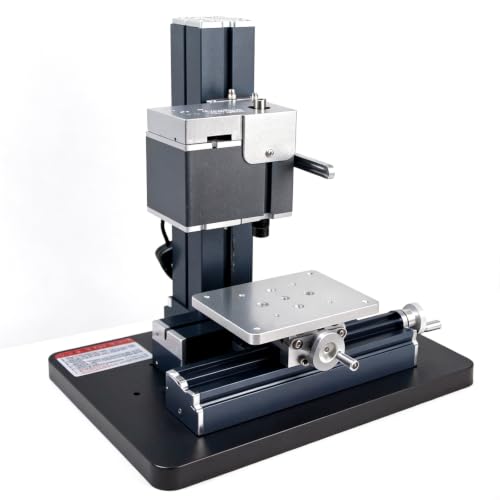
- X-Y-Z positioning with 0.02 mm handwheel graduations
- 20,000 RPM motor and 1–6 mm chuck for micro-drilling
- All-metal benchtop construction with dual feed controls
Best For: PCB work, models, and small detailed parts
Best Variable-Speed Value
Hoteche Mini Benchtop Drill Press

- Three speed settings from 0 to 5,000 RPM
- 100W motor with a keyed 0.6–6.5 mm chuck
- 170 × 170 mm table and 23 mm spindle travel
Best For: Light DIY drilling across wood, plastic, PCB, and steel
Best Compact Multi-Speed Option
Mini Precision Benchtop Drill Press

- Three adjustable ranges reaching up to 12,000 RPM
- Cast iron base and full copper wire motor
- 10 mm chuck for crafts and softer materials
Best For: Jewelry, crafts, and compact DIY work
Compact Precision Pick – Mini B10 Drill Press
For small-scale projects, this compact benchtop machine is one of the more space-conscious drill presses for precision. Its metal structure, adjustable 24V power supply, and 40mm maximum stroke are suited to controlled drilling in softer materials and detailed DIY work.
Best For: Home users, jewelry and model projects, and drilling wood, plastic, resin, aluminum, or other soft materials.
Pros:
- Compact 5.9-by-4.7-by-8.7-inch design with low-noise operation
- Adjustable speed reaches up to 7,000 RPM
- Includes a mini vise and 10-piece HSS drill-bit set
- Base slots support a mini vise or CNC sliding table
Cons:
- Limited to a 40mm drilling stroke
- Accepts drill bits from 0.6mm to 6mm
- Designed for softer materials rather than heavy-duty drilling
This is a practical choice when bench space is limited and fine control matters more than capacity. The small chuck range and short stroke define its use, but the included accessories make it ready for detailed hobby work.
Portable Precision Pick – Milescraft DrillMate
If you need drill presses for precision without dedicating space to a stationary machine, the Milescraft DrillMate offers a portable alternative. It guides compatible cordless drills for repeatable straight or angled holes on boards, walls, edges, and round stock.
Best For: DIYers who want guided drilling in varied locations and on stock up to 3 inches in diameter.
Pros:
- Supports 45, 60, 75, and 90-degree drilling angles
- Self-centering base accommodates round stock up to 3 inches
- All-metal construction with high-tolerance guide bushings
- Can be mounted to create a custom jig
Cons:
- Requires a compatible 3/8-inch or 1/2-inch cordless drill
- Hand-powered design is not a standalone drill press
- Listed drilling capacity is 0.38 inches for wood and metal
The DrillMate is best viewed as a flexible drill-guide system rather than a replacement for a powered benchtop press. Its angle settings, self-centering base, and portable format make repeatable positioning easier where a full machine is impractical.
Versatile Benchtop Pick – SKIL 10-Inch Drill Press
SKIL 6.2 Amp 10 In. 5-Speed Benchtop Drill Press with Laser Alignment & Work Light - DP9505-00
Check Price On AmazonFor general workshop use, this SKIL model combines a 6.2-amp induction motor with features that support drill presses for precision. Its five speed settings, laser alignment system, adjustable depth stop, and tilting work surface help adapt the machine to different materials and drilling tasks.
Best For: Home workshops needing a full-size benchtop press for wood, metal, and angled drilling.
Pros:
- Five speeds from 610 to 2,800 RPM
- Laser alignment system helps position holes accurately
- Adjustable depth stop supports consistent drilling depth
- Work surface tilts 45 degrees left and right
Cons:
- Maximum chuck size is 1/2 inch
- Heavier and less portable than compact drill guides
- Included components are limited to the press, hex wrench, and chuck key
This is the strongest all-around option in the group for conventional bench work. The motor and adjustable table provide broader workshop utility, while the laser and depth stop add useful positioning and repeatability.
Micro-Work Precision Pick – PROXXON TBM 115
For miniature work, the PROXXON TBM 115 is purpose-built among drill presses for precision. It can drill holes down to 1/64 inch, and its depth gauge, parallel fence, three speed selections, and included precision collet set support detailed, controlled projects.
Best For: Hobbyists working on micro holes, intricate models, electronics-related projects, and other detailed bench tasks.
Pros:
- Micro-hole capability down to 1/64 inch or 0.5mm
- Includes six precision collets
- Adjustable parallel fence and depth gauge improve repeatability
- Ribbed die-cast aluminum table and hard-chromed steel column provide stability
Cons:
- Three speed selections offer less adjustment than continuously variable systems
- Its 85-watt motor is oriented toward detailed work rather than heavy drilling
- Listed wood and metal drilling capacity is 0.5mm
The TBM 115 stands out when small hole sizes and controlled positioning are the priority. Its collets and precision-focused adjustments make it well suited to delicate work, but its stated capacity points to micro-projects rather than general construction tasks.
Best for Easy Setup – Mini Precision Benchtop Drill Press
If you need drill presses for precision work on small, non-hard materials, this compact benchtop model offers a practical setup. Its 400–4500 RPM variable-speed range, solid aluminum-alloy body, and thickened base are suited to careful drilling in wood, plastic, resin, aluminum, and composite panels.
Best For: Small DIY projects, jewelry work, crafts, and light drilling in wood, plastic, resin, and soft metal.
Pros:
- Continuously variable speed from 400 to 4500 RPM.
- Solid, CNC-processed construction with a stable, non-skid base.
- Compact design with a 0.5-inch chuck and 12V operation.
Cons:
- Limited drilling capacity: up to 4 mm in wood and 3 mm in metal.
- Recommended for non-hard materials and light-duty applications.
- Requires a suitable 12V/5A power supply.
This is a niche precision tool rather than a general-purpose workshop press. Choose it when compact size and fine control matter more than large-hole capacity or heavy-duty power.
Versatile Workshop Choice – VEVOR 8 in Benchtop Drill Press
For shoppers comparing drill presses for precision across common workshop materials, the VEVOR 8-inch model combines five selectable speeds with useful alignment features. Its adjustable depth stop, 2-inch spindle travel, tilting worktable, and LED light support accurate drilling in wood and metal.
Best For: General benchtop woodworking and metalworking where adjustable speed, depth control, and worktable positioning are useful.
Pros:
- Five speeds from 750 to 3200 RPM for varied materials and tasks.
- Adjustable depth stop and 2-inch spindle travel support repeatable holes.
- Worktable adjusts in height and tilts up to 45 degrees.
- Integrated LED work light improves visibility in dim areas.
Cons:
- Speed changes require belt adjustment rather than electronic control.
- Maximum chuck and stated drilling capacity are limited to 1/2 inch.
- At 25.4 pounds, it requires a dedicated, stable benchtop space.
With more capacity and adjustability than a miniature craft press, this VEVOR model is a balanced choice for a home workshop. Its mechanical speed changes are less convenient than a dial, but the depth stop and tilting table add practical precision.
Powerful Digital-Control Pick – 710W Variable-Speed Benchtop Drill Press
If you want drill presses for precision with more motor output and easy speed monitoring, this benchtop model provides a digital RPM display and adjustable 800–3000 RPM control. Its 13 mm clamping range, 60 mm spindle travel, and compact metal construction suit DIY woodworking, metalworking, and plastic drilling.
Best For: DIY users who want a compact press with a powerful motor, digital speed feedback, and broad chuck compatibility.
Pros:
- 710W pure copper motor provides substantial power for DIY tasks.
- Digital display shows real-time RPM for easier speed control.
- 1–13 mm clamping range accommodates a variety of bits.
- Compact benchtop design includes variable speed and a depth stop.
Cons:
- Maximum speed is 3000 RPM, lower than some small precision presses.
- Stated metal drilling capacity is 0.5 inch.
- At 19.2 inches tall, it still needs adequate bench clearance.
This model stands out when motor power and visible RPM feedback are priorities. It offers a useful middle ground between a small craft press and a larger workshop machine, though its capacity remains oriented toward DIY-scale work.
Best Micro-Drilling Pick – Precision Mini Drill Press with X-Y Table
For drill presses for precision work, this compact model stands out with dedicated X-Y-Z positioning and fine handwheel graduations. Its 36W motor reaches 20,000 RPM, while the 1–6 mm chuck suits small holes in PCB materials, models, acrylic, plastic, wood, and soft metals.
Best For: PCB work, models, small parts, and detailed hobby projects requiring repeatable positioning.
Pros:
- X travel is 145 mm, with 40 mm Y and Z travel for repositioning workpieces without repeated clamping.
- 0.02 mm handwheel graduations support fine, incremental depth and table adjustments.
- All-metal construction, dovetail slides, and anti-loosening hardware help reduce vibration-related play.
- Compact 12V benchtop design with dual swing-arm and handwheel feed controls.
Cons:
- The 1–6 mm chuck and 6 mm stated capacities limit it to small-scale drilling.
- Its single-speed design offers less material-specific adjustment than variable-speed models.
- The small 120 × 100 mm table is intended for compact workpieces.
This is the most specialized option here for precision layouts and micro-drilling. Choose it when accurate positioning and fine control matter more than drilling large holes or handling larger stock.
Best Variable-Speed Value – Hoteche Mini Benchtop Drill Press
This Hoteche model is a practical choice among drill presses for precision when you need adjustable speeds for different materials. Its three settings cover 0–2,200, 3,300, and 5,000 RPM, and the keyed 0.6–6.5 mm chuck provides a secure grip for small drill bits.
Best For: DIYers drilling wood, plastic, PCB materials, and light steel on a compact benchtop machine.
Pros:
- Three variable-speed settings provide more flexibility across wood, plastic, PCB work, and steel.
- The 100W motor offers practical power for hobby and DIY projects.
- Its 170 × 170 mm table gives more work surface than a micro-sized precision platform.
- 23 mm spindle travel supports controlled drilling depth, and the keyed chuck promotes bit stability.
Cons:
- Stated capacities are limited to 10 mm in wood and 5 mm in metal.
- The 1/4-inch maximum chuck size is not intended for large bits.
- Only three speed settings are provided rather than continuously adjustable control.
With a useful combination of speed selection, a 100W motor, and a reasonably sized table, this is a balanced option for general hobby precision. It is better suited to light-duty work than demanding metal fabrication.
Best Compact Multi-Speed Option – Mini Precision Benchtop Drill Press
For shoppers comparing drill presses for precision in a small workshop, this compact benchtop machine combines a cast iron base with three adjustable speed ranges. It is designed primarily for wood, plastic, resin, aluminum, composite board, and other non-rigid materials, with a chuck supporting bits up to 10 mm.
Best For: Jewelry making, crafts, furniture-related DIY, and drilling vertical or angled holes in softer materials.
Pros:
- Three speed ranges extend from 1,800 to 12,000 RPM, allowing material-specific adjustment.
- A full copper wire motor and cast iron base are intended to support smooth operation and durability.
- Compact desktop construction saves workbench space while using a handle-driven feed.
- Includes a collet key, Allen wrenches, carbon brushes, replacement belt, and English manual.
Cons:
- The supplied notes emphasize non-rigid materials rather than heavy-duty metal drilling.
- Its stated metal drilling capacity is only 0.24 inch.
- Speed ranges overlap and are adjusted in three broad settings rather than with continuous control.
This model offers more motor power and a larger chuck than the other compact choices, while retaining a space-saving footprint. It makes the most sense for craft and DIY users who value speed flexibility but do not need an industrial-scale press.
How We Picked the Best Drill Presses for Precision
We focused on features that directly affect drilling accuracy and repeatability: variable-speed control, stable benchtop construction, useful spindle travel, adjustable tables, reliable depth stops, and compatibility with common drill-bit sizes. We also included portable drill guides and compact micro presses because precision work does not always require a full-size machine.
The selection covers several use cases, including woodworking, light metalworking, jewelry and craft projects, electronics enclosures, and general DIY repairs. Product specifications can vary by seller and revision, so confirm the listed chuck range, motor power, speed settings, and included accessories before ordering.
Quick Comparison
| Type | Best suited for | Features to prioritize |
|---|---|---|
| Portable drill guide | Occasional repairs and field work | Stable base, alignment controls, compatible drill size |
| Mini or micro benchtop press | Crafts, electronics, jewelry, and small parts | Low runout, fine feed control, compact footprint |
| Standard benchtop press | Woodworking, DIY, and light fabrication | Motor power, speed range, table adjustment, depth stop |
| X-Y table press | Repeatable hole placement | Cross-axis movement, locking controls, rigid table |
Key Buying Factors for Drill Presses for Precision
Speed and Motor Control
Choose multiple speed settings or variable-speed control when working with different materials and bit diameters. Lower speeds generally suit larger bits and metal, while higher speeds are useful for small bits, plastics, wood, and delicate craft work. A motor should provide consistent power without excessive vibration.
Spindle Travel and Depth Control
Spindle travel determines how deeply the machine can drill in one operation. A depth stop is especially valuable for repeated holes, countersinking, and production-style tasks. For small components, a smooth handwheel or quill feed can matter more than maximum travel.
Table and Positioning Accuracy
A rigid, adjustable table helps keep the workpiece square to the bit. Tilting tables are useful for angled holes, while an X-Y positioning table makes it easier to move small parts precisely without repositioning the entire setup. Locking adjustments reduce movement during drilling.
Chuck Range, Runout, and Stability
Check that the chuck accepts the bits you plan to use. Micro presses may favor small shanks, while general-purpose models offer broader ranges. Low runout, a sturdy column, and a stable base help prevent wandering holes and uneven finishes. Clamp small or irregular workpieces rather than holding them by hand.
Who Should Buy Which Drill Presses for Precision?
Choose a portable drill guide if you need occasional alignment help with a handheld drill or must work away from a bench. Choose a mini or micro press for small parts, model-making, electronics, jewelry, and other light-duty tasks where compact control is more important than capacity.
Choose a standard benchtop drill press for the broadest DIY and woodworking capability, especially when you need more power, larger bits, or deeper holes. Choose an X-Y table model when precise hole placement and repeatability are central to your work. Before buying, also verify bench space, noise expectations, available electrical power, and whether clamps or vises are included.