The best compact mechanical keyboards save desk space without forcing you to give up responsive switches, useful navigation keys, or modern connectivity. This roundup compares 10 standout options across 60%, 65%, and 75% layouts.
Whether you want a wireless work keyboard, a customizable gaming board, or an affordable starter model, use the buying guide below to match layout, switches, features, and budget to your setup.
Best 10 Compact Mechanical Keyboards Picks for 2026
Best Customizable Pick

- Tri-mode wireless and wired connectivity
- Hot-swappable 3-pin/5-pin switch support
- 75% layout with knob and RGB lighting
Best For: Gamers and keyboard enthusiasts seeking wireless customization
Best Low-Profile Option

- Ultra-slim 75% wireless design
- Bluetooth 5.1 for three devices
- QMK remapping with Mac and Windows support
Best For: Productivity users who want a slim cross-platform keyboard
Best Budget Space-Saver

- Compact 68-key 65% layout
- Detachable Type-C wired connection
- Mechanical-style feel with LED backlighting
Best For: Budget users wanting a small wired gaming keyboard
Best Gasket-Mount Value

- Tri-mode wireless and USB-C connectivity
- Gasket mount with five-layer dampening
- Hot-swappable sockets and control knob
Best For: Users wanting a cushioned, customizable wireless gaming keyboard
Best Space-Saving Wired Pick
MageGee MK-Box 60% Mechanical Keyboard

- 68-key compact layout with arrow keys
- Smooth linear red switches
- Blue backlighting with about 16 modes
Best For: Portable wired gaming and work setups
Best Quiet Wireless Option
Womier DK75 75% Wireless Keyboard
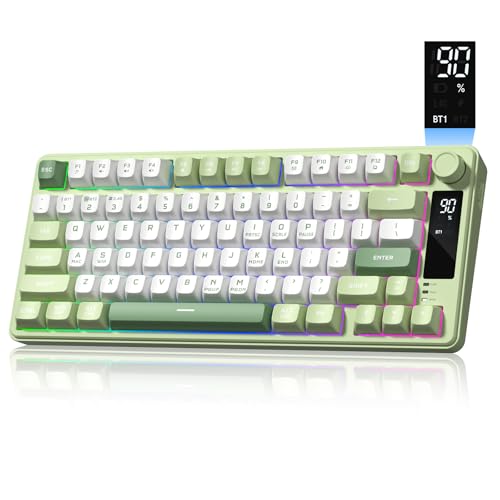
- Tri-mode Bluetooth, 2.4GHz, and USB-C connectivity
- Quiet membrane switches for shared spaces
- 4000mAh battery with RGB lighting
Best For: Quiet multi-device work and gaming
Best for Adjustable Gaming Response

- Hall Effect switches with adjustable actuation
- 8000Hz polling and 0.3ms stated latency
- Windows driver for macros and key customization
Best For: Competitive Windows PC gaming
Best Wireless Custom Pick

- Tri-mode connectivity with up to five devices
- Hot-swappable 75% layout with 4000mAh battery
- RGB, macros, sound dampening, and control knob
Best For: Gamers and multitaskers wanting a versatile wireless keyboard
Best Wired Value

- 81-key 75% layout with CNC aluminum volume roller
- Gasket mount and layered sound absorption
- Hot-swappable switches with PBT MDA keycaps
Best For: Fixed gaming or workstations that prefer wired simplicity
Best Multi-Device Typing Pick

- 85-key layout with tri-mode connectivity
- 4000mAh battery and three Bluetooth channels
- Gasket mount, hot-swap support, and mellow thocky sound
Best For: Hybrid users switching among computers, tablets, and consoles
Best Customizable Pick – AULA F75 Pro
The AULA F75 Pro is a strong option for shoppers comparing compact mechanical keyboards with flexible connectivity and extensive customization. Its 75% layout keeps arrow keys and a control knob while freeing desk space, and its hot-swappable design supports both 3-pin and 5-pin switches.
Best For: Gamers and enthusiasts who want a customizable wireless keyboard with RGB lighting, a knob, and a softer, dampened typing feel.
Pros:
- Tri-mode Bluetooth 5.0, 2.4GHz, and USB-C connectivity supports up to five devices.
- Hot-swappable PCB accepts 3-pin or 5-pin switches without soldering.
- 81-key 75% layout retains arrow keys while saving desktop space.
- 4000mAh battery, RGB lighting, macro support, and a multifunction knob add versatility.
Cons:
- Its 75% footprint is larger than a 65% or ultra-slim keyboard.
- Some customization features require the F75 driver.
Choose the F75 Pro if you want compact mechanical keyboards to offer more than basic portability. It combines wireless flexibility, enthusiast-friendly switch swapping, and built-in controls in a feature-rich layout.
Best Low-Profile Option – Keychron K3 Version 2
The Keychron K3 Version 2 suits buyers who prioritize a slim, travel-friendly design among compact mechanical keyboards. Its 75% layout provides dedicated arrow keys and Mac multimedia controls, while Bluetooth 5.1 and USB-C support make it practical across computers and mobile devices.
Best For: Mac and Windows users who want an ultra-slim wireless keyboard for productivity, travel, and everyday multitasking.
Pros:
- Ultra-slim 75% layout measures 0.87 inches high and weighs about 500 g.
- Bluetooth 5.1 connects with up to three devices, with USB-C wired support.
- QMK firmware and Keychron Launcher enable remapping, macros, and shortcuts.
- Includes Mac and Windows keycaps and a white backlight.
Cons:
- It uses a single-color white backlight rather than RGB.
- It is not water resistant.
The K3 is a sensible fit when a low-profile build matters more than elaborate lighting or a full enthusiast-style construction. Its cross-platform layout and programmable controls make it especially useful for productivity setups.
Best Budget Space-Saver – GEODMAER 65% Gaming Keyboard
The GEODMAER GM68 is aimed at shoppers who want the compact footprint of compact mechanical keyboards without paying for a true mechanical switch platform. Its 65% wired layout includes separate arrow keys, LED backlighting, and a detachable Type-C cable in a portable form.
Best For: Budget-conscious gamers and office users who prefer a small, dependable wired keyboard with mechanical-style feedback.
Pros:
- 65% 68-key layout saves desk space and fits easily in a backpack.
- Detachable Type-C wired connection provides a stable, low-latency connection.
- Backlighting offers always-on and breathing modes with adjustable brightness.
- Rated for more than 10 million keystrokes and includes 11 media buttons.
Cons:
- It uses membrane technology rather than actual mechanical switches.
- Wired connectivity does not provide wireless flexibility.
- The plastic enclosure is less premium than an aluminum-bodied keyboard.
The GM68 makes the most sense for buyers who value size, price, and straightforward wired performance. It delivers mechanical-style feel and gaming-oriented features, but it should not be treated as a fully mechanical keyboard.
Best Gasket-Mount Value – Redragon K673 Pro
The Redragon K673 Pro is a compelling choice among compact mechanical keyboards for users who want a cushioned typing experience and wireless flexibility. Its 81-key layout, gasket-mounted construction, tri-mode connectivity, and control knob combine practical everyday features with gaming-focused customization.
Best For: Gamers and everyday users who want a compact wireless keyboard with dampened acoustics, RGB lighting, and switch-swapping support.
Pros:
- Tri-mode USB-C, Bluetooth, and 2.4GHz connectivity supports switching between devices.
- Gasket construction and five-layer dampening provide a softer, quieter typing feel.
- Upgraded sockets accept most 3-pin and 5-pin switches.
- Multifunction knob controls lighting brightness and media playback.
Cons:
- The listed compatible operating system is Windows 11.
- Its 81-key layout is less compact than a 65% board.
The K673 Pro is well suited to buyers who want a comfortable, feature-rich compact board without giving up wireless connectivity. Its gasket design and hot-swappable sockets make it more adaptable than a basic gaming keyboard.
Best Space-Saving Wired Pick – MageGee MK-Box 60% Mechanical Keyboard
If you want compact mechanical keyboards for gaming or everyday work without giving up dedicated arrow keys, the MageGee MK-Box offers a practical 68-key layout. Its linear red switches, detachable USB cable, and small footprint suit straightforward wired setups.
Best For: Gamers, students, and office users who want a portable wired keyboard with dedicated arrow keys and function-row access.
Pros:
- 68-key compact layout retains arrow keys and F1-F12 access through the layout and function controls.
- Linear red switches provide smooth, low-resistance keystrokes without a tactile bump.
- Blue backlighting offers about 16 lighting modes with adjustable brightness and speed.
- USB plug-and-play compatibility includes Windows, Linux, and Mac systems.
Cons:
- Wired USB connectivity may be less convenient than a wireless keyboard.
- Blue single-color lighting is less customizable than full RGB backlighting.
- Linear switches may not suit users who prefer tactile feedback.
The MK-Box is a sensible value-oriented choice when desk space and portability matter more than wireless features or advanced software customization. Its 68-key arrangement balances compactness with useful navigation controls.
Best Quiet Wireless Option – Womier DK75 75% Wireless Keyboard
Among compact mechanical keyboards, the Womier DK75 is a flexible choice for users who value quiet typing and wireless convenience. Although it uses silent membrane switches rather than mechanical switches, its 75% layout, tri-mode connectivity, and built-in controls make it useful for work, gaming, and travel.
Best For: Shared offices, libraries, students, and users who want a quiet multi-device keyboard with wireless connectivity.
Pros:
- Supports Bluetooth 5.0, 2.4GHz wireless, and USB-C wired modes.
- Silent membrane switches provide cushioned, low-noise typing.
- RGB lighting includes 15 effects, seven colors, and adjustable brightness and speed.
- 4000mAh rechargeable battery, screen, rotary knob, and PBT keycaps add everyday convenience.
Cons:
- It uses membrane switches, so it may not satisfy buyers specifically seeking a mechanical feel.
- The supplied details list compatibility primarily with Windows systems.
- It is not water resistant.
The DK75 stands out for quiet operation and connection flexibility rather than mechanical switch performance. Choose it when a clean, low-noise desk setup and multi-device use are higher priorities than traditional mechanical feedback.
Best for Adjustable Gaming Response – AULA WIN68 HE 60% Keyboard
For competitive gaming, the AULA WIN68 HE is one of the more performance-focused compact mechanical keyboards in this selection. Its Hall Effect magnetic switches support adjustable actuation, while the 8000Hz polling rate, wired USB-C connection, and Windows web driver target users who want detailed control.
Best For: Competitive PC gamers and Windows users who want adjustable actuation, rapid triggering, and programmable controls.
Pros:
- Hall Effect switches offer adjustable actuation from 0.02mm to 3.44mm.
- 8000Hz polling and stated 0.3ms latency target fast in-game response.
- Windows web driver supports key mapping, macros, RGB, RT, SOCD, DKS, and other settings.
- Compact 68-key layout saves desk space while retaining arrow keys and basic function access.
Cons:
- The customization driver supports Windows but not Mac.
- It is wired only, with no Bluetooth or 2.4GHz wireless mode listed.
- Advanced settings may be unnecessary for casual typists or basic office use.
The WIN68 HE is best viewed as a specialized gaming keyboard rather than a general-purpose compact board. Its adjustable magnetic switches and extensive Windows customization are compelling for players who will actively tune the controls.
Best Wireless Custom Pick – AULA F75
The AULA F75 is a strong option for shoppers comparing compact mechanical keyboards that combine wireless flexibility with a space-saving layout. Its 75% design keeps arrow keys, an 81-key arrangement, RGB lighting, and a multifunction knob while leaving more room on the desk.
Best For: Gamers and multitaskers who want tri-mode connectivity, extensive customization, and a large rechargeable battery.
Pros:
- Supports Bluetooth 5.0, 2.4GHz wireless, and USB wired connections, with up to five devices.
- Hot-swappable PCB accepts 3-pin and 5-pin switches without soldering.
- 4000mAh battery, pre-lubricated switches and stabilizers, and five-layer sound dampening support a smoother, quieter feel.
- Includes RGB effects, programmable macros, N-key rollover, and a mode-switching control knob.
Cons:
- The 75% layout does not include a dedicated number pad.
- Macro customization and music-reactive lighting require the driver.
- The many lighting and connection features may be more than a basic office setup needs.
Choose the F75 if you want one compact mechanical keyboard for gaming, office work, and multiple devices. Its wireless modes and customization options make it especially versatile, while the missing number pad may matter for frequent data entry.
Best Wired Value – RK ROYAL KLUDGE R75
The RK ROYAL KLUDGE R75 is a practical choice among compact mechanical keyboards for users who prefer a simple USB-C connection. Its 75% layout preserves arrow and function keys, while the aluminum volume roller adds convenient media control without taking much desk space.
Best For: Wired gaming and productivity setups that prioritize quick linear switches, a volume knob, and a tuned typing feel.
Pros:
- 81-key 75% layout retains essential navigation and function keys.
- Gasket mount and layered PORON, IXPE, and case foam help reduce vibration and unwanted resonance.
- Hot-swappable PCB supports both 3-pin and 5-pin switches.
- Includes PBT MDA-profile keycaps, RGB customization, and a CNC aluminum volume roller.
Cons:
- USB-C is the only listed connection; there is no wireless mode.
- The silver linear switches use shorter travel, which may not suit users seeking a tactile or clicky feel.
- There is no dedicated number pad.
The R75 makes sense when you want a compact, responsive keyboard without managing battery charging or wireless pairing. It offers useful enthusiast features out of the box, but its corded design is best for a fixed desk setup.
Best Multi-Device Typing Pick – Kisnt KN85
The Kisnt KN85 is designed for shoppers seeking compact mechanical keyboards with a little more room than a typical 75% board while still omitting the number pad. Its 85-key layout keeps F1-F12 keys, arrows, and shortcuts, and its tri-mode connectivity suits mixed laptop, desktop, tablet, and console use.
Best For: Hybrid workers, students, creators, and gamers who switch between devices and prefer a softer, mellow typing sound.
Pros:
- Offers USB-C, 2.4GHz wireless, and Bluetooth 5.0 with three Bluetooth channels.
- 4000mAh rechargeable battery supports wireless use and wired typing while charging.
- Gasket mounting and pre-lubricated linear switches are designed for a smooth, cushioned, thocky sound.
- Hot-swappable PCB, RGB lighting, key remapping, and macros add customization.
Cons:
- The 85-key layout still lacks a dedicated number pad.
- Key remapping and macros require Windows software in wired or 2.4GHz mode.
- Animated RGB effects can reduce battery life, and the manufacturer recommends a wrist rest for extended use.
The KN85 is a well-rounded choice for users who move between devices and want a quieter, softer typing experience than a sharply clacky board. Consider its software limitations and battery-care guidance if you rely heavily on customization or wireless RGB.
How We Picked the Best Compact Mechanical Keyboards
We compared these Compact Mechanical Keyboards by layout, switch feel, connection options, construction, customization, gaming features, and overall practicality. Key considerations included hot-swappable sockets, wireless modes, RGB lighting, gasket or tray-style mounting, included keycaps, control knobs, and compatibility with Windows, macOS, and common gaming setups.
Because “compact” can mean several different things, the selection includes 60%, 65%, and 75% boards. A 60% model maximizes desk space but usually omits dedicated arrow keys and the function row. A 65% layout commonly adds arrow keys and a few navigation buttons, while a 75% keyboard keeps a function row in a compressed arrangement.
Quick Comparison
| Layout | Best For | Main Trade-Off |
|---|---|---|
| 60% | Minimal desks and competitive gaming | More shortcuts; fewer dedicated keys |
| 65% | Balance of portability and daily usability | Limited navigation cluster |
| 75% | Work, gaming, and general-purpose use | Slightly larger footprint |
Key Buying Factors for Compact Mechanical Keyboards
Layout and Desk Space
Choose the smallest layout that still includes the keys you use regularly. If you work with spreadsheets, write frequently, or navigate documents, dedicated arrow keys make a 65% or 75% model easier to live with. Gamers who primarily use mouse controls may prefer a 60% board for extra mouse room.
Switches and Customization
Linear switches are generally smooth and quiet enough for shared spaces, while tactile switches provide a noticeable bump for typing feedback. Clicky switches are louder. Hot-swappable keyboards let you change switches without soldering, making them a better long-term choice for experimentation or repairs.
Connectivity and Battery Use
Wireless models with Bluetooth and 2.4GHz connections offer flexibility for laptops, tablets, and gaming PCs. A wired USB-C connection avoids charging and can be preferable for competitive play. Check whether wireless modes support your operating system and whether RGB lighting significantly reduces battery life.
Gaming Features and Build Quality
Look for reliable anti-ghosting, a stable plate, adjustable feet, and durable keycaps. Hall Effect models can provide adjustable actuation and rapid-trigger features, but traditional mechanical boards often offer broader switch compatibility and simpler customization.
Who Should Buy Which Compact Mechanical Keyboards?
- For the smallest setup: Choose a 60% keyboard if maximum mouse space and portability matter more than dedicated navigation keys.
- For balanced everyday use: A 65% model is a strong compromise for gaming, writing, and compact workstations.
- For work and gaming together: Choose a 75% keyboard for its function row, arrow keys, and more familiar workflow.
- For wireless flexibility: Prioritize Bluetooth plus 2.4GHz support and confirm the keyboard includes the receiver and USB cable.
- For enthusiasts: Pick a hot-swappable board with a knob, gasket construction, and compatible replacement keycaps or switches.
- For competitive gaming: Consider a low-latency wired or 2.4GHz model, and look for adjustable actuation or rapid-trigger support when available.