Choosing the right benchtop conductivity meter comes down to accuracy, temperature compensation, calibration flexibility, and the extra data tools your lab actually uses.
This roundup focuses on models that balance dependable readings with practical features for water testing, research, quality control, and routine bench work.
Best 10 Benchtop Conductivity Meter Picks for 2026
Best for Accurate Lab-Style Readings
Apera EC700 Benchtop Conductivity Meter

- 1% F.S. accuracy with 0-200.0 mS/cm range
- Auto calibration with guide and self-diagnosis
- IP54 protection and 50-group data storage
Best For: Labs, classrooms, and growers needing dependable conductivity and temperature readings.
Best for Automatic Calibration Recognition
Oakton CON 550 Benchtop Conductivity Meter

- Automatically recognizes calibration solutions
- Simple benchtop layout for routine lab use
- Good fit for repeatable quality-control testing
Best For: Labs and facilities that want easy calibration and straightforward conductivity testing.
Best for Teaching Labs
Bante 510 Benchtop Conductivity Meter

- 1 to 3 point calibration with auto-recognition for standard solutions
- Platinum electrodes plus automatic temperature compensation
- Auto-Read endpoint locking simplifies routine measurements
Best For: Teaching labs, student training, and routine conductivity/TDS testing.
Best for GLP Data Logging
Apera PC9500 Benchtop Multiparameter Meter

- 1000-reading GLP data logging with USB export
- Dual-channel pH/ORP and conductivity measurement
- Includes TestBench, stirrer, and Swiss LabSen electrode
Best For: Labs and research users who need accurate multiparameter testing with strong recordkeeping.
Best for Wide-Range Lab Testing
EC200E Digital Conductivity Meter

- 0.00 μS/cm to 200 mS/cm range
- Auto/manual temperature compensation
- 6.0-inch LCD with auto-hold
Best For: Labs and water treatment users who need a stable, wide-range bench meter.
Best for Accurate Calibration
Apera EC820 Benchtop Conductivity Meter Kit

- 0.5% full-scale accuracy
- 1 to 4 point auto calibration
- 500-group storage with USB export
Best For: Users who need reliable EC, TDS, salinity, and resistivity readings with simple calibration and data tracking.
Best for Large Display
Benchtop Lab Conductivity Meter, 6in LCD
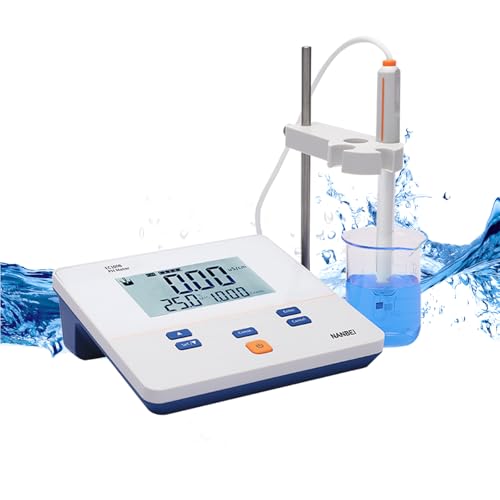
- 6.0-inch LCD is easy to read during testing
- 0.00 μS/cm to 100.0 mS/cm range for versatile use
- IP54 rating and power-outage protection add durability
Best For: Labs and facilities that want a readable, durable benchtop conductivity meter for routine measurements.
Best for Lab Data Logging
Apera EC800 Benchtop Conductivity Meter Kit

- 1% full-scale accuracy across multiple measurement modes
- Stores up to 500 readings with USB data output
- Includes calibration solutions and combo electrode
Best For: Labs and QC users who need dependable measurements plus built-in recordkeeping.
Best for Multi-Parameter Testing
Sper Scientific 860033 Water Quality Meter

- Measures conductivity, pH, ORP, TDS, salinity, and temperature
- Automatic calibration simplifies routine use
- EPA equivalency suits lab and industrial testing
Best For: Labs and industrial teams needing a versatile benchtop meter for multiple water-quality measurements.
Best Multiparameter Pick
Apera PC800 Benchtop pH/Conductivity Meter

- Measures pH, conductivity, TDS, salinity, resistivity, and temp
- Benchtop setup supports routine lab and QA testing
- 0.01 pH and 1% F.S. accuracy for tighter readings
Best For: Users who want a versatile bench meter for multi-parameter water testing.
Best for Accurate Lab-Style Readings – Apera EC700 Benchtop Conductivity Meter
If you want a benchtop conductivity meter that balances accuracy, speed, and practical features, the Apera EC700 is a strong lab-style pick. It measures conductivity and temperature at the same time, uses advanced auto calibration, and is built for stable readings across a wide range.
Best For: Labs, classrooms, and growers who need reliable conductivity and temperature measurements with easy calibration.
Pros:
- 1% F.S. accuracy and a wide 0-200.0 mS/cm measurement range
- Auto calibration with guide and self-diagnosis for easier setup
- Includes a platinum black ATC electrode for stable, responsive readings
- IP54 spill-proof and dust-proof design with 50-group data storage
Cons:
- More meter than casual users need
- Bench-focused design is less portable than handheld options
Overall, the EC700 is a dependable benchtop conductivity meter for users who care about repeatable results and straightforward calibration. Its feature set makes it especially appealing if you need a durable instrument for regular testing rather than a basic one-off reader.
Best for Automatic Calibration Recognition – Oakton CON 550 Benchtop Conductivity Meter
If you want a benchtop conductivity meter that keeps setup simple, the Oakton CON 550 is built around quick calibration and straightforward day-to-day use. It’s a practical pick for labs and facilities that need dependable conductivity readings without spending extra time on configuration.
Best For: Users who want a benchtop conductivity meter with automatic calibration solution recognition and easy routine operation.
Pros:
- Automatically recognizes calibration solutions to speed up setup
- Benchtop design is well suited to regular lab and quality-control testing
- Good choice for users who value simple, repeatable workflows
Cons:
- Not the most feature-packed option for advanced users
- Benchtop format is less portable than handheld meters
Overall, the Oakton CON 550 is a sensible benchtop conductivity meter for buyers who prioritize convenience and consistent calibration over extra bells and whistles. It’s a solid fit when ease of use matters as much as measurement reliability.
Best for Teaching Labs – Bante 510 Benchtop Conductivity Meter
The Bante 510 is a practical benchtop conductivity meter for research and education settings where simple operation, repeatable readings, and standard calibration support matter more than extra bells and whistles. It covers a wide conductivity range, includes platinum electrodes, and adds useful automation like Auto-Read and automatic temperature compensation.
Best For: Teaching labs, student training, and routine conductivity/TDS testing that benefits from straightforward setup and reliable endpoint detection.
Pros:
- 1 to 3 point calibration with automatic recognition for common conductivity standards
- Platinum electrodes and automatic temperature compensation help improve measurement consistency
- Auto-Read function locks the endpoint for easier routine testing
- Simple setup menu and factory reset make it easy to manage in shared labs
Cons:
- Accuracy is listed at ±1% F.S., which may not suit more demanding precision work
- Designed as a classical benchtop unit, so it is less portable than handheld meters
- Feature set is practical rather than advanced for specialized workflows
Overall, this benchtop conductivity meter is a solid pick if you want dependable core functionality without a steep learning curve. It is especially appealing for classrooms and general lab use where calibration flexibility and easy operation are the main priorities.
Best for GLP Data Logging – Apera PC9500 Benchtop Multiparameter Meter
If you need a benchtop conductivity meter for lab work where traceable records matter, the Apera PC9500 is built around high-accuracy multiparameter testing and clean data handling. It combines conductivity, TDS, salinity, and resistivity readings with pH/mV(ORP) measurement, making it a practical fit for routine analysis and documentation-heavy workflows.
Best For: Labs and research users who need a benchtop meter with strong GLP data logging, dual-channel measurement, and PC/printer export.
Pros:
- Comprehensive GLP logging with up to 1000 stored readings and USB export
- Dual-channel simultaneous pH/mV(ORP) and conductivity/TDS/salinity/resistivity measurement
- Includes Apera TestBench and intelligent magnetic stirrer for easier calibration and testing
- Swiss LabSen 211 pH electrode is designed for high-accuracy results
Cons:
- More specialized than a simple conductivity-only meter
- Better suited to lab settings than casual home or field use
This is a strong choice if you want a benchtop conductivity meter that emphasizes documentation, repeatability, and multi-parameter flexibility. It is especially appealing for users who need reliable records and a smoother calibration process rather than the simplest possible interface.
Best for Wide-Range Lab Testing – EC200E Digital Conductivity Meter
If you need a benchtop conductivity meter that can cover everything from low-level lab samples to high-conductivity process water, the EC200E is built for that job. Its broad 0.00 μS/cm to 200 mS/cm range, auto/manual temperature compensation, and large 6.0-inch LCD make it a practical choice for routine testing and day-to-day bench work.
Best For: Labs, water treatment teams, and technicians who want a stable benchtop meter with a wide measurement range and easy-to-read display.
Pros:
- Wide 0.00 μS/cm to 200 mS/cm range suits many sample types.
- Auto and manual temperature compensation improve reading flexibility.
- 6.0-inch LCD and auto/continuous modes simplify operation.
- Auto-hold and IP54 protection add stability and durability.
Cons:
- Benchtop design is less portable than handheld meters.
- Primarily aimed at lab and industrial use, not casual home testing.
Overall, the EC200E stands out as a capable benchtop conductivity meter for users who value range, readability, and reliable compensation features over compact portability. It is a solid fit when you need steady performance on a lab bench rather than a basic field tool.
Best for Accurate Calibration – Apera EC820 Benchtop Conductivity Meter Kit
If you want a benchtop conductivity meter that emphasizes measurement accuracy and calibration control, the Apera EC820 is a strong fit. It combines a wide measurement range with a platinum glass-body electrode, plus auto calibration and data logging features that make it practical for routine lab and field prep work.
Best For: Users who need reliable EC, TDS, salinity, and resistivity readings with simple calibration and data tracking.
Pros:
- 0.5% full-scale accuracy for precise conductivity measurements
- 1 to 4 point auto calibration with included standard solutions
- Measures EC, TDS, salinity, resistivity, and temperature
- 500-group data storage with USB export support
Cons:
- Windows-only PC software limits cross-platform use
- More advanced than needed for casual, occasional testing
Overall, the EC820 is a practical benchtop conductivity meter for buyers who care more about dependable readings and calibration features than the lowest price. Its included accessories and clear display make it a solid choice for labs, hydroponics, and water-quality workflows.
Best for Large Display – Benchtop Lab Conductivity Meter, 6in LCD
If you want a benchtop conductivity meter that’s easy to read at a glance, this EC100B model stands out with its 6.0-inch LCD and practical measuring range from 0.00 μS/cm to 100.0 mS/cm. It also includes manual temperature compensation, settable cell constant options, and power-outage protection for more dependable routine testing.
Best For: Labs, classrooms, and small facilities that need a readable, general-purpose conductivity meter for everyday checks.
Pros:
- Large 6-inch LCD makes readings easier to monitor during testing
- Wide conductivity range covers low- and high-conductivity samples
- Manual temperature compensation helps improve result accuracy
- IP54 protection adds spill- and dust-resistant durability
Cons:
- Manual temperature compensation is less convenient than automatic adjustment
- Accuracy is solid for general use, but not the highest for advanced analytical work
- Design is functional rather than feature-heavy
Overall, this benchtop conductivity meter is a strong pick if you value a large display, simple operation, and broad range coverage over premium automation. It fits well as a straightforward lab workhorse for routine conductivity measurements.
Best for Lab Data Logging – Apera EC800 Benchtop Conductivity Meter Kit
If you need a benchtop conductivity meter for routine lab testing, the Apera EC800 stands out for its mix of measurement range, GLP-style data handling, and straightforward calibration. It is built for scientific research and quality control work where stable readings and easy recordkeeping matter more than extra bells and whistles.
Best For: Labs, quality-control teams, and researchers who want a dependable benchtop meter with conductivity, TDS, salinity, resistivity, and temperature in one unit.
Pros:
- Measures EC, TDS, salinity, resistivity, and temperature with 1% full-scale accuracy
- GLP data management with storage for up to 500 readings and USB output
- Easy 1- to 4-point auto calibration with reminder and self-diagnosis functions
- Includes calibration solutions and a conductivity/temp combination electrode
Cons:
- Windows-only PC software limits cross-platform flexibility
- More advanced than basic testers, so it may be overkill for casual home use
Overall, the EC800 is a strong benchtop conductivity meter if you want lab-friendly features without jumping to a far more expensive research platform. Its data logging, display clarity, and included accessories make it especially practical for repeatable testing workflows.
Best for Multi-Parameter Testing – Sper Scientific 860033 Water Quality Meter
If you need a benchtop conductivity meter that can do more than one job, this Sper Scientific model is built for lab and industrial workflows. It combines conductivity, TDS, salinity, pH, ORP, and temperature in one bench unit, with automatic calibration to help streamline routine testing.
Best For: Labs, QA teams, and industrial users who want a single benchtop instrument for multiple water-quality measurements.
Pros:
- Measures conductivity plus pH, ORP, TDS, salinity, and temperature
- Automatic calibration supports faster, more repeatable setup
- EPA equivalency makes it a strong fit for regulated workflows
- Useful all-in-one design for bench testing and routine monitoring
Cons:
- More instrument than casual or occasional users need
- Higher cost than basic single-parameter meters
- Best value comes when you use multiple measurement modes
This benchtop conductivity meter stands out when you need versatility and compliance-friendly performance in one device. It is a practical choice for users who want a lab-ready meter that can handle broader water-quality analysis without switching instruments.
Best Multiparameter Pick – Apera PC800 Benchtop pH/Conductivity Meter
If you want a benchtop conductivity meter that does more than one job well, the Apera PC800 is built for labs, classrooms, and quality-control workflows that need pH, conductivity, TDS, salinity, resistivity, and temperature in one unit. It’s a practical choice when you want fewer devices on the bench and more complete water-testing data from a single meter.
Best For: Buyers who need a versatile benchtop meter for multi-parameter water testing, especially in lab, education, or light industrial settings.
Pros:
- Measures conductivity plus several related water-quality parameters
- Benchtop format is well suited to repeat testing and routine workflows
- 0.01 pH and 1% F.S. accuracy support more precise readings
- Useful all-in-one setup for reducing clutter on the workbench
Cons:
- More meter than you need if you only want basic conductivity checks
- Benchtop design is less portable than handheld alternatives
This is a strong fit if you want a benchtop conductivity meter that can handle broader testing needs without buying separate instruments. For users who value versatility and repeatable bench-top measurements, the PC800 offers a balanced mix of capability and convenience.
How We Picked the Best Benchtop Conductivity Meter Options
We prioritized measurement range, stated accuracy, calibration capability, and workflow features such as temperature compensation, memory, GLP support, and multiparameter compatibility. We also favored models that suit common lab and field-adjacent testing tasks without adding unnecessary complexity.
Quick Comparison
If you need straightforward conductivity readings, a dedicated meter with a clear display and simple calibration is often the easiest choice. If your work requires more than one parameter, a multiparameter system can save bench space and reduce equipment overlap. For regulated or traceable workflows, data handling and GLP-style records matter as much as raw accuracy.
Key Buying Factors for a Benchtop Conductivity Meter
Accuracy and Resolution
Look for accuracy stated in % of full scale or in absolute units, and make sure the resolution matches the level of precision your samples require. Higher accuracy is especially important for research, compliance, and process verification.
Range and Sample Type
Choose a conductivity range that fits your typical samples. Low-range water testing and high-salinity or industrial samples need very different capabilities, so avoid paying for range you will never use, or underbuying and maxing out the meter too quickly.
Temperature Compensation
Automatic temperature compensation is a major advantage because conductivity changes with temperature. Manual compensation can still work, but it adds steps and leaves more room for error.
Calibration and Electrode Support
Multi-point calibration improves confidence across a wider range of samples. Also consider the supplied electrodes, since platinum sensors, probe quality, and replacement availability affect long-term performance.
Data Management and Compliance
If you need GLP documentation, memory, date/time stamping, or exportable results, prioritize a Benchtop Conductivity Meter with robust data management. These features are especially useful in labs that need audit-friendly records.
Who Should Buy Which Benchtop Conductivity Meter?
Choose a basic single-parameter meter if you want fast routine conductivity checks with minimal setup. Pick a multiparameter model if you also measure pH, TDS, salinity, resistivity, or ORP and want one platform for several tasks. Buy a research-grade or GLP-focused unit if you need stronger documentation, tighter control over calibration, and more confidence in repeatable results.
For most buyers, the best choice is the meter that matches sample range, reporting needs, and day-to-day workflow, not just the highest spec sheet number.