Choosing the best 3D scanner for clay models depends on more than headline accuracy. Sculptors need reliable tracking across organic surfaces, enough detail for fine forms, and software that can turn a messy scan into a usable digital model.
We compare 10 capable handheld and desktop scanners for different clay-sculpting workflows, from small maquettes and textured studies to larger figures prepared for archiving, rendering, or 3D printing.
Best 10 3d Scanner for Clay Models Picks for 2026
Most Versatile
Creality Pika Portable 3D Scanner

- 0.03mm accuracy with blue laser detail capture
- Dual modes for small objects through full-body scans
- Wireless, marker-free, and dark-surface capable
Best For: Makers needing one portable scanner for varied clay projects
Best Processing Workflow
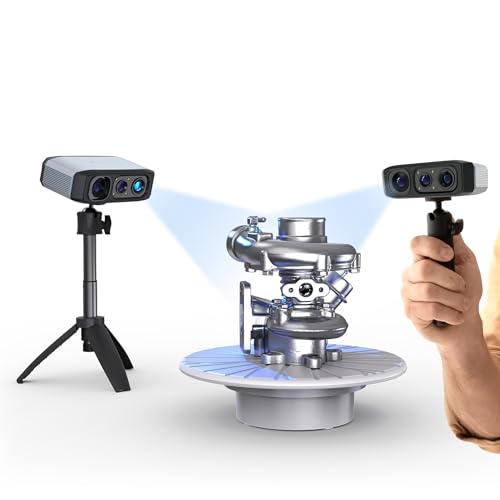
- Up to 0.03mm accuracy and 0.07mm resolution
- AI tracking and anti-shake support easier scanning
- JMStudio integrates scanning, editing, and optimization
Best For: Users who prioritize assisted processing and model cleanup
Best for Larger Sculptures

- Scans objects from 0.8 to 78 inches
- Four cameras support detail and broad coverage
- Full-color capture with no spray for dark or metallic surfaces
Best For: Artists scanning clay pieces from miniatures to large sculptures
Best Fine Detail

- Up to 0.02mm accuracy for small surface details
- Designed for objects measuring 10 to 300mm
- Includes tripod and turntable for stable indoor scanning
Best For: Small clay studies where fine texture detail is the priority
Large-Format Clay Scanning

- 0.1mm single-frame precision
- 360mm x 650mm capture range
- Up to 18fps with full-color scanning
Best For: Large clay sculptures and fast color capture
Precision Clay Detail

- Up to 0.02mm laboratory accuracy
- 60fps and 660,000 points per second
- Blue laser lines with color mapping
Best For: Intricate clay models and precision-focused scanning
Beginner-Friendly Clay Scanning

- Marker-free scanning with AI visual tracking
- 0.03mm accuracy and 0.07mm resolution
- 24-bit color camera and anti-shake modules
Best For: Beginners and marker-free clay model workflows
Best Wireless Pick

- 0.1mm accuracy with 30FPS scanning
- WiFi 6 wireless workflow
- Exports OBJ, STL, and PLY
Best For: Portable clay-model scanning and mobile-friendly 3D printing workflows
Best Lightweight Option

- Lightweight 105g portable design
- 0.1mm precision with anti-shake
- One-click, beginner-friendly operation
Best For: Beginners scanning clay models on Mac or Windows
Best High-Detail Choice

- Up to 0.02mm accuracy
- Scanning speeds up to 60FPS
- Blue-light and NIR scanning modes
Best For: Detailed figurines and advanced clay-model digitization
Most Versatile – Creality Pika Portable 3D Scanner
For shoppers seeking a versatile 3d scanner for clay models, the Creality Pika combines fine-detail blue laser scanning with NIR structured light. Its 0.03mm accuracy, marker-free wired scanning, and compact wireless design make it suitable for clay sculptures ranging from small studies to larger forms.
Best For: Artists and makers who want high detail, portability, color capture, and flexible scanning modes.
Pros:
- Up to 0.03mm accuracy and 0.1mm 3D resolution for detailed models.
- Dual blue laser and NIR structured-light modes cover small objects through life-size scans.
- Scans dark and metallic surfaces without spray and exports STL, OBJ, PLY, and ASC files.
- Compact 260g body, Wi-Fi 6, touchscreen, and dual swappable batteries support mobile use.
Cons:
- Its broad feature set may require time to learn.
- Some AI features are aimed at faces and textured models rather than clay-only workflows.
The Pika is the strongest all-around option here when you want one scanner for detailed clay work, larger pieces, and portable use. Its accuracy and format support also leave room for editing and 3D printing in a broader workflow.
Best Processing Workflow – 3DMakerpro Moose Lite
The 3DMakerpro Moose Lite is a practical 3d scanner for clay models when you value guided capture and built-in cleanup. Blue-light scanning, AI tracking, anti-shake modules, and JMStudio’s integrated editing tools are designed to make detailed model creation more approachable.
Best For: Beginners and hobbyists who want assisted scanning and an integrated scan-to-export workflow.
Pros:
- Blue-light scanning offers up to 0.03mm accuracy and 0.07mm resolution.
- AI tracking, point-cloud processing, and anti-shake features help support steadier scans.
- JMStudio combines scanning, editing, and optimization, with marker-free scanning support.
- Exports OBJ, STL, PLY, and ASC files and captures 24-bit true color.
Cons:
- It weighs 3.56 pounds, making it less convenient for extended handheld use.
- Computer compatibility is limited to Windows 10/11 64-bit and macOS 12/13 according to the supplied details.
- The optional smartphone Smart Grip is sold separately.
Moose Lite stands out for software assistance rather than extreme portability. It is a sensible choice if you want help managing the scan, editing the result, and preparing files for printing or display.
Best for Larger Sculptures – Creality Otter Lite Basic
For a 3d scanner for clay models that may range from small pieces to large sculptures, the Creality Otter Lite Basic offers a wide size range and a four-camera design. Its 0.05mm accuracy, full-color capture, and multiple alignment modes support both artistic scanning and practical 3D-printing workflows.
Best For: Creators scanning clay pieces across a wide range of sizes, including larger sculptures.
Pros:
- Scans objects from 0.8 inches up to 78 inches with quad-camera coverage.
- Up to 0.05mm accuracy and 30fps scanning support a smooth workflow.
- Can scan dark and metallic surfaces without spray and operate outdoors in up to 30,000 lux.
- Captures 24-bit color and exports PLY, OBJ, STL, ASC, 3MF, GLTF, and FBX.
Cons:
- Its accuracy is lower than the highest-precision options in this lineup.
- The optional Scan Bridge handle is sold separately.
- Color and multi-size capabilities may be more than needed for simple monochrome clay studies.
The Otter Lite Basic is a strong fit when scan size flexibility matters more than maximum stated accuracy. It is especially appealing for artists who want to capture both small clay work and substantially larger forms without changing scanners.
Best Fine Detail – 3DMakerpro Seal Lite
The 3DMakerpro Seal Lite is a focused 3d scanner for clay models, built for small objects from 10 to 300mm. Its blue LED light source is designed to capture tiny dents and edge textures, making it a suitable option for detailed clay studies, miniatures, and small sculptural forms.
Best For: Indoor users scanning small clay models where fine surface detail matters most.
Pros:
- Up to 0.02mm accuracy targets small dents and edge textures.
- Small-format scanning covers objects from 10 to 300mm.
- Includes a tripod and turntable, with scan-back, anti-shake, and auto-alignment features.
- JMStudio exports OBJ, STL, PLY, and ASC files and receives lifetime free updates.
Cons:
- It is intended for indoor small-format scanning rather than large sculptures.
- It captures mono texture only, not full color.
- The scanner has a learning curve and requires a relatively powerful PC for smooth operation.
Seal Lite is the precision-focused pick for small clay pieces. Choose it when surface fidelity is more important than scanning speed, color capture, outdoor use, or a broad object-size range.
Large-Format Clay Scanning – Revopoint RANGE
If you need a 3d scanner for clay models—especially larger sculptures, figurines, or forms—the Revopoint RANGE emphasizes a wide capture area, longer scanning distance, and fast handheld operation. Its 0.1mm single-frame precision and RGB color camera support detailed, full-color digital models.
Best For: Large clay sculptures, body-sized forms, and creators who want fast full-color scans.
Pros:
- Designed for large objects, with a 360mm x 650mm single capture range at 600mm.
- Up to 18fps scanning and a 300mm–800mm working distance help speed up larger scans.
- RGB color capture, handheld operation, and compatibility with Windows, macOS, iOS, and Android.
- Beginner-friendly Revo Scan software includes scanning and post-processing tools.
Cons:
- Its 0.1mm single-frame precision is less exact than the higher precision listed for the Creality model.
- Its large-object focus may be more capability than needed for small clay details.
The RANGE is a practical choice when scan coverage and workflow speed matter more than ultra-fine small-object precision. It is particularly well suited to larger clay work and projects that benefit from color reference.
Precision Clay Detail – Creality Raptor Pro
For intricate clay models where fine surface detail is the priority, the Creality Raptor Pro combines listed 0.02mm laboratory accuracy with blue laser lines and a 60fps scanning rate. Its marker-based alignment is designed to help stitch multiple scans together.
Best For: Detailed clay models, advanced users, and projects requiring high listed precision.
Pros:
- Claims up to 0.02mm accuracy in laboratory conditions for capturing intricate details.
- Scans at up to 60fps and 660,000 points per second.
- Supports objects from 5mm to 2000mm, covering small models through larger forms.
- Offers full-color scanning and marker-based alignment for multi-scan stitching.
Cons:
- The 0.02mm figure applies under laboratory conditions, so real-world results may differ.
- Marker-based alignment requires markers, adding preparation to the scanning process.
- The listed package weight is 12.17 pounds, making it less travel-friendly than lighter options.
Among these options, the Raptor Pro has the strongest stated precision and speed specifications. Choose it when detailed clay surface capture and rapid scanning are more important than the simplest setup.
Beginner-Friendly Clay Scanning – 3DMakerpro Moose
The 3DMakerpro Moose is a practical 3d scanner for clay models when you want a simpler handheld workflow. Marker-free scanning, optical anti-shake modules, and AI-assisted repair can reduce interruptions while capturing detailed models for printing or display.
Best For: Beginners, small-to-medium clay models, and users who want marker-free scanning with color capture.
Pros:
- Marker-free technology avoids the need to place markers on the model.
- Blue light scanning lists 0.03mm accuracy and 0.07mm resolution for detailed point clouds.
- Optical anti-shake modules and a re-scanning function help accommodate interrupted or unsteady scans.
- Its 24-bit color camera supports true-color reproduction, while JMStudio includes editing and optimization tools.
Cons:
- The listed 0.03mm accuracy is below the Raptor Pro’s stated 0.02mm laboratory accuracy.
- It is listed as compatible with Windows and macOS, without the broader mobile compatibility noted for the RANGE.
- AI repair and marker-free tracking may still require post-processing for challenging clay surfaces.
Moose stands out as the approachable option for clay artists who value easy setup and stable handheld scanning. Its detailed capture, color camera, and integrated software make it a balanced choice for printing and display workflows.
Best Wireless Pick – CR-Scan Ferret Pro
If you want a flexible 3d scanner for clay models, the Creality CR-Scan Ferret Pro combines 0.1mm accuracy, 0.16mm resolution, and 30FPS scanning. Its anti-shake tracking can help maintain smoother captures when scanning by hand, while WiFi 6 supports wireless transmission to compatible mobile devices.
Best For: Clay artists who want a portable scanner for detailed models, wireless workflows, and export to OBJ, STL, or PLY.
Pros:
- Up to 0.1mm accuracy and 30FPS scanning for detailed captures.
- WiFi 6 wireless transmission supports a more mobile scanning setup.
- Exports OBJ, STL, and PLY files for modeling and 3D printing workflows.
- Anti-shake tracking is designed to improve handheld scanning stability.
Cons:
- Requires compatible hardware and operating systems with specified RAM and processor requirements.
- Highly reflective, transparent, or extremely dark surfaces may be difficult to scan.
- Wireless mobile scanning requires the dedicated bridge and compatible devices.
The Ferret Pro is a well-rounded choice for scanning clay sculptures when portability and easy file export matter. It offers a useful balance of detail, speed, and handheld flexibility, provided your computer or mobile device meets the listed requirements.
Best Lightweight Option – CR-Ferret SE
The Creality CR-Ferret SE is a compact option for anyone seeking a straightforward 3d scanner for clay models. It offers 0.1mm precision, anti-shake technology, one-click operation, and 24-bit full-color capture in a 105g body that is easy to carry between a studio and workshop.
Best For: Beginners and creators who prioritize simple operation, portability, and full-color scanning on Mac or Windows.
Pros:
- Lightweight 105g design is convenient for handheld and on-site use.
- Anti-shake technology helps produce steadier scans with less hand-tremor interference.
- One-click scanning offers a beginner-friendly workflow.
- 24-bit full-color capture records vibrant model textures.
Cons:
- Compatibility is listed for Mac and Windows rather than mobile devices.
- The supplied notes do not specify wireless scanning or file-export formats.
- Its feature set is more focused on simplicity than advanced scanning versatility.
Choose the CR-Ferret SE if you want a small, approachable scanner for digitizing clay work without a complicated setup. Its low weight and one-click workflow make it especially appealing for beginners, though users seeking wireless or more advanced features may prefer another model.
Best High-Detail Choice – CR-Scan Raptor
For highly detailed clay pieces, the Creality CR-Scan Raptor is a powerful 3d scanner for clay models with up to 0.02mm accuracy, 0.1mm fine-detail resolution, and scanning speeds up to 60FPS. Its blue-light and NIR modes cover a broad range of object sizes, while anti-shake tracking and autofocus are intended to support steadier handheld capture.
Best For: Experienced makers who need fine geometry, fast scanning, and full-color models for detailed figurines or larger sculptural work.
Pros:
- Up to 0.02mm accuracy is suited to capturing fine geometry.
- Blue-light scanning reaches up to 60FPS for faster workflows.
- Blue-light and NIR modes support objects from small miniatures to large components.
- 24-bit color capture and 12 circular LED texture lights support detailed textures.
Cons:
- Recommended computer requirements include 16GB or more RAM and a dedicated 6GB VRAM NVIDIA GPU on Windows.
- It is listed as compatible with Windows and macOS, so setup may be less flexible for other platforms.
- Its professional-grade capabilities may be more than needed for simple clay projects.
The Raptor is the strongest fit when preserving small sculptural details is the main priority. It offers impressive speed and scanning range, but its higher system requirements make it better suited to a capable workstation and users prepared for a more advanced tool.
How We Picked the Best 3d Scanner for Clay Models
We focused on specifications and features that matter when scanning clay: stated accuracy, scan resolution, tracking stability, color and texture capture, supported object sizes, operating modes, and portability. We also considered whether each scanner is better suited to small detailed sculptures, larger forms, or flexible studio use.
Accuracy figures are useful comparisons, but they do not guarantee identical results in every session. Clay can have subtle contours, repetitive textures, glossy patches, or soft edges that challenge tracking. Lighting, scan distance, calibration, surface preparation, and cleanup software all affect the final mesh.
Quick Comparison
| Best For | Prioritize | Useful Features |
|---|---|---|
| Small detailed studies | Fine resolution and precision | Blue light, close-range modes, texture capture |
| Large sculptures | Tracking and working distance | Wide scan range, stable frame rate, body-completion tools |
| Color reference archives | Texture and color fidelity | Full-color cameras, texture scanning, consistent lighting |
| Mobile studio work | Portability and setup speed | Wireless bridge, anti-shake tracking, compact design |
| Print-ready workflows | Geometry consistency and software | Reliable alignment, mesh editing, export compatibility |
Key Buying Factors for a 3d Scanner for Clay Models
Accuracy and Detail
Fine stated accuracy is most valuable for small sculptures and delicate facial or surface features. For larger clay forms, dependable tracking and even coverage may matter more than the smallest quoted number.
Tracking and Scan Speed
Choose a scanner that can maintain alignment as you move around the model. Higher frame rates and anti-shake features can reduce drift, especially when scanning handheld or capturing broad curved surfaces.
Color, Texture, and Surface Behavior
Full-color scanning helps preserve painted marks, material references, and documentation details, while geometry-only scanning may be sufficient for CAD or printing. If the clay is unusually shiny, dark, or uniform, check whether the scanner supports a suitable mode or requires temporary scanning spray.
Object Size and Working Distance
Match the scanner’s intended range to your sculptures. Small-format scanners can capture intricate maquettes effectively, but a larger figure may require a wider field of view and longer working distance.
Software and Workflow
Look for straightforward calibration, alignment, hole filling, texture processing, and common export formats. A scanner with excellent hardware can still be frustrating if its software produces difficult-to-clean meshes.
Who Should Buy Which 3d Scanner for Clay Models?
Choose a compact, high-detail model if you mainly scan small clay maquettes, ornaments, or detailed studies. A scanner with strong tracking, a broad size range, and a fast capture rate is a better fit for larger sculptures or frequent handheld work. If preserving the appearance of the original piece matters, prioritize full-color capture and texture scanning. For print-focused projects, emphasize geometric consistency, dependable alignment, and software that exports clean meshes. Wireless or bridge-equipped models suit artists who need to move around the studio, while desktop-oriented options can be preferable when repeatable positioning and controlled lighting matter most.