Choosing among the many 3D printers for hobbyists can feel overwhelming, especially if you want a machine that is easy to set up, dependable, and worth the money.
This roundup focuses on practical picks for beginners, tinkerers, and makers who want consistent results without a steep learning curve.
Best 10 3d Printers for Hobbyists Picks for 2026
Beginner-Friendly Speed Pick

- Full-auto calibration for easier setup
- Fast, quiet printing with active compensation
- Optional multi-color printing with AMS lite
Best For: Hobbyists who want a simple, fast, low-hassle starter printer
Fast Auto-Leveling Value

- One-click auto leveling for easier first layers
- Core XY all-metal structure for stable high-speed printing
- Quick-release nozzle and app-based monitoring
Best For: Hobbyists who want convenience, speed, and simple upkeep
Enclosed High-Speed Upgrade

- Fast 500 mm/s printing with high acceleration
- Enclosed design helps with advanced filaments
- Supports up to 16 colors with AMS
Best For: Hobbyists ready for faster, enclosed printing and multi-material expansion
Budget Starter Bundle

- Includes four PLA filament packs
- CR Touch auto leveling reduces setup effort
- Sprite direct extruder supports PLA, TPU, and PETG
Best For: Budget-conscious hobbyists who want a filament-included starter kit
Speed-First Starter
FLASHFORGE Adventurer 5M for fast, easy printing

- Fully automatic bed leveling
- Up to 600mm/s travel speed
- 280°C direct drive with quick nozzle swaps
Best For: Hobbyists who want fast, easy printing with minimal setup
Multicolor Workshop Pick
Official Creality K2 Combo with CFS

- Prints in up to 16 colors
- 600mm/s speed with adaptive leveling
- AI camera and large 10.24-inch build volume
Best For: Hobbyists who want multicolor printing and more advanced monitoring
Colorful Fast Printer
FLASHFORGE AD5X for multi-color hobby projects
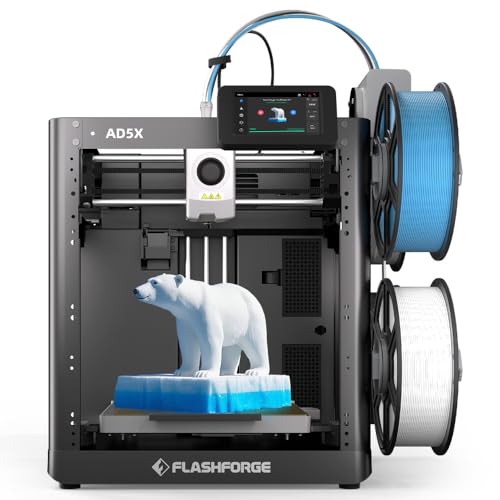
- IFS supports up to 4 colors at once
- Fully automatic leveling
- 600mm/s speed with a 300°C nozzle
Best For: Hobbyists who want easy multicolor printing in a fast machine
Beginner-Friendly Starter Pick
Entina Tina2C Mini 3D Printer for Kids

- Fully assembled with app-guided setup
- Auto leveling and power-loss recovery
- WiFi or TF card printing for flexibility
Best For: First-time users, kids, and compact home projects
Large-Format Production Choice
Creality Ender 5 Max 400mm 3D Printer

- 400×400×400 mm build volume for big parts
- Up to 700mm/s CoreXY speed
- 64-point auto leveling with auto Z-offset
Best For: Large projects, batch printing, and multi-printer setups
Beginner-Friendly Speed Pick – Bambu Lab A1 3D Printer
If you want one of the more approachable 3d printers for hobbyists, the Bambu Lab A1 stands out for its ready-to-use setup, fast motion, and automatic calibration. It is built to reduce the usual beginner friction while still giving you room to experiment with multi-color printing through AMS lite.
Best For: Hobbyists who want an easy, quiet, and fast first printer with optional multi-color printing.
Pros:
- Full-auto calibration handles Z-offset, bed leveling, and other setup tasks automatically.
- High-speed printing with 10,000 mm/s² acceleration for quick turnaround on hobby projects.
- Active flow rate compensation helps keep prints smooth and consistent.
- 1-Clip quick swap nozzle makes maintenance and nozzle changes simpler.
Cons:
- Multi-color printing requires AMS lite, which is sold separately unless bundled.
- Best fit for users who value ease of use over deep manual tuning.
The A1 is a strong practical choice if you want a printer that gets out of the way and lets you focus on making things. It combines speed, automation, and quiet operation in a package that suits casual builders and growing hobbyists alike.
Fast Auto-Leveling Value – FLASHFORGE AD5M 3D Printer
The FLASHFORGE AD5M is a practical pick for hobbyists who want speed and convenience without giving up core printing features. Among 3d printers for hobbyists, it stands out for one-click automatic leveling, a quick-swap nozzle system, and remote management tools that make day-to-day printing easier.
Best For: Hobbyists who want a fast, low-maintenance printer with easy leveling and simple nozzle changes.
Pros:
- Fully automatic one-click leveling helps deliver a reliable first layer.
- Core XY all-metal motion structure supports high-speed printing with stable, low-noise performance.
- Quick-release nozzle swaps in about 3 seconds for easy maintenance.
- Remote monitoring and batch file transfer are available through the slicer and app.
Cons:
- Print size is limited to 220 x 220 x 220 mm.
- Advanced users may want more manual control than the automated workflow emphasizes.
The AD5M is a sensible choice if you care about getting prints started quickly and keeping maintenance simple. Its automatic leveling and fast nozzle changes make it especially appealing for hobbyists who print often and value convenience.
Enclosed High-Speed Upgrade – Bambu Lab P1S 3D Printer
If you’re comparing 3d printers for hobbyists and want a step up in performance, the Bambu Lab P1S is built around speed, enclosure, and automatic leveling. It also supports multi-color and multi-material printing with AMS, making it a strong option for users who want to expand beyond basic single-material projects.
Best For: Hobbyists who want a fast enclosed printer for more advanced filaments and multi-color projects.
Pros:
- Up to 500 mm/s printing speed with 20,000 mm/s² acceleration for rapid jobs.
- Fully enclosed design improves performance with advanced filaments.
- Automatic bed leveling simplifies setup and improves print success.
- Supports up to 16 colors with Bambu Lab AMS connected.
Cons:
- Multi-color printing requires the AMS accessory.
- Carbon/glass fiber reinforced polymers are not recommended.
- More of a performance-focused printer than a basic entry-level machine.
The P1S is a compelling choice if your hobby printing has moved beyond the basics and you want faster output with more material flexibility. Its enclosed body and auto-leveling make it easier to handle more demanding prints while keeping the workflow straightforward.
Budget Starter Bundle – Creality Ender 3 V3 SE Bundle
Creality Ender 3 V3 SE 3D Printer Bundle with PLA Filament 4 Packs(Black+White+Red+Blue)
Check Price On AmazonFor hobbyists who want a familiar budget path into 3d printers for hobbyists, the Ender 3 V3 SE bundle adds useful speed and leveling upgrades plus four PLA filament packs. It is aimed at making the early printing experience easier with auto leveling and a direct extruder, while still keeping the setup rooted in Creality’s popular Ender line.
Best For: Budget-minded hobbyists who want a starter printer bundle with filament included.
Pros:
- 250 mm/s top speed and 2500 mm/s² acceleration improve print turnaround.
- Sprite full metal direct extruder supports smooth feeding for PLA, TPU, and PETG.
- CR Touch auto leveling and strain sensor help reduce manual setup work.
- Bundle includes four PLA filament packs in black, white, red, and blue.
Cons:
- Print speed is lower than some newer premium options.
- Best suited to users who are comfortable with a more traditional Creality-style printer experience.
This bundle makes sense if you want to start printing right away with filament already in the box. It pairs beginner-friendly automation with broad material support, making it a practical entry choice for hobby projects and general-purpose prints.
Speed-First Starter – FLASHFORGE Adventurer 5M for fast, easy printing
If you want one of the more approachable 3d printers for hobbyists, the FLASHFORGE Adventurer 5M focuses on speed and simplicity. Fully automatic bed leveling removes one of the biggest beginner pain points, while the CoreXY design, 600mm/s travel speed, and quick nozzle changes make it a practical pick for users who want to spend more time printing and less time tuning.
Best For: Hobbyists who want fast prints, automatic setup, and a straightforward all-around machine for everyday projects.
Pros:
- Fully automatic leveling helps deliver reliable first layers without manual adjustment.
- CoreXY frame and 600mm/s travel speed support very fast printing.
- Quick 3-second nozzle swaps and a 35-second warm-up to 200°C keep workflow moving.
- 280°C direct drive extruder with optional nozzle sizes adds flexibility for different projects.
Cons:
- Build volume is limited to 220 x 220 x 220 mm.
- It uses a single-color setup, so it is not aimed at multi-color work.
Overall, the Adventurer 5M is a strong fit if your priority is fast, low-fuss printing rather than advanced material handling or multicolor output. It looks especially appealing for hobbyists who value convenience and consistent everyday results.
Multicolor Workshop Pick – Official Creality K2 Combo with CFS
Among 3d printers for hobbyists, the Creality K2 Combo stands out if you want multicolor printing without giving up speed or monitoring features. With support for up to 16 colors through the CFS, 600mm/s printing, adaptive leveling, and a chamber AI camera, it is built for users who want creative flexibility and more oversight during longer jobs.
Best For: Hobbyists who want multicolor prints, a large build volume, and extra monitoring features for more ambitious projects.
Pros:
- Supports up to 16 colors, opening up more creative print options.
- 600mm/s speed and 20000mm/s² acceleration help shorten print times.
- Chamber AI camera can spot issues like spaghetti, foreign objects, and idle printing.
- Large 10.24 x 10.24 x 10.24 inch build size handles helmets and grouped parts.
Cons:
- The multicolor CFS setup adds complexity beyond a basic single-material printer.
- At 39.7 pounds, it is a heavier machine to move or reposition.
The K2 Combo is a compelling choice if your hobby projects benefit from color variety and a larger build area. It combines fast hardware with useful smart features, making it better suited to serious makers than casual first-time buyers.
Colorful Fast Printer – FLASHFORGE AD5X for multi-color hobby projects
The FLASHFORGE AD5X is a practical option for 3d printers for hobbyists who want multicolor printing without stepping away from a fast, automatic workflow. Its IFS system supports up to four colors at once, while fully automatic leveling, a 600mm/s top speed, and a 300°C nozzle give it the flexibility to handle a wide range of common filament-based projects.
Best For: Hobbyists who want easy multicolor printing in a fast, auto-leveling machine with a standard-sized build area.
Pros:
- IFS technology supports up to four colors simultaneously.
- Fully automatic leveling helps reduce setup time and leveling mistakes.
- 600mm/s speed makes it well suited to quick turnaround projects.
- 300°C nozzle expands filament compatibility, including PLA, ABS, and PETG.
Cons:
- Build volume is 220 x 220 x 220 mm, so very large models may not fit.
- It offers fewer colors at once than a system designed for 16-color printing.
If you want colorful hobby prints but still value speed and easy setup, the AD5X hits a useful middle ground. It is especially appealing for makers who want more creative output without moving into a much more complex machine.
Beginner-Friendly Starter Pick – Entina Tina2C Mini 3D Printer for Kids
If you want one of the more approachable 3d printers for hobbyists who are just getting started, the Entina Tina2C focuses on simplicity first. It comes fully assembled, uses app-guided setup, and is designed to get a first print going in as fast as 8 minutes, which makes it a practical choice for home use, kids, and beginner makers.
Best For: First-time users, kids, and hobbyists who want a compact printer with guided setup and low-maintenance operation.
Pros:
- Fully assembled and beginner-friendly, with guided setup through the Poloprint Cloud app.
- Supports WiFi printing plus TF card offline mode for flexible workflows.
- Auto leveling, power-loss recovery, and a flexible magnetic build plate help reduce failed prints.
- Includes AI-powered search, photo-to-print features, and 20+ creative modules for STEM learning.
Cons:
- Small 3.9 × 3.9 × 3.9 inch build volume limits larger projects.
- Built for ease of use rather than advanced performance or large-format printing.
The Tina2C is a strong fit if you value a low-friction start and a compact footprint over raw output capacity. For hobbyists who want an easy, family-friendly printer for learning and small creative builds, it covers the basics well.
Speed-Focused Upgrade – Creality K1C Fast CoreXY 3D Printer
For hobbyists who want a faster machine, the Creality K1C stands out among 3d printers for hobbyists by combining a CoreXY motion system with speeds up to 600mm/s. It also adds auto leveling, an AI camera, and a clog-resistant extrusion setup, so it is aimed at users who want speed without giving up day-to-day reliability.
Best For: Hobbyists who want a compact fast printer with smart monitoring and support for stronger filaments.
Pros:
- CoreXY design supports up to 600mm/s printing speed and strong vibration resistance.
- AI camera can monitor prints, capture timelapses, and alert you to errors.
- Clog-free extruder and quick-swap tri-metal nozzle are built for smoother maintenance.
- Supports CF materials plus PLA, ASA, PETG, TPU, and more with a closed chamber and hardened steel nozzle tip.
Cons:
- Advanced speed and material features may be more than a casual beginner needs.
- Its compact size is better for moderate builds than oversized projects.
The K1C is a practical pick if you care most about print speed and filament versatility. It offers a strong mix of automation and performance features that suit experienced hobbyists or motivated beginners ready to grow.
Large-Format Production Choice – Creality Ender 5 Max 400mm 3D Printer
If your projects are getting bigger, the Creality Ender 5 Max is built for large-scale 3d printers for hobbyists who need more room and more throughput. Its 400×400×400 mm build volume, fast 700mm/s-capable CoreXY system, and multi-printer WLAN control make it better suited to ambitious makers, studios, and print-farm style workflows than to small desktop tinkering.
Best For: Hobbyists, makers, and small teams that need a large build area and organized multi-printer control.
Pros:
- Huge 400×400×400 mm build volume supports oversized models and batch printing.
- Up to 700mm/s CoreXY system is designed for high-output workflows.
- 64-point auto leveling and auto Z-offset simplify setup and improve first-layer success.
- Rigid all-metal frame, linear rail, and dual-gear extruder are built for stability and reliability.
Cons:
- Large footprint and 68.9-pound weight make it far less portable than compact printers.
- Its scale and production focus are likely excessive for simple beginner projects.
The Ender 5 Max makes sense if size and throughput matter more than desk-friendly convenience. For hobbyists moving into large prototypes, batch work, or a small print farm, it offers the kind of capacity that smaller machines cannot match.
How We Picked These 3d Printers for Hobbyists
We prioritized models that make hobby printing simpler: strong out-of-box usability, reliable auto-leveling, stable motion systems, and a good balance of speed and print quality. We also looked at build volume, enclosure options, filament compatibility, and how much maintenance a typical owner should expect.
Quick Comparison: What Matters Most
For most hobbyists, the best printer is not just the fastest one. It is the machine that matches your space, project size, and patience level. Beginners usually benefit from ready-to-use printers with guided calibration, while experienced makers may prefer larger build volume or higher-speed systems for prototypes and multi-part projects.
Key Buying Factors for 3d Printers for Hobbyists
Ease of Setup
Fully assembled or mostly preconfigured printers reduce frustration and help you start printing sooner. Features like auto-leveling, automatic calibration, and app-based control are especially useful if you are new to the hobby.
Build Volume
Small printers work well for figurines, test parts, and classroom use. Larger beds are better for helmets, functional prototypes, cosplay pieces, and fewer split prints.
Speed Versus Quality
High-speed printers can save time, but only if they remain consistent at those speeds. Look for strong acceleration control, rigid frames, and proven extrusion systems if you want fast turnaround without sacrificing surface finish.
Material Support
PLA is the easiest place to start, but many hobbyists eventually want PETG, TPU, or higher-temperature materials. Check nozzle temperature, hotend design, and whether an enclosed printer is needed for the materials you plan to use.
Noise, Maintenance, and Upgrades
If your printer will live in a bedroom, office, or shared space, noise matters. Also consider how easy it is to replace nozzles, clean the bed, and source parts. Some users prefer a machine that works well stock, while others want upgrade potential.
Who Should Buy Which 3d Printers for Hobbyists?
Beginners should favor simple, ready-to-print machines with reliable calibration and low setup hassle. Parents and younger users may want compact, safer, and easier-to-manage models. Makers who value speed and efficiency should look at newer CoreXY-style printers or fast bedslinger alternatives. If you print larger projects, choose a machine with a bigger build area and sturdy frame. If you want multi-color work, select a printer built for that workflow rather than trying to add complexity later.
In short, the best choice among 3d Printers for Hobbyists depends on whether you value ease, speed, size, or advanced material support most.