The HYCHEK 21-in-1 Water Test Kit review is about one thing: getting a broad, practical picture of your water fast.
If you want an easy home test for tap or well water, this kit is built for exactly that.
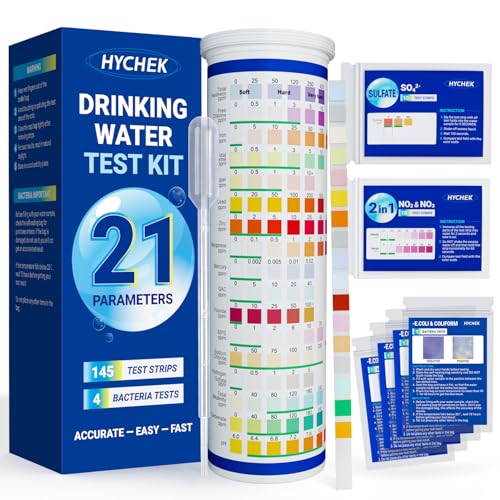
HYCHEK Water Kit Review Summary
The HYCHEK 21-in-1 Water Test Kit is a strong pick for homeowners who want a simple, wide-coverage screening tool instead of a complicated lab process.
It is especially useful for people who want to check several water-quality factors at once, including common concerns like chlorine, hardness, pH, lead, fluoride, iron, copper, and bacteria-related issues.
That broad scope is the main reason to buy it.
If you need a quick, visual, no-special-skills test for routine monitoring, moving into a new home, checking a well, or comparing filtered versus unfiltered water, this kit makes the job easy.
What stands out most is the balance between convenience and coverage.
The strip count is generous, the process is straightforward, and the separate bacteria tests add a useful safety layer that many basic kits skip.
The trade-off is that this is still a strip-based tester, so it is best for screening and monitoring rather than definitive diagnosis.
If you are asking whether the HYCHEK 21-in-1 Water Test Kit is worth it, the answer is yes for most households that value speed, repeat testing, and broad visibility into water quality.
It is not a lab replacement, but it is a very practical first line of defense.
Scorecard
| Category | Score | Why it matters |
|---|---|---|
| Test breadth | 10/10 | Covers a wide range of drinking-water concerns, including heavy metals, disinfectants, hardness, pH, and bacteria testing. |
| Water source coverage | 9/10 | Works well for home drinking water, tap water, and well water monitoring. |
| Ease of use | 9/10 | Simple dip-wait-read process with no technical background required. |
| Result readability | 8/10 | Clear visual blocks help, though strip testing still depends on careful color matching. |
| Testing frequency value | 9/10 | 145 strips and 4 bacteria tests support repeat checks over time. |
| Health-focused usefulness | 9/10 | Useful for families wanting a fast safety screen for common water concerns. |
Bottom line: this is a smart buy for households that want broad, convenient, and repeatable water testing without paying for a lab every time they want reassurance.
Key Features and Specifications of HYCHEK Water Kit
The product design is clearly aimed at everyday users who need a wide snapshot of water quality.
Here is what the HYCHEK Water Kit brings to the table.
| Specification | Details |
|---|---|
| Brand / Manufacturer | HYCHEK |
| Test format | 21-in-1 water testing strips |
| Test coverage | Lead, fluoride, chlorine, hardness, pH, iron, copper, and more |
| Additional safety tests | 4 bacteria tests for coliform and E. coli |
| Total strip count | 145 test strips |
| Recommended uses | Home drinking water, tap water, well water |
| Testing method | Dip, wait, read |
| Dip time | 1 second |
| Wait time | 15 seconds |
| Result aid | Color chart included on the bottle |
For buyers, the key advantage is obvious: one kit covers a lot of ground.
Instead of buying separate testers for chlorine, pH, hardness, or metal concerns, this kit consolidates the essentials into one package.
The included color chart is also important.
Strip testing lives or dies by how easy the results are to interpret, and HYCHEK clearly leans into vivid, distinct color blocks to reduce guesswork.
That matters because many buyers do not want to cross-reference a pile of charts just to decide whether the water looks normal.
Another practical advantage is the strip quantity.
With 145 test strips plus 4 bacteria tests, the kit is better suited to ongoing monitoring than one-off testing.
That makes it more useful for people checking seasonal well changes, filtration performance, or water after plumbing work.
Pros and Cons of HYCHEK Water Kit
Every broad-coverage test kit has trade-offs.
Here is the practical HYCHEK 21-in-1 Water Test Kit pros and cons breakdown from a buyer’s perspective.
- Pros: Very wide testing coverage for common drinking-water concerns.
- Pros: Includes separate bacteria testing for coliform and E. coli screening.
- Pros: Easy for beginners to use with a simple dip-wait-read process.
- Pros: Large strip count supports repeated testing and multiple water sources.
- Pros: Good fit for both tap and well water households.
- Pros: Clear color chart and vivid blocks improve readability.
- Cons: Strip testing is less precise than certified lab analysis.
- Cons: Color matching can vary with lighting and user interpretation.
- Cons: Serious contamination concerns still require lab confirmation.
- Cons: Bacteria testing is separate, not integrated into every strip.
The strongest selling point is the breadth of testing.
The biggest drawback is also typical for this category: you are getting convenience, not lab-grade certainty.
That is not a flaw if you understand what the kit is for.
It is a screening tool, and a strong one.
What the 21-in-1 Test Covers
This kit is attractive because it checks a lot of the values homeowners actually worry about.
The exact parameters mentioned include lead, fluoride, chlorine, hardness, pH, iron, and copper, plus additional indicators that help round out the overall picture.
That matters because water problems are not always one-dimensional.
A home might have acceptable disinfectant levels but excessive hardness, or water that looks clear but still needs a closer look for metals or bacteria-related issues.
A broad kit helps you identify patterns sooner.
For example, if your water tastes metallic or leaves staining on sinks and fixtures, copper or iron becomes more relevant.
If water feels rough on skin or leaves scale in appliances, hardness is the more likely concern.
If you are evaluating drinking water for family use, lead and bacteria testing naturally rise to the top of the list.
Buyer insight: this breadth is especially valuable if you do not yet know what problem you are dealing with.
The kit helps you narrow down possibilities before you spend money on a lab test or treatment system.
How Easy the Strip Testing Is
Ease of use is a major reason strip kits sell well, and HYCHEK follows the formula well.
The process is simple: dip for 1 second, wait 15 seconds, then read the colors.
There is no meter to calibrate, no batteries to manage, and no technical setup.
That makes it appealing for casual homeowners, renters, and anyone who wants a quick check after plumbing work, filter installation, or a change in water source.
It also helps if you plan to test often, because a simple workflow increases the chance that you will actually use the kit.
The main limitation is the same one that affects most strip-based testers: the result quality depends on consistency.
Follow the timing exactly, keep the strips dry until use, and avoid reading them in dim or tinted lighting.
If you are sloppy with timing, the reading will be less trustworthy.
Practical verdict: easy enough for beginners, but accuracy improves when you treat it like a process, not a guess.
Well Water vs Tap Water Use Cases
One reason this kit stands out in the home water testing category is that it is not limited to a single use case.
It is useful for tap water, well water, and general drinking water monitoring.
For tap water, the kit is helpful if you want to compare water before and after filtration, check chlorine-related concerns, or monitor changes after municipal maintenance work.
Many city-water users want reassurance more than anything else, and this kit provides that quickly.
For well water, the value is even higher.
Well owners often need periodic checks because local groundwater conditions can change.
A broad screening kit is useful for tracking minerals, acidity, hardness, and potential safety issues without waiting for every answer from a lab.
For families who drink filtered water, this kit can also act as a filter performance check.
If the numbers or colors shift over time, you may catch a filter that is due for replacement before taste or safety problems become obvious.
Best fit: homeowners who want a practical, repeat-use testing tool for everyday monitoring rather than a one-time diagnostic report.
How to Read the Color Chart Accurately
Color-chart testing can be surprisingly effective when you use it carefully.
HYCHEK’s design uses vivid blocks intended to make the readings easier to compare, but you still need a disciplined approach.
Here are the best practices:
- Read results in consistent, bright white light.
- Keep the strip flat and compare it immediately after the wait time.
- Do not guess between two shades too quickly; compare carefully.
- Store strips tightly sealed and away from moisture.
- Use the same testing routine each time for better trend tracking.
This is one of those products where repeatability matters more than perfection.
You are not trying to publish a lab paper; you are trying to detect whether the water is behaving normally or whether something deserves attention.
If one test suggests a serious issue, treat it as a signal to confirm, not the final word.
When to Use the Bacteria Tests
The inclusion of 4 bacteria tests is a strong differentiator, especially for well-water households.
Coliform and E. coli screening can provide important peace of mind when you are worried about biological contamination rather than just mineral balance.
You should consider using the bacteria tests when:
- You are testing a new well or recently serviced plumbing.
- There has been flooding, backflow, or a change in water clarity or smell.
- You are moving into a home with an unknown water history.
- You want periodic safety checks for a private water source.
That said, bacteria screening should be viewed carefully.
If the result suggests contamination, the next step is a certified lab test or professional evaluation.
In other words, the bacteria tests are useful for screening, but they are not the end of the process.
Important caution: do not ignore a concerning result simply because the water looks clear or tastes normal.
Biological contamination can be invisible.
Comparable Alternatives to Consider
If you are still deciding, it helps to compare this kit with other common options in the category.
- laboratory water test services for the most detailed confirmation when you suspect a serious issue.
- digital TDS meters if you mainly want a quick dissolved-solids reading rather than full parameter coverage.
- basic pH and chlorine test strips for simpler, lower-scope monitoring.
- well water test kits with mail-in lab confirmation if you want a more formal follow-up path.
- under-sink water quality monitors if you prefer continuous or installed tracking.
Compared with these, the HYCHEK Water Kit sits in a very sensible middle ground.
It gives you more coverage than the simplest strip packs, but it remains much easier and faster than lab-based testing.
Who Should Buy HYCHEK Water Kit?
The HYCHEK 21-in-1 Water Test Kit is a good choice for:
- Homeowners who want a fast screening tool for drinking water.
- Well-water users who need routine checks without sending every sample to a lab.
- Families wanting broad safety reassurance for tap or filtered water.
- New homeowners who want to evaluate an unfamiliar water supply.
- Budget-conscious buyers who want broad testing without overcomplicating the process.
You should probably skip it if you need highly precise, legally defensible results right away or if you already know you need full lab-grade contamination analysis.
In those cases, a certified lab service is the better route.
Best buyer fit: people who want convenience, breadth, and routine monitoring more than scientific precision.
Design and Usability Analysis
HYCHEK’s product design choices are focused on lowering friction.
The kit uses a strip format, includes a visible color chart, and presents the process in a short, easy sequence.
That is exactly what most home testers want.
The visual style also matters more than people think.
Clear color blocks make the product less intimidating, especially for first-time buyers.
A complicated interface would hurt this category, but this kit keeps the experience simple.
From a usability standpoint, the biggest strength is that it encourages repeat testing.
The more steps a product has, the less likely people are to use it regularly.
Here, the process is short enough that ongoing monitoring feels realistic.
The main design limitation is also typical of strip kits: results are inherently more subjective than digital instruments.
That is why I would call this a smart screening kit, not a precision instrument.
Buyer Advice and Final Comparison
If your goal is to make a smart first purchase, the decision comes down to how much coverage you want.
If you only want one or two readings, a smaller strip kit may be enough.
If you want broad water insight with room for repeat checks, the HYCHEK 21-in-1 Water Test Kit is the more practical move.
Its strongest advantage is the combination of wide parameter coverage, beginner-friendly testing, and added bacteria screening.
Those three things together make it one of the more useful home water screening kits for everyday consumers.
Still, keep expectations grounded.
A strip kit can point you in the right direction, but it should not be treated as the final authority if the results raise a health concern.
The best use of this kit is to identify whether you need to investigate further.
Is HYCHEK Water Kit Worth It?
Yes — for the right buyer, the HYCHEK Water Kit is absolutely worth it.
It delivers broad home water screening, strong usability, and enough strip volume to support repeated monitoring over time.
If you are comparing the HYCHEK 21-in-1 Water Test Kit review against simpler alternatives, the extra coverage is what makes it stand out.
You get a more complete picture of your water, which is valuable whether you are checking tap water, well water, or a new filtration setup.
Final recommendation: buy it if you want a practical, affordable, easy-to-use screening kit that helps you make better decisions about your water.
Skip it only if you need lab-level certainty from day one.
For most households, though, this is a very sensible and useful water testing kit.