Camera sliders with motion tracking make it easier to create repeatable tracking shots, time-lapses, and controlled camera moves without manually pushing the rig. The right model depends on your camera weight, travel needs, movement range, and preferred control method.
We compare 10 motorized sliders and motion-control systems, from compact phone-friendly options to longer carbon-fiber rails designed for mirrorless and cinema-camera workflows.
Best 10 Camera Sliders with Motion Tracking Picks for 2026
App-Controlled Creative Pick

- Six programmable shooting modes
- Bluetooth app control for iOS and Android
- Carbon fiber with multi-angle mounting
Best For: Solo creators and flexible studio or location shooting
AI Tracking Powerhouse

- AI face and object tracking
- 360-degree pan and dual-axis motion
- Quiet 7kg-capacity motorized system
Best For: Solo filmmakers and advanced multi-axis shots
Long-Travel Value Pick

- 47.2-inch motorized travel range
- App and optional 2.4G remote control
- Includes a 4400mAh NP-F750 battery
Best For: Product videos, time-lapses, and extended tracking moves
Professional Multi-Axis Choice

- Five-axis DJI gimbal integration
- AI tracking with app-based motion control
- 11lb horizontal payload and quiet motor
Best For: Professional filmmakers using compatible DJI RS gimbals
Long-Track Workhorse
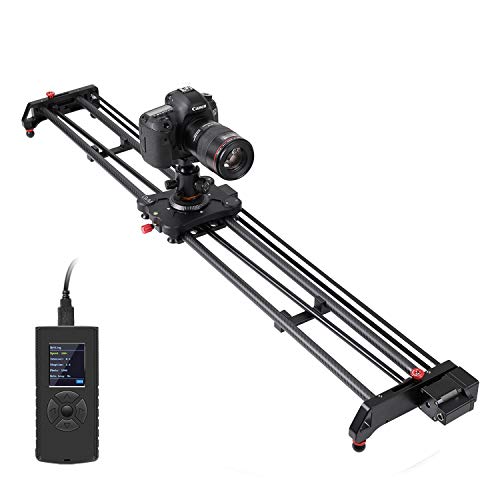
- 48-inch carbon-fiber track with 5 kg capacity
- Programmable speed, intervals, loops, and endpoints
- Includes battery, cables, remote, and carrying bag
Best For: Long tracking shots and heavier camera setups
App-Controlled Dolly

- Wireless app control for manual, video, and time-lapse modes
- Quiet dual motor rated below 30 dB
- Includes NP-F750 battery with up to five hours of runtime
Best For: Quiet, portable app-controlled camera movement
Creator-First Compact Pick
IFOOTAGE PICO Motorized Slider

- 15.8-inch portable design for travel and tabletop filming
- 360-degree pan combined with motorized linear motion
- App control supports time-lapse, stop motion, and panorama
Best For: Compact creator rigs and lightweight cameras
Long-Track Versatility
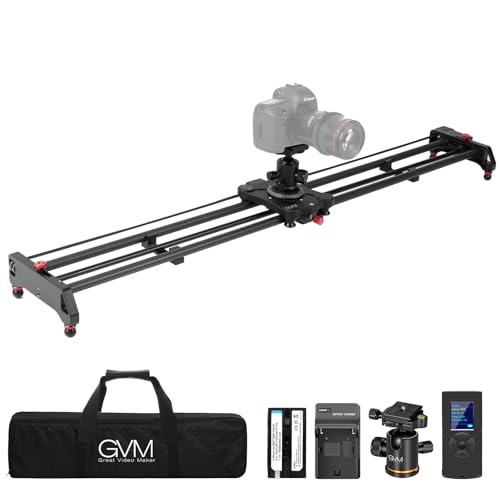
- 48-inch carbon-fiber rail
- Tracking and 120° panorama modes
- Remote-controlled video and time-lapse settings
Best For: Extended camera moves and programmed studio shots
AI Subject Tracking
IFOOTAGE Shark Slider Nano II-660

- AI face and object tracking
- Up to 8 keyframes via app or touchscreen
- DJI RS integration for multi-axis tracking
Best For: Solo creators and precise automated follow shots
App-Controlled Creative Pick – GVM 32-Inch Motorized Slider
For creators seeking camera sliders with motion tracking, the GVM 32-inch motorized slider offers app-controlled tracking, panoramic, time-lapse, and video modes. Its carbon-fiber construction, adjustable legs, and multiple mounting threads make it a versatile choice for studio or location work.
Best For: Vloggers, photographers, and filmmakers who want customizable automated camera movement with broad mounting flexibility.
Pros:
- Six shooting modes with adjustable start and end points, speed, dwell time, and pauses.
- iOS and Android app control over Bluetooth.
- Carbon-fiber build with adjustable legs and a carry bag.
- Supports horizontal, vertical, and 45-degree setups with multiple 1/4-inch and 3/8-inch ports.
Cons:
- Its 32-inch class length may provide less travel than extended professional sliders.
- Remote operation depends on the app and compatible shutter-release cable.
The GVM is a practical all-rounder when programmable motion and portability matter more than advanced multi-axis control. It is especially appealing for solo creators producing repeatable tracking shots and time-lapses.
AI Tracking Powerhouse – IFOOTAGE Shark Nano II 660
The IFOOTAGE Shark Nano II 660 is one of the more advanced camera sliders with motion tracking, combining AI subject tracking with motorized sliding and 360-degree pan movement. It also supports waypoint programming, quiet operation, and optional DJI gimbal integration for coordinated multi-axis shots.
Best For: Professional creators, interview shooters, live-streamers, and solo operators who need automated subject following and complex camera movement.
Pros:
- AI tracking can follow faces or moving objects through the iFootage Moco app.
- Offers 360-degree pan movement, dual-axis control, and up to eight waypoints.
- Supports up to 7kg horizontally and operates below 20dB.
- Touchscreen and smartphone controls, with USB-C PD 60W power support.
Cons:
- DJI gimbal integration requires a separate gimbal and adapter compatibility.
- The advanced feature set may be more than casual users need.
- A 17-inch sliding range is relatively compact for sweeping dolly moves.
Choose the Nano II 660 when intelligent tracking and multi-axis control are priorities. Its compact travel range is offset by sophisticated automation, quiet performance, and strong support for heavier camera setups.
Long-Travel Value Pick – NEEWER ER1 47.2-Inch Slider
For buyers who want extended movement without stepping up to a more specialized motion-control system, the NEEWER ER1 provides a 47.2-inch motorized track with app control and time-lapse support. It can also use an optional 2.4G remote and supports several shooting angles.
Best For: Product videos, time-lapse photography, and creators who need long camera travel with a relatively lightweight carbon-fiber rail.
Pros:
- Long 47.2-inch travel for broad tracking movements.
- App control with manual, video, and time-lapse modes.
- Included 4400mAh NP-F750 battery supports extended shooting.
- Supports horizontal, 45-degree tilt, tracking, and 120-degree panorama setups.
Cons:
- The 2.4G remote is not included.
- Charger is not included.
- Minor shake may occur during macro photography.
The ER1 stands out for its combination of long travel, battery operation, and angle flexibility. It is a sensible choice for creators who prioritize reach and automated movement, provided they plan for the missing charger and optional remote.
Professional Multi-Axis Choice – IFOOTAGE Shark Nano II-860
The IFOOTAGE Shark Slider Nano II-860 is designed for filmmakers who need camera sliders with motion tracking plus coordinated gimbal movement. Its 24.9-inch travel, AI-powered tracking, quiet brushless motor, and compatibility with several DJI RS gimbals support precise, cinematic motion control.
Best For: Professional filmmaking, interviews, vlogs, and on-location productions using compatible DJI RS gimbals.
Pros:
- Supports five-axis motion control with compatible DJI RS2, RS3 Pro, RS4, and RS4 Pro gimbals.
- AI-powered tracking and app controls enable intelligent subject following and custom motion paths.
- Handles up to 11lb horizontally and 5.5lb vertically.
- Quiet PD60W brushless motor with PD and NPF battery power options.
Cons:
- Advanced gimbal features require a separately purchased compatible gimbal.
- At 7.65lb, it is heavier than more compact travel sliders.
- Its 24.9-inch travel is shorter than the NEEWER ER1’s track.
The Nano II-860 is best suited to production teams and serious solo filmmakers who can take advantage of synchronized gimbal motion. Its higher weight and specialized ecosystem make it less compelling for simple horizontal slides, but valuable for complex, repeatable camera moves.
Long-Track Workhorse – 48-Inch Motorized Slider
For creators comparing camera sliders with motion tracking, the GVM Great Video Maker offers a full 48-inch carbon-fiber track with programmable motorized movement. You can set start and end points, adjust speed and intervals, and use tracking, time-lapse, or panoramic shooting modes.
Best For: Longer tracking shots, panoramic movement, time-lapse projects, and heavier camera setups up to 5 kg.
Pros:
- 48-inch carbon-fiber rail provides a long travel range.
- Adjustable speed, interval, stop time, photo count, and automatic looping.
- Supports manual and motorized operation, with multiple tripod mounting ports.
- Includes a battery, charger, shutter-release cables, remote, and carrying bag.
Cons:
- At 11.8 pounds and 48 inches long, it is less convenient for travel.
- It is not water resistant.
- Its extensive setup and controls may be more than casual users need.
This is the strongest option here for extended, repeatable camera moves and larger rigs. Choose it when track length and programmable motion matter more than portability.
App-Controlled Dolly – NEEWER DL400 Motorized Dolly
The NEEWER DL400 is a compact choice for camera sliders with motion tracking, combining app control with a motorized dolly design. Its dual motor operates below 30 dB, while five speed settings and a supplied NP-F750 battery support controlled movement for video and time-lapse work.
Best For: Creators who want wireless phone control, quiet tabletop or studio movement, and a portable dolly for loads up to 6.6 pounds.
Pros:
- NEEWER App supports Manual, Live Video, and Time Lapse modes.
- Ultra-quiet dual motor is rated below 30 dB.
- Supplied NP-F750 battery offers up to five hours of runtime.
- Ball head provides 360-degree rotation and 90-degree tilt.
Cons:
- A camera shutter cable is required separately for time-lapse photography.
- The maximum load is 6.6 pounds, limiting heavier setups.
- The supplied guidance advises against starting at the fastest speed uphill.
The DL400 stands out when wireless control and low operating noise are priorities. Its app-based workflow is convenient, though time-lapse users should budget for the separate shutter cable.
Creator-First Compact Pick – IFOOTAGE PICO Motorized Slider
For compact camera sliders with motion tracking, the IFOOTAGE PICO pairs a 15.8-inch motorized rail with 360-degree panning and phone control. It is designed for lightweight creator setups, including DJI Pocket 3, action cameras, smartphones, and compatible mirrorless cameras.
Best For: Travel creators, tabletop filming, product videos, vlogging, time-lapse, stop motion, and compact B-roll setups.
Pros:
- Compact 15.8-inch design suits desks, studios, and travel kits.
- Combines linear motion with 360-degree panning for two-axis movement.
- App control supports repeatable moves, time-lapse, stop motion, panorama, and multi-point targeting.
- Compatible with DJI Pocket 3, Action 5, Action 6, smartphones, and lightweight cameras.
Cons:
- The compact 15.8-inch rail offers less travel than a full-size slider.
- It is intended for lightweight setups rather than large camera rigs.
- The supplied notes do not specify maximum load or battery runtime.
The PICO is the most portable and creator-focused option in this group. It makes repeatable motion easier in small spaces, especially when paired with a compact camera or DJI Pocket 3.
Long-Track Versatility – GVM 48-Inch Motorized Slider
The GVM 48-inch motorized slider is a practical choice for camera sliders with motion tracking when you need extended travel and several programmed movement options. It supports horizontal, tracking, and 120° panoramic shooting, along with video and time-lapse modes controlled from the included remote.
Best For: Long product shots, panoramic movements, and programmed time-lapse work.
Pros:
- 48-inch carbon-fiber rail provides substantial travel for wider compositions.
- Supports tracking, horizontal, and 120° panoramic shooting.
- Remote control manages speed, endpoints, dwell time, pauses, shot count, and looping.
- Includes multiple 1/4-inch and 3/8-inch mounting ports plus six shutter cables.
Cons:
- At 5.42 kg, it is less convenient to transport than a compact slider.
- It is not water resistant.
The GVM stands out when rail length and shooting-mode flexibility matter most. Its remote and broad camera compatibility make it well suited to repeatable studio or time-lapse setups, though its size and weight favor planned productions over quick handheld-style portability.
Compact Dolly Tracking – NEEWER Wireless Motorized Dolly
The NEEWER DL100 is a compact alternative for camera sliders with motion tracking, using three adjustable wheels to create straight or circular routes. Its wireless remote lets you change speed and direction or pause the dolly, making it useful for lightweight cameras, phones, and action cameras.
Best For: Portable tabletop moves, circular tracking shots, and lightweight camera setups.
Pros:
- Adjustable wheel angles support straight-line and creative circular movement.
- Wireless remote offers three speeds, direction control, and pausing from up to 6 meters.
- Built-in 1,800mAh battery provides up to 6 hours of service time.
- Supports cameras and phones up to a stated 6.6-pound maximum.
Cons:
- Its 6.6-pound payload is lower than that of a full-size professional slider.
- It has only three selectable movement speeds.
- The product is not water resistant.
The DL100 prioritizes portability and route flexibility rather than long rail travel or advanced programmed motion. It is a sensible fit for creators who want remote-controlled tracking with compact cameras, smartphones, or action cameras.
AI Subject Tracking – IFOOTAGE Shark Slider Nano II-660
The IFOOTAGE Shark Slider Nano II-660 is built for camera sliders with motion tracking, combining AI face and object tracking with app or touchscreen control. It also supports keyframed movements, 360° pan capability, and DJI RS integration for more coordinated multi-axis shots.
Best For: Solo creators and productions needing precise subject tracking, keyframes, and quiet operation.
Pros:
- AI recognizes faces and tracks subjects for follow shots.
- DJI RS compatibility enables claimed 5-axis intelligent tracking with supported stabilizers.
- Offers 0.01mm positioning accuracy, up to 140mm/s slide speed, and a 7.7-pound payload.
- App and IPS touchscreen control support up to eight keyframes and six shooting modes.
Cons:
- Advanced multi-axis tracking requires a compatible DJI RS stabilizer.
- Its 26-inch rail is shorter than the GVM’s 48-inch travel.
- It is not water resistant.
The Nano II-660 is the most feature-focused option here for automated subject movement and precise repeatable shots. Its quiet motor, tracking tools, and control options suit solo operation, while the DJI integration adds capability for creators already using supported RS equipment.
How We Picked the Best Camera Sliders with Motion Tracking
We evaluated these sliders by looking at the features that most affect real-world shooting: motorized movement, tracking and time-lapse support, control options, rail length, stated payload, portability, and compatibility with cameras, phones, gimbals, and accessories. Models with app, remote, or touchscreen control can make it easier to program repeatable moves, while multi-axis systems offer more advanced control for professional rigs.
Because product specifications and included accessories can vary by configuration, confirm the current payload rating, battery setup, mounting hardware, and app compatibility before buying.
Quick Comparison
- Best for compact setups: Choose a portable slider such as the iFootage PICO or Shark Nano II 660 when space and transport weight matter most.
- Best for longer moves: Consider a 47.2-inch or 48-inch model from NEEWER or GVM for broader lateral movement and larger framing changes.
- Best for advanced motion control: The iFootage Shark Slider Nano II-860 and Nano II-660 variants are aimed at users who want gimbal compatibility, face tracking, or multi-axis operation.
- Best for simple automated movement: A basic motorized slider with app or remote control can handle repeatable slides, round trips, and time-lapse work without the complexity of a full motion-control rig.
Key Buying Factors for Camera Sliders with Motion Tracking
Payload and Camera Balance
Check the slider’s maximum load against your complete setup, including the camera, lens, quick-release plate, gimbal, and any follow-focus or monitoring accessories. Stay below the published limit for smoother movement and better reliability.
Tracking and Control Features
Look for the tracking mode you actually need. Face tracking can help with presenter and subject shots, while programmable speed, interval, loop, and time-lapse controls are more useful for repeatable production moves. App control is convenient, but physical remotes or touchscreens can be preferable outdoors or on set.
Rail Length, Speed, and Noise
Longer rails provide wider movement but are less convenient to carry. A slider should also offer an appropriate speed range: slow, consistent motion matters for time-lapse and cinematic shots, while faster travel can help with event, product, or social-video work. Consider motor noise when recording dialogue nearby.
Power and Mounting
Review battery capacity, charging options, operating time, and whether the unit can run from external power. Multiple mounting points, tripod compatibility, and a stable carriage are important when using heavier cameras or angled setups.
Who Should Buy Which Camera Sliders with Motion Tracking?
Traveling creators and phone shooters should prioritize compact models that are quick to set up. Product photographers and time-lapse users will benefit from programmable movement, reliable looping, and fine speed control. Mirrorless and DSLR filmmakers should focus on payload, rail stability, and battery life. Professional motion-control users may prefer a longer slider or a multi-axis system with gimbal and subject-tracking compatibility.
Before purchasing, match the slider to your heaviest intended setup rather than your current camera alone. That leaves room for accessories and helps keep automated moves smooth as your production needs grow.