The best camera sliders make controlled tracking shots, repeatable time-lapse moves, and smooth product footage easier to capture. This roundup compares compact manual rails with longer motorized systems for cameras, phones, and action cameras.
Use the comparison and buying advice below to match slider length, payload, motion control, and portability to the way you actually shoot.
Best 10 Camera Sliders Picks for 2026
Best Portable Manual Slider
Zecti 24-Inch Carbon Fiber Slider

- Lightweight 24-inch manual design
- Adjustable legs and multiple mounting threads
- Supports phones, action cameras, and small cameras
Best For: Travel and flexible manual tracking shots
Best Compact Motorized Slider

- 255mm motorized travel with 360-degree pan
- Onboard A/B controls and app keyframes
- Compact tabletop design with phone holder
Best For: Solo tabletop and product video creators
Best Versatile Manual Slider

- 16-inch carbon fiber rail with four bearings
- Adjustable legs for uneven surfaces
- Includes ball head, phone clamp, and action mount
Best For: Portable multi-device shooting outdoors or on tabletops
Best Advanced Motorized Slider

- Up to eight programmable motion points
- AI face and object tracking
- Quiet brushless motor with touchscreen control
Best For: Cinematic, repeatable, multi-axis production moves
Best App-Controlled Long-Rail Option

- 120cm carbon-fiber rail for extended camera movement
- App-controlled tracking, panoramic, video, and time-lapse modes
- Includes six shutter cables, extension cable, adjustable legs, and bag
Best For: Long programmed moves and versatile multi-angle shooting
Best Premium Multi-Axis Choice

- 360-degree pan and dual-axis motorized movement
- 7kg horizontal payload with quiet sub-20dB operation
- Touchscreen/app control, AI tracking, and DJI gimbal support
Best For: Professional multi-axis shots and quiet, heavy-camera setups
Best Value Long-Rail Slider

- 120cm carbon-fiber rail with 11lb horizontal capacity
- App control plus optional 2.4G remote operation
- Includes 4400mAh NP-F750 battery and supports time-lapse mode
Best For: Product videos, time-lapse work, and outdoor shooting
Best Professional Feature Set
GVM 48-Inch Carbon Fiber Slider
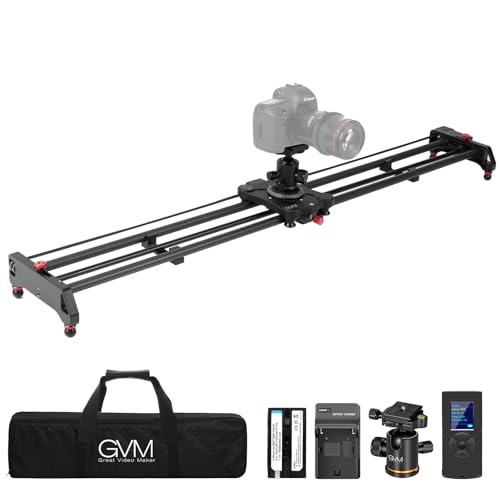
- Supports tracking, panoramic, horizontal, and time-lapse modes
- Remote programs speed, endpoints, pauses, and looping
- Long 120-centimeter rail with tripod screw ports
Best For: Programmable video and time-lapse production
Best Versatile Mid-Length Pick

- Supports video, time-lapse, and automatic round trips
- Works horizontally, vertically, and at 45 degrees
- Adjustable feet and tripod-compatible mounting holes
Best For: Interviews and general DSLR or cellphone photography
Best Portable Manual Slider – Zecti 24-Inch Carbon Fiber Slider
The Zecti 24-inch camera slider is a lightweight manual option for creators who want smooth tracking shots without adding much bulk to a travel kit. Its adjustable legs, bubble level, and multiple mounting threads support horizontal, vertical, diagonal, and sideways setups.
Best For: Travel photographers, smartphone users, and small-camera setups needing a versatile manual slider.
Pros:
- Portable 24-inch carbon fiber design weighs about 654g.
- Four precision bearings and a double interior rail system are designed for quiet, stable movement.
- Adjustable legs, nonskid feet, bubble level, and 1/4-inch and 3/8-inch mounting holes support varied setups.
- Compatible with phones, action cameras, and small cameras from brands including Sony, Canon, Lumix, Insta360, GoPro, and DJI.
Cons:
- Manual operation does not provide programmable or motorized movement.
- The supplied notes indicate that overtightened screws may cause noise or rough movement and may require adjustment.
- Maximum recommended load is 4.4 pounds.
Choose the Zecti when portability and flexible positioning matter more than automated motion. It is a practical entry-level camera slider, provided you are comfortable fine-tuning the hardware if the carriage feels too tight.
Best Compact Motorized Slider – IFOOTAGE Shark Slider PICO
The IFOOTAGE Shark Slider PICO is a compact motorized camera slider for tabletop videos, product demonstrations, and smartphone content. It combines 255mm of slide travel with 360-degree pan rotation, while onboard controls let you set A/B points without opening the app.
Best For: Solo creators making product, food, tabletop, time-lapse, and stop-motion videos.
Pros:
- Motorized sliding and 360-degree pan movement add changing perspectives to close-ups.
- Onboard controls support A/B points, speed adjustments, and looping for basic moves.
- The Moco app allows up to eight keyframes for more complex programmed sequences.
- Compact 15.7-inch aluminum body includes built-in feet, a carrying case, and up to seven hours of horizontal battery operation.
Cons:
- Payload is limited to 2.4 pounds horizontally or 1.1 pounds vertically, including accessories.
- Additional mounts and a PD 30W-or-higher charger are sold separately.
- Its 255mm travel is shorter than that of a full-size slider.
The PICO is a strong fit when automated motion and portability are priorities. Its phone holder makes setup accessible, while app-based keyframes provide room to expand into more advanced tabletop moves.
Best Versatile Manual Slider – NEEWER CS1M 16-Inch Slider
The NEEWER CS1M is a compact manual camera slider that balances portability with broad mounting flexibility. Its 16-inch carbon fiber rail uses four bearings, adjustable legs, and a ball head, with included phone and action-camera accessories for smaller rigs.
Best For: Creators who need one lightweight slider for cameras, phones, GoPro-style cameras, and uneven outdoor surfaces.
Pros:
- Carbon fiber and aluminum construction supports up to 4.4 pounds horizontally.
- Adjustable legs elevate from 2 to 5cm and help level the slider on uneven terrain.
- Four bearings, a tension knob, bubble level, and 1/4-inch and 3/8-inch threads support controlled positioning.
- Includes a 360-degree ball head, phone clamp, action-camera mount, and carrying bag.
Cons:
- At 16 inches, the rail offers less travel than longer 24- or 26-inch models.
- It is a manual slider, so repeatable programmed movement is not available.
- Maximum support decreases to 2.2 pounds at a 45-degree tilt or vertically.
The CS1M is a well-rounded choice for portable camera sliders when accessory compatibility and setup flexibility are important. Its shorter rail favors compact rigs and close-range movement rather than long tracking shots.
Best Advanced Motorized Slider – IFOOTAGE Shark Nano II
The IFOOTAGE Shark Nano II is an advanced motorized camera slider for filmmakers who need programmable, multi-axis movement. Its touchscreen and Moco app support up to eight motion points, while AI face and object tracking, DJI gimbal integration, and multiple shooting modes expand its production capabilities.
Best For: Filmmakers producing interviews, product shots, time-lapses, stop-motion, macro footage, and coordinated gimbal moves.
Pros:
- Supports up to eight customizable motion points through the touchscreen or Moco app.
- AI-powered face and object tracking can help keep a selected subject centered.
- Brushless motor and stabilization algorithms are designed for quiet, steady movement.
- Includes independent touchscreen control, USB-C PD 3.0 charging, and five shooting modes.
Cons:
- Its advanced controls and app features may be more than casual users need.
- DJI gimbal integration uses the included custom RS Adapter, so compatibility depends on the supported setup.
- The supplied notes do not specify the complete payload, battery runtime, or included accessory list.
The Nano II is aimed at controlled, repeatable camera movement rather than simple manual slides. It makes the most sense for production workflows that can take advantage of keyframes, tracking, multi-axis coordination, and quiet operation.
Best App-Controlled Long-Rail Option – GVM 48-Inch Motorized Slider
For creators who need long, programmable camera sliders, the GVM 48-inch model combines a carbon-fiber rail with app control and multiple automated shooting modes. Its 120cm travel length and adjustable legs make it suitable for horizontal, vertical, and 45-degree setups.
Best For: Long tracking shots, time-lapse work, panoramic movement, and creators who want smartphone-controlled operation.
Pros:
- Supports tracking, panoramic, time-lapse, and video modes with adjustable speed, intervals, and endpoints.
- iOS and Android app control avoids reliance on a hardwired controller.
- Carbon-fiber construction, adjustable legs, and multiple 1/4-inch and 3/8-inch mounting ports support flexible setups.
- Includes six shutter-release cables, an extension cable, and a carry bag.
Cons:
- Its 120cm rail and 4kg weight are less convenient for compact travel than shorter sliders.
- The listed battery life is approximately two hours.
- It is not water resistant.
The GVM is a practical choice when rail length and programmable movement matter most. It offers broad shooting flexibility, though buyers should account for its larger packed size and limited listed battery runtime.
Best Premium Multi-Axis Choice – IFOOTAGE Shark Nano II 660
The IFOOTAGE Shark Nano II 660 is a compact, feature-rich option among camera sliders, adding motorized pan movement, waypoint programming, and compatibility with select DJI gimbals. Its quiet motor and high payload rating suit demanding production and live-content setups.
Best For: Professional filmmakers, gimbal users, live streaming, interviews, weddings, and quiet recording environments.
Pros:
- Offers 360-degree pan movement and dual-axis motorized control.
- Supports up to 7kg horizontally and 3.5kg vertically, with claimed movement precision down to 1µm.
- Provides touchscreen and iOS/Android app control, with up to eight customizable waypoints.
- Includes AI face/object tracking, multi-target mode, USB-C PD 60W support, and DJI gimbal integration with the appropriate adapter.
Cons:
- The 17-inch sliding range is shorter than the 120cm travel of the other listed long-rail models.
- DJI gimbal integration requires a compatible gimbal and sufficient 60W-plus power supply.
- Its advanced controls and multi-axis features may be more than casual users need.
Choose the Nano II 660 if synchronized pan, slider, and gimbal movement are priorities. It is the most production-oriented option here, but its shorter travel and specialized ecosystem may not suit every simple slide shot.
Best Value Long-Rail Slider – NEEWER ER1 47.2-Inch
The NEEWER ER1 is a long carbon-fiber camera slider designed for smooth automated moves without excessive weight. It supports app control, optional 2.4G remote control, time-lapse programming, and a rechargeable NP-F750 battery for extended shooting sessions.
Best For: Product videos, time-lapse photography, outdoor creators, and buyers wanting a 120cm motorized slider with flexible controls.
Pros:
- Provides a 47.2-inch/120cm rail with an 11lb horizontal and 5.5lb 45-degree tilt capacity.
- Supports manual, video, and time-lapse modes through the app, with optional 2.4G remote control.
- Includes a 4400mAh NP-F750 battery and uses a quiet stepper motor.
- Carbon-fiber construction, four roller bearings, adjustable shooting angles, and 1/4-inch and 3/8-inch mounting holes add flexibility.
Cons:
- The 2.4G remote control is not included.
- A charger is not included; the listing specifies a 5V/2A Type-C portable charger as an option.
- Minor shake may occur during macro photography.
The ER1 balances long travel, portability, and useful automation for general video and time-lapse work. It is a strong everyday option, provided you budget for the missing charger and avoid expecting perfectly shake-free macro movement.
Best Compact Pick – NEEWER Wireless Motorized Dolly
If you want camera sliders for compact setups and creative movement, the NEEWER DL100 offers a portable three-wheel design with wireless speed and direction control. Its adjustable wheels support straight-line or circular routes, while the built-in battery provides up to six hours of service time.
Best For: Smartphone, action-camera, and lightweight camera users who want portable automated tracking shots.
Pros:
- Wireless remote adjusts speed, direction, and pause functions from up to 6 meters away.
- Three selectable speeds support controlled movement for different shots.
- Adjustable wheel angles enable straight-line and circular movement.
- Built-in 1800mAh battery offers up to six hours of service time.
Cons:
- Supports a maximum recommended load of 6.6 pounds.
- Not water resistant.
- Accessories such as smartphone holders and action-camera adapters are not included.
The DL100 is a practical choice when portability and creative movement matter more than a long rail. Its compact footprint, rechargeable battery, and broad mounting compatibility make it especially useful for mobile content setups.
Best Professional Feature Set – GVM 48-Inch Carbon Fiber Slider
Among camera sliders for advanced motion control, this 48-inch GVM model emphasizes programmable shooting. It supports tracking, horizontal movement, 120-degree panoramic shots, video, and time-lapse modes, with remote settings for speed, endpoints, pauses, dwell time, looping, and shot counts.
Best For: Professional-style video and time-lapse work requiring long travel and programmable motion.
Pros:
- Offers tracking, horizontal, 120-degree panoramic, video, and time-lapse shooting modes.
- Remote control allows adjustment of endpoints, speed, pauses, dwell time, and automatic looping.
- Time-lapse mode supports up to 1,000 photos and adjustable step distance.
- Multiple 1/4-inch and 3/8-inch ports support tripod mounting.
Cons:
- Its 120-centimeter length and 5.42-kilogram weight make it less portable.
- Only camera compatibility is specified in the supplied details.
- Not water resistant.
This GVM slider is the most feature-rich option here for repeatable, automated camera movement. Its long carbon-fiber rail and extensive remote programming are well suited to controlled production environments, provided transport weight is not a concern.
Best Versatile Mid-Length Pick – GVM 27-Inch Motorized Slider
This 27-inch GVM is one of the more flexible camera sliders for interviews and general photography. Its aluminum-alloy rail supports time-lapse, video, and automatic round-trip shooting, while adjustable feet and multiple mounting holes help with setup on the ground or a tripod.
Best For: DSLR, video-camera, and cellphone users who need multiple shooting angles in a manageable rail size.
Pros:
- Supports time-lapse, video, and automatic round-trip shooting.
- Works horizontally, vertically, and at 45-degree angles.
- Adjustable non-slip feet help level the slider during setup.
- Multiple 1/4-inch and 3/8-inch screw holes support ground or tripod use.
Cons:
- Maximum recommended load is 2.5 kilograms.
- At 2.36 kilograms, it is not the lightest portable option.
- Not water resistant.
The GVM 27-inch model balances useful shooting modes with a shorter footprint than the 48-inch rail. Its multi-angle capability is particularly appealing for interview photography and creators who want one slider for several camera positions.
How We Picked the Best Camera Sliders
We focused on the features that have the greatest effect on real-world shooting: usable travel length, drive system, payload support, motion-control options, setup demands, and compatibility with different cameras. The selection includes manual carbon-fiber rails for straightforward moves, compact motorized models for travel and tabletop work, and longer systems designed for interviews, commercial video, and time-lapse capture.
We also considered whether each slider offers useful accessories or control methods, such as phone apps, remotes, rotary-axis movement, ball heads, phone clamps, and action-camera mounts. A slider is only a good buy if its size and controls fit your workflow.
Quick Comparison
- Best for simple manual moves: Zecti and NEEWER carbon-fiber sliders.
- Best for compact motorized shooting: IFOOTAGE Shark Slider Pico.
- Best for portable two-axis control: IFOOTAGE Shark Nano II models.
- Best for long travel: the 47.2-inch NEEWER and 48-inch GVM sliders.
- Best for phone and action-camera setups: models with included clamps and mounts, such as the NEEWER 16-inch slider.
Key Buying Factors for Camera Sliders
Manual or Motorized Operation
Manual sliders are quicker to set up, quieter, and generally easier to transport. They work well for live camera moves where you can control speed by hand. Motorized Camera Sliders provide repeatable motion, which is more valuable for time-lapse, product shots, visual effects, and automated passes.
Travel Length and Portability
A 15- to 27-inch slider is easier to use on a desk, small tripod, or travel setup. Longer 47- to 48-inch models create more dramatic lateral movement but need more room, stronger support, and a larger carrying solution. Remember that advertised length is not always the same as the carriage’s usable travel.
Payload, Stability, and Mounting
Check the stated load rating with your complete setup attached, including the camera, lens, battery, cage, and head. A sturdy rail and multiple bearings help reduce wobble, while tripod compatibility matters for longer sliders. A ball head or leveling base can make camera alignment much faster.
Control and Power
For motorized models, look for the control method you prefer: onboard controls, remote, or app. Confirm whether the system supports time-lapse, variable speed, loop or round-trip movement, and any desired rotary-axis functions. Battery capacity and charging options are especially important for outdoor or extended shoots.
Who Should Buy Which Camera Sliders?
Choose a compact manual slider if you want an affordable, low-maintenance tool for B-roll, tabletop footage, or occasional tracking shots. Pick a compact motorized model if portability and repeatable movement matter more than maximum travel. For professional time-lapse, product work, or wide lateral compositions, a longer motorized slider is usually the better investment. Phone and action-camera users should prioritize included mounts and a lighter carriage, while DSLR and mirrorless users should verify payload and tripod support before buying.