The best analog vacuum gauges make it easy to monitor negative pressure at a glance, whether you are evacuating an HVAC system, testing an engine, or checking a pump and plumbing setup.
This roundup compares 10 selected gauges and vacuum-testing tools by scale, construction, connection style, pressure range, and intended use so you can choose a practical match for your equipment.
Best 10 Analog Vacuum Gauges Picks for 2026
Industrial Pick
Winters Liquid-Filled Pressure and Vacuum Gauge

- 2.5-inch dual-scale dial reads vacuum and pressure
- IP65 stainless steel case with liquid-filled display
- ±1.5% accuracy and 1/4-inch NPT bottom mount
Best For: Pumps, compressors, machinery, and general equipment monitoring
Precision Digital Alternative

- Reads microns, millibar, torr, and inches Hg
- Automatic temperature compensation and five-digit LCD
- Includes T-fitting, hook, sensor, and padded case
Best For: HVAC and refrigeration evacuation measurements
Outdoor-Ready Pick
SENCTRL Liquid-Filled Vacuum Gauge

- -30 inHg to 0 inHg and -100 to 0 kPa range
- IP67 waterproof stainless steel case
- Silicone-oil filling rated from -40 to 140°F
Best For: HVAC work, outdoor testing, and air-pump applications
Back-Mount Value
MEANLIN MEASURE Vacuum Pressure Gauge

- 2.5-inch center-back mount with stainless steel construction
- -30 inHg to 0 psi vacuum range
- Includes 1/2-inch and 3/8-inch NPT hex bushings
Best For: Panel installations and compact vacuum monitoring
Reliable HVAC Testing
SENCTRL Glycerin-Filled Vacuum Gauge

- -30 inHg to 30 psi dual-scale range
- Glycerin-filled, IP67 waterproof design
- Lower 1/4-inch NPT mount
Best For: HVAC, air-pump, tank, and general non-corrosive pressure testing
Compact HVAC Readout
MEANLIN Stainless Steel Vacuum Gauge

- -30 inHg to 0 psi vacuum range
- 2.5-inch liquid-filled stainless steel dial
- Includes 1/2-inch and 3/8-inch NPT bushings
Best For: Compact HVAC vacuum-testing installations
Automotive Diagnostics
Hromee Fuel Pump and Vacuum Tester
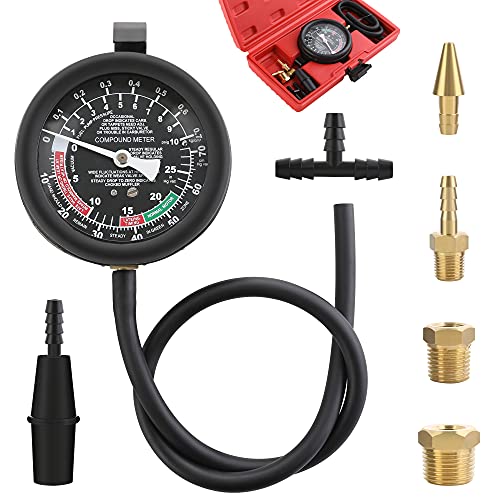
- Reads 0-28 inHg vacuum and 0-10 psi pressure
- Large 4-inch color-coded dial
- Includes hose, adapters, and carrying case
Best For: Carbureted-engine vacuum and low-pressure fuel diagnostics
Rugged Liquid-Filled Pick
30 inHg Silicone Oil Vacuum Gauge

- Liquid-filled design reduces pointer flutter
- 2.5-inch dual Psi/Bar dial
- 1/4-inch NPT lower mount
Best For: HVAC and non-corrosive pressure testing
Versatile Range Pick
Stainless Steel Vacuum Pressure Gauge

- -30 inHg to 30 psi measurement range
- Liquid-filled stainless steel design
- Includes 1/2-inch and 3/8-inch bushings
Best For: Flexible lower-mount installations
Compact Utility Pick
Winters Dry Vacuum Pressure Gauge

- Compact 1-1/2-inch dial
- Dual psi/kPa and vacuum/kPa display
- Brass internals with steel case
Best For: Basic, space-constrained pressure checks
Industrial Pick – Winters Liquid-Filled Pressure and Vacuum Gauge
For buyers comparing analog vacuum gauges, the Winters PFQ798 combines a 2.5-inch dial with a liquid-filled design for clear, steady readings. Its dual scale covers 30 inches Hg to 0–30 psi/kPa, while the stainless steel case and brass internals suit non-corrosive liquid and gas applications.
Best For: Pumps, compressors, HVAC equipment, hydraulic presses, and general machinery where a durable bottom-mount gauge is useful.
Pros:
- Liquid-filled dial helps limit pointer movement from vibration and pulsation.
- 304 stainless steel case has an IP65 rating for protection from dust and liquids.
- 2.5-inch dial provides ±1.5% full-scale accuracy and dual pressure/vacuum readings.
- Uses a 1/4-inch NPT lower-mount connection.
Cons:
- Designed for non-corrosive media rather than every fluid or gas.
- Its pressure-and-vacuum range is less specialized than a dedicated micron vacuum gauge.
The Winters is a practical analog vacuum gauge for installations that need both vacuum and low-pressure readings. Its liquid-filled construction and protected case make it a strong fit for equipment exposed to vibration or everyday shop conditions.
Precision Digital Alternative – CPS VG200 Digital Vacrometer
Although it is digital rather than analog, the CPS VG200 is worth considering when vacuum work requires micron-level readings. It switches among microns, millibar, torr, and inches Hg, with automatic temperature compensation and a five-digit LCD for detailed evacuation measurements.
Best For: HVAC and refrigeration evacuation procedures where precise digital vacuum measurements are more useful than a traditional dial.
Pros:
- Measures in microns, millibar, torr, and inches Hg.
- Calibrated to NIST standards and includes automatic temperature compensation.
- Cleanable sensor withstands up to 400 psi positive pressure.
- Includes a T-fitting, hook, and padded carrying case.
Cons:
- Not an analog gauge, so it may not suit buyers specifically wanting a mechanical dial.
- Requires batteries or another power source for operation, unlike a passive analog gauge.
The VG200 is the stronger choice when evacuation accuracy and multiple measurement units matter most. Its included accessories and protective case also make it convenient for technicians moving between jobs.
Outdoor-Ready Pick – SENCTRL Liquid-Filled Vacuum Gauge
The SENCTRL is a straightforward analog vacuum gauge for HVAC, air pumps, tanks, and vacuum testing. Its 2.5-inch dual-scale dial reads from -30 to 0 inches Hg and -100 to 0 kPa, while silicone-oil filling and an IP67 stainless steel case help it handle vibration, moisture, and temperature changes.
Best For: Air-conditioning line repair, HVAC manifolds, outdoor vacuum testing, and air-pump or vacuum-oil applications.
Pros:
- Liquid-filled design helps reduce pointer flutter from vibration and pulsation.
- IP67 waterproof case helps prevent condensation-related window fogging.
- Silicone oil is rated for use from -40 to 140°F.
- Uses a 1/4-inch NPT lower-mount connection with brass and stainless steel wetted parts.
Cons:
- Accuracy varies across the range at ±3/2/3%.
- Measures vacuum only, so it does not provide a positive-pressure scale.
- Intended for non-corrosive liquids and gases.
For buyers wanting analog vacuum gauges that can tolerate damp or variable outdoor conditions, the SENCTRL offers useful protection and a clear dual-scale display. Its range is focused on vacuum testing rather than combined pressure monitoring.
Back-Mount Value – MEANLIN MEASURE Vacuum Pressure Gauge
The MEANLIN MEASURE gauge is a compact analog vacuum gauge with a 2.5-inch stainless steel face and center-back mounting. Its -30 inHg to 0 psi range is suited to vacuum-only monitoring, and the included 1/2-inch and 3/8-inch NPT hex bushings provide additional connection flexibility.
Best For: Panels, equipment, and vacuum applications where a center-back mount and a compact 2.5-inch dial are preferred.
Pros:
- Center-back mount can simplify installation in panel-style setups.
- Stainless steel liquid-filled gauge construction is specified for the unit.
- Provides a focused -30 inHg to 0 psi vacuum range.
- Includes 1/2-inch and 3/8-inch NPT hex bushings in addition to the 1/4-inch NPT connection.
Cons:
- The supplied notes do not specify a gauge accuracy rating.
- Its 32–131°F operating temperature range is narrower than some outdoor-oriented gauges.
- It does not provide a positive-pressure measurement range.
This MEANLIN model is a sensible fit when mounting orientation and connection adaptability matter more than advanced specifications. Confirm the required port arrangement and operating conditions before choosing it for a permanent installation.
Reliable HVAC Testing – SENCTRL Glycerin-Filled Vacuum Gauge
For shoppers comparing analog vacuum gauges, the SENCTRL combines a dual-scale vacuum and pressure display with a durable, liquid-filled design. Its 2.5-inch dial covers -30 inHg to 30 psi and uses a lower 1/4-inch NPT connection for compatible testing setups.
Best For: HVAC line repair, air-pump testing, tank checks, and general water, oil, or air pressure testing.
Pros:
- Glycerin filling helps reduce pointer flutter from vibration and pulsation.
- 304 stainless steel case and brass/stainless steel wetted parts suit non-corrosive liquids and gases.
- IP67 waterproof construction helps prevent condensation and window fogging.
- Dual inHg, psi, and kPa scales provide flexible readings.
Cons:
- Designed for non-corrosive media, so it is not intended for every fluid or gas.
- The 2.5-inch dial may be less convenient to read from a distance than a larger gauge.
With its liquid-filled movement, sealed case, and broad vacuum-to-pressure range, this is a practical choice for HVAC and workshop testing where vibration resistance and clear readings matter.
Compact HVAC Readout – MEANLIN Stainless Steel Vacuum Gauge
The MEANLIN is a straightforward option among analog vacuum gauges, offering a 2.5-inch stainless steel dial with a -30 inHg to 0 psi range. Its liquid-filled construction and lower 1/4-inch NPT mount are suited to installations where a compact vacuum-only display is needed.
Best For: HVAC and other compatible vacuum-testing setups requiring a lower-mount analog gauge.
Pros:
- Clear 2.5-inch face covers the full -30 inHg to 0 psi vacuum range.
- Stainless steel construction provides a durable housing.
- Liquid-filled design is intended to support steadier readings.
- Includes 1/2-inch NPT and 3/8-inch NPT hex bushings for connection flexibility.
Cons:
- It does not provide a positive-pressure range beyond 0 psi.
- Its stated operating temperature range is limited to 32-131°F.
- NPT sizing is nominal and does not indicate the actual outside diameter.
This gauge makes sense for buyers who want a compact, stainless steel vacuum indicator and can use the included bushings to match their existing fittings.
Automotive Diagnostics – Hromee Fuel Pump and Vacuum Tester
Hromee Fuel Pump and Vacuum Tester Gauge, Carburetor Pressure Diagnostics Leakage Tool Kit
Check Price On AmazonFor automotive shoppers seeking analog vacuum gauges, the Hromee kit combines a large 4-inch, color-coded gauge with hoses and adapters for engine diagnostics. It reads 0-28 inHg vacuum and 0-10 psi pressure, making it useful for checking both vacuum systems and low-pressure fuel systems.
Best For: Carbureted vehicles with mechanical fuel pumps, engine vacuum-line checks, brake-assist testing, and locating selected leaks or pressure losses.
Pros:
- Large 4-inch color-coded dial is designed for easy reading.
- Measures both 0-28 inHg vacuum and 0-10 psi pressure.
- Includes a 2-foot hose plus multiple adapters for common vehicle connections.
- Blow-molded carrying case supports storage and transport.
Cons:
- Intended for carburetor engines with mechanical fuel-pump pressures below 10 psi.
- The kit is specialized for automotive diagnostics rather than general HVAC gauge installation.
- The hose’s maximum working pressure is 40 psi, so it is not for higher-pressure systems.
This is the most versatile choice of the three for automotive troubleshooting, especially when you need a portable kit that can test both engine vacuum and low fuel pressure.
Rugged Liquid-Filled Pick – 30 inHg Silicone Oil Vacuum Gauge
If you need analog vacuum gauges for water, oil, air, or HVAC pressure testing, this liquid-filled model combines a 2.5-inch dial with a 30 inHg vacuum range. Its silicone oil filling is designed to reduce pointer flutter in vibrating or pulsating systems.
Best For: Water pipe, HVAC, and general non-corrosive liquid or gas pressure testing where vibration resistance is useful.
Pros:
- Silicone oil helps inhibit pointer flutter and protect internal mechanisms from vibration and pulsation.
- Dual Psi/Bar display and a stated 2.5% accuracy rating support varied pressure-testing tasks.
- Stainless steel case, brass and stainless wetted parts, and a -40°C to 70°C operating range suit varied environments.
- 1/4-inch NPT lower mount and included adhesive tape simplify installation.
Cons:
- The 2.5-inch dial may be less compact than smaller utility gauges.
- It is intended for non-corrosive media rather than aggressive chemicals.
This is a practical choice when a liquid-filled analog gauge and broad temperature tolerance matter more than specialized high-precision instrumentation.
Versatile Range Pick – Stainless Steel Vacuum Pressure Gauge
For buyers comparing analog vacuum gauges with a combined vacuum-and-pressure scale, this MEANLIN MEASURE model covers -30 inHg to 30 psi. The 2.5-inch stainless steel liquid-filled gauge uses a lower mount and includes 1/2-inch and 3/8-inch NPT hex bushings.
Best For: General installations that need a lower-mount gauge with multiple connection options and a combined vacuum/pressure range.
Pros:
- Measures from -30 inHg through 30 psi for combined vacuum and pressure checks.
- Stainless steel construction and liquid-filled design are suited to a durable utility setup.
- Includes 1/2-inch and 3/8-inch NPT hex bushings for added connection flexibility.
- Backed by a stated one-year warranty.
Cons:
- The listed operating temperature range is limited to 0°C to 55°C.
- NPT sizes are nominal pipe sizes, so the listed size does not equal the actual outside diameter.
Its broad measurement range and included bushings make this a flexible option, especially when your installation may require adapting from the 1/4-inch NPT connection.
Compact Utility Pick – Winters Dry Vacuum Pressure Gauge
This Winters model is a compact choice among analog vacuum gauges, with a 1-1/2-inch dial and a dry, economy-style construction. Its dual-scale face covers 30 inches Hg vacuum to zero and displays psi/kPa and Hg vacuum/kPa readings.
Best For: Basic non-corrosive liquid or gas pressure checks where a smaller dial and economical dry gauge are preferred.
Pros:
- Compact 1-1/2-inch dial fits applications with limited mounting space.
- Brass wetted parts are intended for non-corrosive liquid and gas pressure measurement.
- Black steel case provides corrosion resistance, while the dual-scale display supports multiple readings.
- Available connection details include 1/8-inch or 1/4-inch NPT options and lower or center-back mounting.
Cons:
- It is a dry gauge, so it does not offer liquid filling for damping vibration or pulsation.
- The stated accuracy is 3/2/3% over the range, less precise than gauges with tighter published accuracy ratings.
- The smaller dial may be harder to read from a distance.
This gauge suits straightforward utility work and space-constrained installations, but a liquid-filled design may be preferable for systems with noticeable vibration.
How We Picked These Analog Vacuum Gauges
We selected products across the main use cases for Analog Vacuum Gauges, including HVAC service, automotive diagnostics, water and plumbing systems, shop equipment, and general industrial monitoring. The comparison considers readable dial size, vacuum range, pressure capability, case and wetted-part materials, liquid-filled versus dry construction, connection location, included fittings, and overall installation flexibility.
Several products are dedicated vacuum gauges, while others combine vacuum and positive-pressure readings or include diagnostic accessories. That distinction matters: a simple dial gauge can be ideal for routine monitoring, while a test kit or dual-scale instrument may be more useful for troubleshooting.
Quick Comparison
| Best For | What to Look For |
|---|---|
| HVAC evacuation | Deep-vacuum capability, clear inHg scale, durable case, and compatible fittings |
| Automotive testing | Vacuum and pressure readings, hose adapters, and a portable test format |
| Water or plumbing systems | Liquid-filled housing, corrosion-resistant case, and suitable NPT connection |
| Industrial monitoring | Stainless-steel construction, stable movement, and a readable dual-scale dial |
| Budget utility use | Simple dry gauge with the correct range and mounting orientation |
Key Buying Factors for Analog Vacuum Gauges
Vacuum Range and Units
Most general-purpose models display vacuum in inches of mercury, abbreviated inHg or sometimes shown as inches Hg. Choose a scale that covers the vacuum level you expect without making normal readings difficult to interpret. Dual-scale dials can add kPa or positive-pressure readings, but extra markings may reduce at-a-glance clarity.
Construction and Filling
Liquid-filled gauges help dampen pointer vibration and are often preferable around pumps, engines, or other equipment with pulsation. Stainless-steel cases generally offer better resistance to moisture and rough service than painted steel. Brass internals are common for ordinary, non-corrosive applications, but verify material compatibility before exposing the gauge to aggressive fluids.
Connection and Mounting
Check the thread specification before ordering. Many options use 1/4-inch NPT connections and may include adapters for 3/8-inch or 1/2-inch NPT fittings. Lower-mount gauges suit panel or manifold installations from below, while center-back mounts can provide a cleaner face when the gauge is installed behind a panel. Confirm clearance for the case, fitting, and hose.
Accuracy and Intended Task
Analog gauges are excellent for visual trend monitoring, but they are not interchangeable with micron-level digital vacrometers. For HVAC evacuation work where deep-vacuum measurement is critical, use an instrument designed to display microns or pair the analog gauge with a calibrated digital gauge. For leak checks, engine diagnostics, and basic pressure verification, a robust analog dial may be sufficient.
Who Should Buy Which Analog Vacuum Gauges?
Choose a liquid-filled stainless-steel model for equipment exposed to vibration, moisture, or outdoor service. Pick a dual-range vacuum/pressure gauge when you need to observe both suction and positive pressure. Automotive users should favor a dedicated tester with hoses and adapters, especially for carburetor, fuel-pump, and engine troubleshooting. For a permanent installation, prioritize the correct mount position, thread size, and dial visibility over extra accessories.
If you need the simplest low-cost option for occasional checks, an economy dry gauge can work well when its range and fittings match the system. For deeper HVAC evacuation work, consider a digital micron gauge instead of relying on an analog dial alone.