Finding the right conductivity meter can make routine water-quality checks, research workflows, and teaching demonstrations faster and more consistent. The best choice depends on your required range, accuracy, portability, and whether you also need pH, TDS, salinity, or temperature readings.
We compared 10 conductivity meters for labs and related testing environments, from dedicated benchtop instruments to waterproof pocket testers and multiparameter systems. Use the guide below to narrow the list by application, features, and operating conditions.
Best 10 Conductivity Meters for Labs Picks for 2026
Classic Benchtop Precision

- 0 to 200 mS/cm range
- Platinum electrodes included
- Automatic calibration recognition
Best For: Research and education laboratories
Portable Multi-Parameter Testing

- Measures EC, pH, TDS, salinity, and temperature
- Replaceable probe design
- Includes calibration and storage accessories
Best For: Portable, multi-parameter water testing
Large-Screen Lab Monitoring
Benchtop Lab Conductivity Meter
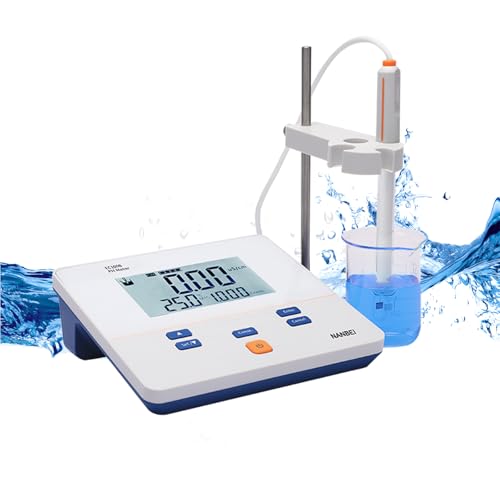
- 6-inch LCD display
- 0.00 S/cm to 100.0 mS/cm range
- IP54 spill and dust protection
Best For: Benchtop testing with easy-to-read measurements
All-in-One Water Analysis

- Measures conductivity, pH, TDS, and more
- Includes LSI/hardness calculator
- Date and time stamping included
Best For: Broad multi-parameter water analysis
Classroom Quick-Check
Handheld LED Conductivity Tester

- Ten-level LED conductivity display
- Dual probes test liquids and solids
- Battery included; no calibration required
Best For: Classroom demonstrations and basic screening
Benchtop Precision Pick
EC700 Conductivity/Temperature Meter

- Conductivity and temperature measurement
- 1–4 point automatic calibration
- Stores 50 groups of data
Best For: Routine benchtop laboratory testing
Data-Ready Portable Choice

- Measures conductivity, TDS, salinity, and more
- Stores 500 data sets
- USB and RS-232 communication
Best For: Portable, multi-parameter lab workflows
Industrial Precision Pick
Myron L 4PII Conductivity Meter

- Measures conductivity, resistivity, TDS, and temperature
- Auto-ranging with adjustable temperature compensation
- Date-and-time stamping with LCD display
Best For: Routine lab and industrial water-quality testing
Connected Data-Logging Pick
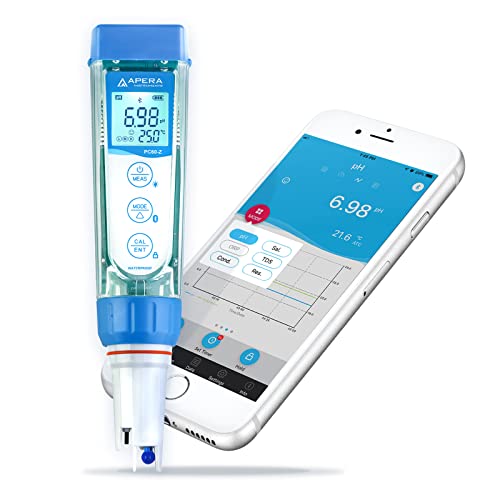
- Tests pH, conductivity, TDS, salinity, and resistivity
- Bluetooth app control within a stated 30-foot range
- Cloud-based logging plus standalone operation
Best For: Digitally managed lab and field testing
Grower-Friendly Combo Pick
Bluelab Combo Meter for pH, EC & Temperature
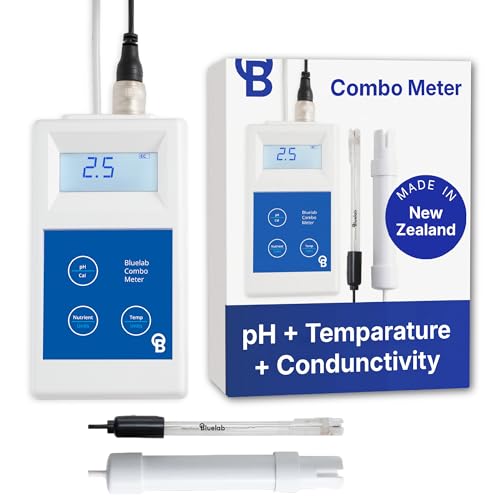
- Measures conductivity, pH, and temperature
- Provides EC, PPM, and CF scales
- Includes batteries, storage cap, and calibration solution
Best For: Hydroponic and general water-quality monitoring
Classic Benchtop Precision – Bante 510 Conductivity Meter
For labs that need a traditional benchtop instrument, the Bante 510 is a practical choice among conductivity meters for labs. It measures from 0 to 200 mS/cm, uses platinum electrodes, and supports automatic recognition of several conductivity standards.
Best For: Research and education settings requiring broad-range benchtop conductivity and TDS measurements.
Pros:
- Wide 0 to 200 mS/cm measurement range.
- Includes two platinum conductivity electrodes for reliable measurements.
- Supports one- to three-point calibration with automatic standard recognition.
- Automatic temperature compensation and Auto-Read help simplify routine testing.
Cons:
- Benchtop design is less convenient for field or highly portable work.
- Listed accuracy is ±1% F.S., which may not suit applications demanding tighter specifications.
The Bante 510 balances useful automation with a conventional laboratory format. Its calibration, temperature-compensation, and reset functions make it a sensible fit for repeatable instructional or research workflows.
Portable Multi-Parameter Testing – Apera PC60 Pocket Tester
The Apera PC60 is a compact alternative to larger conductivity meters for labs, combining conductivity with pH, TDS, salinity, and temperature testing. Its replaceable probe, clear display, and included accessories make it convenient for quick measurements away from the bench.
Best For: Portable lab checks and users who need conductivity alongside several water-quality parameters.
Pros:
- Measures pH, EC, TDS, salinity, and temperature.
- Replaceable multi-parameter probe supports continued use and easy installation.
- Backlit LCD offers dual readings and indicators for calibration and stability.
- Kit includes calibration solutions, storage solutions, batteries, and a carrying case.
Cons:
- Pocket format may be less suitable for high-throughput benchtop workflows.
- Electrode warranty is six months, shorter than the instrument’s two-year limited warranty.
Choose the PC60 when portability and measurement versatility matter more than a dedicated benchtop setup. The complete kit reduces the number of accessories needed to begin testing.
Large-Screen Lab Monitoring – Benchtop Lab Conductivity Meter
This benchtop model focuses on easy viewing and straightforward laboratory operation. Among conductivity meters for labs, it stands out for its 6-inch display, settable cell constant, IP54 protection, and range extending from 0.00 S/cm to 100.0 mS/cm.
Best For: Stable benchtop measurement where a large display and configurable temperature settings are priorities.
Pros:
- Large 6.0-inch LCD screen is designed for easy reading.
- IP54 construction helps protect against spills and dust.
- Settable cell constant and manual temperature compensation provide configuration flexibility.
- Factory reset simplifies returning settings to their defaults.
Cons:
- Listed accuracy is 1.5% FS, lower than some instruments with tighter stated accuracy.
- Manual temperature compensation requires more operator input than automatic compensation.
The EC100B is a practical choice for labs that value visibility and durable everyday handling. Its broad range and adjustable settings support varied conductivity applications, provided its stated accuracy meets your requirements.
All-in-One Water Analysis – Myron L 6PIIFCE Meter
Myron L 6PIIFCE Conductivity, Resistivity, TDS, pH, ORP/Free Chlorine, Temperature Meter
Check Price On AmazonThe Myron L 6PIIFCE is designed for broad water-analysis work rather than conductivity alone. It combines conductivity, resistivity, TDS, pH, ORP/free chlorine, and temperature functions, making it one of the more versatile conductivity meters for labs and field-oriented testing.
Best For: Users who want multiple water-quality measurements in one compact instrument.
Pros:
- Measures conductivity, resistivity, TDS, pH, ORP/free chlorine, and temperature.
- Includes an LSI/hardness calculator.
- Offers autoranging and adjustable temperature compensation.
- Provides adjustable conductivity/TDS ratio plus date and time stamping.
Cons:
- Its broad feature set may be unnecessary for labs needing only conductivity.
- Supplied notes do not specify the measurement range or accuracy.
The 6PIIFCE makes the most sense when consolidating several water-testing functions is more important than selecting a dedicated conductivity meter. Verify the instrument’s detailed specifications for your application before purchase.
Classroom Quick-Check – Handheld LED Conductivity Tester
For simple demonstrations and quick screening, this United Scientific tester is a practical entry among conductivity meters for labs. Its ten-level LED display gives qualitative results, while dual brass probes handle both immersed liquids and solids.
Best For: Classrooms, introductory chemistry experiments, and basic lab or field checks where visual conductivity comparisons are sufficient.
Pros:
- Ten-level green LED display provides quick visual readings.
- Dual brass probes test liquids and solids.
- Includes a 12V battery and requires no calibration.
- Compact 14 cm design fits lab drawers and field kits.
Cons:
- Provides qualitative levels rather than a precise numerical conductivity value.
- Battery-powered design has a listed minimum operating voltage of 12 volts.
This is a straightforward choice when speed, simplicity, and portability matter more than detailed data logging or quantitative accuracy.
Benchtop Precision Pick – EC700 Conductivity/Temperature Meter
The Apera Instruments EC700 is a more structured option among conductivity meters for labs, combining conductivity and temperature measurement with a benchtop format. Its platinum black electrode, guided calibration, and data storage support repeatable routine testing.
Best For: Laboratory benches needing conductivity and temperature readings, guided calibration, and stored measurement results.
Pros:
- Measures conductivity and temperature simultaneously.
- Supports a 0–200.0 mS/cm range with stated 1% F.S. accuracy.
- Offers one- to four-point automatic calibration with a calibration guide.
- Stores up to 50 groups of data and includes calibration solutions.
Cons:
- Benchtop format is less convenient for field use than a handheld meter.
- Its IP54 protection is limited to spill and dust resistance rather than full waterproofing.
Choose the EC700 when calibration assistance, a dedicated electrode holder, and modest onboard data storage are more valuable than maximum portability.
Data-Ready Portable Choice – EC310F Multi-Mode Meter
This portable EC310F expands beyond basic conductivity testing, making it a versatile option among conductivity meters for labs. It measures conductivity, TDS, salinity, temperature, and resistivity, while offering extensive storage and USB or RS-232 communication.
Best For: Portable lab workflows that need multiple measurement modes, configurable compensation, and substantial data storage.
Pros:
- Measures conductivity, TDS, salinity, temperature, and resistivity.
- Offers 1–3 point calibration with standard recognition.
- Stores up to 500 sets of data and supports GLP-compliant records.
- IP65 protection and USB or RS-232 communication support practical lab use.
Cons:
- Its stated accuracy is ±1.0% F.S., so it is not the most accuracy-focused option in this group.
- More adjustable settings may require more setup than a simple LED tester.
The EC310F is the strongest fit for users who need portability plus broader measurement capabilities and electronic record handling in one instrument.
Industrial Precision Pick – Myron L 4PII Conductivity Meter
The Myron L 4PII is a practical choice among conductivity meters for labs when you need conductivity, resistivity, TDS, and temperature readings in one battery-powered instrument. Auto-ranging, adjustable temperature compensation, and a date-and-time stamp support efficient routine testing.
Best For: Lab and industrial users who need a reusable, high-accuracy meter with multiple water-quality measurement modes.
Pros:
- Measures conductivity, resistivity, TDS, and temperature.
- Includes auto-ranging and adjustable temperature compensation.
- Offers date-and-time stamping, LCD display, and 500-millisecond response time.
- Supports immersion up to 1 meter and temperatures from 32°F to 132°F.
Cons:
- Requires a 9V battery.
- The supplied notes do not specify wireless connectivity or cloud data logging.
The 4PII emphasizes straightforward, versatile measurement rather than app-based workflows. Its broad parameter coverage and adjustable compensation make it a solid fit for repeatable testing across lab or industrial applications.
Connected Data-Logging Pick – Apera PC60-Z Smart Meter
The Apera PC60-Z stands out among conductivity meters for labs for its Bluetooth connection and ZenTest app support. It combines pH, conductivity, TDS, salinity, and resistivity testing with real-time control, calibration, and cloud-based data management.
Best For: Professionals who want multi-parameter testing with smartphone control and accessible digital records.
Pros:
- Measures pH, conductivity, TDS, salinity, and resistivity.
- Connects to smartphones, tablets, or MacBooks within a stated 30-foot range.
- Supports cloud-based logging, data management, and sharing.
- Can operate as a standalone tester when not connected to a smart device.
Cons:
- Battery type and quantity are not specified in the supplied details.
- The probe has a six-month warranty, shorter than the instrument’s two-year warranty.
- Temperature accuracy is listed as ±0.5°C.
The PC60-Z is the strongest option here for connected workflows. Its hybrid standalone design preserves basic usability in the lab while the app and cloud tools add useful control and recordkeeping.
Grower-Friendly Combo Pick – Bluelab Combo Meter for pH, EC & Temperature
The Bluelab Combo Meter is a convenient option among conductivity meters for labs when your workflow also requires pH and temperature readings. It provides EC, PPM, and CF conductivity scales, automatic temperature compensation, and simple calibration features for water testing.
Best For: Hydroponic growers and users monitoring nutrient solution, aquarium, pool, or other water conditions.
Pros:
- Monitors conductivity, pH, and temperature in one meter.
- Offers EC, PPM, and CF conductivity scales.
- Automatic temperature compensation supports consistent readings as temperature changes.
- Includes AAA batteries, a pH probe storage cap, and calibration solution.
Cons:
- The pH probe requires two-point calibration and care.
- The pH probe warranty is six months, compared with five years for the meter.
- The supplied notes position it primarily for water and growing applications rather than advanced laboratory data logging.
The Combo Meter is appealing when ease of use and nutrient monitoring matter more than connectivity. Its multiple conductivity scales and included setup accessories make it especially practical for hydroponic and general water-testing routines.
How We Picked These Conductivity Meters for Labs
We focused on meters suited to laboratory, classroom, field, water-quality, and controlled production testing. The selection includes dedicated conductivity instruments as well as multiparameter meters that measure conductivity alongside pH, TDS, salinity, resistivity, oxidation-reduction potential, or temperature.
Our comparison emphasizes measurable range, stated accuracy, calibration flexibility, electrode design, portability, display and connectivity features, and the practical needs of routine testing. Because a meter’s real-world performance depends heavily on its probe and calibration, we also considered whether the product appears appropriate for repeatable measurements rather than occasional basic checks.
Quick Comparison
Benchtop models such as the Bante 510 and Apera EC700 are generally the strongest fit for fixed workstations, shared laboratories, and repeat measurements. Portable options such as the Apera PC60 series and Myron L meters are more convenient when samples must be tested at multiple locations. Multiparameter instruments can reduce equipment costs and bench clutter, but dedicated meters may be preferable when conductivity is the primary measurement and maximum workflow simplicity matters.
Check each product’s included probe, calibration accessories, power source, warranty, and software support before purchasing. Product names and listed specifications can vary by seller or configuration.
Key Buying Factors for Conductivity Meters for Labs
Range, Resolution, and Accuracy
Choose a range that covers your lowest and highest expected conductivity without forcing the meter to operate at its limits. Low-conductivity purified-water work may require greater resolution and a suitable cell constant, while nutrient solutions, wastewater, and saline samples often need a much broader range. Compare stated accuracy and resolution separately; a display with more decimal places does not automatically indicate better accuracy.
Calibration and Temperature Compensation
Automatic calibration and multiple calibration points can simplify routine work across a broad range. Temperature compensation is equally important because conductivity changes with temperature. Look for automatic temperature compensation when samples vary in temperature, and verify whether the instrument supports the reference temperature or compensation method your procedures require.
Probe and Sample Compatibility
Electrode material, cell design, cable length, and replacement availability affect maintenance and measurement quality. Platinum electrodes are common for general laboratory use, while specialized low-conductivity or high-range applications may need a different probe. Confirm that the supplied cell constant matches your samples and that replacement sensors are readily available.
Workflow and Data Features
For shared benches, a clear display, stable stand, automatic endpoint recognition, and simple cleaning routine can save time. Bluetooth or software support is useful when results must be documented electronically. For field or classroom use, prioritize waterproofing, battery life, portability, and a durable housing.
Who Should Buy Which Conductivity Meters for Labs?
Choose a benchtop meter for a dedicated laboratory station, frequent testing, or a workflow that benefits from a larger display and stable sample handling. Choose a pocket or portable meter for field sampling, inspections, hydroponics, or quick checks across multiple rooms. Select a multiparameter model if you regularly need pH, TDS, salinity, resistivity, or temperature in addition to conductivity. For teaching labs and occasional demonstrations, a simpler electric conductivity tester may offer the most practical balance of cost and ease of use.