Reliable conductivity readings depend on more than a good sensor. Temperature can significantly affect results, so the best meters automatically compensate for changing conditions while providing the measurement range and accuracy your work requires.
This roundup compares 10 conductivity meters with temperature compensation, from compact pocket testers and multiparameter tools to benchtop instruments designed for repeatable laboratory measurements.
Best 10 Conductivity Meters with Temperature Compensation Picks for 2026
Best All-in-One Hydroponic Pick
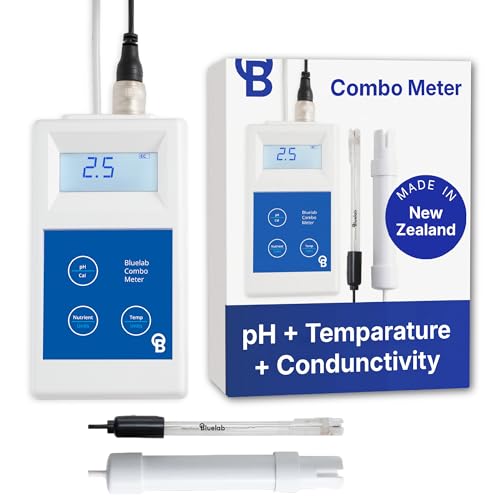
- Tests pH, conductivity, and temperature
- ATC with EC, PPM, and CF scales
- Includes calibration solution and batteries
Best For: Hydroponic growers needing multi-parameter testing
Best Compact EC Tester
Milwaukee C65 Conductivity Meter

- Automatic temperature compensation
- 0–1,999 µS/cm range
- IP65 waterproof body and replaceable electrode
Best For: Routine handheld conductivity and temperature checks
Best Benchtop Data Features

- Automatic or manual temperature compensation
- Five conductivity/TDS calibration points
- Stores up to 99 data points
Best For: Lab and industrial benchtop measurement
Best Portable Multi-Parameter Kit

- Measures pH, EC, TDS, salinity, and temperature
- Replaceable multi-parameter probe
- Complete kit with solutions and carrying case
Best For: Portable comprehensive water testing
Industrial Accuracy Pick

- Measures conductivity, resistivity, TDS, and temperature
- Adjustable temperature compensation and auto-ranging
- High accuracy with four-digit resolution
Best For: Industrial and outdoor water-quality checks
Waterproof Combo Choice

- Measures pH, TDS, EC, and temperature
- Waterproof design for outdoor applications
- Includes two AAA batteries
Best For: Hydroponics, ponds, and water gardens
Benchtop Calibration Pick

- 0–200.0 mS/cm range with 1% F.S. accuracy
- One- to four-point automatic calibration
- Stores up to 50 groups of data
Best For: Benchtop conductivity and temperature measurement
Portable Range Flexibility
Extech EC210 Conductivity/TDS Meter

- Measures conductivity, TDS, and temperature
- Adjustable 0–5% per °C compensation
- Compact kit with cable, battery, and soft case
Best For: Portable water testing with selectable ranges
Waterproof Pocket Precision
Apera EC60 Waterproof Conductivity Tester

- Automatic compensation across 0–50°C
- Conductivity, TDS, and salinity modes
- IP67 waterproof body with replaceable probe
Best For: Outdoor water testing and portable routine checks
Laboratory Data Management
Apera AI522 EC800 Benchtop Meter

- Measures conductivity, TDS, salinity, resistivity, and temperature
- Stores 500 groups of GLP data with USB output
- Includes guided one- to four-point auto-calibration
Best For: Laboratory research and quality-control documentation
Best All-in-One Hydroponic Pick – Bluelab Combo Meter
For growers who want conductivity meters with temperature compensation plus pH testing, the Bluelab Combo Meter checks conductivity, temperature, and pH in one handheld unit. Its automatic temperature compensation helps maintain consistent readings when water temperature changes, while EC, PPM, and CF scales support different feeding routines.
Best For: Hydroponic growers and indoor gardeners who need one meter for nutrient strength, pH, and temperature.
Pros:
- Measures conductivity, pH, and temperature in water.
- Automatic temperature compensation supports consistent readings.
- Offers EC, PPM, and CF conductivity scales.
- Includes batteries, storage cap, and calibration solution.
Cons:
- The pH probe requires two-point calibration.
- Probe care kit is sold separately.
- Probe warranty is limited to six months.
This is the most versatile choice of the group for plant-focused water testing, especially if pH and nutrient monitoring belong in the same workflow. The five-year instrument warranty adds reassurance for regular use.
Best Compact EC Tester – Milwaukee C65 Conductivity Meter
Milwaukee Instruments Waterproof Conductivity EC/Temp Tester with Replaceable Electrode - C65
Check Price On AmazonThe Milwaukee C65 is a straightforward option for shoppers seeking conductivity meters with temperature compensation in a compact, waterproof design. It measures conductivity from 0 to 1,999 µS/cm, includes automatic temperature compensation, and uses a replaceable electrode for easier long-term maintenance.
Best For: Users who want a simple handheld EC and temperature tester for routine water checks.
Pros:
- Provides automatic temperature compensation.
- Has a 0–1,999 µS/cm conductivity range.
- Fully waterproof to IP65 standards.
- Replaceable electrode can extend serviceability.
Cons:
- It is designed for conductivity and temperature rather than multi-parameter testing.
- The listed range may be limiting for higher-conductivity applications.
Choose the C65 when simplicity, water resistance, and a replaceable electrode matter more than expanded pH, TDS, or salinity functions. Its factory calibration also makes it a practical starting point for routine measurements.
Best Benchtop Data Features – Sper Scientific 860032
For lab and industrial buyers comparing conductivity meters with temperature compensation, the Sper Scientific 860032 emphasizes measurement flexibility and record keeping. It supports automatic or manual temperature compensation, multiple conductivity and TDS calibration points, and storage for up to 99 data points.
Best For: Labs and industrial workspaces that need benchtop testing, multiple measurement scales, and basic data management.
Pros:
- Measures conductivity, TDS, and salinity across several units.
- Offers automatic or manual temperature compensation.
- Includes five conductivity/TDS calibration points and two salinity points.
- Provides data hold, Min/Max tracking, and 99-point storage.
Cons:
- The benchtop format is less portable than a pocket tester.
- Its 4.15-pound product weight may not suit field work.
- The feature set may be more than needed for occasional basic readings.
This meter is the strongest fit when repeatable bench work and measurement records are priorities. Its included electrode holder, AC adapter, computer cable, and software support a more organized testing setup.
Best Portable Multi-Parameter Kit – Apera PC60 5-in-1 Tester
The Apera PC60 combines conductivity meters with temperature compensation functionality with pH, TDS, and salinity testing in a portable waterproof-style pocket format. Its dual display shows temperature alongside the selected measurement, while the replaceable multi-parameter probe and complete carrying case make field checks convenient.
Best For: Portable water testing when conductivity, pH, TDS, salinity, and temperature are all useful.
Pros:
- Measures pH, EC, TDS, salinity, and temperature.
- Uses a replaceable multi-parameter probe.
- Provides a clear backlit LCD with dual-display readings.
- Includes calibration solutions, storage solution, batteries, and case.
Cons:
- Its six-month electrode warranty is shorter than the two-year instrument warranty.
- Multi-parameter testing may be unnecessary for users who only need EC.
- Probe replacement adds a maintenance consideration.
The PC60 is a well-rounded travel-friendly kit for users who need more than conductivity alone. Its included accessories reduce setup time, and the replaceable probe helps keep the instrument serviceable.
Industrial Accuracy Pick – Myron L 4PII
The Myron L 4PII is a practical choice when you need conductivity meters with temperature compensation for routine conductivity, resistivity, and TDS measurements. Its adjustable temperature compensation, auto-ranging, and date-and-time stamping support repeatable field or plant checks.
Best For: Industrial and outdoor users who want a reusable, battery-powered meter with multiple water-quality readings.
Pros:
- Measures conductivity, resistivity, TDS, and temperature.
- Offers auto-ranging and adjustable temperature compensation.
- Provides high accuracy, a four-digit resolution, and a 500-millisecond response time.
- Supports outdoor use with an immersion depth listed at 1 meter.
Cons:
- Requires a 9V battery, which is not listed as included.
- Its upper temperature range is limited to 132 °F.
- The plastic construction may be less suitable for users seeking a metal-bodied meter.
The 4PII stands out for combining several water-quality measurements with adjustable compensation and data-stamping features. It is especially well suited to users who value a capable handheld instrument for industrial or outdoor work.
Waterproof Combo Choice – HM Digital COM-300
The HM Digital COM-300 is a convenient option among conductivity meters with temperature compensation when you want several readings in one waterproof handheld device. It measures pH, TDS, EC, and temperature, making it useful for quick checks around hydroponic systems, ponds, and water gardens.
Best For: Hydroponic growers, pond owners, and water-garden users who want a portable combo meter.
Pros:
- Combines pH, TDS, EC, and temperature measurement.
- Waterproof design is suited to outdoor applications.
- Includes two AAA batteries.
- Uses a sump-type screened inlet.
Cons:
- The supplied notes do not specify a measurement range or accuracy rating.
- The cap sponge must be kept moist with KCl storage solution.
- Its upper temperature range is listed at 130 °F.
The COM-300 is appealing when versatility and portability matter more than detailed bench-style controls. Its waterproof construction and four measurement modes make it a practical general-purpose option for water-related applications.
Benchtop Calibration Pick – Apera Instruments EC700
The Apera Instruments EC700 is designed for users who need conductivity meters with temperature compensation in a more controlled benchtop format. It measures conductivity and temperature simultaneously, provides a 0–200.0 mS/cm range, and supports one- to four-point automatic calibration.
Best For: Laboratories, workshops, and water-quality stations that need stable benchtop readings and stored measurement data.
Pros:
- Measures conductivity and temperature simultaneously with an ATC electrode.
- Offers a 0–200.0 mS/cm conductivity range and 1% F.S. accuracy.
- Includes one- to four-point automatic calibration with a calibration guide and self-diagnosis.
- Stores up to 50 groups of data and includes calibration solutions.
Cons:
- At 2.2 pounds, it is less portable than a handheld meter.
- Its IP54 rating is described as spill-proof and dust-proof, not fully waterproof.
- The supplied notes do not list a battery power option.
The EC700 is the strongest fit here for repeatable bench work, thanks to its ATC electrode, guided calibration, digital processing, and data storage. Choose it when calibration workflow and stable readings are more important than compact field portability.
Portable Range Flexibility – Extech EC210 Conductivity/TDS Meter
If you need conductivity meters with temperature compensation for field testing, the Extech EC210 combines conductivity, TDS, and temperature readings in a compact handheld design. Its adjustable 0–5% per °C compensation setting helps adapt readings to different water temperatures, while three measurement ranges support varied applications.
Best For: Portable water testing when adjustable temperature compensation, conductivity, and TDS measurements are useful.
Pros:
- Measures conductivity, TDS, and temperature.
- Offers three conductivity and three TDS ranges.
- Adjustable temperature compensation from 0–5% per °C.
- Includes a conductivity cell, 1-meter cable, battery, and soft case.
Cons:
- Uses a 9V battery rather than the included AAA battery format of some pocket testers.
- Its plastic housing and compact design may be less suited to benchtop workflows.
The EC210 is a practical choice for users who want broad conductivity and TDS range selection in a lightweight meter. Min/Max and Data Hold functions add convenience when taking readings away from the lab.
Waterproof Pocket Precision – Apera EC60 Waterproof Conductivity Tester
For a pocket-sized option among conductivity meters with temperature compensation, the Apera EC60 offers automatic temperature compensation from 0–50°C and ±1% full-scale accuracy. It switches between conductivity, TDS, and salinity at the press of a button and uses a replaceable platinum-black probe.
Best For: Outdoor and routine water testing where waterproof construction, automatic calibration, and multiple measurement modes matter.
Pros:
- Provides automatic temperature compensation from 0–50°C.
- Switches among conductivity, TDS, and salinity measurements.
- Includes automatic one- to three-point calibration and a customizable TDS factor.
- IP67 waterproof, floatable body with a replaceable probe.
Cons:
- Its listed temperature range tops out at 50°C.
- Requires four AAA batteries.
The EC60 stands out for convenient field use: its backlit display shows temperature alongside the measurement, and stable-reading and calibration indicators simplify routine checks. The replaceable probe may also extend the tester’s serviceability.
Laboratory Data Management – Apera AI522 EC800 Benchtop Meter
The Apera AI522 EC800 is designed for laboratory and quality-control settings where conductivity meters with temperature compensation need more than basic spot readings. Its conductivity/temperature combination electrode supports regular water solutions, while GLP data management stores up to 500 groups and provides USB output.
Best For: Scientific research and quality-control workflows that benefit from benchtop operation, stored results, and USB data transfer.
Pros:
- Measures conductivity, TDS, salinity, resistivity, and temperature.
- Supports one- to four-point automatic calibration with guidance and reminders.
- Stores up to 500 groups of GLP data and offers USB output.
- Large backlit display shows conductivity and temperature simultaneously.
Cons:
- At 5.5 pounds, it is less portable than pocket-style testers.
- The supplied notes do not specify the automatic temperature-compensation range.
The AI522 is the strongest fit here for organized benchtop measurement and recordkeeping. Its included 50 mL calibration solutions and broad parameter coverage make it suited to repeatable laboratory and quality-control routines.
How We Picked the Best Conductivity Meters with Temperature Compensation
We focused on meters that measure conductivity and temperature while offering automatic or clearly specified temperature compensation. We also considered accuracy, measurement range, calibration options, probe design, display readability, water resistance, data features, and the practical needs of different users.
The selection spans pocket testers for fast checks, multiparameter meters for hydroponics and aquariums, and benchtop instruments for laboratories, education, water treatment, and quality control. Because application requirements vary, a meter with the broadest feature list is not automatically the best choice for every buyer.
Quick Comparison
| Best For | Meter Type | Features to Prioritize |
|---|---|---|
| Hydroponics and indoor growing | Portable multiparameter meter | EC, TDS, temperature, simple calibration |
| Routine field testing | Waterproof pocket tester | Replaceable or durable probe, fast readings, clear display |
| Laboratory and quality control | Benchtop meter | Wide range, selectable calibration points, data handling |
| Water treatment and technical work | Advanced multiparameter meter | Conductivity, resistivity, salinity, TDS, and temperature modes |
Key Buying Factors for Conductivity Meters with Temperature Compensation
Measurement Range and Accuracy
Match the range to the samples you test. Low-conductivity water, nutrient solutions, brine, and process liquids can require very different capabilities. Accuracy specifications are often expressed as a percentage of full scale, so compare them alongside the expected reading rather than treating the percentage as a universal error figure.
Temperature Compensation
Automatic temperature compensation, or ATC, adjusts conductivity readings based on the sample temperature. Check whether compensation is built in, whether the meter allows a reference temperature or temperature coefficient, and whether the included probe measures temperature directly. ATC improves consistency, but it does not replace proper calibration or good sampling technique.
Calibration and Probe Design
Look for straightforward calibration using suitable standards and enough calibration points for your operating range. Replaceable probes can reduce long-term ownership costs, while integrated pocket probes are convenient for quick testing. Rinse the sensor between samples and follow the manufacturer’s storage instructions.
Display, Durability, and Data Features
A waterproof housing is valuable for field and grow-room use. Benchtop models may be preferable when you need a stable stand, larger display, GLP records, or more controlled testing. Consider battery life, automatic shutoff, temperature display, and whether the meter stores or exports readings.
Who Should Buy Which Conductivity Meters with Temperature Compensation?
Choose a pocket tester if you need quick checks in aquariums, pools, hydroponic reservoirs, or field locations. Choose a multiparameter meter if you also need pH, TDS, salinity, or resistivity without carrying several instruments. Choose a benchtop model for frequent laboratory work, broader ranges, more controlled calibration, and improved repeatability.
Before buying, identify your expected conductivity range, required accuracy, sample environment, and preferred workflow. The best conductivity meter with temperature compensation is the one that fits those requirements without adding features you will not use.