The best anemometers for hobbyists make it easier to measure wind speed for weather watching, drone flying, sailing, HVAC experiments, and outdoor projects. This roundup includes compact handheld meters, durable outdoor designs, and app-connected options.
Use the guide below to compare measurement ranges, displays, extra sensors, and portability so you can choose a meter that matches your projects without paying for features you will not use.
Best 10 Anemometers for Hobbyists Picks for 2026
Best All-Around Pick
TopTes TS-301 Digital Anemometer
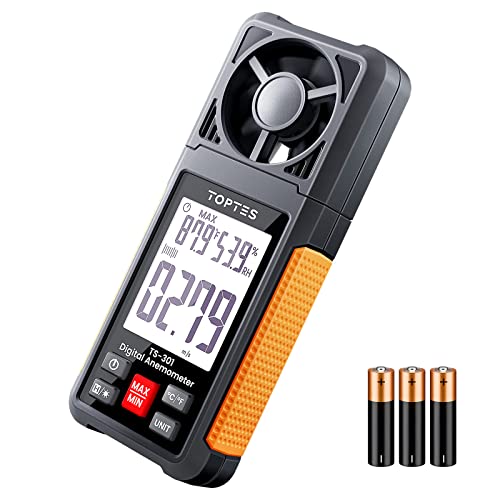
- Large backlit LCD for quick readings
- Six wind-speed units plus temperature and humidity
- Compact design with pouch, batteries, and three-year warranty
Best For: Outdoor activities and basic HVAC airflow checks
Best Rugged Compact Option
Extech 45118 Mini Thermo-Anemometer

- Waterproof and designed to float
- Measures 100–5,500 ft/min with averaging modes
- Includes wind chill, temperature, lanyard, and drop resistance
Best For: Portable field and HVAC airflow measurements
Best for HVAC Hobby Projects
HoldPeak 866B Digital Anemometer

- Measures light airflow and supports CFM calculations
- MAX, MIN, and AVG readings for changing wind
- Backlight, tripod mount, case, and wrist strap included
Best For: Home HVAC and ventilation comparisons
Best Simple Mechanical Model
Eisco Small Outdoor Anemometer

- Display-free wind-cup design for hands-on learning
- Weather-resistant, corrosion-resistant construction
- Compact option for classrooms and field studies
Best For: Educational wind experiments and basic outdoor observation
Best for Easy Setup
BTMETER BT-100 Handheld Anemometer

- Measures speed, temperature, and wind chill
- Five speed units and backlit LCD
- Tripod thread, case, strap, and batteries included
Best For: Portable outdoor activities and basic HVAC checks
Best for Data Logging
BTMETER BT-100APP Bluetooth Anemometer

- Connects to iPhone, iPad, and Android devices
- Logs and exports readings through the app
- Includes MAX/MIN/AVG, hold, and tripod mounting
Best For: Hobby weather tracking and recorded measurements
Best for Simple Readability
Mcbazel 3-in-1 Digital Anemometer

- Shows speed, temperature, and Beaufort level together
- Five selectable wind-speed units
- Backlight, data hold, and MAX/MIN/AVG functions
Best For: Beginner-friendly sailing, fishing, and outdoor checks
Best Compact Pick
BTMETER BT-816B Handheld Anemometer

- Measures wind speed, temperature, and wind chill
- Offers current, maximum, and average modes
- Lightweight design with backlit LCD
Best For: Portable outdoor checks and everyday hobby use
Best Wind-Level Reader
Soonkoda 3-in-1 Handheld Anemometer

- Measures wind speed, temperature, and wind level
- Displays readings in multiple speed units
- Includes Beaufort scale and data-hold functions
Best For: Outdoor hobbies where wind level is useful
Best Advanced Weather Meter
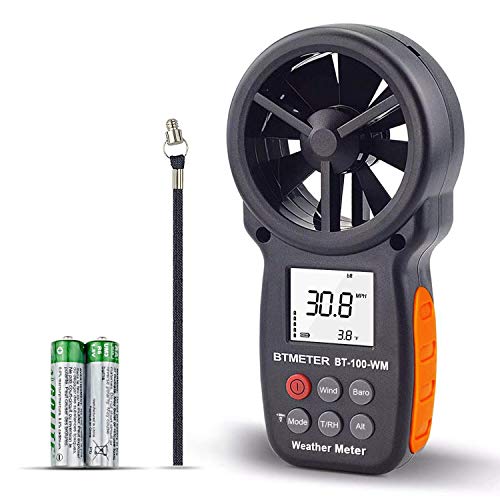
- Adds humidity, dew point, pressure, and altitude readings
- Logs 16 groups of barometric-pressure data
- Includes tripod mounting and backlit display
Best For: Hobby weather tracking and detailed outdoor measurements
Best All-Around Pick – TopTes TS-301 Digital Anemometer
For hobbyists who want a versatile handheld option, the TopTes TS-301 is one of the more feature-rich anemometers for hobbyists. Its large backlit display, six wind-speed units, and added temperature and humidity readings make it useful for both outdoor activities and basic indoor airflow checks.
Best For: Outdoor enthusiasts, drone and RC pilots, sailors, golfers, and hobbyists checking HVAC or vent airflow.
Pros:
- Large 2.26-inch backlit LCD is easy to read.
- Measures wind speed in six units, including mph, knots, and m/s.
- Also measures temperature and relative humidity.
- Includes batteries, a carry pouch, and a three-year warranty.
Cons:
- Temperature and humidity sensors may need at least 30 minutes to adjust to a new environment.
- Automatic shutoff occurs after 10 minutes without use.
The TS-301 is a strong choice when you want more than basic wind-speed readings. Its compact design and broad measurement options make it a practical general-purpose meter, while the environmental sensors add useful context for hobby projects and outdoor planning.
Best Rugged Compact Option – Extech 45118 Mini Thermo-Anemometer
The Extech 45118 is a compact choice for hobbyists who value portability and durability. This waterproof thermo-anemometer covers air velocity from 100 to 5,500 feet per minute and adds temperature, wind-chill, and averaging functions for more informed field measurements.
Best For: Hobbyist HVAC checks, air-quality projects, and outdoor measurements where a compact, water-resistant meter is useful.
Pros:
- Waterproof design and floats if dropped in water.
- Measures air velocity from 100 to 5,500 ft/min.
- Provides wind-chill readings and selectable 5-, 10-, and 13-second averaging.
- Includes a lanyard and is rated for a six-foot drop.
Cons:
- The supplied notes do not specify the display size or measurement-unit options.
- Its one-year warranty is shorter than some competing options.
Choose the 45118 when rugged portability matters more than a large display or extensive feature set. Its waterproof construction, floating design, and averaging modes make it well suited to field use and repeated airflow checks.
Best for HVAC Hobby Projects – HoldPeak 866B Digital Anemometer
The HoldPeak 866B is a practical pick for anemometers for hobbyists who want to compare airflow around the home or workshop. It measures light airflow, supports MAX, MIN, and AVG readings, and can help estimate CFM when readings are combined with vent area.
Best For: Home HVAC troubleshooting, ventilation comparisons, drone preparation, sailing, and outdoor wind checks.
Pros:
- Measures airflow from 0.67 to 67.1 mph with stated ±5% accuracy.
- Supports MAX, MIN, and AVG readings for changing wind conditions.
- Includes temperature, wind chill, backlight, and multiple speed units.
- Offers a 1/4-inch tripod mount for hands-free measurements.
Cons:
- Tripod is not included.
- Backlight turns off after 15 seconds.
- Its one-year warranty is relatively limited.
The 866B stands out for hobbyists focused on airflow comparisons rather than occasional wind checks alone. Its memory functions and tripod compatibility are especially useful for repeat measurements, while the case and wrist strap make transport straightforward.
Best Simple Mechanical Model – Eisco Small Outdoor Anemometer
The Eisco Small Anemometer takes a simple, display-free approach to wind measurement. Its revolving cups provide a hands-on way to study wind speed, making it a suitable entry point for anemometers for hobbyists, classroom demonstrations, and outdoor science projects.
Best For: Educational activities, classroom experiments, science labs, and basic outdoor wind studies.
Pros:
- Simple mechanical design is easy to understand and use.
- Made with corrosion-resistant, weather-resistant materials.
- Compact size is convenient for classroom and field studies.
- Requires no batteries or electronic display.
Cons:
- Has no display, so it does not provide a direct digital reading.
- Requires suitable placement at least four feet above ground and away from obstructions.
- The supplied notes do not specify a numerical measurement range or accuracy.
This Eisco model is best viewed as a durable teaching and observation tool rather than a precision digital meter. It is a good fit when the goal is to demonstrate how wind cups respond to moving air or conduct straightforward outdoor studies.
Best for Easy Setup – BTMETER BT-100 Handheld Anemometer
For hobbyists who want a straightforward, portable instrument, the BTMETER BT-100 is a versatile choice among anemometers for hobbyists. It measures wind speed in five units, along with wind temperature and wind chill, while its backlit display keeps readings visible in dim conditions.
Best For: Drone flying, kite flying, sailing, shooting, climbing, and basic HVAC airflow checks.
Pros:
- Measures wind speeds from 0.67 to 67.1 mph with stated accuracy of ±2% of readings.
- Includes wind temperature, wind chill, low-battery indicator, and five selectable speed units.
- Tripod mount, carrying case, neck strap, and two included AAA batteries improve portability.
Cons:
- Does not include app connectivity or data logging.
- Temperature range is limited to -10°C to 60°C.
The BT-100 offers a useful balance of features and simplicity. Its tripod thread is particularly helpful when you need hands-free readings for RC aircraft or other outdoor projects.
Best for Data Logging – BTMETER BT-100APP Bluetooth Anemometer
The BTMETER BT-100APP stands out for hobbyists who want to review measurements later. In addition to wind speed, temperature, and wind chill readings, its Bluetooth connection can pair with compatible mobile devices for data logging and export.
Best For: Weather-station projects, sailing, drone use, shooting, and hobbyists who want phone-based records.
Pros:
- Bluetooth app support allows data logging and export to Excel or TXT files.
- Offers MAX/MIN/AVG readings, data hold, adjustable power-off timing, and backlight controls.
- Measures wind speed in five units and includes a tripod mount for continuous testing.
Cons:
- Stated wind-speed accuracy is ±5% of readings, less precise than the non-Bluetooth BT-100.
- Requires a compatible phone or tablet to use the app features.
If tracking trends matters more than taking occasional spot readings, the BT-100APP is the more capable option. Its logging and export features add flexibility for hands-on weather and airflow experiments.
Best for Simple Readability – Mcbazel 3-in-1 Digital Anemometer
The Mcbazel 3-in-1 is a compact option for hobbyists who prefer to see several basic readings at once. It displays wind speed, temperature, and Beaufort wind level on a double-line LCD, with backlighting for easier viewing in low-light conditions.
Best For: Sailing, fishing, indoor and outdoor checks, and beginners learning to interpret wind conditions.
Pros:
- Displays wind speed, temperature, and Beaufort scale level together.
- Supports m/s, km/h, knots, ft/s, and mph speed units.
- Includes MAX/MIN/AVG, data hold, backlight, auto power-off, and low-battery indication.
Cons:
- AAA batteries are required but not included.
- Only a user manual is listed among the included components.
The Mcbazel keeps operation simple while adding useful summary functions. Its simultaneous display and Beaufort-scale reading make it a practical entry point for anemometers for hobbyists who do not need Bluetooth logging.
Best Compact Pick – BTMETER BT-816B Handheld Anemometer
For hobbyists seeking compact anemometers for hobbyists, the BTMETER BT-816B combines wind-speed, temperature, and wind-chill readings in a lightweight handheld design. Its backlit display and multiple measurement modes make it practical for quick checks indoors or outdoors.
Best For: Sailing, shooting, climbing, drone activities, HVAC checks, and portable field measurements.
Pros:
- Measures wind speed from 0.2–67 mph, with current, maximum, and average modes.
- Displays temperature and real-time wind chill, with selectable Celsius or Fahrenheit.
- Very compact and lightweight at about 53 g, with a backlit LCD and included lanyard.
Cons:
- Its temperature range is limited to -14°F–113°F.
- It does not include the humidity, pressure, or altitude readings found on more advanced weather meters.
The BT-816B is a sensible choice when portability and straightforward wind readings matter most. It offers useful hobby-focused features without adding the broader environmental measurements of a full weather meter.
Best Wind-Level Reader – Soonkoda 3-in-1 Handheld Anemometer
The Soonkoda 3-in-1 is one of the more approachable anemometers for hobbyists who want wind speed, temperature, and wind level in one device. Its dual-line display shows wind speed and temperature together, while the Beaufort scale adds an easy-to-understand wind-strength reference.
Best For: Sailing, surfing, fishing, flying, HVAC work, and hobbyists who prefer Beaufort wind-level readings.
Pros:
- Combines wind speed, wind temperature, and Beaufort wind level measurement.
- Supports m/s, km/h, knots, ft/s, and mph.
- Includes maximum, minimum, average, data hold, backlight, and auto power-off functions.
Cons:
- The supplied notes do not specify an accuracy rating.
- It lacks the humidity, pressure, altitude, and dew-point functions available on more advanced models.
- Its listed measuring range begins at 0.06 m/s, so extremely light airflow may be difficult to assess.
Choose the Soonkoda if the Beaufort scale and simultaneous wind-temperature display fit your routine. It is feature-rich for basic field measurements, though buyers needing documented accuracy or broader weather data may want a more advanced meter.
Best Advanced Weather Meter – BTMETER BT-100WM Anemometer
For hobbyists who want more than basic airflow readings, the BTMETER BT-100WM expands the typical anemometer with humidity, dew point, barometric pressure, altitude, and wind-chill measurements. It also supports data logging and tripod mounting, making it useful for repeated observations and outdoor analysis.
Best For: Weather tracking, long-range shooting, hunting, sailing, kite flying, drone activities, and HVAC airflow checks.
Pros:
- Measures wind speed, temperature, relative humidity, dew point, pressure, altitude, and wind chill.
- Logs 16 groups of barometric-pressure data for comparison and analysis.
- Offers five wind-speed units, backlit viewing, a tripod hole, and maximum, minimum, average, and current readings.
Cons:
- It is larger and heavier than mini handheld models, weighing about 150 g.
- Its wind-speed range starts at 0.67 mph, which is less suited to measuring very light breezes.
- The broader feature set may be unnecessary for users who only need wind speed.
The BT-100WM is the strongest fit here for hobbyists building a fuller environmental picture. Its extra sensors and pressure logging add value for planning and comparison, but they come with more size and complexity than a basic anemometer.
How We Picked the Best Anemometers for Hobbyists
We focused on practical features that matter during real-world use: wind-speed range, measurement units, display readability, portability, durability, and ease of operation. We also considered useful extras such as temperature, wind chill, airflow measurements, barometric pressure, data logging, and Bluetooth connectivity.
Because hobbyists have varied needs, this selection includes straightforward budget meters as well as more capable models for HVAC testing, drone flying, sailing, weather observation, and educational projects. A good handheld anemometer should provide stable readings, simple controls, and a design that is comfortable to carry outdoors.
Quick Comparison
| Best For | Look For | Useful Feature |
|---|---|---|
| Basic outdoor checks | Simple controls and clear display | Multiple wind-speed units |
| HVAC and airflow projects | Airflow readings and broad range | CFM or volume-flow modes |
| Drone flying and photography | Fast response and portability | Backlit screen |
| Weather monitoring | Wind, temperature, and pressure data | Wind chill or barometer functions |
| Logging and remote use | Bluetooth compatibility | Mobile app support |
Key Buying Factors for Anemometers for Hobbyists
Measurement Range and Accuracy
Choose a range that comfortably exceeds the conditions you expect to measure. A wider range is helpful for outdoor sports and strong gusts, while sensitivity at the low end matters for gentle breezes and indoor airflow. For casual use, repeatable readings and sensible resolution are often more valuable than laboratory-level precision.
Units and Measurement Modes
Look for meters that support familiar units such as miles per hour, meters per second, knots, and feet per minute. If you work with vents, fans, or ducts, CFM and airflow modes can be more useful than wind speed alone. Temperature and wind-chill readings add convenience for outdoor observations.
Display, Controls, and Battery Life
A backlit LCD is helpful at dusk or indoors, while large digits are easier to read when holding the meter at arm’s length. One-handed controls, auto shutoff, and a compact body improve everyday usability. Check the battery type and whether replacements are easy to find.
Durability and Connectivity
For sailing, fieldwork, or school demonstrations, favor a weather-resistant design and a protective case or cover. Bluetooth models can be worthwhile when you need app-based logging or a larger viewing screen, but they may require more setup than a basic handheld meter.
Who Should Buy Which Anemometers for Hobbyists?
Choose a simple compact model if you mainly want quick wind checks for walks, gardening, kites, or basic weather observations. HVAC hobbyists should prioritize airflow and CFM functions. Drone pilots, sailors, and outdoor photographers benefit from portable meters with fast readings, broad ranges, and readable backlit displays.
For users who want to record measurements or review trends, a Bluetooth anemometer is the better fit. If durability and classroom demonstrations matter most, select a weather-resistant model with uncomplicated controls. Finally, consider the accessories and warranty before buying: a case, wrist strap, and clear instructions can make a modest meter much more useful in the field.