The best sound level meters for field work make it easier to document noise, identify problem areas, and take consistent readings outside the lab. This roundup compares portable meters with different accuracy levels, measurement features, connectivity options, and data-logging capabilities.
Whether you need occasional workplace checks or a more structured environmental noise survey, the right meter depends on compliance requirements, measurement range, and how much data you need to capture in the field.
Best 10 Sound Level Meters for Field Work Picks for 2026
Classic Field Meter
Extech 407730 Digital Sound Level Meter

- 40–130 dB range with 0.1 dB resolution
- A/C weighting and 2 dB accuracy
- Max/Min, Max Hold, and analog bar graph
Best For: Routine spot checks and general field noise measurements
Professional Outdoor Choice
CRY2831 IEC 61672 Class 2 Sound Level Meter

- IEC 61672-1:2013 Class 2 design
- 29–138 dB range with A/C/Z weighting
- IP54 enclosure and AC/DC power
Best For: Industrial, environmental, and workplace spot checks
Connected Monitoring Pick
Extech SL250W Sound Meter with ExView App

- Bluetooth connection to the ExView app
- A/C weighting with fast/slow response
- Backlit LCD and tripod mount
Best For: App-assisted professional field monitoring
Data Logging Workhorse
Triplett SLM420BT Sound Level Meter

- IEC 61672-1 Class 2 and ±1.4 dB accuracy
- Logs up to 32,690 readings
- Bluetooth, USB transfer, and included case
Best For: Industrial surveys and documented noise monitoring
Advanced Field Logging
Piccolo-2 Class 2 Sound Level Meter

- Class 2 measurement from 30 dBA to 130 dBZpk
- Logs multiple metrics, weightings, octave bands, and FFT
- Includes software, waveform recording, and large data storage
Best For: Field surveys requiring detailed logging and post-processing
Practical Site Checks
PT6708 Digital Sound Level Meter

- 30–130 dB range with ±1.5 dB stated accuracy
- A/C weighting, fast/slow response, MAX, and data hold
- Backlit display and automatic power-off
Best For: Quick environmental and workplace noise checks
Portable Everyday Monitoring

- 30–130 dB A/C-weighted readings with ±1.5 dB stated accuracy
- Large backlit display with MAX/MIN and data hold
- Includes batteries, manual, and carry case
Best For: Portable spot checks at home, work, or on site
Best Data-Logging Pick

- Stores up to 43,000 readings with PC and Excel export
- 30–130 dB range with ±1.5 dB accuracy
- Color alarms, graph display, and A/C weighting
Best For: Field inspections requiring detailed records and data export
Best Simple Handheld
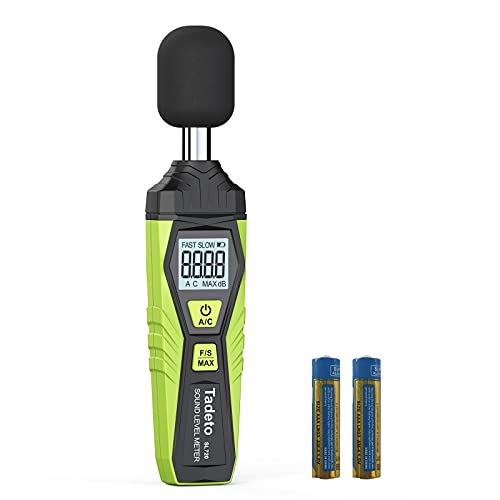
- 30–130 dB range with ±2.0 dB accuracy
- A/C weighting and FAST/SLOW response modes
- Backlit LCD in a portable manual design
Best For: Routine spot checks in homes, workplaces, and job sites
Best Rechargeable Logger

- Up to 8 hours of operation on a charge
- ±1.5 dB accuracy with A/C measurement ranges
- Graph display, alarms, logging, and USB-C connectivity
Best For: Portable monitoring across home, office, classroom, and industrial settings
Classic Field Meter – Extech 407730 Digital Sound Level Meter
The Extech 407730 is a straightforward option for sound level meters for field work when you need readable measurements without app connectivity or extensive data logging. It measures 40 to 130 dB, offers A/C weighting, and displays readings digitally with 0.1 dB resolution.
Best For: Routine spot checks, facility walkthroughs, and general field noise measurements.
Pros:
- Measures 40 to 130 dB with 2 dB accuracy and 0.1 dB resolution.
- Fast analog bar graph helps show changing sound levels at a glance.
- Max/Min recording, Max Hold, auto power-off, and included windscreen support practical field use.
Cons:
- It does not list Bluetooth, app connectivity, or onboard data logging.
- The 40 dB minimum range may be less suitable for very quiet environments.
This is a compact, battery-powered meter for users who value simple controls and immediate readings. Its included AAA batteries and windscreen make it easy to put into service for basic measurements.
Professional Outdoor Choice – CRY2831 IEC 61672 Class 2 Sound Level Meter
The CRY2831 is built for demanding sound level meters for field work, combining IEC 61672-1:2013 Class 2 compliance with a 29 to 138 dB measurement range. Its A, C, and Z weighting options, fast/slow response settings, and IP54-rated enclosure suit professional spot checks in varied environments.
Best For: EHS teams, inspectors, facility managers, and industrial or environmental field measurements.
Pros:
- Wide 29 to 138 dB range and 20 Hz to 12.5 kHz frequency response.
- Class 2 design with listed ±1.5 dB accuracy and a low-noise condenser microphone.
- IP54 protection, AC/DC power, and an operating range of -20°C to 60°C support field use.
Cons:
- Its professional feature set may be more than casual users need.
- The supplied notes do not list onboard data logging or wireless connectivity.
For field teams that need broader coverage than a basic decibel meter, the CRY2831 offers application-specific weighting and response controls in a ruggedized package. Factory calibration and expert support add reassurance for professional users.
Connected Monitoring Pick – Extech SL250W Sound Meter with ExView App
The Extech SL250W adds Bluetooth connectivity to the ExView app, making it a useful choice among sound level meters for field work when you want to view measurements through a mobile device. It includes A and C weighting, fast/slow response settings, a backlit LCD, and a tripod mount.
Best For: Professional users who want app-assisted monitoring and flexible setup in the field.
Pros:
- Bluetooth connectivity works with the ExView app and lists a range of up to 90 meters.
- A/C weighting and fast/slow response support different measurement situations.
- Backlit LCD, tripod mount, windscreen, and lightweight 116 g design aid portability.
Cons:
- The supplied notes do not specify the meter’s measurement range or accuracy.
- Bluetooth features depend on a compatible cellphone or smart device.
The SL250W is a practical fit when wireless access matters more than extensive standalone logging. Its portable design and tripod compatibility also make it convenient for repeatable monitoring setups.
Data Logging Workhorse – Triplett SLM420BT Sound Level Meter
Triplett SLM420BT Sound Level Meter and Datalogger | Bluetooth Connectivity, 30 to 130dB
Check Price On AmazonThe Triplett SLM420BT stands out among sound level meters for field work when measurements need to be stored, transferred, and reviewed later. It conforms to IEC 61672-1 Class 2, measures 30 to 130 dB, and can log up to 32,690 readings with programmable sampling and date/time stamps.
Best For: OSHA-oriented checks, environmental monitoring, industrial surveys, and projects requiring measurement records.
Pros:
- Class 2 compliance with listed ±1.4 dB accuracy and 30 to 130 dB range.
- Stores up to 32,690 readings and supports Bluetooth apps plus USB PC transfer.
- A/C weighting, fast/slow response, Min/Max, Data Hold, and analog AC/DC outputs provide flexible analysis.
- Includes a windscreen, software, USB cable, 9V battery, and hard canvas case.
Cons:
- Its logging and connectivity features may be unnecessary for quick, one-off readings.
- The 9V battery requirement differs from meters supplied with AAA batteries.
Choose the SLM420BT when documentation is central to the job. Its large logging capacity, wireless and USB transfer options, and included carrying case make it well suited to extended field surveys.
Advanced Field Logging – Piccolo-2 Class 2 Sound Level Meter
For demanding sound level meters for field work, the Piccolo-2 combines Class 2 measurement capability with logging, waveform recording, and software-based analysis. Its broad range and multiple measurement modes make it suited to documenting changing noise conditions rather than taking only quick spot readings.
Best For: Field technicians, environmental noise surveys, and users who need logged data plus post-processing tools.
Pros:
- IEC 61672/ANSI S1.4 Class 2 measurements across 30 dBA to 130 dBZpk.
- Records Leq, Lmax, Lmin, Lpeak, and SEL with A, C, and Z weightings.
- Includes octave-band, FFT, waveform recording, and noise-analysis software features.
- Stores up to 198,948 records.
Cons:
- Its advanced logging and analysis features may be more than needed for simple checks.
- The supplied notes do not specify weather resistance or included accessories beyond the battery.
This is the most capable option of the three for structured field documentation and later analysis. Choose it when data storage and analysis matter as much as the live reading.
Practical Site Checks – PT6708 Digital Sound Level Meter
The PT6708 is a straightforward choice among sound level meters for field work when you need quick readings across common work and environmental settings. It offers A/C weighting, fast and slow response options, and a clear backlit display, but it does not generate reports directly from the device.
Best For: Basic workplace, workshop, school, office, traffic, and residential noise checks.
Pros:
- Measures 30–130 dB with 0.1 dB resolution and stated accuracy of ±1.5 dB.
- Provides A and C weighting, fast and slow response, MAX, and data hold.
- Backlight supports reading in dim conditions and includes automatic power-off.
- IEC651 Type 2 and ANSI S1.4 Type 2 compliance is stated in the notes.
Cons:
- Cannot keep and generate a report directly from the meter.
- Its plastic construction may be less suitable for rough field conditions than a specialized logger.
For quick measurements and comparison checks, the PT6708 covers the essential controls without a complicated workflow. It is less suitable when you need built-in reporting or extensive data capture.
Portable Everyday Monitoring – TopTes TS-501B Decibel Meter
The TopTes TS-501B is a compact option for sound level meters for field work involving routine noise checks. Its large backlit display, A/C weighting, MAX/MIN readings, and data hold make it easy to operate around homes, offices, workshops, factories, and other everyday locations.
Best For: Portable spot checks, noisy-neighbor documentation, home projects, and general workplace monitoring.
Pros:
- Measures 30–130 dB with A/C weighting and stated accuracy of ±1.5 dB.
- Large 2.25-inch backlit LCD is designed for easy viewing in dim light.
- MAX/MIN measurement and data hold help capture changing sound levels.
- Includes three AAA batteries, a user manual, and a carry case.
Cons:
- The supplied notes do not mention data logging, report generation, or analysis software.
- Its 30–8,000 Hz frequency range is narrower than the Piccolo-2’s stated span.
This meter is a convenient fit when portability and simple controls are priorities. It provides useful live readings and peak-style checks, but users needing formal logging should consider a more advanced instrument.
Best Data-Logging Pick – DANOPLUS DP-441
For field teams that need more than a spot reading, the DANOPLUS DP-441 is one of the more capable sound level meters for field work. It combines a 30–130 dB range with data logging, PC export, visual trends, adjustable alarms, and A/C weighting.
Best For: Field inspections and documentation-heavy projects where recorded readings and spreadsheet export are useful.
Pros:
- Stores up to 43,000 readings and exports data to Excel through a PC connection.
- Offers ±1.5 dB accuracy, A/C frequency weighting, and FAST/SLOW response settings.
- Uses a color screen with line charts, analog bars, date, and time information.
- Three-color alarm indicators allow manual threshold adjustment.
Cons:
- PC connectivity and analysis require a compatible Windows computer.
- Charging takes about 1.5 hours, so planning around battery use may be helpful.
The DP-441 is a strong choice when a field reading needs to become a record. Its large storage capacity and export features set it apart from simpler handheld meters, while the adjustable weighting and response controls support varied measurement situations.
Best Simple Handheld – Tadeto SL720
The Tadeto SL720 keeps field measurements straightforward. For users comparing sound level meters for field work, it provides a 30–130 dB range, A/C weighting, selectable response speeds, and a backlit LCD in a portable manual instrument.
Best For: Routine checks around homes, offices, factories, vehicles, construction sites, and audio systems.
Pros:
- Measures from 30 to 130 dB with stated ±2.0 dB accuracy and 0.1 dB resolution.
- A weighting supports ambient-noise checks, while C weighting suits louder machinery and motor sounds.
- FAST and SLOW response options accommodate general measurements and changing noise levels.
- Backlit LCD improves readability in darker locations, and the unit is designed for easy carrying.
Cons:
- It does not list data logging or PC export features in the supplied specifications.
- Its stated accuracy is lower than the ±1.5 dB models in this roundup.
The SL720 is a practical option when the priority is quick, readable measurements rather than stored inspection records. Its weighting and response controls add useful flexibility without making the basic operation unnecessarily complex.
Best Rechargeable Logger – GAIN EXPRESS SLM-442
The GAIN EXPRESS SLM-442 is a rechargeable option for buyers comparing sound level meters for field work. It records measurements, connects to a PC for export, displays numerical and graphical data, and adds three-color alerts for monitoring noise in varied environments.
Best For: Portable monitoring in classrooms, offices, homes, commercial spaces, and industrial settings.
Pros:
- Runs for up to 8 hours on a charge and uses a USB Type-C interface.
- Measures 30–130 dB(A) and 35–130 dB(C) with stated ±1.5 dB accuracy.
- Stores readings for PC export and shows both numerical and graphical information.
- Includes adjustable auto-shutoff behavior and a rear calibration knob.
Cons:
- The supplied notes conflict on storage capacity, citing both 31,000 and 3,100 records.
- The product requires a USB connection and compatible Windows versions for PC export.
- Only an AAA battery is listed in the specifications, despite the rechargeable design noted in the features.
The SLM-442 offers a useful balance of portability, logging, rechargeable operation, and visual alerts. Before buying, confirm the exact storage capacity and battery configuration, since the supplied specifications are inconsistent on those points.
How We Picked the Best Sound Level Meters for Field Work
We compared these 10 meters by looking at measurement range, A- and C-weighting support, display readability, portability, calibration information, data logging, software or app connectivity, and power options. We also considered whether each model is better suited to quick spot checks, recurring inspections, equipment troubleshooting, or more formal noise documentation.
Class 2 instruments and models referencing IEC 61672-1 are generally more appropriate when measurement consistency and documented accuracy matter. Less specialized meters can still be useful for screening, maintenance, personal projects, and identifying obvious changes in sound levels.
Quick Comparison
- Best for straightforward readings: Choose a portable meter with a clear backlit display, simple controls, and A/C weighting.
- Best for repeated inspections: Look for internal memory, timestamped records, USB export, or Bluetooth connectivity.
- Best for professional surveys: Prioritize Class 2 specifications, integrating-averaging capability, calibration support, and analysis software.
- Best for low-light or changing conditions: A backlit screen, visible alarm indicators, and a broad 30–130 dB range improve usability.
Key Buying Factors for Sound Level Meters for Field Work
Accuracy and Standards
Check whether the meter identifies a measurement class, cites IEC 61672-1, or includes factory calibration documentation. A Class 2 meter is often the practical choice for general occupational and environmental surveys, while a basic decibel reader may be sufficient for preliminary checks.
Weighting and Measurement Modes
A-weighting approximates typical human hearing and is commonly used for workplace and environmental noise readings. C-weighting is useful for louder sounds and low-frequency content. Fast or slow response settings, maximum hold, and integrating or averaging modes help produce more meaningful results than a single instantaneous reading.
Recording and Connectivity
For field work involving multiple locations or long observation periods, data logging can save time and reduce transcription errors. Review storage capacity, sampling intervals, export formats, rechargeable battery life, and whether an app or desktop software is included.
Usability in the Field
A readable screen, responsive buttons, tripod compatibility, a microphone windscreen, and a durable carrying case can matter as much as headline specifications. If readings will be taken outdoors, use appropriate wind protection and keep the microphone positioned consistently.
Who Should Buy Which Sound Level Meters for Field Work?
Homeowners, hobbyists, and maintenance teams should favor simple, portable meters with broad ranges, backlighting, and A/C weighting. Contractors and workplace inspectors will benefit from data logging, maximum hold, rechargeable power, and Bluetooth or USB export. Industrial hygienists, consultants, and environmental professionals should prioritize a Class 2 or integrating-averaging model with calibration documentation and analysis tools.
Before buying, confirm the meter’s stated accuracy, operating range, calibration procedure, and included accessories. A meter that matches your reporting requirements is usually more valuable than one with the largest feature list.