Finding the right sound level meter for home use can make it easier to investigate noisy appliances, monitor entertainment volume, check workshop conditions, or keep an eye on a baby’s room and sleeping area.
These 10 picks cover portable decibel meters, large wall displays, rechargeable models, and data-logging devices, so you can match features and measurement range to the way you plan to use one.
Best 10 Sound Level Meters for Home Use Picks for 2026
Best Overall Value

- 30–130 dB range with A/C weighting
- Backlit 2.25-inch LCD
- MAX/MIN, hold, batteries, and case included
Best For: Versatile household and neighborhood noise checks
Best Analog-Style Readout

- 40–130 dB measurement range
- 0.1 dB resolution and ±2 dB accuracy
- Fast analog bar graph with Max Hold
Best For: Visual monitoring of changing and peak sound levels
Best for Loudness Context

- 30–130 dB range with ±1.5 dB accuracy
- dB and SONE measurement units
- FAST/SLOW response and MAX/MIN tracking
Best For: Comparing measured noise with perceived loudness
Best Compact Carrying Option

- 30–130 dB range with ±1.5 dB accuracy
- Backlight, hold, Max/Min, and auto power-off
- Includes carrying pouch and gift box
Best For: Portable everyday noise monitoring
Best Large Display

- 11-inch adjustable-brightness display
- 30–130dB range with ±1.5dB stated accuracy
- Wall-mountable or desktop design with face-icon alerts
Best For: At-a-glance monitoring in homes, classrooms, and studios
Best Portable Pick
VLIKE Handheld A/C Decibel Meter
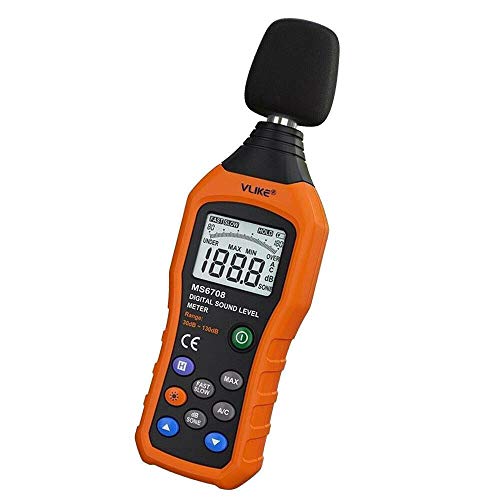
- Compact handheld sound-level reader
- 30–130dB range with A/C modes
- Backlit display, max lock, and auto ranging
Best For: Quick room-by-room checks and portable measurements
Best for Data Logging
Rechargeable Sound Level Meter

- Stores up to 3,100 records for later review
- Supports PC export and graphical readings
- Rechargeable with A/C and C weighting ranges
Best For: Noise tracking that benefits from saved data and reporting
Best Wall-Mount Option
13-Inch Decibel Meter Recorder

- Large 13-inch display with 4-inch digits
- Stores up to one year of readings
- 16.4-foot sensor and adjustable alarms
Best For: Home studios, classrooms, and continuous room monitoring
Best Portable Value
Tadeto Digital Sound Level Meter
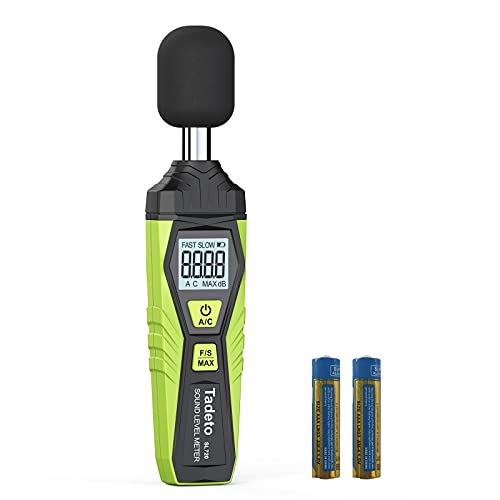
- 30–130 dB range with ±2.0 dB accuracy
- A/C weighting and fast/slow response modes
- Lightweight backlit LCD design
Best For: Portable household and ambient-noise checks
Best for Data Tracking
Rechargeable Decibel Meter Logger

- Records up to 43,000 readings
- Exports data to Excel through a PC
- Rechargeable with color alarms and chart display
Best For: Long-term home noise recording and analysis
Best Overall Value – TopTes TS-501B
If you want practical sound level meters for home use, the TopTes TS-501B combines a broad 30–130 dB range with an easy-to-read backlit display. Its compact design and included case make it convenient for checking household, neighborhood, workshop, or home-theater noise.
Best For: Home users who want a versatile, portable meter with useful everyday measurement features.
Pros:
- Measures 30–130 dB with A/C weighting and ±1.5 dB accuracy.
- Large 2.25-inch backlit LCD is easier to read in dim rooms.
- Includes MAX/MIN, data hold, three AAA batteries, and a carrying case.
Cons:
- Its frequency range is limited to 30–8,000 Hz.
- It uses disposable AAA batteries rather than a rechargeable power source.
The TS-501B is a well-rounded choice when you want straightforward controls, peak-reading features, and a display that works in low light without moving into more specialized equipment.
Best Analog-Style Readout – Extech 407730
Among sound level meters for home use, the Extech 407730 stands out for pairing a digital reading with a fast analog bar graph. It covers 40–130 dB and adds A/C weighting, Max/Min recording, and Max Hold for tracking changing or peak sound levels.
Best For: Buyers who prefer a recognized meter with a responsive visual bar graph and simple peak tracking.
Pros:
- Provides 0.1 dB resolution across a 40–130 dB measurement range.
- Fast-responding analog bar graph helps show sound changes at a glance.
- Includes A/C weighting, Max/Min recording, Max Hold, auto power-off, and a windscreen.
Cons:
- Its stated accuracy is ±2 dB, less precise than the ±1.5 dB models listed here.
- The measurement range starts at 40 dB rather than 30 dB.
The Extech is a sensible option if the bar graph matters to you during live monitoring. Its extra resolution and windscreen add convenience, though its narrower low-end range may matter for quieter home environments.
Best for Loudness Context – Goldeep SL750A
The Goldeep SL750A is one of the more flexible sound level meters for home use because it reports both dB and SONE units. It also offers FAST and SLOW response settings, A/C weighting, and MAX/MIN tracking for comparing changing household noise with perceived loudness.
Best For: Users who want both sound-intensity readings and a more intuitive loudness reference.
Pros:
- Measures 30–130 dB with ±1.5 dB accuracy.
- Switchable dB and SONE units help relate measurements to perceived loudness.
- FAST/SLOW response, A/C weighting, MAX/MIN, data hold, and a windbreak ball are included.
Cons:
- The supplied notes do not specify a backlit display.
- Its listed frequency response is 31.5 Hz–8 kHz, which may not suit specialized audio analysis.
Choose the Goldeep when response-speed control and SONE readings are more useful to you than a basic dB-only display. It is equipped for everyday indoor and outdoor checks, including home, traffic, office, and instrument noise.
Best Compact Carrying Option – RISEPRO HT-80A
The RISEPRO HT-80A keeps the essentials close at hand for sound level meters for home use: a 30–130 dB range, ±1.5 dB accuracy, backlighting, and hold, Max, and Min functions. Its included black pouch and gift-box packaging also make storage and portability straightforward.
Best For: Home, family, study, and business users seeking a compact meter with core monitoring features.
Pros:
- Measures 30–130 dB with stated ±1.5 dB accuracy.
- Offers backlight, data hold, maximum and minimum readings, and auto power-off.
- Includes a black carrying pouch and gift box.
Cons:
- The supplied notes list only Type A frequency weighting.
- Its stated frequency range ends at 4 kHz, narrower than several alternatives.
The HT-80A is a straightforward pick for routine noise checks when you want a compact package and familiar monitoring controls. Consider another model if C-weighting or a wider frequency response is important.
Best Large Display – 11-Inch LED Decibel Meter
For shoppers comparing sound level meters for home use, this wall-mountable DANOPLUS model prioritizes visibility. Its 11-inch adjustable-brightness LED display shows sound level, temperature, and humidity clearly, making it useful for monitoring a room from across the space.
Best For: Home offices, classrooms, studios, and other spaces where an easy-to-see wall or desktop display is useful.
Pros:
- Large 11-inch display with adjustable brightness
- 30–130dB range and stated ±1.5dB accuracy
- Color-coded face icons identify sound-level ranges without an audible alarm
- Rechargeable 2000mAh battery and 9.8-foot USB cable
Cons:
- Larger and less portable than handheld meters
- Temperature and humidity readings add size if you only need decibel measurements
This is a practical choice when at-a-glance monitoring matters more than pocket portability. Calibration capability is also useful for maintaining readings over long-term use.
Best Portable Pick – VLIKE Handheld A/C Decibel Meter
If portability is a priority when choosing sound level meters for home use, the VLIKE VL6708 is a compact handheld option. It measures 30–130dB, offers A/C weighting modes, and includes a backlit display for checking levels in darker areas.
Best For: Homeowners, families, and users who want a straightforward handheld meter for spot checks around rooms, offices, roads, or audio equipment.
Pros:
- Compact handheld design for convenient spot measurements
- A/C mode, maximum-value lock, and automatic range selection
- Backlight supports nighttime or low-light readings
- Power-saving design and auto backlight shutoff help conserve batteries
Cons:
- Batteries are not included and it requires four AAA batteries
- Cannot store or generate a report directly from the device
- Plastic handheld format is less suitable for permanent room monitoring
The VLIKE is best suited to quick, manual checks rather than documentation-heavy projects. Its A/C modes and max lock provide useful flexibility for a basic portable meter.
Best for Data Logging – Rechargeable Sound Level Meter
For buyers who need more than a live reading, this GAIN EXPRESS data-logging meter adds recording and PC export to the usual sound-level functions. It measures up to 130dB, provides visual alerts, and can store readings for later review—features that make it one of the more capable sound level meters for home use.
Best For: Tracking recurring household, neighbor, classroom, or office noise where saved measurements and computer analysis are valuable.
Pros:
- Stores up to 3,100 data records and supports PC export on Windows 7, 10, and 11
- 30–130dB(A) and 35–130dB(C) measurement ranges
- Numerical and graphical display with three-color light alarms
- USB rechargeable operation with approximately eight hours per charge
Cons:
- Recording and PC features may be unnecessary for simple spot checks
- Supplied notes list one AAA battery requirement alongside rechargeable operation, so power setup may require attention
This is the strongest fit for documenting patterns over time rather than simply checking a single noise event. Its calibration knob, adjustable auto-shutoff, and Type-C connection add useful control for repeated monitoring.
Best Wall-Mount Option – 13-Inch Decibel Meter Recorder
If you want sound level meters for home use that are easy to read from across a room, this wall- or desktop-mount model emphasizes visibility and long-term monitoring. Its large display, remote sensor, alarms, and extensive data logging make it suited to spaces where noise needs ongoing attention.
Best For: Home studios, classrooms, and rooms needing highly visible continuous noise monitoring.
Pros:
- 13-inch HD display with large 4-inch digits for viewing from a distance
- Records readings every 2 seconds and stores up to one year of data
- Includes a 16.4-foot sensor plus adjustable audible and visual alarms
- Supports desktop or wall mounting and offers a 30–130 dB range
Cons:
- Its 13-inch body is much less portable than a handheld meter
- Weighs 2.66 pounds and requires a suitable mounting or placement area
This is the strongest choice when readability and historical data matter more than portability. The large format and remote sensor are particularly useful for monitoring a home studio or shared living space.
Best Portable Value – Tadeto Digital Sound Level Meter
For shoppers comparing sound level meters for home use, the Tadeto offers a straightforward handheld design with a 30–130 dB range, A/C weighting, and selectable response speeds. Its backlit LCD and lightweight build make it practical for checking noise in different rooms or locations.
Best For: Portable household noise checks, baby rooms, home offices, and general ambient-noise measurements.
Pros:
- Measures from 30 to 130 dB with stated accuracy of ±2.0 dB
- Offers both A- and C-weighted measurements for different sound conditions
- Selectable fast and slow response modes support changing or relatively stable noise
- Lightweight design includes a backlit LCD with 0.1 dB resolution
Cons:
- Uses replaceable batteries rather than the rechargeable design found on some meters
- Does not list onboard data logging or PC export in the supplied details
This is a sensible pick for basic, repeatable measurements without the bulk of a wall-mounted monitor. It balances useful measurement controls with a portable form factor for everyday home checks.
Best for Data Tracking – Rechargeable Decibel Meter Logger
If your home noise project involves reviewing changes over time, this model stands out among sound level meters for home use with 43,000-record storage and PC export. It combines a rechargeable design with adjustable weighting, response speeds, color-coded alarms, and a real-time chart display.
Best For: Home users who want to record, export, and analyze noise patterns over extended periods.
Pros:
- Stores up to 43,000 readings and supports Excel export through a PC connection
- Provides stated ±1.5 dB accuracy across a 30–130 dB range
- Includes A/C weighting, adjustable fast/slow response, and a real-time line chart
- Rechargeable 1,000 mAh battery and three-color adjustable alarm indicators
Cons:
- PC connectivity and data export require a compatible Windows 7, 10, or 11 computer
- Its analysis-focused features may be more than needed for occasional spot checks
This is the most capable option here for documenting recurring noise and examining trends later. Choose it when data storage, export, and rechargeable operation are more important than the simplest possible interface.
How We Picked the Best Sound Level Meters for Home Use
We focused on meters with practical home-monitoring features, including broad measurement ranges, readable displays, portability, maximum and minimum readings, data hold, and automatic power-off functions. Models with A/C weighting are especially useful because they offer more flexibility for comparing general environmental noise with louder, lower-frequency sound.
We also included different form factors. Portable testers suit occasional checks around the house, while wall-mounted displays work better for classrooms, home offices, studios, nurseries, and other spaces where sound needs to be watched continuously. Data loggers earned consideration for users who need evidence of changing noise levels over hours or days.
Quick Comparison
| Best For | Features to Look For | Recommended Type |
|---|---|---|
| Occasional room checks | Simple controls, backlit LCD, data hold | Portable handheld meter |
| Continuous visibility | Large display, alarm indicators, wall mounting | Wall-mounted sound monitor |
| Noise investigations | MAX/MIN readings, A/C weighting, stable measurement | Advanced handheld meter |
| Long-term records | Data logging, USB export, rechargeable battery | Recording decibel meter |
Key Buying Factors for Sound Level Meters for Home Use
Measurement Range and Accuracy
Most home-oriented models in this roundup measure roughly 30 to 130 dB, covering quiet rooms, conversations, appliances, traffic, and many household disturbances. A wider range is useful, but stated accuracy and consistent operation matter more than a maximum number alone. These consumer meters are best for comparisons and monitoring, not regulated professional sound certification.
Weighting Options
A-weighting is the standard choice for approximating how people perceive ordinary environmental sound. C-weighting gives more emphasis to bass and is useful when assessing subwoofers, machinery, music systems, or other low-frequency sources. If you expect to investigate several types of noise, choose a model offering both.
Display, Alarms, and Placement
A backlit screen helps in dim rooms, while a large LED display is easier to read from across a room. Alarm icons, color indicators, and programmable thresholds can make continuous monitoring more convenient. For reliable comparisons, position the meter consistently and avoid covering its microphone or placing it directly against a wall unless the design calls for wall mounting.
Logging, Power, and Portability
Choose a compact handheld meter for quick checks in multiple rooms. Select a rechargeable data logger when you need trends, stored readings, or computer export. Battery-powered models are convenient for occasional use, while USB charging is helpful for frequent monitoring.
Who Should Buy Which Sound Level Meters for Home Use?
Choose a basic portable meter if you want to check appliances, neighbors, music, or home-office noise without maintaining records. Choose an A/C-weighted handheld model if you need more control for comparing different sound sources. Choose a wall-mounted display for a classroom, studio, nursery, or shared room where sound levels should remain visible. Choose a data logger if you need to document patterns, identify peak periods, or export measurements for later review.