Finding the right digital sound level meter is easier when you know which features matter beyond the advertised decibel range. The models in this roundup cover everyday noise checks, audio testing, workplace monitoring, and longer-term data collection.
Use the guide below to compare measurement functions, display designs, logging capabilities, and portability before choosing a meter that fits your environment and accuracy needs.
Best 10 Digital Sound Level Meters Picks for 2026
Best for Precision Basics
Extech 407730 Digital Sound Level Meter

- 40–130 dB range with 0.1 dB resolution
- A/C weighting and analog bar graph
- Max/Min tracking plus Max Hold
Best For: Routine noise checks with fine display resolution
Best Portable Value

- 30–130 dB range with ±1.5 dB accuracy
- A/C weighting, FAST/SLOW response, and SONE mode
- MAX/MIN tracking with data hold
Best For: Everyday home, office, classroom, and workplace checks
Best Budget Handheld
VLIKE LCD Digital Decibel Meter
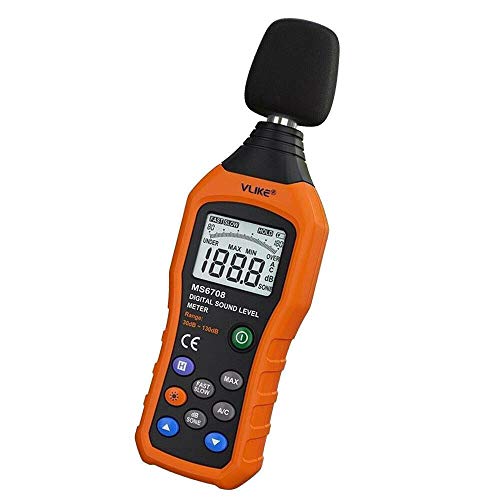
- 30–130 dB range with A/C mode
- Backlit display and Max locking
- Compact anti-drop casing
Best For: Quick portable noise checks without onboard reporting
Best for Data Logging
GAIN EXPRESS SLM-442 Sound Level Meter

- Stores up to 3,100 records with PC export
- USB rechargeable with up to 8 hours of operation
- Three-color alarm display and graphical readings
Best For: Ongoing noise monitoring and measurement documentation
Best Everyday Pick
RISEPRO HT-80A Digital Sound Level Meter

- 30–130 dB range with ±1.5 dB accuracy
- MAX/MIN, data hold, backlight, and auto shutoff
- Includes carrying pouch and gift box
Best For: Portable everyday noise checks
Best Large-Display Option
SW-525A Wall-Hanging Sound Level Meter

- Large red LCD for easy viewing
- 30–130 dB measurement range
- Automatic, wall-hanging design
Best For: Stationary noise monitoring with a visible display
Best for Comfort
DANOPLUS DP-441 Data-Logging Decibel Meter

- Stores up to 43,000 readings for PC export
- A/C weighting with FAST/SLOW response settings
- Three-color alarm and rechargeable USB operation
Best For: Documented noise surveys and PC analysis
Best Overall
TopTes TS-501B Sound Level Meter

- 30–130 dB range with ±1.5 dB accuracy
- A/C weighting, MAX/MIN, and data hold
- Backlit 2.25-inch display with batteries and case
Best For: General home, office, workshop, and factory noise checks
Best Simple Option
Tadeto SL720 Digital Sound Level Meter
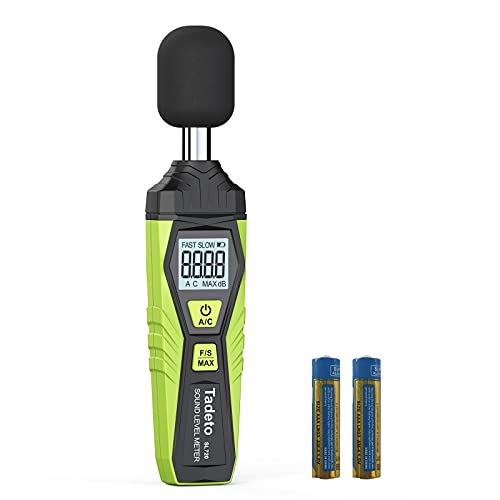
- 30–130 dB measurement range
- Fast/slow response and A/C weighting
- Backlit 0.1 dB-resolution LCD display
Best For: Basic environmental and household noise monitoring
Best Feature Set
Tadeto TE017 Sound Level Meter

- Five adjustable ranges across 30–130 dB
- ±1.5 dB accuracy with A/C weighting
- Alarms, MAX/MIN, data hold, and backlight
Best For: Alert-based monitoring across home, business, and industrial settings
Best for Precision Basics – Extech 407730 Digital Sound Level Meter
The Extech 407730 is a straightforward choice among digital sound level meters when you want a 40–130 dB range, 0.1 dB resolution, and a fast visual readout. Its A/C weighting, Max/Min recording, and Max Hold function make it useful for checking changing or sustained sound levels.
Best For: Buyers who want a traditional handheld meter with fine display resolution and simple peak tracking.
Pros:
- Measures 40–130 dB with 0.1 dB resolution and stated 2 dB accuracy
- Includes A/C weighting and a fast-responding analog bar graph
- Records Max/Min values and offers Max Hold
- Includes a microphone windscreen and four AAA batteries
Cons:
- Its 40 dB minimum is higher than meters that begin at 30 dB
- Uses replaceable AAA batteries rather than a rechargeable design
The Extech 407730 emphasizes clear, responsive readings and practical controls. It is a sensible fit for routine noise checks when data logging and computer export are not priorities.
Best Portable Value – Goldeep SL750A Decibel Meter
The Goldeep SL750A is one of the more flexible digital sound level meters for everyday noise checks, covering 30–130 dB with stated ±1.5 dB accuracy. A/C weighting, FAST/SLOW response, dB and SONE units, and MAX/MIN tracking give it useful options for home, office, classroom, music, and workplace measurements.
Best For: Portable environmental and loudness checks where flexible response modes and an easy-to-read display matter.
Pros:
- 30–130 dB range with ±1.5 dB accuracy and 31.5 Hz–8 kHz response
- Supports A/C weighting and dB/SONE readouts
- FAST and SLOW response settings suit changing or steady sounds
- Includes data hold, MAX/MIN tracking, windbreak ball, and two AAA batteries
Cons:
- Does not list computer data export or onboard data logging
- Operates on replaceable AAA batteries
With its broad range and multiple weighting, response, and unit settings, the SL750A is a practical general-purpose meter. It offers more measurement flexibility than a basic read-only model without requiring a separate accessory kit to begin testing.
Best Budget Handheld – VLIKE LCD Digital Decibel Meter
The VLIKE VL6708 is a compact option among digital sound level meters, offering 30–130 dB measurement with A/C mode and an automatic range function. Its backlit display, Max locking, and drop-resistant casing support basic checks in homes, offices, schools, roads, and industrial settings.
Best For: Personal and general-purpose noise monitoring when portability, backlighting, and simple controls are priorities.
Pros:
- 30–130 dB measurement range with A/C mode
- Backlight supports reading measurements in darker conditions
- Max locking and auto-ranging simplify basic monitoring
- Portable casing features an anti-drop structure and power-saving design
Cons:
- Batteries are not included
- Cannot store or generate a report directly from the device
- The supplied notes do not specify measurement accuracy
The VL6708 keeps the feature set focused on real-time readings rather than documentation. It is best suited to quick, portable checks, especially when a backlit display and straightforward A/C measurement are more useful than data export.
Best for Data Logging – GAIN EXPRESS SLM-442 Sound Level Meter
The GAIN EXPRESS SLM-442 stands out among digital sound level meters for recording and computer connectivity. It measures 30–130 dB(A) and 35–130 dB(C), stores up to 3,100 records according to the supplied notes, and uses a USB connection for exporting data on compatible Windows systems.
Best For: Users who need rechargeable operation, logged measurements, PC export, and visible alarm indicators for ongoing noise monitoring.
Pros:
- Stores up to 3,100 data records and supports PC data export
- USB rechargeable design provides up to 8 hours of operation per charge
- Offers 30–130 dB(A) and 35–130 dB(C) ranges with ±1.5 dB accuracy
- Includes graphical readings, three-color alarm lights, and an adjustable auto-shutoff
Cons:
- PC connectivity is specified for Windows 7, Windows 10, and Windows 11
- Its recording and alarm features may be unnecessary for simple spot checks
The SLM-442 is the strongest fit here for documenting sound over time. Its rechargeable battery, adjustable shutdown, calibration knob, alarm display, and data export make it more appropriate for repeated inspections than a basic handheld reader.
Best Everyday Pick – RISEPRO HT-80A Digital Sound Level Meter
The RISEPRO HT-80A is a practical choice among digital sound level meters for checking noise in homes, workplaces, study areas, and other environments. It covers 30–130 dB, offers ±1.5 dB accuracy, and includes useful monitoring features such as MAX/MIN readings and data hold.
Best For: Everyday noise checks, personal use, workplace monitoring, and portable measurements.
Pros:
- Measures from 30–130 dB with ±1.5 dB accuracy.
- Includes FAST response, A-frequency weighting, data hold, and MAX/MIN readings.
- Backlit display supports use in darker conditions.
- Includes a carrying pouch and gift box.
Cons:
- Uses a 31.5 Hz–4 kHz frequency range.
- Its plastic construction may be less suited to demanding industrial handling.
With a portable design, broad measurement range, and straightforward controls, the HT-80A balances useful features with everyday convenience. It is a solid fit when you want a general-purpose meter rather than a data-logging system.
Best Large-Display Option – SW-525A Wall-Hanging Sound Level Meter
The SW-525A is one of the more visible digital sound level meters in this roundup, featuring a large red LCD display and a wall-hanging design. Its 30–130 dB range makes it suitable for displaying decibel readings where a larger, easy-to-see screen is useful.
Best For: Wall-mounted or stationary noise displays in spaces where screen visibility matters.
Pros:
- Large LCD display is designed for at-a-glance viewing.
- Measures sound levels from 30–130 dB.
- Automatic operation simplifies basic monitoring.
Cons:
- Wall-hanging design is less portable than handheld meters.
- The supplied notes do not specify accuracy, weighting options, or data-logging features.
The SW-525A focuses on readable presentation and stationary operation rather than advanced analysis. Choose it when a large display is more important than portability or detailed recording functions.
Best for Comfort – DANOPLUS DP-441 Data-Logging Decibel Meter
The DANOPLUS DP-441 stands out among digital sound level meters for recording and exporting measurements. It stores up to 43,000 data points, connects to a Windows PC for Excel export and analysis, and adds visual alarms for changing noise levels.
Best For: Noise surveys, record keeping, PC-based analysis, and users who need rechargeable operation.
Pros:
- Records up to 43,000 readings and supports PC export.
- Measures 30–130 dB with stated ±1.5 dB accuracy.
- Offers A/C frequency weighting and FAST/SLOW response settings.
- Three-color alarm indicators and a configurable threshold provide visual alerts.
Cons:
- PC connectivity is specified for Windows 7, 10, and 11.
- Its data-logging features may be more than needed for quick spot checks.
For users who need more than a single live reading, the DP-441 provides a strong combination of logging, visualization, alarms, and computer connectivity. Its rechargeable battery and real-time display further support extended measurement sessions.
Best Overall – TopTes TS-501B Sound Level Meter
The TopTes TS-501B is a practical choice among digital sound level meters for checking household, workplace, and equipment noise. Its 30–130 dB range, A/C weighting, backlit display, and peak-reading functions make it versatile for routine measurements.
Best For: Home noise checks, noisy-neighbor monitoring, workshops, offices, and factories.
Pros:
- Measures 30–130 dB with stated ±1.5 dB accuracy.
- Offers A- and C-weighting, plus MAX/MIN readings and data hold.
- Includes a large 2.25-inch backlit LCD, carry case, and three AAA batteries.
Cons:
- Uses AAA batteries rather than a rechargeable power system.
- Does not list fast/slow response selection in the supplied specifications.
With its strong feature mix, readable screen, and included accessories, the TS-501B is a well-rounded option for general-purpose sound measurements.
Best Simple Option – Tadeto SL720 Digital Sound Level Meter
The Tadeto SL720 keeps digital sound level meters straightforward while adding useful response controls. It measures from 30 to 130 dB, displays readings to 0.1 dB, and provides fast or slow measurement modes for changing or relatively steady noise.
Best For: Everyday environmental checks in homes, offices, factories, vehicles, schools, and construction areas.
Pros:
- Provides a 30–130 dB range with stated ±2.0 dB accuracy.
- Includes A/C weighting for ambient noise and higher-intensity machine sounds.
- Offers fast and slow response modes, a backlit LCD, and low-battery indication.
Cons:
- Its stated accuracy is lower than some alternatives in this roundup.
- The supplied notes do not mention a carry case, MAX/MIN function, or data hold.
This is a sensible pick when you want a lightweight, manually operated meter with essential weighting and response settings rather than an extensive feature set.
Best Feature Set – Tadeto TE017 Sound Level Meter
The Tadeto TE017 stands out among digital sound level meters for its adjustable measurement ranges and alert functions. Along with a 30–130 dB range and stated ±1.5 dB accuracy, it combines A/C weighting, fast/slow response, MAX/MIN measurement, data hold, and audible and visual alarms.
Best For: Users who want adjustable monitoring and alerts for personal, household, business, study, or industrial environments.
Pros:
- Offers five adjustable measurement ranges within 30–130 dB.
- Provides stated ±1.5 dB accuracy with A/C weighting and fast/slow response.
- Includes MAX/MIN readings, data hold, backlight, and audible/visual alarms.
Cons:
- The supplied notes do not specify included batteries or a carry case.
- Its additional controls may be more than needed for simple occasional checks.
The TE017 is the most feature-focused choice here, especially for monitoring situations where selectable ranges and audible or visual warnings are useful.
How We Picked These Digital Sound Level Meters
We selected these meters to represent the most useful options across portable sound checks, home projects, audio work, workplace monitoring, and basic environmental measurement. Our comparison emphasizes measurement range, A/C weighting support, display readability, maximum and minimum readings, data hold, logging, alarms, power options, and ease of use.
Because specifications and included accessories can vary by seller or production run, verify the current listing before buying. These are practical consumer and light-professional tools; applications requiring certified compliance measurements may call for a professionally calibrated instrument.
Quick Comparison
| Best For | Features to Prioritize | Good Match |
|---|---|---|
| Everyday noise checks | Simple controls, backlight, data hold | Basic portable meters |
| Audio and equipment testing | A/C weighting, broad range, MAX/MIN | Extech, TopTes, or Tadeto models |
| Long-term monitoring | Data logging, USB transfer, rechargeable battery | Recording and data-logger models |
| Visible alerts | Alarm indicator, large screen, wall-mount design | SW-525A-style meters |
Key Buying Factors for Digital Sound Level Meters
Measurement Range and Weighting
A 30–130 dB range handles most household, workshop, traffic, and equipment measurements. A-weighting approximates human hearing and is useful for general noise checks, while C-weighting is better suited to louder sounds and low-frequency content. If you compare readings across devices, use the same weighting and measurement settings.
Accuracy, Response, and Calibration
Look for published accuracy and fast or slow response settings when available. Fast response is useful for changing sounds; slow response produces a steadier reading. Calibration capability is valuable for repeatable work, but an adjustment feature does not automatically make a consumer meter laboratory-certified.
Display and Controls
A backlit LCD helps in dim rooms, while a large display is easier to read from across a workshop or venue. MAX/MIN, data hold, and auto power-off are practical conveniences. Confirm that the buttons are accessible and that the meter can be operated without obscuring its microphone.
Logging, Alerts, and Power
Choose a data logger when you need trends rather than occasional spot readings. Storage capacity, USB export, recording intervals, and software compatibility matter more than a large headline data count. Rechargeable models reduce battery waste, while replaceable batteries may be preferable for field work.
Who Should Buy Which Digital Sound Level Meters?
For occasional household checks, a compact meter with a backlight, data hold, and MAX/MIN function is usually sufficient. Audio enthusiasts and technicians should favor models offering both A and C weighting, a broad range, and dependable response controls. Buyers monitoring noise over hours or days should choose a recording meter with generous storage and straightforward data export. For workshops, classrooms, or shared spaces, prioritize a large readable display and a visible alarm. If measurement results will support regulatory, legal, or occupational-health decisions, consider a calibrated professional instrument instead of relying solely on a budget digital meter.