The best light meters for hobbyists make it easier to measure brightness instead of relying on guesswork. Whether you are balancing studio lighting, checking a workspace, or tuning grow lights, the right meter can provide useful readings quickly.
This roundup compares ten handheld options across measurement range, sensor design, display features, refresh speed, and specialized capabilities, so you can choose a practical fit for your projects and budget.
Best 10 Light Meters for Hobbyists Picks for 2026
Best All-Around Meter

- 0.1–200,000 lux range
- Rotating probe and backlit LCD
- Measures temperature and humidity
Best For: General home, office, plant, and workshop measurements
Best for Photography

- One-tenth-stop exposure accuracy
- Incident and reflected readings
- Photo, Cine, and HD Cine modes
Best For: Still photography, flash, and DSLR or mirrorless video
Best Split-Sensor Design
- Up to 200,000 lux
- Separate flexible probe
- Switchable backlight and temperature units
Best For: Flexible general-purpose light and temperature checks
Best for Grow-Light Analysis

- Measures PAR and UVA ranges
- Breaks PAR into blue, green, and red
- Records up to 100 PAR readings
Best For: Indoor grow-light spectrum and coverage analysis
Best Plant-Growing Pick
Dr.meter Digital Illuminance Light Meter

- 0–200,000 lux measurement range
- Lux/FC conversion with fast readings
- Peak recording and low-battery alert
Best For: Hobby gardeners and plant-light checks
Best High-Range Pick
- Measures up to 400,000 lux
- 270° rotating sensor for easier positioning
- Stores 33 readings for comparisons
Best For: Grow lights, LEDs, and angled measurements
Best Compact Pick

- Lightweight 5-ounce portable design
- Lux/FC readings up to 199,900 lux
- Backlit display with max/min and data hold
Best For: Portable household, office, and hobby measurements
Wide-Range Pick
200,000-Lux Digital Light Meter

- Measures up to 200,000 lux
- LUX/FC switching with auto range
- Backlight, hold, and MAX/MIN functions
Best For: General plant, home, outdoor, and photography measurements
Feature-Rich Choice
POROMETISTO Handheld Light Meter

- 0–200,000 lux and 0–20,000 FC range
- Digital and analog-bar display
- Includes backlight, hold, MAX/MIN, and two-year warranty
Best For: Grow-light, photography, and low-light checks
Flexible Sensor Pick
DANOPLUS Rotating-Sensor Lux Meter

- Separate sensor rotates 360 degrees
- Four ranges up to 200,000 lux
- MIN/MAX, hold, auto-ranging, and FC mode
Best For: Angled measurements for plants, headlights, home, and office lighting
Best All-Around Meter – TopTes TS-710
For hobbyists comparing light meters for hobbyists, the TopTes TS-710 is a versatile choice for everyday illuminance checks. It measures lux and foot-candles across a broad range, while the rotating probe and backlit display make it practical for plants, rooms, workshops, and troubleshooting lighting.
Best For: Hobbyists who want one general-purpose meter for plant lighting, home LEDs, offices, and car headlights.
Pros:
- Measures 0.1–200,000 lux and 0.1–20,000 foot-candles.
- 180° rotating sensor and fast 0.5-second sampling support flexible measurements.
- Includes temperature, humidity, MAX/MIN, data-hold, case, and three AAA batteries.
Cons:
- Designed for visible-light measurements rather than dedicated plant PAR readings.
- Temperature readings may take time to adapt to a new environment.
The TS-710 offers a strong mix of range, convenience, and extra environmental features. It is especially appealing when you need a straightforward meter for several household or hobby projects.
Best for Photography – Sekonic L-308X-U Flashmate
Photographers looking beyond basic light meters for hobbyists may prefer the Sekonic L-308X-U. This compact exposure meter is built around incident and reflected readings, with dedicated photo, cine, and HD cine modes for still photography and video work.
Best For: Hobbyist photographers and videographers who need exposure readings for ambient or electronic flash lighting.
Pros:
- Provides exposure accuracy down to one-tenth of a stop.
- Supports ambient, corded flash, and cordless flash measurements.
- Photo, Cine, and HD Cine modes cover stills, cinema, and DSLR or mirrorless video.
Cons:
- Its photography-focused design is less suited to general room or plant illuminance checks.
- Flash and cinema functions may be more than casual users need.
The L-308X-U is a specialized option rather than a general lux meter. Choose it when camera exposure control matters more than measuring everyday lighting levels.
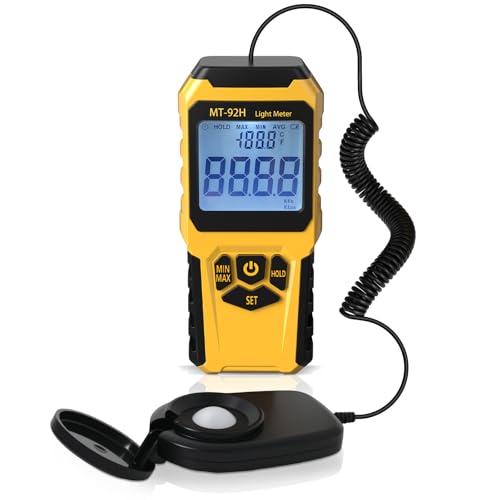
Best Split-Sensor Design – MT-92H Light Meter
The MT-92H gives hobbyists shopping for light meters for hobbyists a compact option with a separate probe and quick updates. Its lux and foot-candle readings, switchable backlight, and temperature measurement make it useful when lighting conditions vary across a space.
Best For: Users who value flexible probe positioning, readable measurements, and basic temperature monitoring.
Pros:
- Measures up to 200,000 lux with 0.1-lux resolution and ±3% accuracy.
- Separate split-sensor probe allows flexible positioning.
- Switches between lux/foot-candles and Celsius/Fahrenheit, with a backlight for dark environments.
Cons:
- The supplied notes do not list data logging or MAX/MIN functions.
- Its 188-gram weight is higher than some pocket-sized light meters.
The MT-92H is a practical middle ground for hobbyists who want fast, readable measurements and a detached sensor. It is most useful for general illuminance work rather than specialized photographic or horticultural analysis.
Best for Grow-Light Analysis – AH-Quantuv PAR Meter
For growers choosing light meters for hobbyists, the AH-Quantuv is the specialized pick for analyzing plant-light performance. Instead of reporting only general illuminance, it measures PAR and UVA, displays blue, green, and red contributions, and records readings for mapping light distribution.
Best For: Indoor growers who want to compare grow-light intensity, spectrum, UVA, and coverage across a growing area.
Pros:
- Measures PAR from 400–750 nm and UVA from 320–400 nm.
- Shows separate blue, green, and red PAR contributions.
- Stores up to 100 PAR measurements for identifying hotspots and low-light zones.
Cons:
- It is focused on horticultural measurements rather than general lux or foot-candle readings.
- The specialized features may be unnecessary for basic household lighting checks.
The AH-Quantuv is the strongest fit when plant performance and grow-light coverage are the main priorities. Its spectrum breakdown and recording function provide more actionable information for growers than a basic illuminance meter.
Best Plant-Growing Pick – Dr.meter Digital Illuminance Light Meter
For hobbyists comparing light meters for hobbyists, the Dr.meter Digital Illuminance Light Meter is a practical option for checking indoor, outdoor, and plant-growing light. It provides fast readings in either lux or foot-candles and covers a broad 0–200,000 lux range.
Best For: Hobby gardeners, plant growers, and general home or office light checks.
Pros:
- Measures up to 200,000 lux for sunlight and bright grow-light environments.
- Switches between lux and foot-candle measurements.
- Fast readings twice per second, with a peak-data function for brief light pulses.
- Includes a low-battery alert and the required 9V battery.
Cons:
- Uses a 9V battery rather than a rechargeable power source.
- Its peak function may be more specialized than casual users need.
This is a straightforward choice when you want broad measurement range, quick response, and simple unit switching for plant care or everyday illumination checks.
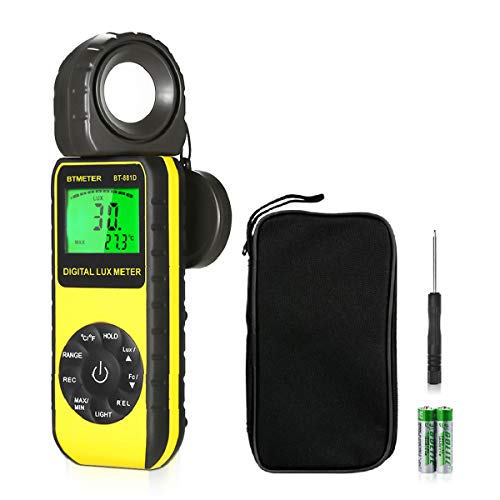
Best High-Range Pick – BTMETER BT-881D Light Meter
The BTMETER BT-881D stands out among light meters for hobbyists who want an especially wide measurement range and flexible positioning. Its 270-degree rotating sensor lets you measure from different angles without turning the whole meter around.
Best For: Hobbyists measuring grow lights, LEDs, plants, and indoor or outdoor lighting from awkward angles.
Pros:
- Measures from 0.01 to 400,000 lux and up to 40,000 foot-candles.
- Provides readings in about 0.4 seconds with two to three samples per second.
- Rotating sensor improves access when measuring from different directions.
- Stores 33 readings and includes a relative measuring mode for comparisons.
Cons:
- The wider feature set may be unnecessary for simple household checks.
- Specified accuracy varies by measurement range.
Choose this model if measurement flexibility and maximum range matter more than having a minimal, basic meter. The rotating sensor and memory functions are especially useful for comparing multiple lighting locations.
Best Compact Pick – UNI-T UT383 Light Meter
The UNI-T UT383 is a compact choice for hobbyists who want a portable light meter with useful essentials rather than an oversized feature set. It measures in lux or foot-candles, samples every 0.5 seconds, and includes max/min, data hold, and overload indicators.
Best For: Hobbyists needing a lightweight meter for home, office, agriculture, photography, or general light checks.
Pros:
- Compact 5-ounce design for convenient portability.
- Measures up to 199,900 lux and 18,500 foot-candles.
- Large four-digit LCD includes backlighting for easier viewing.
- Offers max/min, data hold, low-battery indication, and auto shutdown.
Cons:
- Its maximum range is lower than the BTMETER BT-881D.
- Sampling is slightly slower than the fastest model in this roundup.
- The supplied notes do not indicate a peak-recording feature.
This is a sensible everyday option when portability and core measurement functions are priorities. It is well suited to hobbyists who want a compact meter for varied indoor, outdoor, and photography-related checks.
Wide-Range Pick – 200,000-Lux Digital Light Meter
For hobbyists comparing light meters for hobbyists, this digital illuminance meter offers a broad 0–200,000 lux measuring range in a compact handheld format. Its automatic range selection and LUX/FC switching make it practical for checking indoor rooms, outdoor brightness, grow plants, or photography lighting.
Best For: Hobbyists who need broad-range brightness readings for plants, photography, and general indoor or outdoor checks.
Pros:
- Measures up to 200,000 lux and supports LUX or FC units.
- Includes MAX/MIN, data hold, backlight, and automatic power-off functions.
- Large display and automatic range conversion simplify readings.
- Three AAA batteries are included.
Cons:
- The supplied notes do not specify measurement accuracy.
- Its feature set is focused on brightness measurement rather than advanced logging.
Choose this model when maximum range and straightforward operation matter more than specialized controls. It is a flexible general-purpose option for casual plant, home, and photography measurements.
Feature-Rich Choice – POROMETISTO Handheld Light Meter
Among light meters for hobbyists, the POROMETISTO LT01 stands out for its combination of a wide range, quick sampling, and easy-to-read display. It measures up to 200,000 lux, shows both digital and analog-bar readings, and includes practical functions for tracking changing light.
Best For: Hobbyists adjusting grow lights, checking photography setups, or comparing illumination in dim and bright spaces.
Pros:
- Measures 0–200,000 lux and 0–20,000 FC with stated accuracy of ±(3% + 5 lux) under standard incandescent lamps.
- Two readings per second and a digital-plus-analog display help show light changes.
- Backlight, data hold, and MAX/MIN recording support difficult or low-light measurements.
- Includes batteries, sensor cap, lanyard, manual, and a stated two-year warranty.
Cons:
- The stated accuracy specification is specifically given for standard incandescent lamps.
- Its included batteries are listed as two AA batteries, unlike the compact AAA format used by some meters.
This is a strong fit for hobbyists who value display clarity and measurement aids as much as range. The warranty and included accessories also make it a convenient ready-to-use choice.
Flexible Sensor Pick – DANOPLUS Rotating-Sensor Lux Meter
For light meters for hobbyists who need to position the sensor precisely, the DANOPLUS DP-331 uses a separate 360-degree rotating sensor. Its four automatic ranges cover up to 200,000 lux, while the switchable FC mode supports common brightness checks around the home, office, plants, or vehicles.
Best For: Hobbyists measuring light from awkward angles or checking plants, headlights, home, and office lighting.
Pros:
- Rotating sensor can be adjusted to a suitable position for measurement.
- Offers 0–200,000 lux across four ranges and switchable 0–20,000 FC readings.
- Includes stated ±4% ±10 digits accuracy across a 400–700 nm spectral range.
- Provides MIN/MAX, data hold, auto-ranging, and selectable auto-power-off functions.
Cons:
- The separate sensor may be less convenient to carry than an integrated design.
- The supplied notes do not mention a backlight.
The rotating sensor is the main reason to choose this meter: it can help hobbyists aim the sensing element without repositioning the entire device. Its broad range and practical hold functions round out the design for routine measurements.
How We Picked These Light Meters for Hobbyists
We focused on meters that offer useful functionality for home photographers, makers, indoor gardeners, DIY users, and students. Important considerations included measurement range, lux and foot-candle support, sensor positioning, display readability, refresh behavior, portability, and ease of use.
The selection includes general-purpose illuminance meters as well as tools designed for photographic exposure or horticultural lighting. Because specifications and included accessories can vary by seller, confirm the current listing details before purchasing.
Quick Comparison
| Best For | What to Look For |
|---|---|
| Everyday brightness checks | Wide lux range, simple controls, and a readable LCD |
| Photography | Incident and reflected metering, flash support, and exposure modes |
| Grow lights | PAR or PPFD measurement and a suitable spectral range |
| Hard-to-reach areas | Rotating or split sensor design |
| Frequent field use | Fast refresh, compact construction, and backlighting |
Key Buying Factors for Light Meters for Hobbyists
Measurement Type and Range
Most general-purpose models measure illuminance in lux, with some also offering foot-candles. A range up to 200,000 lux is useful for comparing dim rooms, bright windows, and outdoor conditions. Photographers should distinguish between an illuminance meter and a dedicated exposure meter, which may calculate camera settings from incident or reflected light.
Sensor Positioning
A rotating sensor helps you aim at a light source while keeping the display visible. Split or remote-style sensors can be useful when measuring inside cabinets, near equipment, or in awkward corners. A fixed sensor is usually adequate for straightforward room and desk measurements.
Display and Controls
Look for a large, high-contrast screen, intuitive range selection, data hold, and a backlight if you often work in dark areas. Auto-ranging is convenient, while manual range controls can make readings more predictable for repeat measurements.
Specialized Features
Grow-light users may need PAR or PPFD readings rather than ordinary lux, particularly when comparing plant lighting. Photography users should prioritize incident, reflected, flash, and cine modes over maximum lux range.
Who Should Buy Which Light Meters for Hobbyists?
- For general home and workshop checks: Choose an affordable digital illuminance meter with a broad range and simple lux/foot-candle readings.
- For photography and video: Choose a dedicated exposure meter such as the Sekonic option, especially if you use flash or cine settings.
- For indoor plants and grow lights: Choose the PAR meter, since horticultural measurements provide more relevant information than lux alone.
- For tight spaces: Select a rotating- or split-sensor model that lets you position the sensor independently of the display.
- For occasional hobby use: A compact meter with a clear screen, hold function, and wide range should provide the best balance of cost and convenience.
Before buying, confirm the meter’s units, accuracy claims, battery requirements, operating range, and return policy. For hobby projects, repeatable readings and easy handling are often more valuable than advanced features you will rarely use.