The best mineral collection kits make geology hands-on, combining real specimens with labels, identification guides, and activities that encourage close observation. The options below range from compact starter sets to larger collections designed for classrooms or extended exploration.
We compared specimen variety, educational support, organization, age suitability, and overall usefulness so you can choose a kit that fits the learner, setting, and budget.
Best 10 Mineral Collection Kits Picks for 2026
Largest Collection
National Geographic 300+ Rock Collection

- Includes 300+ genuine specimens
- Two geodes to crack open
- Guide, magnifying glass, and storage bag
Best For: Large starter collections and earth-science exploration
Hands-On Testing Pick

- Includes 15 mineral specimens
- Streak plate and nail support testing
- Compact, battery-free activity kit
Best For: Focused introductory mineral identification
Book Bundle
National Geographic Collection with Expert Book

- 300+ genuine specimens included
- Two break-open geodes
- 100+ page hardcover earth-science book
Best For: Learners who want collecting and deeper reading
Treasure Hunt Set
DANCING BEAR Rock and Geode Kit

- 250+ pieces in a simulated rock hunt
- Includes geodes, fossils, and gemstones
- ID sheet and rock book included
Best For: Interactive family geology activities
Classroom Collection
Introductory Earth Science Set

- 75 numbered rock and mineral samples
- Includes streak plate, magnet, magnifier, and study guide
- Covers igneous, sedimentary, and metamorphic rocks
Best For: Classrooms and structured Earth science lessons
Young Geologist Pick

- Includes 15 authentic specimens
- Individual storage compartments help organize samples
- Magnifier and identification guide included
Best For: Young beginners and geology gifts
Starter Collector Set
54-Piece Rock and Mineral Collection

- Includes 54 assorted rocks, crystals, and minerals
- Nine polished gems plus 45 raw specimens
- Display case, ID cards, guidebook, and magnifier included
Best For: Beginner collectors and interactive STEM learning
Best Guided Collection
National Geographic 15-Piece Gemstone Set
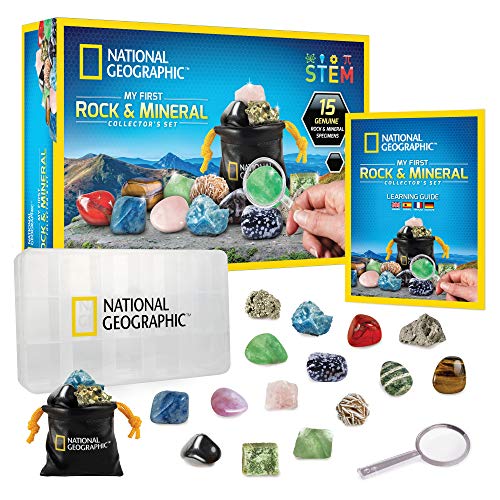
- 15 named gemstones and crystals
- Includes guide, case, and storage pouch
- Recommended for ages 8 and up
Best For: Young beginners who want guided geology learning
Best Bulk Variety
800-Piece Gemstones and Crystals Set

- Approximately 800 stones weighing 3 pounds
- Includes more than 30 crystal varieties
- Useful for crafts, study, and collecting
Best For: Bulk collecting and hands-on creative projects
Best Compact Display Set
Dancing Bear 18-Piece Rock Collection

- Includes 18 rocks and minerals
- Comes with a plastic collection box
- Includes descriptions and educational information
Best For: Young beginners, classrooms, and simple gifting
Largest Collection – National Geographic 300+ Rock Collection
For shoppers seeking mineral collection kits with plenty of variety, this National Geographic set includes more than 300 genuine rocks, minerals, and crystals. Two break-open geodes, a magnifying glass, learning guide, and storage bag add hands-on exploration and organization.
Best For: Kids ages 8 and up who want a large starter collection or an expansion set with identification materials.
Pros:
- Includes over 300 genuine specimens from around the world.
- Two geodes provide an engaging crystal-discovery activity.
- Includes a full-color guide, magnifying glass, and storage bag.
Cons:
- The very large assortment may be more than younger children need.
- It is primarily a collecting and identification set rather than a detailed testing kit.
This is a strong choice when quantity and variety matter most. The included guide and viewing tool make the collection more useful for basic earth-science exploration.
Hands-On Testing Pick – Toysmith Mineral Science Kit
This compact option among mineral collection kits focuses on learning how to classify and identify samples. It includes 15 mineral specimens, a magnifying viewer, streak plate, nail, and identification guide for simple geology activities.
Best For: Children ages 8 and up who need a smaller, activity-focused introduction to mineral identification.
Pros:
- Provides 15 mineral specimens for focused study.
- Includes a streak plate and nail for basic testing activities.
- Compact design requires no batteries.
Cons:
- Offers substantially fewer specimens than the larger collection kits.
- The included tools and guide are basic.
Choose this kit if practical identification exercises are more important than building a large display collection. Its smaller format is also convenient for limited storage space.
Book Bundle – National Geographic Collection with Expert Book
This National Geographic bundle combines a 300-piece collection with a hardcover earth-science book, making it one of the more learning-oriented mineral collection kits. It also includes two geodes and a 100-plus-page resource covering rocks, minerals, fossils, and more.
Best For: Kids ages 8 and up who want a substantial specimen collection paired with extended reading and reference material.
Pros:
- Includes over 300 genuine rocks, minerals, and crystals.
- Two geodes add a hands-on discovery activity.
- Hardcover book offers more than 100 pages of earth-science content.
Cons:
- The larger set may require more storage and organization.
- The book and specimens are supplied in English.
The book distinguishes this version from collection-only kits, giving curious learners a reference they can continue using after examining the specimens. It is a good fit for sustained interest in earth science.
Treasure Hunt Set – DANCING BEAR Rock and Geode Kit
For an activity-centered choice among mineral collection kits, this DANCING BEAR set includes more than 250 pieces mixed with clean gravel to simulate a rock hunt. An identification sheet, rock book, geodes, fossils, and themed treasures support matching and discovery.
Best For: Families looking for an interactive geology-themed treasure hunt with rocks, fossils, and geodes.
Pros:
- Includes over 250 pieces for an extended sorting and discovery activity.
- Features break-open geodes, shark teeth fossils, arrowheads, and gemstones.
- Identification sheet and rock book support STEM learning.
Cons:
- The mixed-gravel format can require additional sorting.
- The listed recommended age starts at 3, so close supervision is appropriate for younger children.
This set emphasizes play and discovery over formal mineral testing. It is particularly appealing when the goal is to recreate the excitement of a treasure hunt while introducing geology concepts.
Classroom Collection – Introductory Earth Science Set
Geosciences Industries 13357 Introductory Earth Science Classroom Rocks and Minerals Collection
Check Price On AmazonThis expansive mineral collection kit is designed for structured Earth science study, with 75 labeled rock and mineral samples plus tools and reference materials. The included classification charts, streak plate, magnet, and magnifier make it suitable for hands-on identification and lessons about the rock cycle.
Best For: Classrooms, homeschooling, and older students who need broad specimen variety and study tools.
Pros:
- Includes 75 numbered and indexed rock and mineral samples.
- Covers igneous, sedimentary, and metamorphic rocks.
- Includes a streak plate, magnet, magnifier, and introductory study guide.
- Samples measure approximately 1–2 inches for hands-on examination.
Cons:
- The larger collection may be more than casual learners need.
- Manufacturer guidance recommends ages 11–13, so it may not suit younger children.
Choose this set when breadth and lesson-ready materials matter most. Its indexed specimens and classification resources give learners a more organized introduction to geology than a small novelty collection.
Young Geologist Pick – 15-Piece Rock and Mineral Kit
This compact mineral collection kit offers an approachable starting point for children exploring geology. It includes 15 authentic specimens in individual storage compartments, along with a magnifier and identification guide for simple observation and matching activities.
Best For: Young beginners, family learning, and gift buyers seeking a compact geology activity.
Pros:
- Provides 15 rock and mineral specimens in a dedicated storage box.
- Includes a magnifying glass for examining textures and details.
- Identification sheet supports beginner-friendly learning.
- Recommended for ages 6 and up.
Cons:
- Its 15-piece assortment is smaller than the other collections in this roundup.
- The supplied details do not specify the individual specimen types.
This is a straightforward choice for a first geology activity, especially when easy storage and simple identification are priorities. More advanced learners may prefer a larger assortment or more extensive reference material.
Starter Collector Set – 54-Piece Rock and Mineral Collection
This versatile mineral collection kit combines 54 assorted specimens with labels, learning cards, a guidebook, and a compartmented display case. With nine polished gemstones and 45 raw crystals, rocks, and minerals, it supports both beginner collecting and hands-on STEM activities.
Best For: Beginners who want a displayable collection with identification resources and interactive learning materials.
Pros:
- Includes 54 pieces: nine polished gems and 45 raw crystals, rocks, and minerals.
- Comes with illustrated identification and game cards plus a learning book.
- Transparent compartment storage case supports organization and display.
- Includes a magnifier and covers origins, hardness, and mining locations in the guide.
Cons:
- Individual pieces are assorted, so exact specimens may vary.
- The set may be less suited to formal classification than a classroom-focused collection.
This set stands out for combining collection, display, and guided activities in one package. It is a practical middle ground for learners who want more variety than a small starter kit without moving to a full classroom assortment.
Best Guided Collection – National Geographic 15-Piece Gemstone Set
For shoppers seeking mineral collection kits with a clear educational focus, this National Geographic set offers 15 named rock and mineral specimens plus materials for organizing and identifying them. It is a straightforward choice for introducing children to geology without overwhelming them with a large bulk assortment.
Best For: Children ages 8 and up who want a curated geology collection with an identification guide.
Pros:
- Includes 15 gemstones and crystals, including tiger’s eye, rose quartz, pyrite, and fluorite.
- Comes with a clear storage box, storage pouch, and full-color learning guide.
- Designed to support rock identification and learning about geology.
- Compact 9.2-by-6.1-by-2.2-inch format is easy to store and display.
Cons:
- Includes fewer specimens than bulk mineral collection kits.
- Recommended for ages 8 and up, so it may not suit younger children.
This is a polished, gift-ready option for beginners who value specimen variety, storage, and guided learning over quantity.
Best Bulk Variety – 800-Piece Gemstones and Crystals Set
Among mineral collection kits, this bulk set stands out for shoppers who want a large quantity and broad variety. It includes approximately 800 polished crystal chips across more than 30 kinds, making it useful for collecting, sorting, crafts, and hands-on exploration.
Best For: Older children, teens, adults, and crafters who prefer a large assortment of small stones.
Pros:
- Provides approximately 800 stones weighing about 3 pounds.
- Includes more than 30 types, such as amethyst, lapis lazuli, rose quartz, and obsidian.
- Small irregular pieces are suitable for collection, study, jewelry projects, and DIY crafts.
- Offers substantially more specimens than curated display kits.
Cons:
- Stones are small, irregular, and varied in size, so individual specimens may be harder to identify.
- The assortment is random rather than a fixed list of every included stone.
- Its recommended age information varies in the supplied details, so supervision may be appropriate for younger users.
Choose this set when volume and creative flexibility matter most; choose a curated kit instead if guided identification and display-ready specimens are priorities.
Best Compact Display Set – Dancing Bear 18-Piece Rock Collection
This compact option is one of the more practical mineral collection kits for a classroom, beginner collector, or gift recipient who wants a defined assortment. It includes 18 rocks and minerals, a plastic collection box, and descriptive educational information for basic exploration.
Best For: Kids ages 4 to 12, teachers, and beginners who want a simple boxed collection.
Pros:
- Includes 18 rocks and minerals in a clearly defined collection.
- Plastic collection box helps keep the specimens together.
- Description sheet and educational information support geological learning.
- Compact 9.25-by-4.5-by-1.5-inch case is convenient for storage.
Cons:
- Provides less quantity and variety than the 800-piece bulk set.
- The supplied details do not identify the individual rocks and minerals included.
- Plastic and acrylic components may feel less premium than a more display-focused case.
This set balances a manageable specimen count with basic educational materials, making it a sensible entry point when organization and simplicity are more important than maximum variety.
How We Picked the Best Mineral Collection Kits
We focused on what makes a rock and mineral set genuinely useful rather than judging it by piece count alone. Our comparison considered the variety and stated number of specimens, whether rocks and minerals are labeled, the quality of included books or identification sheets, storage and presentation, and suitability for the intended age group.
We also included options for different use cases: first collections for young children, STEM activities, classroom demonstrations, fossil and geode exploration, and larger bulk sets for sorting or group projects. Because specimen size and contents can vary, buyers should check the current listing details before ordering.
Quick Comparison
| Best For | Look For |
|---|---|
| Young beginners | Clearly labeled specimens, sturdy storage, and simple activities |
| Independent learners | An identification guide, descriptive cards, and varied examples |
| Classrooms and groups | Higher piece counts, duplicate specimens, and easy sorting |
| Collectors and display | Attractive boxes, unusual specimens, and reliable descriptions |
Key Buying Factors for Mineral Collection Kits
Specimen Variety and Authenticity
A larger count does not always mean a better learning experience. Look for a useful mix of minerals, rocks, crystals, fossils, or geodes, depending on your goals. Tumbled pieces are safer and easier to handle, while rough specimens can reveal texture, cleavage, and natural formations.
Labels and Learning Materials
Name labels, an identification sheet, or a geology book can turn a box of stones into an educational activity. Beginners benefit from clear photos and basic facts; older students may prefer information about hardness, streak, formation, and geographic origin.
Age, Safety, and Storage
Check the recommended age and supervise younger children, especially when kits contain small parts, sharp edges, or pieces that could present a choking risk. A divided case or labeled box helps prevent specimens from getting mixed up and makes repeat activities easier.
Quantity Versus Usability
Bulk collections are valuable for sorting, group lessons, and crafts, but compact sets may offer better organization and stronger educational context. Choose the format that matches how often the collection will be used.
Who Should Buy Which Mineral Collection Kits?
Choose a compact, clearly labeled starter set for a child exploring geology for the first time. A kit with a book, ID sheet, or guided activities is the better choice for homeschool lessons and independent study. Classrooms, camps, and siblings may benefit most from larger collections with many specimens to sort and compare.
If presentation matters, prioritize a well-organized box with descriptive information. For hands-on experimentation or group projects, favor higher-count sets, but confirm that the pieces are sufficiently varied and safely packaged. The right mineral collection kit is the one that combines specimens the learner will handle with information that helps them understand what they find.