Finding the right USB duplicator under $500 depends on what you need to copy: flash drives, SATA storage, M.2 SSDs, or a mix of media types. The products in this roundup cover compact standalone copiers, multi-port flash duplicators, and dual-bay cloning docks.
Use the guide below to compare speed, supported drive formats, duplication capacity, and ease of use before choosing a model for a classroom, office, IT workflow, media project, or small production environment.
Best 10 USB Duplicators Under 500 Picks for 2026
Best USB Flash Drive Duplicator

- Standalone copying and erasing
- Supports USB 3.0/2.0 media
- LCD monitoring and verification
Best For: IT teams managing small USB duplication and sanitizing jobs
Best Hard Drive Cloner

- Clones SATA HDDs and SSDs offline
- Accepts 2.5-inch and 3.5-inch drives
- Supports drives up to 10TB
Best For: Drive upgrades, migrations, and SATA disk access
Best Portable USB Duplicator
EZ Dupe 1:4 Mini USB Plus MK II
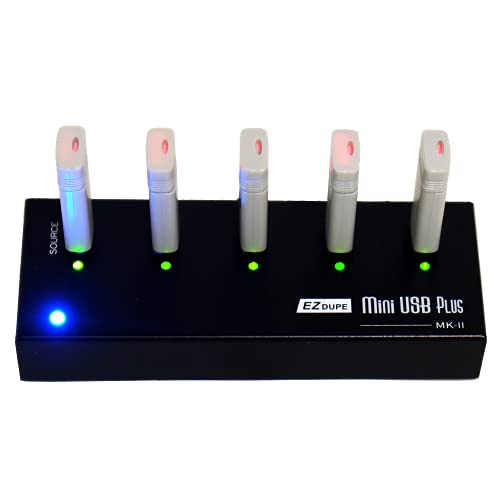
- Copies four USB drives simultaneously
- Standalone and power-bank compatible
- Supports USB 1.0 through 3.0 media
Best For: Portable multi-drive USB copying
Best NVMe Duplicator

- Dual-bay NVMe SSD enclosure
- One-click offline cloning
- USB 3.2 Gen 2x2 up to 20Gbps
Best For: Fast NVMe SSD cloning and drive access
Best for Easy Setup
UB300 1:2 Standalone USB 2.0 Duplicator

- Duplicates one USB drive to two targets without a computer
- Supports quick data copying and bit-for-bit cloning
- Includes media testing and erase functions
Best For: Small USB deployment, backup, and technician use
Best SATA Drive Dock Duplicator

- Offline clones 2.5- and 3.5-inch SATA drives
- Supports up to 24TB per bay
- Adds three USB 3.0 hub ports
Best For: SATA drive migration, backup, and desktop storage work
Best Professional USB Duplicator
Vinpower 1:3 Standalone USB Cloner
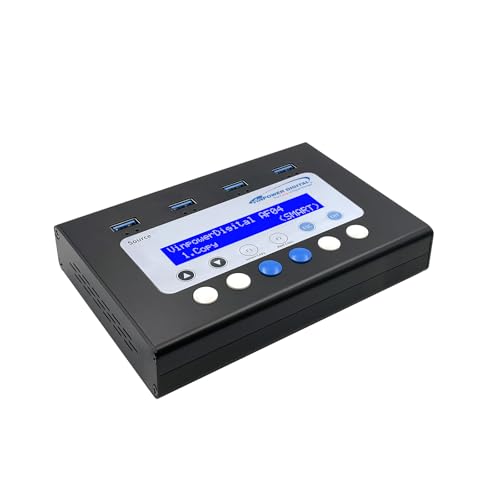
- Copies one USB drive to three targets independently
- Offers Smart Copy and bit-for-bit Raw Copy
- Adds DoD wiping and damaged-sector error skipping
Best For: Professional USB deployment and secure media management
Best SATA Clone Dock
Vantec NexStar JX Dual-Bay Dock

- Dual-bay SATA drive design
- Standalone clone function
- USB 3.2 Gen1 connectivity
Best For: Standalone SATA drive cloning
Best Multi-Drive USB Duplicator
DupliM Mini 1-to-10 USB Duplicator

- Copies up to 10 USB drives
- Supports files, folders, images, and flash drives
- Windows and Mac compatible
Best For: Batch USB flash-drive duplication
Best High-Capacity Clone Dock
WAVLINK Dual-Bay Hard Drive Dock

- Offline SATA drive cloning
- Supports two drives up to 20TB each
- USB 3.0 with UASP support
Best For: Large-capacity HDD and SSD cloning
Best USB Flash Drive Duplicator – StarTech 1:2 USB Duplicator
For buyers comparing usb duplicators under 500, the StarTech USBDUP12 is a practical standalone option for copying or erasing two USB drives at a time. It works without a computer and includes several duplication, verification, and erase modes.
Best For: IT technicians and teams that regularly create, sanitize, or verify USB flash drives.
Pros:
- Copies to two USB drives without requiring a computer.
- Supports USB 3.0 and USB 2.0 flash media and external USB storage with separate power.
- Offers file, sector-by-sector, quick-erase, and overwrite modes.
- LCD, activity/error LEDs, and Copy & Compare help monitor results.
Cons:
- The 1:2 configuration limits simultaneous output capacity.
- Asynchronous copying requires source content under 64 MB.
- External USB storage may need its own power source.
Its LCD controls, upgradeable firmware, and DoD/NIST SP 800-88 Rev. 1 Clear overwrite option make it a well-equipped choice for structured USB management rather than casual one-off copying.
Best Hard Drive Cloner – SABRENT Dual-Bay SATA Dock
Among usb duplicators under 500, the SABRENT EC-HD2B stands out for users duplicating SATA hard drives or SSDs rather than USB flash media. Its dual-bay design supports offline cloning and also works as a USB 3.0 drive dock.
Best For: Home users, technicians, and PC builders cloning 2.5-inch or 3.5-inch SATA drives.
Pros:
- Supports standard 2.5-inch and 3.5-inch SATA HDDs and SSDs.
- Offers offline cloning without requiring drivers.
- Supports drives up to 10TB, with 20TB capacity listed in the specifications.
- USB 3.0 transfer speeds reach up to 5Gbps.
Cons:
- It is designed for SATA drives, not USB flash-drive duplication.
- Offline cloning is listed at up to 60Mbps.
- The drive bays and power supply make it less portable than compact flash-media duplicators.
This is a focused choice for disk migration and drive access. Choose it when your workflow centers on SATA HDDs or SSDs and you want a dock that can also perform standalone cloning.
Best Portable USB Duplicator – EZ Dupe 1:4 Mini USB Plus MK II
For buyers seeking usb duplicators under 500 with higher output capacity, the updated EZ Dupe Mini USB Plus MK II can copy up to four USB flash drives simultaneously. It is standalone, compact, and supports asynchronous copying for replacing finished drives without waiting for a full batch.
Best For: Users who need to produce multiple USB copies quickly in a portable setup.
Pros:
- Copies up to four USB flash drives at the same time.
- Runs without a computer and can use a power bank or USB power source.
- Supports USB 1.0, 2.0, and 3.0 flash media.
- Updated version lists a 2.5GB/min or 45MB/second maximum copy speed.
Cons:
- Actual speed depends on the connected drives.
- External USB storage requires its own power source.
- The one-year manufacturer warranty is shorter than some competing coverage options.
With four output ports and asynchronous operation, this EZ Dupe model is better suited to repeated small-batch copying than a basic one-to-one duplicator, while its compact design helps when equipment needs to move between locations.
Best NVMe Duplicator – Rosewill Dual-Bay M.2 Cloner
The Rosewill RS-N2-CL broadens the usb duplicators under 500 category beyond flash media with a dual-bay NVMe enclosure and standalone SSD cloning. Its USB 3.2 Gen 2×2 interface is rated up to 20Gbps, making it the speed-focused option in this group.
Best For: Users cloning compatible M.2 NVMe SSDs or accessing two NVMe drives through a high-speed USB dock.
Pros:
- Supports M Key and B+M Key NVMe SSDs in a dual-bay design.
- Provides one-click standalone cloning.
- Includes S.M.A.R.T. monitoring and TRIM support.
- Comes with USB-C and USB-A cables plus a 12V/2A power adapter.
Cons:
- It is intended for compatible NVMe M.2 SSDs, not USB flash drives or SATA drives.
- Host performance depends on the connected computer, cables, and SSDs.
- Its larger enclosure and external power adapter reduce portability.
This Rosewill dock is the specialized pick for NVMe workflows. Its fast interface and health-management features are useful when SSD performance and convenient two-drive access matter more than broad media compatibility.
Best for Easy Setup – UB300 1:2 Standalone USB 2.0 Duplicator
If you need usb duplicators under 500 for basic flash-drive deployment, the BestDuplicator UB300 offers straightforward standalone copying without a computer. It can duplicate one source USB drive to two targets and supports both data-only and bit-for-bit copying modes.
Best For: IT departments, schools, businesses, and technicians distributing or backing up USB flash-drive content.
Pros:
- Copies one USB drive to two targets simultaneously without a computer.
- Offers Quick Copy and Whole Media Copy modes.
- Includes capacity checks, media information, speed tests, and erase functions.
- Compact design with LCD navigation and individual port LEDs.
Cons:
- Designed primarily for USB 1.1 and USB 2.0 media.
- Additional card formats require a compatible USB card reader.
- Best results require source and target media with similar capacities.
The UB300 is a practical choice when you want a compact, computer-free USB duplicator with useful media-testing features. Its two-target capacity suits small deployment runs rather than high-volume production.
Best SATA Drive Dock Duplicator – MAIWO Dual-Bay HDD SSD Cloner
Among usb duplicators under 500, the MAIWO docking station is suited to users who need to clone 2.5- or 3.5-inch SATA hard drives and SSDs. Its dual-bay design supports offline cloning, while USB 3.0 connectivity and three hub ports add flexibility for computer-based storage tasks.
Best For: Home labs, IT work, data backup, drive migration, and users handling large SATA HDD or SSD transfers.
Pros:
- Clones SATA HDDs and SSDs offline without drivers or a computer.
- Supports drives up to 24TB per bay, with 48TB total stated capacity.
- Provides USB 3.0 connectivity with up to 5Gbps bandwidth.
- Includes three USB 3.0 Type-A hub ports and a 12V 3A power supply.
Cons:
- Designed for SATA drives rather than direct USB flash-drive duplication.
- The unit is less compact than a small flash-drive duplicator.
- Offline cloning uses a two-bay source-to-target workflow rather than multiple target copies.
The MAIWO is the better fit when your duplication work centers on full-size SATA storage. It combines offline cloning with a useful USB hub, making it more versatile as a desktop drive dock than as a dedicated flash-drive production duplicator.
Best Professional USB Duplicator – Vinpower 1:3 Standalone USB Cloner
For buyers comparing usb duplicators under 500 for recurring professional use, the Vinpower Flash Memory USB Duplicator provides three target ports and standalone operation. Smart Copy, Raw Copy, secure erasing, and Read Error Skip make it suitable for more demanding duplication and media-management workflows.
Best For: Businesses, IT teams, schools, agencies, and organizations distributing bootable drives, software, firmware, or secure data.
Pros:
- Duplicates USB drives to three targets without a PC.
- Smart Copy and Raw Copy modes cover file-level and bit-by-bit duplication.
- Includes DoD 5220.22-M data wiping for USB drive reuse or disposal.
- Read Error Skip can bypass damaged sectors during duplication.
Cons:
- The supplied notes do not specify supported USB generations or copy speed.
- It is focused on USB flash media rather than SATA hard-drive cloning.
- Advanced functions may be more than casual users need.
The Vinpower stands out for organizations that need more than simple copying. Its three-port layout, raw cloning, secure erasure, and error-skipping features provide a stronger toolkit for repeated USB deployment and media handling.
Best SATA Clone Dock – Vantec NexStar JX Dual-Bay Dock
For shoppers comparing usb duplicators under 500, the Vantec NexStar JX is a compact dual-bay dock designed for standalone SATA drive cloning. Its two-bay layout supports a straightforward source-and-target workflow without requiring a computer during cloning.
Best For: Users who need a compact dual-bay SATA drive dock with a standalone clone function.
Pros:
- Dual-bay design for SATA drives.
- Includes a standalone clone function.
- Uses USB 3.2 Gen1 connectivity.
- Compact 5.67 x 4.53 x 2.32-inch footprint.
Cons:
- Designed for SATA drives rather than USB flash media.
- The supplied notes do not specify supported drive capacities.
The NexStar JX is a focused option when your priority is duplicating SATA drives in a simple dual-bay enclosure. It is less suitable if you specifically need a multi-port USB thumb-drive duplicator.
Best Multi-Drive USB Duplicator – DupliM Mini 1-to-10 USB Duplicator
Among usb duplicators under 500, the DupliM Mini stands out for simultaneous flash-drive copying. It can duplicate up to 10 USB 3.0 or 2.0 drives through a computer-connected setup and supports source files, folders, image files, or another flash drive.
Best For: Windows and Mac users who need to duplicate up to 10 USB flash drives at once.
Pros:
- Duplicates up to 10 USB 3.0 or 2.0 drives simultaneously.
- Supports image files, flash drives, and selected files or folders.
- Works with Windows and Mac OS through the included DupliM software.
- Includes a power adapter and USB 3.0 cable.
Cons:
- Requires a connected computer for operation.
- Minimum requirements include a 1.8 GHz dual-core processor and 2GB of RAM.
- Its stated media type is USB flash or pen drives, not SATA disks.
The DupliM Mini is the strongest fit here for batch USB flash-media work, especially when a computer-based workflow is acceptable. Its 10-drive capacity offers more simultaneous output than a basic two-bay drive dock.
Best High-Capacity Clone Dock – WAVLINK Dual-Bay Hard Drive Dock
For buyers seeking usb duplicators under 500 for hard-drive work, the WAVLINK Dual Bay Dock combines offline cloning with broad SATA compatibility. It accepts 2.5-inch and 3.5-inch SATA I, II, and III HDDs or SSDs, with support for drives up to 20TB per bay according to the supplied notes.
Best For: Users who want offline cloning and file transfers between two large SATA HDDs or SSDs.
Pros:
- Supports 2.5-inch and 3.5-inch SATA I, II, and III drives.
- Provides computer-free offline cloning.
- Supports up to two 20TB drives.
- Offers USB 3.0 with UASP and up to 5Gbps transfer rates.
Cons:
- The target drive must have capacity equal to or greater than the source.
- It is intended for SATA drives, not USB thumb-drive duplication.
- Its warranty description specifies SATA interface only.
The WAVLINK dock is a practical choice for large-capacity SATA backups and drive upgrades. Its offline clone button simplifies the process, while the fixed bezel design is intended to provide more stable drive positioning.
How We Picked the Best USB Duplicators Under 500
We focused on practical duplication equipment that can be purchased for less than $500 and matched different use cases rather than selecting ten nearly identical devices. The list includes standalone USB flash duplicators, computer-connected copiers, SATA drive docks, and an M.2 enclosure with cloning support.
Our comparisons emphasize the number of target copies, offline versus computer-assisted operation, supported storage formats, advertised transfer speeds, capacity limits, and features such as data erasure, USB hubs, tool-free installation, and LCD or status indicators. Because real-world performance varies by source media, target media, file size, and interface, published speed ratings should be treated as comparisons rather than guarantees.
Quick Comparison
| Type | Best suited to | What to check |
|---|---|---|
| Standalone USB duplicator | Repeated flash-drive copying without a computer | Target count, media compatibility, erase modes, and speed |
| Computer-connected USB copier | Flexible office or production workflows | Required software, host operating system, and USB bandwidth |
| Dual-bay SATA dock | Cloning 2.5- or 3.5-inch HDDs and SSDs | Offline-clone support, drive capacity, and destination requirements |
| M.2 duplicator or enclosure | NVMe or M.2 SSD migration | M.2 key type, PCIe generation, thermal limits, and enclosure compatibility |
Key Buying Factors for USB Duplicators Under 500
Media and Connector Compatibility
Confirm that the device supports the exact storage you plan to duplicate. USB flash models are not interchangeable with SATA docks, and an M.2 enclosure may support only particular key types or PCIe interfaces. For hard-drive docks, verify both 2.5-inch and 3.5-inch support if you use desktop drives.
Copy Count and Workflow
A 1:2 duplicator works well for occasional small batches, while 1:3, 1:4, or 1:10 models can save substantial time for deployment or distribution work. Standalone operation is useful when you want to copy without a computer, whereas computer-connected models may offer more control over files and destinations.
Speed, Capacity, and Reliability
Compare interface generations and advertised transfer rates, but allow for slower flash drives, fragmented source disks, and many-small-file workloads. Check maximum supported capacity and whether the destination must match or exceed the source. For frequent use, prioritize clear status feedback, stable power, cooling, and a straightforward error process.
Erasing and Cloning Features
If you repurpose media, look for verified erase modes rather than assuming every duplicator securely wipes data. For drive docks, distinguish sector-by-sector cloning from ordinary file copying; cloning is generally the better choice for migrating an operating-system drive.
Who Should Buy Which USB Duplicators Under 500?
Choose a standalone flash duplicator if you regularly create identical USB drives for installers, training materials, or distribution and want a simple computer-free workflow. Choose a higher-output model when batch size matters more than compactness.
Choose a dual-bay SATA dock if your work involves upgrading laptops, cloning desktop drives, or accessing bare HDDs and SSDs. An M.2 model is the better fit for compatible NVMe migration and modern compact storage. Finally, choose a computer-connected copier when you need flexible file management or plan to integrate duplication into an existing Mac or PC workflow.