Upgrading drives, preparing system images, or making a dependable backup is easier with the right hard drive duplicator. The models in this roundup cover simple dual-bay docks, faster standalone cloners, multi-drive systems, and options with erasing or connectivity features.
We compare these 10 picks by drive compatibility, cloning method, speed, capacity support, connectivity, and ease of use so you can choose a duplicator that fits your hardware and workflow without exceeding a $300 budget.
Best 10 Hard Drive Duplicators Under 300 Picks for 2026
Best Value Dock

- Supports 2.5-inch and 3.5-inch SATA drives
- Offline cloning without drivers or a PC connection
- USB 3.0 connectivity with up to 10TB drive support
Best For: Home users needing an affordable SATA cloning dock
Best Standalone Tool
Vinpower 1-to-3 HDD/SSD Duplicator

- Standalone operation requires no PC
- Offers smart copy, raw mode, and error skipping
- Includes DoD-style secure erase functionality
Best For: Technicians handling cloning, recovery, and sanitization
Best USB-C Option

- USB-C connection with up to 5Gbps interface speed
- Offline one-to-one cloning without a computer
- Reads and writes two SATA drives independently
Best For: USB-C users working with 2.5-inch and 3.5-inch SATA drives
Best Business-Ready Design

- Standalone duplication and erasure without a PC
- Supports 2.5-inch and 3.5-inch SATA drives
- Offers up to 90MB/s copying and DoD-style sanitization
Best For: Repeatable SATA duplication and secure drive erasure
Best Overall SATA Pick
StarTech Dual-Bay SATA Duplicator
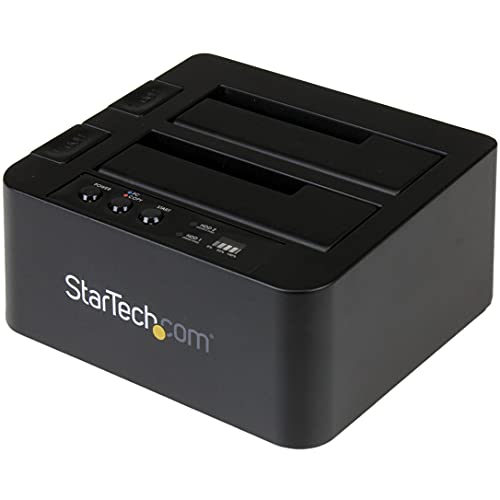
- Standalone sector-by-sector SATA cloning
- Supports 2.5-inch and 3.5-inch drives
- USB 3.2 Gen 2 docking mode
Best For: IT professionals and SATA drive migration
Most Versatile Multi-Drive Pick
ICY BOX Triple-Bay NVMe/SATA Cloner

- Clones NVMe and SATA drive types
- Three independent tool-free bays
- USB 3.2 Gen 2 up to 10 Gbps
Best For: Mixed NVMe/SATA drive management
Best Value Aluminum Dock

- Offline cloning for two SATA drives
- Aluminum housing with LED indicators
- Manual switch helps prevent mode errors
Best For: Affordable home and workshop SATA cloning
Best Compact Clone Dock
WAVLINK Dual-Bay SATA Duplicator

- Offline cloning without a computer
- Supports 2.5-inch and 3.5-inch SATA drives
- USB 3.0 with UASP and USB-C adapter
Best For: Simple home and small-office drive backups
Best High-Capacity Hub
MAIWO Dual-Bay Drive Duplicator

- Up to 48TB total stated capacity
- Three USB 3.0 hub ports
- Offline cloning with progress indicators
Best For: High-capacity backups and USB expansion
Best UASP Performance
WAVLINK USB 3.0/USB-C SATA Dock

- UASP support up to 6Gbps
- Offline cloning up to 60Mbps
- Hot-swapping and automatic sleep mode
Best For: Fast SATA access on compatible Windows, Mac, and Linux systems
Best Value Dock – Sabrent Dual-Bay SATA Cloner
For shoppers comparing hard drive duplicators under 300, the SABRENT EC-HD2B is a straightforward two-bay option for cloning or accessing standard SATA drives. It supports both 2.5-inch and 3.5-inch HDDs and SSDs, connects over USB 3.0, and works without driver installation.
Best For: Home users and small offices that need an affordable SATA drive dock with offline cloning.
Pros:
- Supports 2.5-inch and 3.5-inch SATA HDDs and SSDs.
- Offline cloning requires no computer connection.
- Supports drives up to 10TB and USB 3.0 transfer speeds up to 5Gbps.
- Includes a power supply, USB 3.0 cable, and user manual.
Cons:
- Supports SATA drives, not other drive interfaces.
- Offline cloning is rated up to 60Mbps, below the USB 3.0 interface maximum.
This is a practical choice when you want simple drive access and occasional one-to-one cloning without investing in a more specialized duplicator.
Best Standalone Tool – Vinpower 1-to-3 HDD/SSD Duplicator
Among hard drive duplicators under 300, the Vinpower HDDMINI stands out for standalone operation and specialized data-handling features. It can clone 2.5-inch or 3.5-inch HDDs and SSDs without a PC, while offering smart-copy, raw bit-for-bit copying, read-error skipping, and secure erasure.
Best For: Field technicians and users who need standalone cloning, recovery-oriented copying, or drive sanitization.
Pros:
- Operates without a computer or software.
- Supports both 2.5-inch and 3.5-inch HDDs and SSDs.
- Read Error Skip can continue copying around bad sectors.
- Includes raw duplication and DoD 5220.22-M-style secure erase functionality.
Cons:
- The supplied notes identify a 1-to-3 model, but do not provide a detailed port layout or simultaneous-copy workflow.
- Optional CompactFlash support requires an add-on interface module.
- Its listed media speed is 90MB/s.
The HDDMINI is more feature-focused than a basic docking station, making it useful when copying difficult drives or erasing sensitive data matters as much as routine duplication.
Best USB-C Option – Sabrent Dual-Bay USB-C Cloner
If you are shopping for hard drive duplicators under 300 and want a modern computer connection, the SABRENT EC-CH2B combines offline cloning with USB-C access. Its two bays mount as separate drives when connected to a computer, while a button enables one-to-one cloning without a PC.
Best For: Windows and Mac users with USB-C connectivity who need a tool for both drive access and occasional cloning.
Pros:
- Works with bare 2.5-inch and 3.5-inch SATA HDDs and SSDs.
- Supports offline cloning without a computer.
- Both bays can be read and written as separate drives over USB.
- Tool-free, hot-swappable design with drive-access LEDs.
Cons:
- Does not support IDE/PATA, M.2, or NVMe drives.
- The included cable uses USB-C at the dock end; a USB-C computer port or separate adapter is needed.
- The target drive must be the same size as or larger than the source.
This model is a strong fit for users who want a flexible SATA dock and a USB-C workflow, provided their computers and drives match its connection requirements.
Best Business-Ready Design – Systor 1:1 HDD/SSD Duplicator
For buyers evaluating hard drive duplicators under 300, the Systor SYS101HS-DP offers a dedicated standalone design for copying and erasing SATA drives. It handles 2.5-inch and 3.5-inch HDDs or SSDs without an adapter and provides a stated transfer rate of up to 90MB/s.
Best For: Small businesses and users who need repeatable SATA duplication and DoD 5220.22-M-compliant sanitization.
Pros:
- Works without a computer or software.
- Supports both 2.5-inch and 3.5-inch SATA HDDs and SSDs.
- Copies data-only or entire hard drives.
- Provides hot-swappable operation and DoD 5220.22-M data erasure.
Cons:
- It is a 1:1 duplicator rather than a multi-target unit.
- Compatibility is listed for SATA drives, with no support details for NVMe or IDE drives.
- The listed digital storage capacity is 3TB.
With metal construction, standalone controls, and long-term support details, the SYS101HS-DP is geared toward dependable, repeatable drive-copying and sanitization tasks rather than general-purpose USB docking.
Best Overall SATA Pick – StarTech Dual-Bay SATA Duplicator
For shoppers comparing hard drive duplicators under 300, the StarTech SDOCK2U313R is a practical choice for standalone cloning of 2.5-inch and 3.5-inch SATA drives. It works without a computer, supports sector-by-sector copying, and can also function as a USB-to-SATA docking station.
Best For: IT professionals and users who need a dependable dual-bay SATA cloner with broad drive compatibility.
Pros:
- Clones SATA HDDs and SSDs without a computer.
- Supports 2.5-inch and 3.5-inch SATA drives of any capacity, including 4Kn drives.
- Sector-by-sector duplication works with any file format and includes empty sectors.
- USB 3.2 Gen 2 connectivity, TRIM support, tool-free bays, and a two-year warranty.
Cons:
- The target drive must be equal to or larger than the source drive.
- It does not support M.2 NVMe drives.
- The IDE adapter is sold separately.
This StarTech dock stands out for SATA-focused cloning and professional-oriented features. Its combination of offline operation, 4Kn support, and a USB docking mode makes it a versatile option when M.2 compatibility is not required.
Most Versatile Multi-Drive Pick – ICY BOX Triple-Bay NVMe/SATA Cloner
The ICY BOX triple-bay station is a strong contender among hard drive duplicators under 300 for users working with mixed storage types. Its three independent slots support M.2 PCIe NVMe drives alongside 2.5-inch and 3.5-inch SATA HDDs and SSDs, with one-touch offline cloning.
Best For: Professionals and enthusiasts who need to clone or access multiple NVMe and SATA drives from one station.
Pros:
- Supports cloning between NVMe and SATA drive types, including NVMe-to-NVMe and SATA-to-NVMe.
- Triple-bay design allows three drives to be connected at once.
- One-touch offline cloning requires no software or computer setup.
- USB 3.2 Gen 2 offers transfer speeds up to 10 Gbps and includes USB-C and USB-A connectivity.
Cons:
- The supplied notes do not specify a maximum supported drive capacity.
- Its plastic construction may be less rugged than an aluminum dock.
- Cloning features are more extensive than needed for users who only work with SATA drives.
With three bays and support for both NVMe and SATA formats, this ICY BOX model offers the broadest compatibility in the group. It is especially useful for mixed-device environments where drive types change frequently.
Best Value Aluminum Dock – SSK Dual-Bay SATA Cloner
For buyers seeking hard drive duplicators under 300 with a straightforward SATA design, the SSK DK103 PRO provides dual-bay offline cloning and USB 3.0 connectivity. Its manual mode switch helps separate cloning from PC data-transfer functions, while the aluminum body supports heat dissipation.
Best For: Home users and technicians who need an affordable dual-bay dock for 2.5-inch or 3.5-inch SATA drives.
Pros:
- Clones two SATA HDDs or SSDs without connecting to a computer.
- Supports 2.5-inch and 3.5-inch SATA I, II, and III drives.
- Manual mode switch helps prevent accidental operation in the wrong mode.
- Aluminum construction, UASP support, and LED power, position, and progress indicators.
Cons:
- It does not support hot-plugging.
- USB 3.0 connectivity is slower on paper than the USB 3.2 Gen 2 models here.
- No warranty is listed in the supplied product details.
The SSK is a sensible value-oriented choice for basic SATA duplication and drive access. Its manual switch and aluminum housing add practical usability, though users needing NVMe support, hot-plugging, or a stated warranty should consider another model.
Best Compact Clone Dock – WAVLINK Dual-Bay SATA Duplicator
For shoppers comparing hard drive duplicators under 300, this WAVLINK dual-bay dock is a straightforward choice for cloning or accessing two SATA drives. It supports 2.5-inch and 3.5-inch HDDs and SSDs, with offline cloning that works without a computer.
Best For: Home users and small offices that need a simple two-drive cloning and backup dock.
Pros:
- Supports two 2.5-inch or 3.5-inch SATA drives, up to 2x20TB.
- Offline cloning requires no computer, drivers, or software.
- USB 3.0 with UASP supports transfer speeds up to 5Gbps and includes USB-C adapter compatibility.
- Fixed bezels provide added drive stability and protection.
Cons:
- The target drive must be at least as large as the source for offline cloning.
- Designed for SATA drives only.
- Offline cloning does not require a computer, but regular file access uses USB connectivity.
This is a practical, tool-free duplicator for routine backups and drive transfers. Its dual-bay design and broad operating-system compatibility make it a versatile option when you want simple cloning without extra software.
Best High-Capacity Hub – MAIWO Dual-Bay Drive Duplicator
Among hard drive duplicators under 300, the MAIWO stands out for its high stated capacity and built-in USB expansion. This dual-bay SATA dock supports offline cloning, drive management, and file transfers while accommodating up to 24TB per bay.
Best For: Users who need high-capacity drive support plus extra USB ports for peripherals or flash storage.
Pros:
- Supports 2.5-inch and 3.5-inch SATA HDDs and SSDs, with up to 48TB total capacity.
- Offline cloning works without a computer or drivers.
- Three USB 3.0 Type-A hub ports add convenient peripheral connectivity.
- LED indicators show clone progress at 25%, 50%, 75%, and 100%.
Cons:
- The supplied notes specify SATA drive support rather than other drive interfaces.
- Offline cloning requires the target drive to have sufficient capacity for the source data.
- The unit uses a separate 12V/3A power supply.
The MAIWO is a strong fit when capacity and connectivity matter more than a minimal footprint. Its progress indicators and independent power supply also make longer cloning jobs easier to monitor.
Best UASP Performance – WAVLINK USB 3.0/USB-C SATA Dock
This WAVLINK model is a capable contender among hard drive duplicators under 300, combining dual-bay SATA access with USB 3.0 and USB-C connectivity. It supports offline cloning, hot-swapping, and UASP-enhanced transfers for compatible systems.
Best For: Users who want a dual-bay SATA dock with UASP support and flexible computer connectivity.
Pros:
- Works with 2.5-inch and 3.5-inch SATA I, II, and III HDDs and SSDs.
- Supports offline cloning without drivers, with cloning speeds up to 60Mbps.
- UASP supports transfer speeds up to 6Gbps, while USB 3.0 supports up to 5Gbps.
- Includes hot-swapping, a power switch, and automatic sleep after 30 minutes of inactivity.
Cons:
- Not compatible with M1- or M2-based Macs according to the supplied notes.
- The target disk must be equal to or larger than the source for offline cloning.
- Offline cloning is supported, but online cloning is not.
This dock is well suited to users who value speed-oriented connectivity and convenient power management. Check system compatibility carefully, especially if you use an Apple computer with an M1 or M2 processor.
How We Picked the Best Hard Drive Duplicators Under 300
We focused on duplicators and docking stations that support common 2.5-inch and 3.5-inch SATA hard drives or SSDs, with additional consideration for M.2 NVMe support where applicable. We also compared offline cloning, computer-assisted transfers, advertised data rates, drive-bay layout, USB connectivity, and practical extras such as drive erasing, USB hubs, and high-capacity support.
Because advertised speeds depend on the source drive, destination drive, interface, and file workload, rated throughput is treated as a comparison point rather than a guaranteed real-world result. Before buying, verify that the duplicator supports the exact drive type and capacity you plan to use.
Quick Comparison
| Best For | Look For | Notable Feature |
|---|---|---|
| Simple SATA cloning | Dual-bay offline duplicator | Easy drive-to-drive copying |
| Frequent cloning jobs | Higher rated transfer speed | Shorter potential cloning times |
| Multiple target drives | 1-to-3 duplicator | Parallel duplication |
| Secure drive retirement | Built-in eraser | Data sanitization options |
| Mixed modern storage | NVMe and SATA support | Broader drive compatibility |
| Desktop storage expansion | USB 3.0, USB-C, or UASP | Faster computer-connected transfers |
Key Buying Factors for Hard Drive Duplicators Under 300
Drive Type and Size
Most affordable duplicators handle 2.5-inch and 3.5-inch SATA drives, but that does not automatically include M.2 SSDs. M.2 drives may use SATA or NVMe protocols, and these are not interchangeable. Check both the physical format and interface before purchasing.
Offline Versus Computer-Assisted Cloning
Offline cloning copies a source drive directly to a destination without requiring cloning software or a host computer. It is convenient for drive upgrades and repeatable field work. Docking stations that rely on a computer can be more flexible for file transfers, backups, and drive management, but they may require compatible software.
Speed and Interface
USB 3.0, USB-C, UASP, and 10Gbps interfaces can improve computer-connected performance, but the slowest component still limits the transfer. For standalone devices, compare the rated clone speed and look for clear status indicators that show progress.
Capacity and Destination Rules
Many duplicators require the destination drive to be at least as large as the source, even when the source contains relatively little data. Confirm supported maximum capacity and whether the device can clone to a larger drive without unexpected partition issues.
Erasing and Additional Ports
If you regularly decommission drives, a built-in eraser can be more useful than a small speed advantage. USB hubs and card or peripheral ports add convenience, but they should not outweigh compatibility, cooling, and reliable power delivery.
Who Should Buy Which Hard Drive Duplicators Under 300?
Choose a basic dual-bay SATA dock if you want occasional drive upgrades, backups, or easy access to loose drives. A USB-C or UASP model is a better fit for newer laptops and faster computer-connected file transfers. Choose a high-speed duplicator when cloning is part of routine IT or repair work, and consider a 1-to-3 unit when several identical target drives must be prepared at once.
For mixed storage environments, select a model explicitly supporting both NVMe and SATA rather than relying on an adapter assumption. If secure disposal is part of your workflow, prioritize a duplicator with a documented erase function. Whichever model you choose, keep the source drive untouched until you verify that the clone boots or that the transferred files are complete.