Moving video projects, disk images, photo libraries, and other large files demands more than a basic USB adapter. The right docking station can make drive access faster, simplify backups, and let you connect bare SATA HDDs or SSDs without installing them in a computer.
We selected 10 options ranging from straightforward dual-bay docks to high-capacity multi-drive enclosures. The best choice depends on your transfer-speed needs, drive count, cloning requirements, storage capacity, and whether you need a compact workstation accessory or a more permanent desktop storage setup.
Best 10 Hard Drive Docking Stations for Large Files Picks for 2026
Best Dual-Bay Cloner
Sabrent USB 3.0 Docking Station

- Dual bays for 2.5-inch and 3.5-inch SATA drives
- Offline cloning without a computer
- Up to 5Gbps USB 3.0 transfers
Best For: Drive cloning and two-drive file access
Best High-Capacity Enclosure
ORICO 5-Bay Hard Drive Enclosure
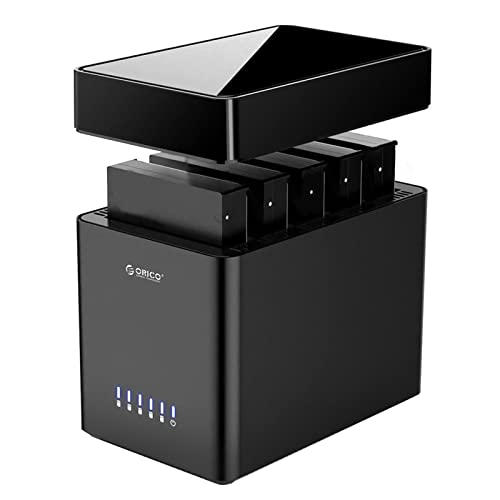
- Five SATA bays for storage expansion
- Up to 110TB total capacity
- Fan-assisted cooling and USB 3.0
Best For: Multi-drive home storage and backups
Best Simple SATA Dock
Sabrent USB 3.0 Single-Bay Dock
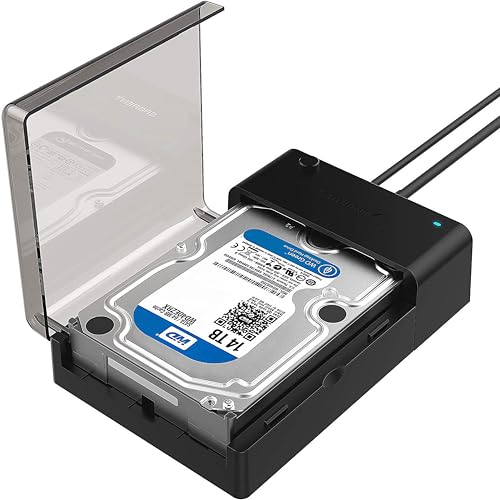
- Tool-free access to one SATA drive
- Supports 2.5-inch and 3.5-inch formats
- Includes 12V adapter for 3.5-inch drives
Best For: Occasional single-drive transfers
High-Capacity Cloning Pick

- Holds up to five SATA drives, up to 100TB total
- Offline 1:4 duplication without a computer
- Aluminum vertical design with anti-vibration pads
Best For: Photographers and professionals needing large storage plus offline cloning
Fast Connectivity Pick
WAVLINK 4-Bay 10Gbps Enclosure

- Four SATA bays with stated capacity up to 128TB
- 10Gbps USB-C supports large-file transfers
- Adds 4K HDMI output and temperature-controlled fans
Best For: Workstations needing fast storage expansion and display connectivity
Reliable Multi-Drive DAS

- Five 3.5-inch bays support up to 100TB
- Independent controllers for stable multi-drive access
- 10Gbps USB-C with trayless hot-swap support
Best For: Local large-file storage users who prefer JBOD DAS over RAID or NAS
High-Capacity Cloner

- Up to 48TB across two bays
- Offline cloning without a computer
- Three USB 3.0 hub ports
Best For: Large-file backups, cloning, and high-capacity SATA workflows
Professional Dual-Bay Workflow
StarTech.com SDOCK2U33 Dual-Bay Dock

- Two tool-less SATA drive bays
- Independent power controls
- Designed for backup and disk imaging
Best For: IT workflows and frequent two-drive hot-swapping
Best Dual-Bay Cloner – Sabrent USB 3.0 Docking Station
For shoppers comparing hard drive docking stations for large files, the SABRENT EC-HD2B combines two SATA bays with USB 3.0 transfer speeds and offline cloning. It accepts standard 2.5-inch and 3.5-inch SATA hard drives or SSDs without requiring drivers.
Best For: Users who need to read two SATA drives or clone one drive to another without a computer.
Pros:
- Supports 2.5-inch and 3.5-inch SATA HDDs and SSDs.
- Dual-bay design supports offline drive cloning.
- Supports up to 10TB per drive and 20TB total storage capacity.
- USB 3.0 transfer rates reach up to 5Gbps.
Cons:
- Designed for SATA drives and does not indicate support for NVMe or IDE drives.
- Offline cloning is rated up to 60Mbps, slower than the USB 3.0 interface speed.
The EC-HD2B is a practical choice when drive duplication matters as much as file access. Its two-bay layout and broad SATA form-factor support make it more versatile than a single-drive reader.
Best High-Capacity Enclosure – ORICO 5-Bay Hard Drive Enclosure
The ORICO 5-bay enclosure is built for expanding storage when working with large files, backups, photos, videos, or media libraries. It supports five SATA HDDs or SSDs, with a stated total capacity of up to 110TB and USB 3.0 connectivity.
Best For: Home storage expansion, high-capacity backups, and users managing several SATA drives in one enclosure.
Pros:
- Five bays support 2.5-inch and 3.5-inch SATA drives.
- Supports up to 110TB total, with drives up to 22TB each.
- USB 3.0 transfer rates reach up to 5Gbps.
- Includes a 60mm fan and honeycomb ventilation for heat dissipation.
Cons:
- Linux systems can read only one drive at a time, according to the product notes.
- The enclosure uses USB 3.0 rather than a faster 10Gbps interface.
- Its five-drive design is larger and heavier than a single-bay dock.
With five bays and substantial stated capacity, the ORICO is suited to users who want a centralized storage enclosure rather than a portable drive reader. The built-in cooling and protection features are useful for longer-running storage setups.
Best Simple SATA Dock – Sabrent USB 3.0 Single-Bay Dock
For straightforward access to large files, the SABRENT EC-DFLT provides a tool-free single bay for bare 2.5-inch or 3.5-inch SATA drives. Its USB 3.0 connection supports UASP, while the included 12V adapter powers 3.5-inch drives.
Best For: Users who need an uncomplicated dock for swapping and reading one bare SATA drive at a time.
Pros:
- Accepts 2.5-inch and 3.5-inch SATA HDDs and SSDs.
- Tool-free, hot-swappable lay-flat design.
- Plug-and-play operation on Windows 10/11, macOS, and Linux.
- Includes the required 12V power adapter for 3.5-inch drives.
Cons:
- Supports SATA drives only; it does not support IDE, M.2, NVMe, M.2 SATA, or SAS drives.
- The host connection is USB-A, so USB-C-only computers require an adapter.
- It accommodates one drive at a time and does not pass S.M.A.R.T. diagnostics through the USB bridge.
This dock is a sensible budget-oriented option for occasional drive access and file transfers. Be sure your computer has a USB-A port and that your drive is a bare SATA model before ordering.
Best Fast USB-C Enclosure – WAVLINK 4-Bay 10Gbps Dock
The WAVLINK 4-bay enclosure is designed for hard drive docking stations for large files, pairing four SATA bays with a USB 3.2 Gen 2 Type-C connection rated up to 10Gbps. It also adds independent bay switches, temperature-controlled fans, an extra USB-C port, and 4K HDMI output.
Best For: Creative workflows, large media libraries, and users who want fast USB-C storage with display connectivity.
Pros:
- Four bays support 3.5-inch and 2.5-inch SATA drives.
- USB-C 3.2 Gen 2 supports transfer rates up to 10Gbps.
- Supports up to four 22TB drives, or 88TB total.
- Aluminum construction and fans that activate at 48°C support cooling.
Cons:
- 2.5-inch drives require separate 2.5-to-3.5-inch mounting brackets.
- 4K HDMI output requires a host USB-C port with video output support and a USB-C-to-C cable.
- The high-speed interface does not guarantee that every mechanical drive will reach 10Gbps.
The WAVLINK offers the most connectivity and interface speed of this group, making it a strong fit for high-volume transfers and workstation setups. Its mounting-bracket requirement for 2.5-inch drives is the main compatibility detail to plan for.
High-Capacity Cloning Pick – ORICO 5-Bay USB-C Dock
For users comparing hard drive docking stations for large files, the ORICO 5-bay dock combines substantial storage expansion with one-button offline duplication. It accommodates up to five 2.5-inch or 3.5-inch SATA SSDs or HDDs, with a stated maximum capacity of 100TB.
Best For: Photographers, video users, and professionals who need multi-drive storage and offline cloning.
Pros:
- Supports up to five drives and a total stated capacity of 100TB.
- Offline 1:4 duplication can create four copies from one source drive without a computer.
- Aluminum vertical construction helps with heat dissipation and includes anti-vibration pads.
- Includes USB-C-to-C and USB-C-to-A connectivity for compatible computers and other devices.
Cons:
- Cloning overwrites the target disks, so backups are required beforehand.
- USB 3.2 Gen 1 is slower than the 10Gbps interfaces on some competing docks.
- Drives are not included.
The ORICO is particularly compelling when offline duplication matters as much as everyday file access. Choose it over a faster dock if its four-copy cloning feature and five-bay capacity better match your workflow.
Fast Connectivity Pick – WAVLINK 4-Bay 10Gbps Enclosure
The WAVLINK is a versatile option among hard drive docking stations for large files, offering four SATA bays, a 10Gbps USB-C connection, and support for up to 128TB according to its product description. It also adds HDMI output and temperature-controlled cooling.
Best For: Users transferring large files while expanding desktop connectivity with high-resolution display support.
Pros:
- Four bays support 3.5-inch and 2.5-inch SATA drives, with a stated maximum of 4x32TB.
- USB 3.2 Type-C supports data transfer rates up to 10Gbps.
- Dual fans activate at 48°C to help cool drives during demanding tasks.
- HDMI supports up to 4K at 60Hz when the host USB-C port supports video output.
Cons:
- 2.5-inch drives require separate 2.5-to-3.5-inch mounting brackets.
- HDMI functionality depends on a compatible host USB-C video output and USB-C-to-C cable.
- Its four-bay design offers less drive capacity than five-bay alternatives.
Choose the WAVLINK when fast transfers, cooling, and display expansion are all useful in the same workstation. Confirm your host’s USB-C video capabilities before relying on its HDMI output.
Reliable Multi-Drive DAS – SABRENT 5-Bay USB-C Enclosure
For dependable access to several large drives, the SABRENT 5-bay DAS provides independent connections for each bay over a single 10Gbps USB-C link. It supports up to five 3.5-inch SATA HDDs or SSDs and is designed for trayless hot-swapping rather than RAID or NAS use.
Best For: Users who want a straightforward, high-capacity direct-attached storage enclosure for Windows, macOS, or Linux.
Pros:
- Five bays support up to 100TB total, using drives up to 20TB each.
- Dedicated ASM1351 controllers provide each bay with an independent connection.
- 10Gbps USB-C, trayless hot-swap access, and individual bay power switches streamline use.
- 120mm PWM cooling fan adjusts its speed as drive temperatures rise.
Cons:
- This is JBOD DAS, not a hardware RAID system or NAS.
- Only 3.5-inch drives are specified; drives are not included.
- The enclosure weighs 10 pounds, making it less portable than smaller docks.
The SABRENT is a strong fit when stable, individual drive access is more important than RAID protection or network sharing. Its five bays and 10Gbps interface make it well suited to large local archives and frequent transfers.
High-Capacity Cloner – MAIWO Dual-Bay SATA Dock
For users handling large files, the MAIWO dual-bay dock combines USB 3.0 access, offline drive cloning, and support for up to 48TB across two SATA drives. Its three USB hub ports also make it useful for consolidating storage and peripherals at a workstation.
Best For: Large-file backups, offline cloning, data recovery, and users who need extra USB 3.0 ports.
Pros:
- Supports 2.5-inch and 3.5-inch SATA HDDs and SSDs.
- Supports up to 24TB per bay, or 48TB total.
- Clones drives offline without a computer or drivers.
- Includes three USB 3.0 hub ports, including one with 2.4A charging.
Cons:
- Limited to SATA drives; IDE and SAS support is not listed.
- Offline cloning requires a compatible target drive and careful source-target selection.
The MAIWO is the strongest capacity-focused option here, especially when offline duplication and workstation expansion matter. Its 5Gbps USB connection is suitable for routine large-file transfers, though actual speeds depend on the drives and host system.
Simple High-Capacity Access – ORICO 22TB SATA Dock
The ORICO docking station is a straightforward choice for accessing large files on a single 2.5-inch or 3.5-inch SATA drive. USB 3.0 with UASP, tool-less hot-swapping, and support for drives up to 22TB make it practical for backups, disk imaging, and file transfers.
Best For: Single-drive access, large-file transfers, and users who want a compact, easy-to-use dock.
Pros:
- Supports 2.5-inch and 3.5-inch SATA I/II/III HDDs and SSDs up to 22TB.
- UASP and USB 3.0 provide transfer speeds of up to 5Gbps.
- Tool-less hot-swapping simplifies drive changes.
- Works with Windows, Mac, Linux, iPadOS devices with Thunderbolt, and Raspberry Pi.
Cons:
- Holds one drive at a time.
- Does not support IDE or SAS drives.
- New or unallocated drives must be initialized and formatted before recognition.
Choose the ORICO when you need uncomplicated access to one high-capacity SATA drive rather than a cloning station. Its automatic sleep mode and anti-skid design add convenience for regular desktop use.
Professional Dual-Bay Workflow – StarTech.com SDOCK2U33 Dual-Bay Dock
For large-file work involving two separate drives, the StarTech.com SDOCK2U33 provides dual-bay USB 3.0 access with tool-less hot-swapping. Independent power buttons let you manage the bays separately, making it suited to backup, disk imaging, and IT-oriented workflows.
Best For: IT professionals, two-drive backup workflows, and frequent hot-swapping of SATA HDDs or SSDs.
Pros:
- Supports two 2.5-inch or 3.5-inch SATA HDDs or SSDs.
- Tool-less, tray-less design enables convenient hot-swapping.
- Independent power buttons allow one bay to remain active while the other is changed.
- Includes LED activity lights, eject buttons, and a 2-year warranty with lifetime technical assistance.
Cons:
- USB 3.2 Gen 1 host connection is limited to 5Gbps.
- IDE drives require a separately sold adapter.
- The supplied notes do not specify a maximum supported drive capacity.
The StarTech.com dock is a dependable fit for repeatable two-drive handling, especially where independent bay control matters. It prioritizes practical serviceability and professional support over extras such as a built-in USB hub or offline cloning.
How We Picked the Best Hard Drive Docking Stations for Large Files
We compared these models by looking at the features that matter most when handling large transfers: interface speed, supported drive formats, bay count, maximum stated capacity, power design, and convenience features. We also considered whether each unit is better suited to occasional drive access, direct disk cloning, backup workflows, or always-connected storage.
Because listed performance depends on the drive, host computer, cable, and file type, connection ratings are treated as practical limits rather than guaranteed sustained speeds. Multi-bay units can also require more careful planning around airflow, power, and drive organization.
Quick Comparison
- Best for simple two-drive access: Dual-bay SATA docks from SABRENT, MAIWO, and StarTech.com.
- Best for direct cloning: Models that explicitly include a standalone clone function, such as the SABRENT EC-HD2B and MAIWO dock.
- Best for several installed drives: ORICO five-bay and SABRENT five-bay enclosures.
- Best for modern desktop connections: WAVLINK and SABRENT USB-C models with 10Gbps-class interfaces.
- Best for flexible drive sizes: Docks and enclosures supporting both 2.5-inch and 3.5-inch SATA drives.
Key Buying Factors for Large Files
Connection Speed and Compatibility
For large files, USB 3.0 is workable for routine backups, while USB-C 10Gbps-class connections offer more headroom when the computer and drive support them. Check the actual port standard on your computer; a USB-C connector alone does not guarantee 10Gbps performance.
Bay Count and Workflow
A dual-bay dock is usually easier to move and is well suited to cloning, recovery, and rotating backup drives. Five-bay enclosures provide more convenient storage expansion, but they take up more desk space and are better for a fixed setup.
Drive Support, Capacity, and Power
Confirm that the station supports your 2.5-inch or 3.5-inch SATA HDD or SSD. Desktop 3.5-inch hard drives need dedicated power, so review the included power adapter and ventilation features. Claimed capacities are often maximum system configurations, not a promise that every drive combination will be recognized identically by every computer.
Cloning and Data Protection
Standalone cloning can copy one drive to another without a computer, but the destination drive generally needs to be equal to or larger than the source. For valuable data, cloning should supplement—not replace—an additional backup.
Who Should Buy Which Hard Drive Docking Stations for Large Files?
Choose a compact dual-bay dock if you occasionally access bare drives, migrate to an SSD, or clone one disk to another. Pick a five-bay enclosure if you manage several drives and want them available from one desktop accessory. A USB-C 10Gbps model makes the most sense for newer computers and frequent large-file transfers. If your priority is straightforward backup or drive recovery, favor simple controls and broad SATA compatibility over unused expansion features.