Understanding the planets is easier when children can see, touch, build, and explore the solar system. The best models turn abstract astronomy lessons into hands-on activities suited to different ages and learning styles.
We’ve gathered 10 solar system models for children, including magnetic displays, glow-in-the-dark planetariums, school project kits, and interactive builds. Use the guide below to find the right balance of accuracy, durability, creativity, and age-appropriate challenge.
Best 10 Solar System Models for Children Picks for 2026
Best Magnetic Classroom Model

- 12-piece magnetic set with planets, sun, moon, asteroid belt, and Pluto
- Large pieces support planetary order and size demonstrations
- Designed for ages 4–10 and repeated classroom handling
Best For: Classroom demonstrations and tactile STEM learning
Best Glow-in-the-Dark Build
National Geographic Solar System Model

- Build and paint the sun and eight planets
- Glow-in-the-dark accents create a room display
- Movable arms and fact poster support hands-on learning
Best For: Creative astronomy projects for ages 8 and up
Best Wall-Mounted School Project
Pllieay Solar System Model Kit

- 63-piece foam and felt craft kit with paints and labels
- Instructions cover planetary positions and names
- Adhesive hooks enable a space-saving wall display
Best For: School science projects and decorative wall displays
Best Family Craft Kit
Wookidel 64-Piece Solar System Project

- 64-piece foam kit includes paints, brushes, sticks, flags, and instructions
- Children paint and build a personalized solar system
- Designed for home activities and classroom projects
Best For: Family crafting and project-based astronomy learning
Best Hands-On Craft Kit
48-Piece Solar System Foam Ball Kit
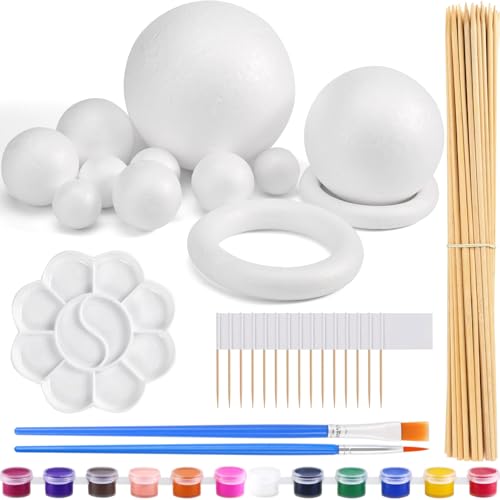
- Ten foam-ball sizes illustrate relative scale
- Includes paints, brushes, sticks, rings, and flags
- No-glue assembly for school or home projects
Best For: Painting, crafting, and science-project learning
Best Rotating Display
4M Glow-in-the-Dark Planetarium

- Snap-together planets need no glue
- Rotating stand creates an 11.8-inch display
- Includes glow paint, facts, and wall chart
Best For: Ages 8–14 and interactive science projects
Best Preschool Learning Board

- Large wooden planets support matching and grasping
- Includes astronauts, puzzle board, and knowledge cards
- Designed for children ages 3 and up
Best For: Preschool puzzle play and introductory space learning
Best Interactive Pick
Talking Solar System Projector

- Projects eight planets and 24 space images
- Includes English and Spanish planet facts
- Doubles as a night light or flashlight
Best For: Younger children who enjoy interactive, bilingual space learning
Best Build-and-Learn Option

- Children assemble a rotating planet model
- Explores orbits, day, night, and space
- Uses eco-friendly, child-safe MDF
Best For: Ages 8–14 who enjoy construction-focused STEM play
Best Large DIY Display
Playz Solar System Projector Kit
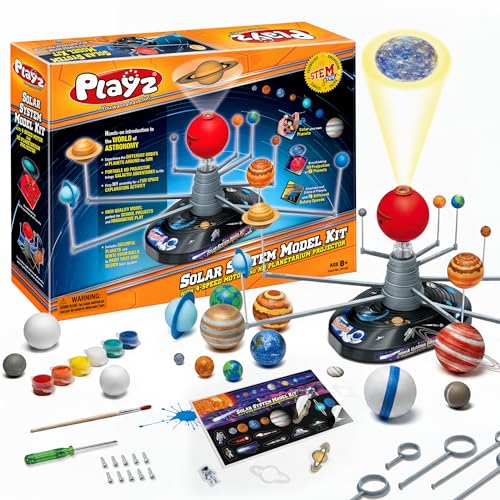
- Includes 75+ parts and a color manual
- Features a four-speed orbit motor
- Large model includes painting and projection
Best For: Ages 8–12 tackling a creative school or science-fair project
Best Magnetic Classroom Model – Giant Magnetic Solar System
For younger learners and classroom demonstrations, the Learning Resources Giant Magnetic Solar System is a practical choice among solar system models for children. Its large magnetic pieces use realistic NASA satellite images and can be arranged on whiteboards, metal doors, or other magnetic surfaces.
Best For: Ages 4–10, classroom lessons, whiteboard demonstrations, and tactile STEM activities.
Pros:
- Includes the sun, moon, planets, asteroid belt, and Pluto in a 12-piece set.
- Large pieces make planetary order and size comparisons easier to demonstrate.
- Flexible magnetic material is designed for repeated handling and classroom use.
- Comes with an educational guide featuring space facts.
Cons:
- Requires a magnetic surface for display.
- It is primarily a flat magnetic teaching set rather than a three-dimensional model.
This model prioritizes visibility and hands-on sequencing over elaborate construction. It is especially useful when an adult wants to explain the solar system to a group or provide a quiet, tactile learning activity.
Best Glow-in-the-Dark Build – National Geographic Solar System Model
The National Geographic Glow in the Dark Solar System Model combines model-building, painting, and astronomy facts. For families seeking solar system models for children ages 8 and up, it offers a creative project that can become a movable, glowing room display.
Best For: Children ages 8 and up who enjoy painting, assembling, and displaying science projects.
Pros:
- Includes eight planets and the sun to customize and paint.
- Glow-in-the-dark accent paint adds a display feature after assembly.
- Movable arms let children adjust the planet positions.
- Includes paints, brush, palette, decals, instructions, and a fact poster.
Cons:
- Assembly and painting require more time and supervision than a ready-to-use model.
- The manufacturer recommends it for ages 8 and up.
This is a strong option when the creative process matters as much as the finished model. Its included materials reduce the need for extra supplies, while the movable design gives children an interactive display to revisit.
Best Wall-Mounted School Project – Pllieay Solar System Model Kit
The Pllieay Solar System Model Kit is a craft-focused option for school assignments and home projects. Among solar system models for children, its felt backdrop, foam hemispheres, paints, and adhesive hooks are suited to creating a labeled display that can be hung on a wall.
Best For: Children ages 8–17 completing a school science project or making a space-themed wall decoration.
Pros:
- Includes 63 pieces, including a felt background plate, foam hemispheres, stars, paints, brushes, and labels.
- Instructions help children learn planetary positions and names.
- Wall-mounting hooks provide a space-saving display option.
- Supports painting, hand-eye coordination, and color-discrimination activities.
Cons:
- As a foam-and-felt craft kit, it requires assembly and painting before use.
- The finished project is intended for wall display rather than movable play.
This kit fits families and classrooms that want the finished project to serve as both a learning aid and decoration. The guided labels and backdrop make it particularly practical for a presentation-style assignment.
Best Family Craft Kit – Wookidel 64-Piece Solar System Project
The Wookidel 64 PCS Solar System Project Kit gives children materials to paint and assemble a personalized planet display. It is a hands-on choice among solar system models for children, with foam pieces, 12 acrylic colors, brushes, a palette, and instructions for home or classroom use.
Best For: Children ages 6–12 working on a family activity, classroom lesson, or school solar system project.
Pros:
- Includes foam discs, a sun, 12 foam balls, stars, bamboo sticks, flags, paints, brushes, and instructions.
- Painting and assembly provide an intuitive way to explore the planets.
- Offers 12 acrylic colors for creative customization.
- Suitable for family activities and classroom solar system themes.
Cons:
- The foam components require painting and assembly before the model is complete.
- Recommended ages vary in the supplied information, with the manufacturer listing ages 6–12.
This kit is a good fit when children need both craft supplies and a structured astronomy activity. It emphasizes creativity and participation, making it more suitable for project-based learning than quick reference or instant display.
Best Hands-On Craft Kit – 48-Piece Solar System Foam Ball Kit
For children who learn by making, this kit is a practical choice among solar system models for children. It includes multiple foam-ball sizes, paint, brushes, bamboo sticks, rings, and labeling flags, giving kids the materials to build and decorate a custom planetary display.
Best For: School science projects, supervised crafts, and children who enjoy painting and hands-on assembly.
Pros:
- Ten ball sizes help demonstrate relative planetary scale.
- Includes 12 paint colors, brushes, a palette, sticks, rings, and flags.
- Assembly requires no glue, and flags can identify the planets.
Cons:
- Children must paint and assemble the model themselves.
- Foam components may require careful handling despite the sturdy shipping box.
This is a flexible project kit rather than a ready-made display. It suits families and classrooms looking to combine creativity with basic solar-system learning.
Best Rotating Display – 4M Glow-in-the-Dark Planetarium
This 4M kit stands out among solar system models for children because it combines construction, painting, rotation, and glow-in-the-dark details. The snap-together planets and included stand create an approximately 11.8-inch display for learning at home or school.
Best For: Children ages 8–14 who want a rotating space display and a structured science-and-craft activity.
Pros:
- Planets snap together without glue.
- Rotating arms make the finished model dynamic to view.
- Includes glow paint, painting supplies, assembly instructions, fun facts, and a wall chart.
Cons:
- Painting and assembly require time and adult guidance for younger users.
- The recommended age range starts at 8 years.
Choose this kit when the finished rotating presentation matters as much as the building process. Its educational facts and glow effect add extra appeal beyond a basic static model.
Best Preschool Learning Board – Wooden Solar System Puzzle
For younger children, this wooden set offers a simpler alternative to build-and-paint solar system models for children. The puzzle board, large wooden planets, astronaut figures, and double-sided knowledge cards support matching, recognition, and introductory space learning.
Best For: Toddlers and preschoolers ages 3 and up who benefit from tactile puzzle play and guided learning.
Pros:
- Large wooden planets are designed for grasping and matching.
- Includes eight planets, a puzzle board, three astronaut figures, and eight double-sided cards.
- Smooth, burr-free construction is described as having passed CPC safety testing.
Cons:
- It is a puzzle-and-learning board rather than a rotating or painted scale model.
- Younger children may benefit from parent or teacher guidance when using the cards.
This set is well suited to early learning environments where durability, simple manipulation, and conversation matter more than detailed model construction. The astronauts and cards also add imaginative play and discussion prompts.
Best Interactive Pick – Talking Solar System Projector
For younger children exploring solar system models for children, this kit combines a planet model with talking facts, projection, and a night-light function. Its English and Spanish modes and included image slides add variety beyond a traditional display.
Best For: Children ages 3–8 who enjoy interactive, bilingual space activities and bedtime projection.
Pros:
- Projects the eight planets and includes 24 space images across three slides.
- Offers educational planet facts in English and Spanish.
- Works as a night light or flashlight and assembles with a snap-and-lock pole.
Cons:
- Requires three AA batteries, which are not included.
- Its interactive features may suit younger learners better than older children seeking a complex build.
This is a practical choice when you want a compact, easy-to-use model that supports early STEM learning while also serving as a bedtime companion.
Best Build-and-Learn Option – Gear-Driven Planet Model
This Smartivity kit takes a hands-on approach to solar system models for children. Kids assemble a gear-driven model and then rotate the planets while exploring basic ideas about orbits, day, night, and the solar system’s structure.
Best For: Builders ages 8–14 who prefer construction-based STEM activities.
Pros:
- Lets children build and rotate their own solar system model.
- Connects construction play with basic astronomy concepts.
- Uses eco-friendly, child-safe MDF materials and comes in gift-ready packaging.
Cons:
- Recommended for ages 8 and up, so it is not intended for preschoolers.
- The supplied details do not indicate a projector, lights, or included planet-fact materials.
Choose this model when the building process matters as much as the finished display and you want an activity centered on practical STEM exploration.
Best Large DIY Display – Playz Solar System Projector Kit
Among solar system models for children, the Playz kit stands out for its large finished size and extensive parts count. It combines a four-speed orbit motor, planet painting, a projector, and educational assembly for a substantial school-project or science-fair display.
Best For: Children ages 8–12 who want a larger DIY project with creative customization.
Pros:
- Includes more than 75 parts and a color instruction manual.
- Offers four orbit speeds and a large 26-by-18-by-11-inch assembled model.
- Allows children to paint foam planets and includes an HD projector in the sun.
Cons:
- Requires four AA batteries, which are not included.
- The large model may need more display space than a compact tabletop kit.
This is a strong fit for families looking for an ambitious, customizable project that can function as both a learning activity and a prominent display.
How We Picked the Best Solar System Models for Children
We compared these models by looking at their intended age range, educational value, construction style, included accessories, and the type of play or project they support. The selection includes simple preschool learning aids, display-ready models, craft kits, interactive astronomy toys, and more involved builds for older children.
We also considered whether each kit encourages independent exploration or requires adult help. Features such as magnets, glow-in-the-dark surfaces, talking components, gears, projectors, paint, and labeled pieces can make lessons more memorable, but they also affect setup time, durability, and the best use case.
Quick Comparison
- Best for early learning: Wooden boards and large magnetic planets offer simple, tactile practice with planet names and order.
- Best for science projects: Pllieay, wookidel, and foam-ball kits provide materials for building and decorating a custom display.
- Best for nighttime discovery: Glow-in-the-dark models and planetariums add an engaging visual element after the lights go out.
- Best for interactive play: Talking, gear-driven, and projector-based models add demonstrations beyond a static display.
Key Buying Factors for Solar System Models for Children
Age and Supervision
Check the manufacturer’s age recommendation before buying. Preschool models should use larger, easy-to-handle pieces, while kits containing small parts, bamboo sticks, toothpicks, paint, or assembly hardware may be better for older children and supervised activities.
Learning Goal
Choose a model based on what your child needs to learn. A magnetic or wooden set works well for identifying planets and practicing order. A craft kit supports a school presentation, while a talking or projector model may be better for guided lessons and repeated exploration.
Assembly and Durability
DIY kits can be rewarding but often require time, workspace, and adult assistance. Consider whether the finished model is designed for display or repeated handling. Larger, sturdier components are generally preferable for younger children.
Accuracy and Included Materials
Look for clearly identified planets and useful instructions. Some project kits include paints, stands, flags, or rods, while others may require extra supplies. Keep in mind that many children’s models simplify planetary sizes and distances for practical reasons.
Who Should Buy Which Solar System Models for Children?
For younger children, choose a large magnetic or wooden model that emphasizes tactile learning and simple planet recognition. Families looking for a creative weekend activity should consider a paint-and-build kit, especially when preparing a school science project.
Older children who enjoy engineering may prefer a gear-driven model, while children interested in astronomy demonstrations may get more from a talking model or planetarium projector. Glow-in-the-dark options are a strong choice for visual learners and bedroom displays. If you want one versatile gift, prioritize a durable kit with clear instructions, informative labels, and enough accessories to support both building and ongoing play.