Engineering students need more than fine print quality. The right resin printer should produce accurate prototypes, fit comfortably in a study space, and remain manageable when coursework gets busy.
This roundup compares 10 strong options across detail, build workflow, speed, automation, and overall value, so you can choose a printer that matches your projects and experience level.
Best 10 Resin Printers for Engineering Students Picks for 2026
Best High-Resolution Pick

- 16K screen with 14 x 19 μm XY resolution
- Large build area for engineering prototypes
- Heating, leveling, sensors, and AI camera
Best For: Detailed, larger prototypes with automated monitoring
Best Stability-Focused Pick

- Ball screws and precision rails reduce vibration
- 14K LCD with over 92% illumination uniformity
- Guided leveling and AI-assisted inspections
Best For: Repeatable, detail-focused engineering prints
Best Complete Workflow Bundle

- Includes printer plus Mercury Plus V3.0 station
- 8.33 x 4.66 x 8.66-inch build area
- 7.5-liter wash-and-cure capacity
Best For: Students starting a complete print and post-process setup
Best Industrial-Resin Option

- Handles resins up to 8,000 cps viscosity
- 14K detail with 0.3 mm minimum aperture
- Factory calibration and AI monitoring
Best For: Advanced materials and detailed engineering parts
High-Detail Workhorse

- 10-inch 12K mono LCD with fine XY resolution
- Large build volume for ambitious prototypes
- Uniform light source and adhesion-focused build plate
Best For: Large, highly detailed student engineering projects
Fast Learning Curve

- 10K resolution with 17 × 17 μm XY pixels
- Print speeds up to 120 mm/h
- Smart inspections support easier operation
Best For: Fast, detail-focused prototyping and coursework
Year-Round Precision

- 16K resolution captures fine prototype details
- Factory pre-leveling simplifies initial setup
- Heating and remote monitoring support stable workflows
Best For: Students wanting guided, high-precision printing
Best Beginner-Friendly Pick
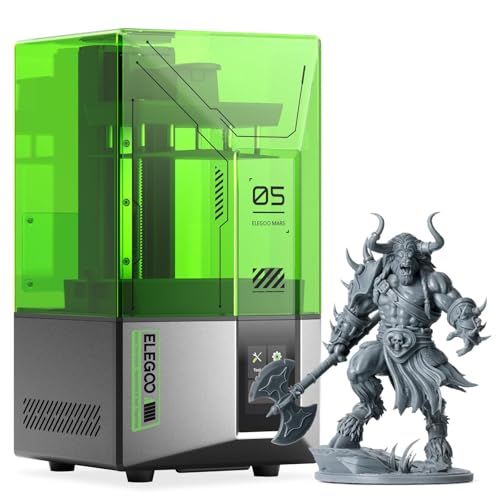
- One-click automatic leveling
- Detailed 4K mono LCD output
- Built-in checks and overheat protection
Best For: Students prioritizing easy setup and reliable small-format detail
Best High-Speed Precision Pick

- Up to 170 mm/h with high-speed resin
- 14K detail with 0.3 mm hole capability
- Automated temperature and resin management
Best For: Students iterating rapidly on highly detailed engineering models
Best Balanced Value Pick

- Sharp 10K mono LCD detail
- Practical 153.4 × 87 × 165 mm build volume
- Power-loss resume and stable platform
Best For: Students seeking versatile detail and dependable everyday prototyping
Best High-Resolution Pick – Saturn 4 Ultra 16K
For engineering students comparing resin printers for engineering students, the ELEGOO Saturn 4 Ultra 16K stands out for detailed prototypes, larger parts, and faster iteration. Its 16K screen, automatic heated resin tank, auto-leveling, and monitoring features aim to reduce setup and print-management work.
Best For: Students who need high-detail, relatively large prints and helpful automation for frequent prototyping.
Pros:
- 16K LCD provides 14 x 19 μm XY resolution for intricate models.
- Large 8.33 x 4.66 x 8.66-inch build volume supports sizable prototypes.
- Automatic resin heating, leveling, sensors, Wi-Fi transfer, and AI camera improve convenience.
- Advertised print speeds reach 150 mm/h with tilted release technology.
Cons:
- At 35.4 pounds, it requires a sturdy, dedicated workspace.
- Its advanced feature set may be more than beginners need for occasional printing.
The Saturn 4 Ultra 16K is a strong engineering-school option when fine detail, build capacity, and automated oversight matter more than a compact footprint.
Best Stability-Focused Pick – Photon P1 14K
The ANYCUBIC Photon P1 is a practical candidate among resin printers for engineering students who prioritize repeatable motion and controlled setup. Its ball screws, precision rails, high-uniformity light system, and assisted leveling are designed to support consistent model quality.
Best For: Students who value mechanical stability, detailed output, and guided calibration for engineering parts.
Pros:
- Industrial-grade ball screws and precision rails help dampen vibration.
- 14K LCD and LighTurbo 4.0 support sharp details and over 92% illumination uniformity.
- Intelligent Leveling 3.0 includes pre-print checks and four-corner leveling guidance.
- AI-assisted checks monitor the build plate, bottom-layer separation, resin level, and residue.
Cons:
- Its 37.8-pound weight and 20.67 x 13.78 x 12.8-inch dimensions call for substantial bench space.
- The supplied notes do not specify a build-volume measurement.
Choose the Photon P1 when a rigid print structure and inspection-oriented workflow are more important than having the most compact student setup.
Best Complete Workflow Bundle – Saturn 4 Ultra 16K Bundle
ELEGOO Saturn 4 Ultra 16K Resin 3D Printer and ELEGOO Mercury Plus V3.0 Wash and Cure Station
Check Price On AmazonFor engineering students shopping for resin printers for engineering students, this bundle adds a Mercury Plus V3.0 wash-and-cure station to the Saturn 4 Ultra 16K. That combination is useful for students who want the printer and post-processing equipment together rather than sourcing each component separately.
Best For: Students building a complete resin-printing workstation for regular prototype production and post-processing.
Pros:
- Includes the Saturn 4 Ultra 16K printer and Mercury Plus V3.0 wash-and-cure station.
- Printer features a large 8.33 x 4.66 x 8.66-inch build area and advertised 150 mm/h speed.
- Smart tank heating to 30°C is designed to support resin conditions.
- The 7.5-liter station is compatible with Mars, Saturn, Photon, Halot, and MSLA LCD/DLP printers.
Cons:
- The combined setup requires more space than the printer alone.
- A bundled workstation may be unnecessary for students who already own washing and curing equipment.
This is the most convenient choice for starting a full resin workflow, especially when the added wash-and-cure station fits the available lab or dorm workspace.
Best Industrial-Resin Option – Photon P1 14K Auto-Leveling
The auto-leveling ANYCUBIC Photon P1 is a capable option for engineering students evaluating resin printers for engineering students who may work with demanding materials. It combines 14K detail with factory calibration, AI monitoring, and support for resins with viscosity up to 8,000 cps.
Best For: Advanced students printing detailed parts with ultra-high-viscosity or industrial-oriented resins.
Pros:
- Supports ultra-high-viscosity resins up to 8,000 cps.
- 14K mono LCD delivers 16.8 x 24.8 micrometer XY pixel size and a minimum 0.3 mm aperture.
- Factory-calibrated Smart Leveling 3.0 performs pre-print checks and provides pressure feedback.
- AI monitoring checks plate installation, bottom-layer separation, resin level, and residue.
Cons:
- The supplied notes do not list a build-volume measurement.
- Its 29.7-pound weight and stated dimensions still require a stable, dedicated location.
The Photon P1 is particularly appealing when material flexibility is central to an engineering project, while its automated checks help reduce avoidable setup and print failures.
High-Detail Workhorse – Saturn 3 12K
For engineering students seeking resin printers for engineering students, the ELEGOO Saturn 3 offers a large build area and highly detailed output for prototypes, functional concepts, and intricate project components.
Best For: Students who need high-resolution prints and room for larger engineering models.
Pros:
- 10-inch 12K monochrome LCD delivers 19 × 24 μm XY resolution.
- Generous 218.88 × 122.88 × 250 mm build volume supports larger projects.
- COB and Fresnel light system is designed for uniform, consistent exposure.
- Laser-carved build plate supports strong print adhesion.
Cons:
- At 33 pounds, it is relatively heavy for moving between workspaces.
- Its large footprint may require dedicated desk space.
The Saturn 3 is a capable choice when detail and build volume matter more than portability. Its compatibility with CHITUBOX and Lychee Slicer also gives students flexibility in their workflow.
Fast Learning Curve – Photon Mono 4 Ultra
The Anycubic Photon Mono 4 Ultra is a practical pick among resin printers for engineering students who want fine detail, fast printing, and helpful monitoring features in a relatively lightweight machine.
Best For: Students who value speed, automated checks, and a straightforward interface.
Pros:
- 7-inch 10K screen provides 17 × 17 μm XY pixel size.
- Maximum print speed is listed at up to 120 mm/h.
- Five intelligent inspections help identify resin, print, and maintenance issues.
- 4.3-inch interface supports eight languages.
Cons:
- Its 7-inch screen and unspecified build volume may be less suitable for large models.
- Advanced automated features may add complexity to a basic workflow.
With high resolution, quick release performance, and built-in inspections, the Photon Mono 4 Ultra balances productivity with ease of operation. It is especially appealing for coursework with frequent iterative prints.
Year-Round Precision – UniFormation GK3T 16K
The UniFormation GK3T is designed for resin printers for engineering students who want maximum detail with a more guided workflow, including factory pre-leveling, resin heating, and remote print monitoring.
Best For: Students who prioritize ultra-fine detail, simplified setup, and stable printing in cooler environments.
Pros:
- 16K LCD resolution and 14 × 19 μm pixel size target highly detailed models.
- Factory pre-leveling and smart resin feeding simplify setup and operation.
- Built-in heating supports resin fluidity in temperatures as low as 0°C/32°F.
- Remote control, progress monitoring, and timelapse features support unattended workflows.
Cons:
- At 52.8 pounds, it is the heaviest option in this selection.
- Its larger dimensions may be challenging in a shared student workspace.
The GK3T stands out for combining very high resolution with convenience-oriented features. Its temperature management and remote monitoring can be useful for students balancing print jobs with classes and other lab work.
Best Beginner-Friendly Pick – ELEGOO Mars 5
For engineering students seeking resin printers for engineering students, the ELEGOO Mars 5 is a practical choice when easy setup and dependable checks matter. One-click automatic leveling, self-checks, and a 4K mono LCD make it approachable for detailed prototypes and design studies.
Best For: Students who want straightforward setup, detailed small-format prints, and built-in safeguards.
Pros:
- One-click automatic leveling reduces setup time.
- 4K mono LCD and COB lighting support detailed prints.
- Residue, resin-shortage, and leveling-failure alerts help reduce waste.
- Overheat protection can stop printing if LED temperatures exceed 80°C.
Cons:
- Its listed features do not include the faster print speeds or higher resolution of the larger Anycubic models.
- The compact printer may be less suitable for larger engineering parts.
The Mars 5 stands out as an accessible student printer because it combines automation, print monitoring, and detailed 4K output without making calibration the focus of every project.
Best High-Speed Precision Pick – ANYCUBIC Photon Mono M7 Pro
Among resin printers for engineering students, the ANYCUBIC Photon Mono M7 Pro is aimed at demanding workflows that benefit from speed and fine resolution. Its 14K LCD, fast print rates, temperature-controlled vat, and automated resin handling can help students iterate through detailed models more efficiently.
Best For: Engineering students working on frequent, highly detailed prototypes and time-sensitive iterations.
Pros:
- Prints at up to 170 mm/h with high-speed resin and 130 mm/h with standard resin under the cited test conditions.
- 14K resolution supports fine details and holes as small as 0.3 mm.
- Temperature-controlled resin vat helps maintain suitable material conditions.
- Six intelligent detection systems, including resin and failed-print detection, simplify operation.
Cons:
- At 33.3 pounds, it is substantially heavier than the other listed options.
- The advanced features may be more than beginners need for occasional projects.
- The maximum 170 mm/h speed depends on high-speed resin and stated test conditions.
The M7 Pro is the strongest fit here for students who value throughput and precision, especially when automated resin management and monitoring can save time across repeated builds.
Best Balanced Value Pick – ANYCUBIC Photon Mono 4
The ANYCUBIC Photon Mono 4 offers a balanced option for resin printers for engineering students who need detailed output, useful build volume, and a manageable footprint. Its 10K mono LCD, uniform matrix lighting, redesigned build platform, and power-loss resume feature support routine prototyping.
Best For: Students who want high-resolution prints and a practical build area for everyday coursework and projects.
Pros:
- 7-inch 10K mono LCD delivers 17 × 17 µm XY pixel size.
- 153.4 × 87 × 165 mm build volume accommodates a range of student projects.
- Re-engineered platform is designed to improve adhesion while easing removal.
- Resume printing after power restoration can reduce wasted resin and time.
Cons:
- It requires first leveling after unboxing.
- Its listed print volume is smaller than what some larger engineering projects may require.
- The notes do not specify an exceptionally high maximum print speed.
With its combination of 10K detail, stable platform design, and power-loss recovery, the Mono 4 is a sensible all-around choice for students balancing print quality, usability, and project flexibility.
How We Picked the Best Resin Printers for Engineering Students
We focused on the features that matter in student engineering work: XY resolution, print consistency, build volume, setup simplicity, speed, and the availability of practical workflow features. Auto-leveling, reliable exposure systems, remote monitoring, and bundled wash-and-cure equipment can reduce wasted time, while a larger build plate may help with assemblies or multiple parts.
We also considered ownership factors such as resin handling, cleaning, ventilation, replacement consumables, and the learning curve. High resolution is useful for small mechanical details, but it does not compensate for poor process control or an inconvenient post-processing routine.
Quick Comparison
| Priority | What to Look For | Best Fit |
|---|---|---|
| Fine detail | 10K, 12K, 14K, or 16K monochrome display | Small parts, miniatures, detailed prototypes |
| Simple setup | Auto-leveling and guided controls | Beginners and busy students |
| Higher throughput | Fast motion system and efficient exposure | Frequent iteration and team projects |
| Complete workflow | Compatible wash-and-cure station or bundle | Students without existing post-processing gear |
| Space-conscious printing | Compact desktop footprint | Dorm rooms, apartments, and shared labs |
Key Buying Factors for Resin Printers for Engineering Students
Accuracy and Useful Resolution
Resolution affects the smallest features a printer can reproduce, but dimensional accuracy also depends on resin, exposure settings, supports, and calibration. For functional prototypes, prioritize repeatable results and a suitable engineering resin rather than choosing solely by the largest resolution number.
Build Volume and Project Scale
Check the actual build dimensions before buying. A compact printer may be ideal for brackets, housings, gears, and component mockups, while a larger Saturn-class machine can print several parts or larger assemblies in one run.
Workflow, Safety, and Cleanup
Resin printing requires gloves, eye protection, ventilation, careful spill control, washing, and UV curing. Allow room for consumables and post-processing. A wash-and-cure bundle can simplify the workflow, but it does not remove the need for safe handling.
Speed and Reliability
Advertised speed is only part of total project time. Account for model preparation, supports, washing, curing, and occasional failed prints. Features such as auto-leveling, stable release, and consistent exposure can be more valuable than peak speed for coursework.
Who Should Buy Which Resin Printers for Engineering Students?
Choose a high-resolution Saturn or UniFormation model if you regularly print detailed parts, multiple components, or larger prototypes. These options make more sense when build capacity and repeatability justify a larger footprint and budget.
Choose an Anycubic Photon P1, Photon Mono M7 Pro, or Photon Mono 4 Ultra if you want a balance of detail, automation, and accessible desktop operation. They suit students iterating on small-to-medium prototypes and learning resin workflows.
The ELEGOO Mars 5 or Anycubic Photon Mono 4 is a sensible starting point for beginners who value a smaller machine and lower entry cost. If you do not already own post-processing equipment, a Saturn-and-Mercury bundle may offer the most convenient complete setup.