Resin printing can produce highly detailed miniatures, models, and prototypes, but the right beginner printer should make setup, leveling, and routine maintenance as straightforward as possible.
We compared 10 resin printers for beginners across resolution, build volume, automation, print speed, usability, and overall value to help you choose a practical first machine.
Best 10 Resin Printers for Beginners Picks for 2026
Best High-Resolution Starter

- 7-inch 10K LCD for detailed prints
- Uniform LighTurbo matrix lighting
- Power-loss resume and tested setup
Best For: Beginners wanting detailed, smooth models with a practical build volume
Best for Easy Setup
- One-click automatic leveling
- Self-check and failure alerts
- 4K mono LCD with COB lighting
Best For: New users who want guided setup and added print protection
Best Plug-and-Play Features

- Factory pre-leveled build platform
- 9K detail with 18 μm XY resolution
- USB, Wi-Fi, and AI model generation
Best For: Beginners making miniatures who want flexible workflows
Best for Large Detailed Prints

- 10-inch 12K mono LCD
- Automatic leveling and self-checks
- User-friendly quick-release and flip-up design
Best For: Beginners planning detailed models and a larger permanent setup
Best Value Detail

- 22-micron XY resolution with an 8K mono LCD
- Compact tabletop design with a 16.5 x 7.2 x 17 cm volume
- Works with Lychee, Chitubox, and other open slicers
Best For: Beginners prioritizing fine detail and flexible software
Best Automated Setup

- Factory-calibrated automatic leveling with pre-print checks
- AI monitoring covers installation, resin, and vat issues
- 14K LCD and support for resins up to 8,000 cps
Best For: Beginners who value automated setup and print oversight
Best Smart Workflow

- 16K resolution with 14 x 19-micron pixel size
- Factory pre-leveling, smart feeding, and quick-release plate
- Built-in heating and remote monitoring via app or slicer
Best For: Beginners seeking a managed, high-precision workflow
Best Beginner-Friendly Choice

- Automatic leveling and one-click self-check
- 4K monochrome LCD with 35×35μm XY resolution
- Sensors monitor resin, debris, film, and overheating
Best For: First-time users who want guided setup and safety monitoring
Best High-Resolution Upgrade

- Up to 150mm/h printing with tilt-release technology
- 16K LCD provides 14×19μm XY resolution
- AI camera and heated resin tray add automation
Best For: Users who want high detail, speed, and advanced monitoring
Best Simple Setup
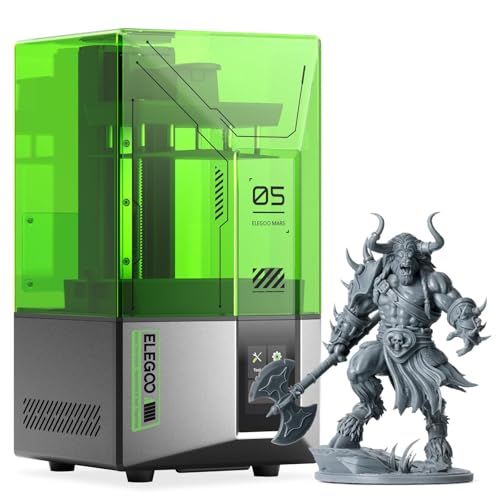
ELEGOO Mars 5 Beginner Resin Printer

- One-click automatic leveling simplifies setup
- Self-check detects common printing issues
- 4K monochrome LCD with overheat protection
Best For: New users seeking simple setup and basic protection
Best High-Resolution Starter – Anycubic Photon Mono 4
For beginners seeking resin printers for beginners, the Anycubic Photon Mono 4 combines a straightforward first setup with highly detailed output. Its 7-inch 10K monochrome LCD, uniform LighTurbo lighting, and relatively spacious build volume make it a versatile choice for detailed models and regular projects.
Best For: Beginners who want sharp, smooth prints and enough build space for everyday projects.
Pros:
- 10K LCD and 17 × 17 μm XY resolution support finely detailed models.
- LighTurbo matrix lighting helps produce smooth, consistent surfaces.
- Pre-assembled and tested design simplifies initial setup after leveling.
- Power-loss resume can reduce wasted resin and print time.
Cons:
- It still requires a first leveling step before printing.
- Its 11-pound size and resin-printing workflow require dedicated workspace and handling.
The Photon Mono 4 is a strong all-around entry point when print detail matters. Its generous resolution and stable build platform are appealing for beginners who expect to continue with more demanding projects.
Best for Easy Setup – ELEGOO Mars 5
The ELEGOO Mars 5 is one of the more approachable resin printers for beginners because automatic leveling and one-click self-checks reduce common setup errors. It also adds residue detection, resin and leveling alerts, and a 4K monochrome LCD for dependable detail.
Best For: First-time users who prioritize automated setup and built-in print safeguards.
Pros:
- One-click automatic leveling helps minimize calibration work.
- Self-check functionality can identify component issues before printing.
- Residue detection and shortage or leveling alarms help prevent waste.
- 4K monochrome LCD with COB lighting reproduces intricate details.
Cons:
- The supplied notes do not specify the printer’s build volume.
- Its safety and monitoring features may not eliminate the need for routine resin-printing cleanup.
Mars 5 stands out for reducing the intimidating parts of a first resin-printer setup. It is a sensible choice if convenience and error prevention matter more to you than maximum screen resolution.
Best Plug-and-Play Features – Creality HALOT-X1 Neo
The Creality HALOT-X1 Neo is a beginner-friendly option among resin printers for beginners, arriving with a factory pre-leveled build platform and tutorial access by QR code. Its 9K LCD targets fine detail, while USB, Wi-Fi, and Creality Cloud support make file transfers flexible.
Best For: Beginners, miniature makers, and tabletop users who want simple startup and flexible connectivity.
Pros:
- Factory pre-leveling supports a plug-and-play first experience.
- 9K LCD and 18 μm XY resolution suit miniatures and intricate models.
- Files can be transferred through USB, 2.4GHz Wi-Fi, or Creality Cloud.
- AI-powered 2D-to-3D generation can turn images into models.
Cons:
- AI model generation is listed as taking as fast as 3.5 hours, so it is not instant.
- The printer’s 153.36 × 77.76 × 160 mm build volume is more compact than larger-format options.
HALOT-X1 Neo is particularly attractive for beginners who value convenience beyond the printer itself. Pre-leveling, tutorials, multiple transfer methods, and image-based model creation create an accessible path into resin printing.
Best for Large Detailed Prints – ELEGOO Saturn 4
The ELEGOO Saturn 4 is a larger, detail-focused choice for resin printers for beginners who want room to grow. Its 10-inch 12K monochrome LCD, automatic leveling, self-checks, and failure detection make advanced print capability more approachable, though the printer’s nearly 30-pound weight calls for a sturdy permanent workspace.
Best For: Beginners who want a larger-format printer for highly detailed and intricate models.
Pros:
- 12K LCD supports excellent detail reproduction on a 10-inch screen.
- Automatic leveling and self-checking simplify the start of a print.
- Foreign-object, resin-shortage, and leveling-failure detection add protection.
- Flip-up lid, quick-release build plate, and spill-conscious tank design improve handling.
Cons:
- At 29.7 pounds, it is substantially heavier than the other listed options.
- Its larger 16.93 × 16.93 × 17.32-inch footprint requires considerable workspace.
- The larger-format design may be more printer than a casual beginner needs.
Saturn 4 is best viewed as an ambitious beginner investment rather than the smallest first printer. Choose it when detailed output, larger-format capability, and automated checks justify dedicating more space and budget to the setup.
Best Value Detail – Phrozen Sonic Mini 8K
For beginners seeking resin printers for beginners that balance approachable operation with highly detailed results, the Phrozen Sonic Mini 8K is a compact option. Its 22-micron XY resolution, 8K monochrome LCD, and support for popular slicers make it suitable for miniatures, models, and action figures.
Best For: Beginners who want sharp detail in a compact tabletop resin printer.
Pros:
- 22-micron XY resolution and an 8K monochrome LCD for fine detail.
- Compact 16.5 x 7.2 x 17 cm printing volume for tabletop use.
- Compatible with open-source software and slicers including Lychee and Chitubox.
- Precise Z-axis calibration supports even printing.
Cons:
- Its build volume is more limited than larger resin printers.
- The printer weighs 22 pounds, so it is not especially lightweight.
The Sonic Mini 8K is a practical starting point when detail quality matters more than large-format capacity. Its open software compatibility also gives beginners room to develop their workflow.
Best Automated Setup – ANYCUBIC Photon P1 14K
For newcomers comparing resin printers for beginners, the ANYCUBIC Photon P1 emphasizes automation and print monitoring. Factory calibration, automatic leveling checks, AI inspection, and support for high-viscosity resins help reduce several common setup and reliability concerns.
Best For: Beginners who want automated leveling, monitoring, and broad resin capability.
Pros:
- Factory-calibrated Smart Leveling 3.0 performs automatic pre-print checks.
- AI monitoring checks build-plate installation, layer separation, resin level, and vat residue.
- 14K monochrome LCD delivers a 13,312 x 5,120 pixel resolution.
- Supports ultra-high-viscosity resins up to 8,000 cps.
Cons:
- At 29.7 pounds, it is less convenient to move than a compact printer.
- Its 16.93 x 24.41 x 16.54-inch footprint requires dedicated space.
The Photon P1 is a strong fit for users who prefer built-in assistance over manual adjustment. Its monitoring features and high-resolution screen make it particularly appealing for repeat printing and detailed work.
Best Smart Workflow – UniFormation GK3T 16K
The UniFormation GK3T is among the resin printers for beginners designed to simplify the complete printing routine. Factory pre-leveling, smart resin feeding, a quick-release plate, temperature management, and remote monitoring make it suited to users who want a streamlined workflow.
Best For: Beginners wanting high precision, temperature control, and remote print management.
Pros:
- 16K LCD with 14 x 19-micron pixel size for highly detailed prints.
- Factory pre-leveling and smart resin-feeding features support plug-and-play use.
- Built-in heating maintains resin fluidity in temperatures as low as 0°C/32°F.
- App and slicing-software support enables remote control, progress updates, and timelapse recording.
Cons:
- At 52.8 pounds, it is substantially heavier than the other listed options.
- The 12.99 x 15.75 x 20.47-inch size may require significant workspace.
The GK3T stands out for its combination of precision and convenience features. It is a capable choice for beginners who want fewer manual steps and expect to print in changing temperatures.
Best Beginner-Friendly Choice – ELEGOO Mars 5 4K
The ELEGOO Mars 5 is a practical pick among resin printers for beginners, combining automatic leveling, self-check features, and a compact 4K MSLA printing setup. Its sensors can flag issues such as low resin, foreign objects, release-film replacement, and overheating before they become bigger problems.
Best For: First-time resin users who want straightforward setup and dependable safety monitoring.
Pros:
- Automatic leveling helps simplify initial setup.
- Built-in mechanical sensing and self-check functions monitor common printing problems.
- 6.6-inch 4K monochrome LCD delivers 35×35μm XY resolution and speeds up to 70mm/h.
- Laser-engraved build plate and one-touch locking support easier print preparation.
Cons:
- Its 70mm/h maximum speed is lower than the Saturn 4 Ultra’s rated speed.
- Users still need to add suitable supports in slicing software and clean the resin tank after printing.
Choose the Mars 5 if ease of setup and guided operation matter more than maximum speed or the highest available resolution. It offers useful beginner-oriented features without moving into the larger footprint of a high-end resin printer.
Best High-Resolution Upgrade – ELEGOO Saturn 4 Ultra 16K
The ELEGOO Saturn 4 Ultra 16K is a substantial upgrade for users who want speed, fine detail, and automated monitoring from their resin printer. Its tilt-release system, 16K monochrome LCD, AI camera, and heated resin tray provide a more advanced feature set than typical entry-level machines.
Best For: Beginners with a larger budget, or growing hobbyists who prioritize detail, speed, and automation.
Pros:
- Prints at up to 150mm/h using tilt-release technology.
- 16K LCD offers 14×19μm XY resolution for highly detailed models.
- AI camera can detect empty build plates and model warping during monitoring.
- Automatic tray heating maintains resin at a stated 25°C, with 24-hour preheating support.
Cons:
- At 40.7 pounds, it is considerably heavier than the Mars 5 models.
- Its larger dimensions require more workspace.
- The advanced feature set may be more than a basic beginner needs.
The Saturn 4 Ultra makes sense when you want a resin printer that can support more demanding projects from the start. Its size and complexity are trade-offs, but the combination of 16K detail, fast printing, temperature control, and AI monitoring is compelling.
Best Simple Setup – ELEGOO Mars 5 Beginner Resin Printer
This ELEGOO Mars 5 is designed as an approachable entry point for resin printing, with one-click automatic leveling and a self-check routine that reviews the printer before a job begins. For shoppers comparing resin printers for beginners, its compact design and protective features make it a straightforward option for everyday projects.
Best For: New users who want automatic leveling, simple diagnostics, and a compact 4K printer.
Pros:
- One-click automatic leveling reduces manual setup work.
- Self-check detects leveling, resin, and foreign-object issues before printing.
- Overheat protection stops printing if LED temperature exceeds 80°C.
- 6.6-inch 4K monochrome LCD uses FEP release film and offers 35×35μm resolution.
Cons:
- The supplied notes do not specify a maximum print speed.
- It still requires resin handling and routine cleanup.
- Its feature set is focused on everyday printing rather than advanced monitoring such as an AI camera.
The Mars 5 is a sensible choice if you want to minimize the most frustrating early setup steps. Automatic leveling, pre-print diagnostics, and overheat protection offer useful reassurance while you learn resin-printing workflows.
How We Picked These Resin Printers for Beginners
We focused on features that matter most when learning resin 3D printing: dependable exposure and motion systems, useful LCD resolution, manageable setup, build-platform design, and access to common replacement parts. We also considered whether each printer suits miniatures, functional models, larger objects, or a mix of projects.
High resolution can improve fine details, but it does not guarantee better results by itself. A beginner-friendly printer also needs consistent leveling, sensible controls, a stable build platform, and a workflow that is easy to repeat. Features such as auto-leveling, mechanical sensors, Wi-Fi, and guided setup can reduce friction, although they may increase the purchase price.
Quick Comparison
- Best for compact, detailed projects: The Photon Mono 4, ELEGOO Mars 5 models, and Phrozen Sonic Mini 8K are suited to miniatures and tabletop-sized prints.
- Best for larger projects: The ELEGOO Saturn 4, Saturn 4 Ultra, and UniFormation GK3T offer more room for bigger models or multiple parts in one job.
- Best for high-resolution detail: The Anycubic Photon P1, Saturn 4 Ultra, and GK3T emphasize very fine LCD resolution.
- Best for easier setup: Models with auto-leveling, pre-leveled platforms, or smart sensors can be more approachable for first-time users.
- Best for speed: The Saturn 4 Ultra is designed for fast printing, but speed still depends on resin, layer height, exposure settings, and model geometry.
Key Buying Factors for Resin Printers for Beginners
Resolution and Print Detail
LCD resolution and pixel size affect small features, lettering, and miniature surfaces. Choose a higher-resolution model if detail is a priority, but remember that proper exposure calibration and resin selection are equally important.
Build Volume
Compact printers use less space and resin, while larger machines let you print bigger parts or several pieces at once. Measure your workspace, including room for the printer cover and ventilation equipment.
Setup and Leveling
Auto-leveling and pre-leveled platforms can simplify the first setup. Manual leveling is still manageable, but it requires careful instructions and occasional adjustment.
Safety and Workflow
Resin requires gloves, eye protection, ventilation, washing, and UV curing. Budget for a wash-and-cure station, cleaning supplies, replacement film, and suitable resin. A printer with convenient controls or network connectivity may also make repeated jobs easier.
Speed and Reliability
Advertised maximum speeds are best treated as upper limits. Consistent results depend on the resin profile, lift settings, support placement, temperature, and maintenance. Beginner-friendly reliability is usually more valuable than maximum speed.
Who Should Buy Which Resin Printers for Beginners?
Choose a compact Mars 5, Photon Mono 4, or Sonic Mini 8K if you are starting with miniatures, figures, jewelry prototypes, or other small detailed parts. Select a Saturn 4 or Saturn 4 Ultra if you want more build space and expect to print larger models or batches. The Photon P1 and GK3T are strong options for shoppers prioritizing very high resolution, while the HALOT-X1 Neo may appeal to users who want guided features, connectivity, and a pre-leveled platform.
Before buying, confirm the printer’s dimensions, resin compatibility, replacement-part availability, slicer support, and return policy. The best first printer is the one that fits both your projects and the complete resin-printing workflow—not just the machine’s advertised resolution.