Choosing the right zoom eyepiece can make telescope observing faster and more convenient. Instead of changing fixed focal-length eyepieces every few minutes, you can adjust magnification while keeping an object centered and refining the view.
We selected 10 zoom telescope eyepieces covering broad everyday ranges, high-power planetary viewing, wide-angle designs, and useful telescope-accessory bundles. The best choice depends on your telescope’s focal length, focuser size, target objects, and preferred viewing comfort.
Best 10 Zoom Telescope Eyepieces Picks for 2026
Versatile Starter
Celestron 8-24mm Zoom Eyepiece

- 8-24mm continuous zoom range
- Fully multi-coated optics
- Standard 1.25-inch fit with filter threads
Best For: Beginners wanting one flexible eyepiece
Wide-View Upgrade
SVBONY SV230 8-20mm Zoom Eyepiece

- 57-72-degree wide-angle field
- Parfocal zooming design
- Dual 1.25-inch and 2-inch interface
Best For: Wide-field planetary and deep-sky viewing
Eyeglass-Friendly Pick

- 7-21mm smooth zoom range
- 16-33mm adjustable eye relief
- All-metal body with multi-coated optics
Best For: Eyeglass wearers and extended sessions
Balanced Value
SVBONY SV191 7.2-21.6mm Zoom Eyepiece

- 7.2-21.6mm versatile zoom range
- 42-65-degree field of view
- 18-20mm eye relief with filter threads
Best For: General-purpose 1.25-inch telescope viewing
Best All-Around Value

- 7-21mm range covers wide and high-power viewing
- 15mm eye relief with rubber eye guard
- Fits standard 1.25-inch telescope focusers
Best For: Flexible everyday skywatching and lunar or planetary observation
Best Wide-Field Upgrade
SVBONY SV245 8-16mm Zoom Eyepiece

- 63° field of view with parfocal zoom design
- Dual 1.25-inch and 2-inch interfaces
- 17-18mm eye relief and eight-element optics
Best For: High-power viewing with wide, comfortable views
Best for Astrophotography
Astromania 8-24mm Zoom Eyepiece

- Continuous 8-24mm zoom for flexible magnification
- M42x0.75 thread supports camera mounting
- Filter thread and fully multi-coated optics
Best For: Visual observing plus lunar and planetary photography
Best All-Around Zoom Value
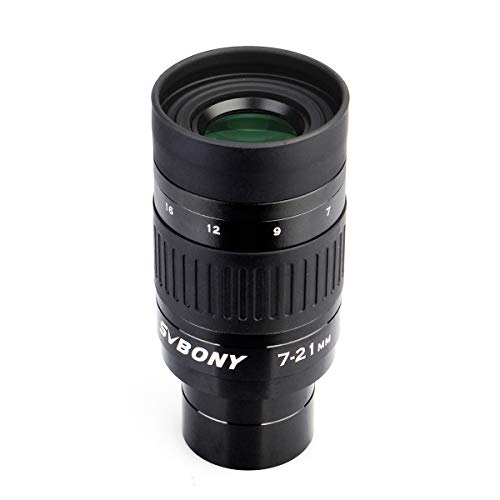
- 7–21mm adjustable focal length
- Fully multi-coated six-element optics
- Comfortable eye relief for eyeglass wearers
Best For: General lunar, planetary, deep-sky, and landscape viewing
Best for High-Power Planetary Viewing

- 3–8mm range for high magnification
- Parfocal design reduces refocusing
- Constant 56° field of view
Best For: Lunar and planetary observation
Best Complete Viewing Set
SV135 Zoom Eyepiece and Diagonal

- Includes 7–21mm zoom eyepiece
- Adds a comfortable 90° viewing angle
- 1.25-inch accessory compatibility
Best For: Observers upgrading a compatible telescope setup
Versatile Starter – Celestron 8-24mm Zoom Eyepiece
The Celestron 8-24mm is a practical choice if you want one of the more adaptable zoom telescope eyepieces for everyday observing. Its 3:1 range lets you move from lower-power views to higher magnification without changing eyepieces.
Best For: Beginners and observers who want broad focal-length flexibility in a standard 1.25-inch format.
Pros:
- Zooms continuously from 8mm to 24mm.
- Fully multi-coated optics are designed to improve brightness, color, and contrast.
- Fits standard 1.25-inch telescope and spotting-scope holders and accepts 1.25-inch filters.
- Includes a removable rubber eyecup, T-threads, and a two-year US warranty.
Cons:
- The 55-degree field of view is less wide than some alternatives in this roundup.
- Its 1.25-inch barrel is not a native fit for 2-inch focusers.
This is a straightforward, flexible option for building a compact observing kit. Choose it when compatibility with standard 1.25-inch equipment and a wide 8-24mm range matter more than an especially wide-angle view.
Wide-View Upgrade – SVBONY SV230 8-20mm Zoom Eyepiece
The SVBONY SV230 stands out among zoom telescope eyepieces for its wide, changing field of view and parfocal design. It covers 8-20mm while helping keep targets sharp during zooming, making it suited to observers who want fewer interruptions.
Best For: Planetary and deep-sky observers who prioritize wide views, edge sharpness, and convenient zooming.
Pros:
- Provides a 57-72-degree apparent field of view.
- Parfocal design is intended to keep the target in focus while zooming.
- Aspherical optics are designed to reduce edge blur and astigmatism.
- Dual 1.25-inch and 2-inch interface supports compatible focusers without an adapter.
Cons:
- Its 8-20mm range is narrower than several other models here.
- At 500g, it is relatively heavy for an eyepiece.
- The supplied warranty is one year, with a 30-day no-reason return period noted.
The SV230 is a compelling pick when a broad, immersive view and minimal refocusing are high priorities. Its dual-size interface also gives it more setup flexibility than typical 1.25-inch-only zooms.
Eyeglass-Friendly Pick – Alstar 7-21mm Zoom Eyepiece
The Alstar 7-21mm is one of the more comfort-focused zoom telescope eyepieces in this selection. Its adjustable 16-33mm eye relief and foldable eyecup make it particularly practical for observers who wear glasses.
Best For: Eyeglass wearers and users seeking a rugged, all-metal 1.25-inch eyepiece for lunar, planetary, and deep-sky viewing.
Pros:
- Offers a smooth 7-21mm stepless zoom range.
- Adjustable 16-33mm eye relief accommodates glasses.
- Seven-element, four-group multi-coated optics include blackened lens edges.
- Accepts standard astronomical filters and has a durable all-metal body.
Cons:
- The 30-47-degree field of view is comparatively narrow.
- It uses a 1.25-inch barrel rather than a dual-size interface.
- The notes do not identify it as parfocal during zooming.
This model makes sense when viewing comfort and mechanical durability take priority over a very wide field. Its broad eye-relief adjustment is the clearest reason to consider it for long observing sessions.
Balanced Value – SVBONY SV191 7.2-21.6mm Zoom Eyepiece
The SVBONY SV191 offers a useful 7.2-21.6mm range in a standard 1.25-inch format. As zoom telescope eyepieces go, it combines a relatively broad 42-65-degree field range with long eye relief, though you should expect to refocus after changing magnification.
Best For: Observers wanting a versatile 1.25-inch zoom with comfortable eye relief and filter compatibility.
Pros:
- Provides a 7.2-21.6mm focal-length range without swapping eyepieces.
- Seven-element, four-group fully multi-coated optics use high-index glass.
- 18-20mm eye relief and a twist-up rubber eyecup support viewing with or without glasses.
- Accepts standard 1.25-inch filters and works with astronomical telescopes and spotting scopes.
Cons:
- It is not parfocal, so refocusing is required after zooming.
- It fits standard 1.25-inch holders but does not offer a native 2-inch interface.
- The warranty information lists one year plus a 30-day no-reason return period.
The SV191 is a well-rounded option for users who value focal-length coverage and comfortable eye relief. It is less convenient than a parfocal model, but its filter support and optical design make it a flexible general-purpose choice.
Best All-Around Value – NEEWER 7-21mm Zoom Eyepiece
The NEEWER 7-21mm is a practical choice if you want one zoom telescope eyepiece for both higher-magnification planetary viewing and wider landscape or sky observations. Its 1.25-inch barrel fits telescopes that accept the standard size, while the zoom ring lets you adjust magnification without swapping eyepieces.
Best For: Observers who want a compact, glasses-friendly eyepiece for lunar, planetary, and general skywatching.
Pros:
- Versatile 7-21mm focal-length range for changing viewing needs.
- 15mm eye relief and a rubber eye guard support comfortable viewing, including for glasses wearers.
- Five-element, three-group design with multiple coatings is intended to improve sharpness, contrast, and light transmission.
- Compatible with telescopes using 1.25-inch eyepieces.
Cons:
- The field of view varies from 40° to 57°, so it is narrower at the short focal length.
- Compatibility is limited to telescopes that accept 1.25-inch accessories.
For beginners or casual observers seeking flexibility, the NEEWER offers a useful focal-length range, comfortable eye relief, and a portable metal housing without requiring frequent eyepiece changes.
Best Wide-Field Upgrade – SVBONY SV245 8-16mm Zoom Eyepiece
The SVBONY SV245 stands out among zoom telescope eyepieces for its 63° field of view, parfocal design, and dual 1.25-inch/2-inch interface. Its 8-16mm range is aimed at higher-power observing, while the detented zoom positions make adjustments more controlled.
Best For: Observers who prioritize a wide field, minimal refocusing, glasses-friendly eye relief, and compatibility with either 1.25-inch or 2-inch equipment.
Pros:
- Parfocal design helps reduce the need to refocus throughout the zoom range.
- 63° field of view provides an immersive viewing experience.
- Dual 1.25-inch and 2-inch interface supports broader telescope compatibility.
- 17-18mm eye relief, folding eye mask, and eight-element multi-coated optics support comfortable, sharp viewing.
Cons:
- The 8-16mm range is less suitable for very low-power, wide-sky scanning.
- At 486g, it is considerably heavier than a compact zoom eyepiece.
- The advanced design may be more capability than casual observers need.
The SV245 is a feature-rich option for serious visual observing, especially when a wide apparent field and quick, accurate magnification changes matter more than minimal size or weight.
Best for Astrophotography – Astromania 8-24mm Zoom Eyepiece
The Astromania 8-24mm is a versatile zoom telescope eyepiece for observers who want broad magnification control and camera support. Its continuous zoom range covers low-power sweeping through higher-power lunar and planetary views, while the threaded top supports camera mounting with an M42x0.75 connection.
Best For: Visual observers and astrophotographers who want one 1.25-inch eyepiece for sky viewing, filter use, and eyepiece-projection photography.
Pros:
- Continuous 8-24mm zoom range offers a broad range of magnifications.
- 40°-60° field of view supports both detailed and wider observations.
- 15-18mm eye relief and a rubber eyecup improve viewing comfort.
- Fully multi-coated optics, a filter thread, and M42x0.75 camera threading add versatility.
Cons:
- The field of view narrows to 40° at the high-power end.
- It uses a standard 1.25-inch barrel rather than offering a 2-inch interface.
- Camera use requires compatible T-ring equipment.
With its broad zoom range and photography-oriented threading, the Astromania is a strong convenience-focused option for users who alternate between visual observing and basic lunar or planetary imaging.
Best All-Around Zoom Value – SV135 7–21mm Zoom Eyepiece
If you want one flexible option for a range of targets, the SVBONY SV135 is a practical choice among zoom telescope eyepieces. Its 7–21mm range covers low-to-higher magnification without requiring frequent eyepiece changes, while the 1.25-inch barrel fits compatible telescope focusers.
Best For: Lunar, planetary, nebula, cluster, landscape, and general visual observing.
Pros:
- Adjustable 7–21mm focal length can replace multiple eyepieces.
- Fully multi-coated, six-element, four-group optical design supports sharp, high-contrast views.
- Comfortable 18–16.3mm eye relief is helpful for eyeglass wearers.
- Wide 40–57° apparent field of view and rubber eye guard improve viewing comfort.
Cons:
- Uses a manual zoom and requires a telescope with a compatible 1.25-inch holder.
- The field of view changes across the zoom range.
The SV135 is a cost-conscious, general-purpose zoom for observers who value convenience and broad target coverage. It is especially appealing when you want to simplify a basic eyepiece collection.
Best for High-Power Planetary Viewing – SV215 3–8mm Zoom Eyepiece
The SVBONY SV215 is a specialized option among zoom telescope eyepieces for high-power lunar and planetary work. Its 3–8mm range lets you adjust magnification without swapping eyepieces, and the parfocal design is intended to minimize refocusing as you zoom.
Best For: High-power observation of the Moon, Venus, Mars, Jupiter, Saturn, and other bright targets.
Pros:
- 3–8mm range supports high-magnification lunar and planetary observing.
- Parfocal design helps maintain focus across the zoom range, with minor tweaking possibly needed.
- Constant 56° field of view and consistent usable eye relief provide a predictable view.
- Click stops at 3, 4, 5, 6, 7, and 8mm are easy to use in the dark.
Cons:
- Its short focal-length range is less suited to wide-field, low-power viewing.
- Requires a telescope with a standard 1.25-inch eyepiece holder.
Choose the SV215 when planetary detail is the priority. The constant field of view, click stops, and smooth zoom ring make magnification changes straightforward during focused observing sessions.
Best Complete Viewing Set – SV135 Zoom Eyepiece and Diagonal
This set combines the versatile SV135 7–21mm zoom eyepiece with the SV188P dielectric star diagonal, making it a convenient upgrade for compatible 1.25-inch telescopes. For shoppers comparing zoom telescope eyepieces, the bundle adds a more comfortable 90-degree viewing path along with adjustable magnification.
Best For: Observers who need both a general-purpose zoom eyepiece and a 90-degree diagonal for overhead targets.
Pros:
- Includes the 7–21mm SV135 zoom eyepiece and SV188P dielectric mirror diagonal.
- The 90-degree diagonal provides a more comfortable angle for viewing objects overhead.
- Fully multi-coated, six-element, four-group eyepiece design supports sharp, high-contrast imaging.
- 1.25-inch nosepiece accepts compatible filters, eyepieces, and Barlow lenses.
Cons:
- The bundle is heavier and bulkier than the eyepiece alone.
- Compatibility depends on a telescope using a 1.25-inch insert barrel; SCT telescopes may need an adapter.
- The eyepiece uses manual focusing and a 40–57° field-of-view range.
This is the most practical pick when you want to add two useful accessories at once. The diagonal improves viewing comfort, while the SV135 supplies flexible magnification for lunar, planetary, deep-sky, and landscape observation.
How We Picked These Zoom Telescope Eyepieces
We compared the selected models by focal-length range, usable field of view, optical design, eye relief, barrel compatibility, parfocal performance, and overall versatility. We also considered whether each eyepiece is better suited to general observing, high-power planetary work, or users who want a complete accessory setup.
A wide zoom range is convenient, but it may come with a narrower apparent field of view at the longer-focal-length setting. We therefore looked beyond magnification numbers to practical handling, viewing comfort, and compatibility with common 1.25-inch and 2-inch telescope systems.
Quick Comparison
| Best For | What to Look For |
|---|---|
| General-purpose observing | 8–24mm or 7–21mm range, comfortable eye relief, and broad compatibility |
| Wide-field viewing | Higher apparent field of view, especially at shorter focal lengths |
| Planets and the Moon | Shorter focal lengths, good control, and parfocal or near-parfocal operation |
| Beginners | Simple 1.25-inch installation and a versatile mid-range zoom |
| Accessory upgrades | Models supplied with a diagonal or compatible 2-inch interface |
Key Buying Factors for Zoom Telescope Eyepieces
Focal-Length Range and Magnification
Magnification equals the telescope’s focal length divided by the eyepiece focal length. A 7–21mm eyepiece produces more magnification than an 8–24mm model when used with the same telescope. Check the range against your telescope before buying: very high magnification can make focusing difficult and exaggerate atmospheric turbulence.
Field of View
Apparent field of view determines how spacious the view feels. Wider designs are easier to use for large targets and can make tracking more comfortable, while narrower views may still work well for the Moon, planets, and compact deep-sky objects.
Barrel Size and Compatibility
Most options here use a 1.25-inch barrel, the common size for many beginner and intermediate telescopes. A 2-inch interface can improve compatibility with larger focusers, but confirm whether the eyepiece uses a true 2-inch optical path or simply includes an adapter. Also check clearance around diagonal mirrors, filters, and focusers.
Eye Relief, Optics, and Parfocal Design
Longer eye relief is valuable for eyeglass wearers and extended sessions. Fully multi-coated or multi-coated optics can improve light transmission and contrast. A parfocal design reduces refocusing as you change settings, although small adjustments may still be necessary with some telescopes.
Who Should Buy Which Zoom Telescope Eyepieces?
Choose a broad 8–24mm or 7–21mm model if you want one convenient eyepiece for exploring the Moon, planets, star clusters, and brighter nebulae. Select a wider-angle model if you often scan star fields or want easier object tracking. For planetary observers, a 3–8mm or 8–16mm zoom can provide more useful high-power control, provided your telescope and local seeing conditions support it.
Beginners should prioritize a straightforward 1.25-inch model with a forgiving focal-length range and comfortable eye relief. Experienced observers may prefer a wider field, improved parfocal behavior, or a 2-inch-compatible design. Finally, verify the eyepiece’s dimensions, focusing requirements, and realistic magnification limits before purchase; convenience is most valuable when the eyepiece matches the telescope and the targets you observe most often.