Choosing the best 3D scanner for large objects means balancing accuracy, scanning speed, tracking reliability, working distance, and software support. A scanner that performs well on a small figurine may struggle with a vehicle panel, furniture component, or full-body scan.
We selected 10 standout models across handheld, wireless, laser, infrared, and all-in-one designs. Use the guide below to match your object size, accuracy needs, budget, and preferred scanning workflow.
Best 10 3d Scanner for Large Objects Picks for 2026
Best Overall

- 0.02mm accuracy and 4m maximum object size
- Blue laser and NIR modes for varied scanning tasks
- Powder-free scanning for dark and metallic surfaces
Best For: Professional large-object scanning and reverse engineering
Best for Outdoor Scanning
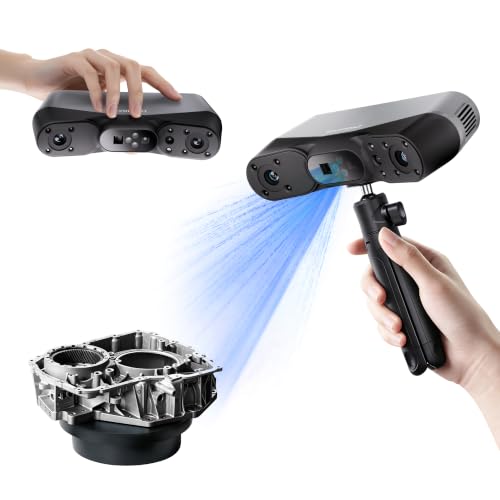
- Scans objects up to 2m per side
- Multiple modes handle dark and reflective surfaces
- Outdoor operation up to 100,000 lux
Best For: Outdoor fieldwork and varied industrial scanning
Best Value Laser Option

- 0.02mm blue-light scanning accuracy
- Handles objects up to 2m in size
- NIR mode supports marker-free scanning
Best For: Precise workshop scanning within a 2-meter range
Best Standalone System

- On-device processing with 32GB RAM and 256GB storage
- Photogrammetric kit for large-object measurement
- Far and Near modes cover large and small subjects
Best For: Portable professional scanning and measurement workflows
Best Wireless Large-Object Scanner

- Wireless scanning with up to 3 hours of battery operation
- Infrared mode supports large objects at up to 20 fps
- Scans black and reflective surfaces without spray
Best For: Portable large-object and outdoor scanning
Best Full-Color Large-Object Scanner

- Scans objects from 0.8 to 78 inches
- Captures 24-bit full-color textures
- Works on dark and metallic surfaces without spray
Best For: Large parts and color-rich 3D models
Best Precision Scanner for Large Parts

- Up to 0.01mm single-frame precision
- 34-laser mode reaches up to 90 fps
- Scans dark and metallic parts without spray
Best For: Industrial inspection and reverse engineering
Best Lightweight Scanner

- 0.05mm accuracy with 0.10mm resolution
- AI tracking and integrated JMStudio workflow
- Lightweight, quiet 250g handheld design
Best For: Medium-size objects and portable detailed scanning
Best All-Around Scanner
Creality Pika Portable 3D Scanner

- Scans objects up to 2000mm in size
- Dual blue-laser and NIR scanning modes
- Wireless, battery-powered design with AI tools
Best For: Large objects, full-body scans, and detailed smaller parts
Best High-Precision Scanner
Creality Raptor Pro with Scan Bridge

- 0.02mm laboratory-condition accuracy
- Scans objects from 5mm to 2000mm
- 60 FPS and full-color mapping support
Best For: Advanced large-object and intricate-detail scanning
Best Overall – Creality CR-Scan Raptor Pro
For shoppers seeking a 3d scanner for large objects, the Creality CR-Scan Raptor Pro combines a 4-meter maximum scan size with 0.02mm accuracy and fast laser capture. Its blue-laser and NIR modes also make it versatile for industrial, automotive, and reverse-engineering work.
Best For: Professional users scanning medium-to-large objects, including dark, metallic, or somewhat transparent surfaces.
Pros:
- Scans objects from 5mm to 4,000mm with up to 0.02mm accuracy.
- Captures up to 660,000 points per second with 60fps laser scanning.
- Supports powder-free scanning of black, metallic, and up to 71% transparent glass surfaces.
- Includes 24-bit color capture and compatibility with professional software such as Rhino, ZBrush, Maya, and SolidWorks.
Cons:
- Recommended Windows setup requires 32GB of RAM and an 8GB VRAM GPU.
- Mac and Android compatibility has specific hardware and operating-system requirements.
The Raptor Pro is a strong all-around option when accuracy, scanning range, and material versatility matter more than a lightweight entry-level setup.
Best for Outdoor Scanning – Revopoint POP 4
The Revopoint POP 4 is a flexible 3d scanner for large objects, supporting scans up to 2 x 2 x 2 meters while offering several modes for different surfaces and environments. Its outdoor lighting tolerance, wireless operation, and AI-assisted cleanup are particularly useful for fieldwork.
Best For: Users scanning large components, construction subjects, archaeological objects, or complex surfaces indoors and outdoors.
Pros:
- Offers up to 0.03mm single-frame accuracy and scanning speeds up to 105fps or 5,000,000 points per second, depending on mode.
- Supports five scanning modes, including options for dark, reflective, narrow, and deep surfaces.
- Can operate in outdoor conditions up to 100,000 lux with the appropriate mode or filter.
- Includes Wi-Fi 6, a 5,500mAh battery grip, and Windows AI object segmentation.
Cons:
- AI object segmentation is limited to Windows.
- Its maximum stated scan volume is 2 meters per side, smaller than some large-format alternatives.
With broad scanning modes and strong outdoor-light performance, the POP 4 is well suited to users who need flexibility across field and workshop environments.
Best Value Laser Option – Creality CR-Scan Raptor
The Creality CR-Scan Raptor is a practical 3d scanner for large objects when you need high precision without moving to the Pro model’s 4-meter range. It scans items from 5mm to 2,000mm and combines blue-light accuracy with NIR marker-free scanning.
Best For: Makers, designers, and professionals scanning objects up to 2 meters, including faces, bodies, artifacts, and detailed parts.
Pros:
- Provides up to 0.02mm accuracy using seven parallel blue laser lines.
- Scans at up to 60fps in blue-light mode and 20fps in infrared mode.
- Supports both marker-assisted precision scanning and marker-free NIR scanning.
- Captures objects ranging from 5 x 5 x 5mm to 2,000 x 2,000 x 2,000mm.
Cons:
- Its maximum object size is half that of the Raptor Pro.
- Requires a capable computer, including at least 16GB RAM and a dedicated Nvidia GPU on Windows.
The standard Raptor makes sense for buyers who want the Pro model’s stated accuracy and fast blue-light workflow but typically scan objects within a 2-meter range.
Best Standalone System – Revopoint MIRACO Plus
The Revopoint MIRACO Plus stands out as a portable 3d scanner for large objects because it processes scans on the device rather than depending entirely on a connected computer. Its Far mode, photogrammetric kit, and integrated display are designed for large surfaces and measurement-focused workflows.
Best For: Professionals who need portable large-object scanning, photogrammetric measurement, and on-device scan processing.
Pros:
- Photogrammetric kit supports large-object measurement with stated length accuracy of 0.02mm + 0.05mm x L(m).
- Far mode handles large machinery, while Near mode captures smaller details.
- Built-in 8-core processor, 32GB RAM, 256GB storage, and 6-inch 2K AMOLED flip screen enable standalone operation.
- Exports to formats including STL, OBJ, PLY, 3MF, GLTF, and FBX.
Cons:
- Continuous scanning battery life is stated at up to 2 hours.
- Revo Design for scan-to-CAD conversion is sold separately.
- The photogrammetric workflow uses a kit with scale bars and coded targets, adding setup steps.
The MIRACO Plus is the most self-contained choice in this group, especially appealing when portability, large-object measurement, and reduced reliance on a workstation are priorities.
Best Wireless Large-Object Scanner – EINSTAR 2
If you need a 3d scanner for large objects that can move beyond the studio, the EINSTAR 2 combines wireless scanning, infrared capture, and blue-laser detail modes. It supports large-object scanning, black and reflective surfaces without spray, and operation in bright outdoor conditions.
Best For: Portable scanning of large objects, vehicles, outdoor subjects, and mixed-size projects.
Pros:
- VCSEL infrared mode is designed for large objects and scans at up to 20 fps.
- Wireless operation includes a swappable battery rated for up to 3 hours of scanning.
- Blue-laser mode reaches up to 90 fps and supports 3mm, 6mm, and 12mm markers.
- Can scan black and reflective objects without spray, with support for bright environments.
Cons:
- At 5.72 pounds in its package, it may be less convenient for extended handheld work than lighter options.
- The listed performance depends on choosing the appropriate laser or infrared scanning mode.
The EINSTAR 2 is a versatile choice when mobility and material adaptability matter as much as scan speed. Its wireless design and outdoor-capable modes make it especially practical for large subjects that are difficult to bring to a fixed workstation.
Best Full-Color Large-Object Scanner – Creality Otter Lite Basic
The Creality Otter Lite Basic is a practical 3d scanner for large objects when you also want full-color texture capture. Its quad-camera design covers subjects from 0.8 inches up to 78 inches, while its structured-light system can scan dark and metallic surfaces without spray.
Best For: Large-part scanning, automotive components, prototypes, artwork, and color-rich digital models.
Pros:
- Quad-camera coverage supports objects up to 78 inches and captures a large area per frame.
- Offers up to 0.05mm accuracy and scanning speeds up to 30 fps.
- Captures 24-bit color textures using an RGB camera and white LED fill lights.
- Supports marker, geometry, and texture alignment plus common export formats.
Cons:
- The optional Scan Bridge handle is sold separately for added stability during extended sessions.
- Its outdoor operating specification is up to 30,000 lux, lower than some alternatives in this group.
Choose the Otter Lite Basic if realistic color is central to your workflow. It balances broad object coverage with detail capture and offers compatibility across Windows, macOS, iOS, and Android through CrealityScan 4.
Best Precision Scanner for Large Parts – Revopoint MetroY Ultra
For buyers seeking a 3d scanner for large objects with an inspection-oriented workflow, the Revopoint MetroY Ultra emphasizes precision, rapid laser capture, and flexible alignment. Its cross-line mode is suited to large-area scans, while additional modes handle fine details and deep holes.
Best For: Industrial inspection, reverse engineering, tight-tolerance parts, and fast medium-sized scans.
Pros:
- Provides up to 0.01mm single-frame precision and stated volumetric accuracy of 0.015 + 0.04 mm x L (m).
- 34-laser cross-line mode supports scanning speeds up to 90 fps with an NVIDIA GPU.
- Scans dark, glossy, and metallic components without spray.
- Wi-Fi 6, a 5500mAh battery grip, and support for outdoor scanning up to 100,000 lux improve field flexibility.
Cons:
- The highest listed 90 fps speed requires an NVIDIA GPU; CPU operation is rated up to 60 fps.
- The recommended Windows setup includes 32GB RAM and an RTX 3060 GPU, which may require a capable computer.
- The notes position the scanner for small to medium objects rather than the largest subjects.
The MetroY Ultra is the strongest fit here for users prioritizing measurement quality and industrial workflows. Its multiple laser modes, high-speed capture, and spray-free handling make it well suited to demanding part documentation and reverse engineering.
Best Lightweight Scanner – 3DMakerpro Moose Lite
If you need a 3d scanner for large objects but want something compact and easy to carry, the 3DMakerpro Moose Lite is a practical option for medium-size projects. Its 15mm-to-1500mm scan range, AI tracking, and 0.05mm accuracy support detailed scans for printing or display work.
Best For: Makers scanning medium-size objects who value low weight, quiet operation, and detailed point clouds.
Pros:
- 0.05mm accuracy and 0.10mm resolution help preserve fine details.
- AI visual tracking and point-cloud processing simplify the workflow.
- Lightweight 250g design with no fan noise is convenient for extended handheld use.
Cons:
- Its listed scan range tops out at 1500mm, so it may be less suitable for very large subjects.
- The supplied notes do not list wireless scanning.
The Moose Lite is a strong fit when portability and detail matter more than maximum scan size. Its integrated JMStudio software also combines scanning, editing, and optimization in one workflow.
Best All-Around Scanner – Creality Pika Portable 3D Scanner
The Creality Pika is a versatile choice if you need a 3d scanner for large objects as well as smaller parts. Its NIR structured-light mode supports scans up to 2000mm in size, while blue laser mode adds precision for mechanical components, figurines, and other detailed objects.
Best For: Users who want one portable scanner for life-size subjects, smaller detailed parts, and wireless scanning sessions.
Pros:
- Dual-mode scanning covers objects from 10mm to 2000mm.
- Up to 0.03mm accuracy and 110 FPS support detailed, efficient capture.
- Wi-Fi 6, a built-in touchscreen, and dual swappable batteries improve portability.
- AI body completion, retexturing, and hole filling can streamline model preparation.
Cons:
- The advertised 0.03mm accuracy is specified for blue-laser scanning, while the listed resolution is 0.1mm.
- AI features and app compatibility may require a supported device and software workflow.
Pika stands out for flexibility: it can move from small precision work to full-body or larger-object scanning without changing devices. Its wireless design and outdoor scanning support add practical convenience.
Best High-Precision Scanner – Creality Raptor Pro with Scan Bridge
For demanding projects, the Creality Raptor Pro is a high-precision 3d scanner for large objects with a scan range extending to 2000mm. Its blue-laser system, fast capture rate, and marker-based alignment are suited to detailed scanning and multi-scan workflows.
Best For: Advanced users scanning large or intricate objects who prioritize precision, speed, and realistic color mapping.
Pros:
- Up to 0.02mm accuracy in laboratory conditions captures intricate details.
- Scans objects from 5mm to 2000mm and captures up to 660,000 points per second.
- Up to 60 FPS supports faster scanning sessions.
- Full-color scanning and marker-based alignment aid realistic, multi-scan models.
Cons:
- The 0.02mm accuracy claim applies under laboratory conditions.
- Marker-based alignment requires reference markers for stitching multiple scans.
- The supplied package weight is 12.17 pounds, making it less travel-friendly than the lighter handheld options here.
The Raptor Pro is the precision-focused choice of this group. It offers the widest stated range alongside strong speed and color capabilities, but its marker-based workflow and heavier package may suit a more established scanning setup.
How We Picked the Best 3d Scanner for Large Objects
We evaluated these scanners by focusing on the factors that matter most when capturing medium and oversized subjects: stated accuracy, supported object dimensions, scan speed, tracking stability, lighting versatility, color capture, portability, and ease of processing. We also considered whether each model is better suited to reverse engineering, 3D printing, restoration, body scanning, or general-purpose digital capture.
Specifications such as accuracy and frame rate are useful comparison points, but real-world results also depend on surface texture, ambient light, scan distance, operator movement, and software settings. Features such as marker support, AI-assisted tracking, object completion, and spray-free scanning can be equally important.
Quick Comparison
- Best for high-detail work: Look for blue-laser systems with approximately 0.02mm stated accuracy.
- Best for large, awkward subjects: Choose a model with stable tracking, long working range, and large-object support.
- Best for mobile scanning: Wireless or all-in-one scanners reduce dependence on a computer during capture.
- Best for color projects: Prioritize full-color capture and software that preserves texture information.
- Best for mixed-size projects: Dual-mode laser and infrared systems offer more flexibility than a single scanning mode.
Key Buying Factors for a 3d Scanner for Large Objects
Accuracy and Resolution
Accuracy describes how closely captured measurements correspond to the real object, while resolution affects the smallest details recorded. For engineering or replacement-part work, prioritize measured precision and repeatability. For visual models, tracking and texture quality may matter more than the smallest advertised figure.
Tracking and Working Range
Large objects often lack convenient reference points, have repetitive surfaces, or require the scanner to move several feet from the subject. Anti-shake tracking, marker support, AI-assisted alignment, and a generous working range help prevent gaps and failed alignments. Check the minimum and maximum supported object size before buying.
Scanning Modes and Surface Handling
Blue laser can capture fine geometry, while infrared or structured-light modes are often more comfortable for larger areas and human subjects. Reflective, transparent, very dark, or textureless surfaces may still require spray, markers, or additional preparation—even when a scanner is advertised as spray-free.
Speed, Connectivity, and Software
High frame rates can shorten capture sessions, but only if tracking remains stable. Consider whether the scanner connects by USB, Wi-Fi, or both; whether it can operate independently; and whether its software supports mesh cleanup, alignment, texture export, and common formats for CAD or 3D printing.
Who Should Buy Which 3d Scanner for Large Objects?
Engineers and product designers should favor the most precise blue-laser models with reliable alignment and strong export tools. 3D-printing hobbyists may prefer a versatile scanner that handles both small details and larger parts without a complicated setup. Automotive, fabrication, and restoration users should prioritize tracking, scan range, portability, and performance on irregular surfaces.
Artists, educators, and content creators will benefit from full-color capture, fast operation, and software that simplifies mesh cleanup. Users scanning people or full-body subjects should look for comfortable infrared modes, wireless operation, and dependable tracking rather than focusing solely on the highest accuracy number.