Preserving old negatives and slides is easier when you choose a film scanner suited to your collection, image-quality goals, and workflow. The models in this roundup range from compact, screen-equipped converters to advanced 35mm scanners designed for detailed editing and archiving.
Before buying, consider supported film formats, scan resolution, color depth, software, storage options, and how much hands-on control you want. The guide below highlights the differences that matter most.
Best 10 Film Scanner Picks for 2026
Best All-in-One Value
Magnasonic FS71 24MP Film Scanner

- 24MP JPEG scans from multiple film and slide formats
- 5-inch screen with HDMI viewing and on-device adjustments
- Fast, standalone scanning with SD card storage
Best For: Home users digitizing mixed film and slide collections
Best for Easy Batch Scanning

- Quick-feeding tray supports continuous scanning
- 7-inch tilting LCD simplifies previewing and editing
- Direct SD/SDHC storage without a computer
Best For: Users digitizing large collections of family slides and negatives
Best Complete Starter Kit
DigitPro M129A Photo and Film Scanner

- Scans film, slides, printed photos, and business cards
- 5-inch screen and standalone one-touch operation
- Includes 8GB SD card and essential scanning accessories
Best For: Beginners digitizing varied family media
Best for Professional 35mm Scans
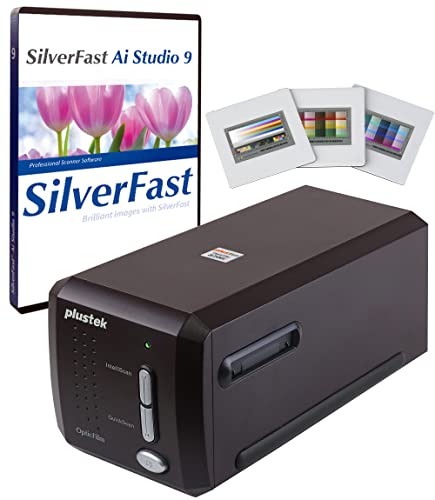
- 7200 resolution with a 16-bit CCD scanning system
- Includes SilverFast 9 and Quick Scan Plus software
- IT8 targets support color calibration
Best For: Advanced users digitizing 35mm slides with detailed control
Best All-Around Choice

- Supports 135, 110, 126 negatives and 50mm slides
- 5-inch LCD with gallery mode
- One-touch editing and SD-card storage
Best For: Home users digitizing mixed film archives
Best Standalone Workflow
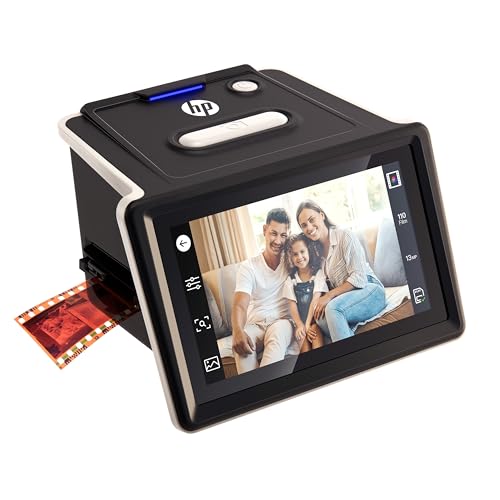
- Scans without a computer
- 5-inch touchscreen for preview and editing
- Quick-load tray for repeated scans
Best For: Users digitizing mixed archives independently
Best Storage Flexibility

- Supports film, slides, negatives, and Super 8
- 128MB built-in memory plus SD support
- 5-inch LCD with HDMI and USB output
Best For: Users with varied formats and flexible storage needs
Professional Detail Pick

- 7200 DPI and 48-bit output for detailed 35mm scans
- CCD sensor captures shadow and highlight detail
- Includes SilverFast SE Plus and a protective carry bag
Best For: Detailed 35mm scanning and larger prints
Best Standalone Format Range
KODAK SCANZA Film & Slide Scanner
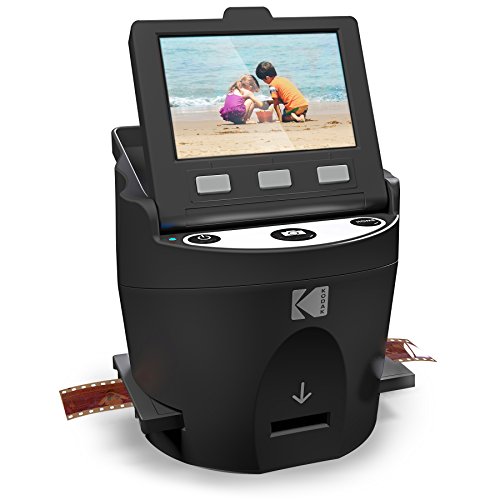
- Handles 35mm, 126, 110, Super 8, and 8mm formats
- Built-in 3.5-inch LCD and one-touch controls
- Includes adapters, cables, and a film cleaning brush
Best For: Easy mixed-format home digitizing
Compact Budget-Friendly Option

- 16MP CMOS scanning for 126 and 135 film
- Built-in editing and 2.31-inch LCD screen
- Lightweight design with direct SD-card saving
Best For: Portable, casual film digitizing
Best All-in-One Value – Magnasonic FS71 24MP Film Scanner
The Magnasonic FS71 is a practical film scanner for quickly digitizing 35mm, 110, 126, and Super 8 negatives, along with several slide formats. Its large screen, standalone controls, and fast scanning make it convenient for home archiving without a computer.
Best For: Families and casual users who want broad format support, on-device adjustments, and straightforward scanning.
Pros:
- Converts multiple film and slide formats into 24MP JPEG files.
- Large 5-inch LCD supports previewing and editing directly on the scanner.
- Scans in less than five seconds and saves to an SD card up to 128GB.
- No computer, drivers, or editing software are required for basic operation.
Cons:
- SD card and HDMI cable are not included.
- Its listed minimum system requirement is Windows 7 for computer use.
Choose the FS71 when convenience and format flexibility matter more than advanced color-calibration features. It is especially well suited to scanning a varied family collection in batches.
Best for Easy Batch Scanning – KODAK Slide N Scan Max
The KODAK Slide N Scan Max is a user-friendly film scanner designed for digitizing family slides and negatives with minimal setup. Its quick-feeding tray, large tilting display, and direct SD card storage support a smooth home archiving workflow.
Best For: Users who prioritize easy batch scanning, a large viewing screen, and simple one-touch editing.
Pros:
- Quick-feeding tray helps maintain a continuous scanning workflow.
- Supports 135mm, 110mm, and 126mm film formats.
- 7-inch tiltable LCD doubles as a viewing screen or digital picture frame.
- Saves scans directly to SD or SDHC cards up to 32GB without requiring a computer.
Cons:
- Storage support is limited to 32GB SD/SDHC cards.
- Its connection type is USB, so HDMI viewing is not listed.
This KODAK model is a strong fit for straightforward family archiving. The large display and simple controls make it approachable, while the quick-feed design is useful when scanning many frames.
Best Complete Starter Kit – DigitPro M129A Photo and Film Scanner
The DigitPro M129A is a versatile film scanner and photo digitizer for 35mm slides, 135 and 110 negatives, printed photos, and business cards. It is supplied as a complete bundle with an SD card and accessories, making it convenient for users who want to start scanning immediately.
Best For: Beginners, parents, and grandparents who want an offline scanner with support for both film and printed photos.
Pros:
- Handles film, slides, printed photos, and business cards.
- Large 5-inch HD screen provides a clear previewing area.
- Works without a computer, apps, or drivers and includes one-touch controls.
- Bundle includes an 8GB SD card, holders, trays, cleaning brush, power adapter, and USB cable.
Cons:
- The included SD card is limited to 8GB.
- The listed resolution is 1080P rather than a higher megapixel specification.
The M129A stands out for its included accessories and broad media support. It is a sensible choice when you need one simple device for both old film and physical photographs, backed by a three-year warranty.
Best for Professional 35mm Scans – Plustek OpticFilm 8300i Ai
The Plustek OpticFilm 8300i Ai is a specialized film scanner for users who want detailed 35mm slide scans and extensive image-processing control. Its CCD sensor, 7200 resolution, calibration target, infrared features, and bundled SilverFast software make it the most advanced option in this group.
Best For: Enthusiasts and advanced users scanning 35mm slides who need color calibration and software-based restoration tools.
Pros:
- Designed specifically for 35mm slides and film.
- Offers 7200 resolution, 16-bit color depth, and CCD sensing.
- Includes SilverFast 9 Ai Studio and Plustek Quick Scan Plus.
- Bundled IT8 calibration targets support more precise color calibration.
Cons:
- Supports 35mm media rather than a broad range of film formats.
- Requires a USB-connected computer and compatible software workflow.
- Its advanced features may be unnecessary for quick casual scanning.
Pick the OpticFilm 8300i Ai when scan control and potential image quality are more important than plug-and-play convenience. It is better suited to a dedicated 35mm digitization workflow than to occasional mixed-format scanning.
Best All-Around Choice – KODAK Slide N Scan
If you want a straightforward film scanner for mixed family archives, the KODAK Slide N Scan combines support for 135, 110, and 126 negatives with 50mm slides. Its large LCD and one-touch controls make it practical for previewing and making basic adjustments without navigating complex software.
Best For: Home users digitizing a variety of slides and negatives with direct SD-card storage and on-device viewing.
Pros:
- Supports 135, 110, and 126 negatives plus 50mm slides.
- Large 5-inch LCD with gallery mode and a wide viewing angle.
- One-touch editing includes color, brightness, resizing, and date/time options.
- Includes film adapters, cleaning brush, USB cable, and HDMI cable.
Cons:
- SD or SDHC card is required for direct storage but is not included.
- Computer compatibility notes list Windows 7 as the minimum requirement.
The KODAK is a versatile film scanner for casual archiving, especially if you value a built-in display and simple controls. Support for several common film formats adds flexibility, while HDMI output provides an easy way to view images on a larger screen.
Best Standalone Workflow – HP FilmScan HPFS500
The HP FilmScan HPFS500 is a convenient film scanner for users who want to digitize slides and negatives without connecting a computer during the scanning process. Its touchscreen, quick-load tray, and support for three common film formats make it well suited to organizing a mixed collection.
Best For: Users who want standalone scanning with touchscreen control and support for 135, 126, and 110 film.
Pros:
- Standalone workflow does not require a computer while scanning.
- Supports 135, 126, and 110 negatives and positive slides.
- 5-inch all-angle LCD touchscreen enables preview and editing.
- Quick-load tray helps speed up repeated scans.
Cons:
- Its listed sensor resolution is 13MP, with 22MP interpolation.
- Computer compatibility notes specify Windows 10 or later and macOS 10.15 or later.
Choose this HP film scanner if hands-on controls and a computer-free process matter more than extensive format support. The touchscreen and batch-friendly tray are useful advantages when working through a sizable box of family slides and negatives.
Best Storage Flexibility – DigitPro C190 Film Scanner
The DigitPro C190 is a practical film scanner for converting several film types while keeping the workflow simple. It includes built-in memory, supports external SD cards up to 64GB, and offers a 5-inch display for previewing and adjusting scans before sharing or transferring them.
Best For: Families and hobbyists who want broad format support, built-in storage, and TV viewing through HDMI.
Pros:
- Supports 35mm/135, 110, 126, 50mm slides, and Super 8 film.
- Includes 128MB built-in memory and supports SD cards up to 64GB.
- 5-inch LCD provides real-time preview and playback.
- Includes film holders, USB and HDMI cables, power adapter, and cleaning brush.
Cons:
- External SD card is not included.
- The supplied details list 1080P resolution rather than a sensor megapixel rating.
The DigitPro stands out when format range and storage options are priorities. Its built-in memory can get you started immediately, while HDMI output and the included accessories make it convenient for family viewing and routine transfers.
Professional Detail Pick – Plustek OpticFilm 8100
If you want a film scanner for detailed 35mm negative and slide digitizing, the Plustek OpticFilm 8100 emphasizes high-resolution output, shadow detail, and included scanning software. Its compact design and included carry bag also make storage and transport convenient.
Best For: Photographers and serious hobbyists digitizing 35mm film for large, detailed prints.
Pros:
- 7200 DPI resolution with 48-bit output for detailed scans.
- CCD sensor designed to capture shadow and highlight detail.
- Includes SilverFast SE Plus software and Plustek QuickScan.
- Supports current Windows and Mac operating systems listed by the manufacturer.
Cons:
- Limited to 35mm negatives and slides.
- Requires a computer connection and driver installation.
- More specialized than a simple standalone scanner.
The OpticFilm 8100 is the strongest choice here when scan detail and editing control matter more than instant, standalone operation. Its 35mm-only focus may be limiting for mixed-format film collections.
Best Standalone Format Range – KODAK SCANZA Film & Slide Scanner
The KODAK SCANZA is a practical film scanner for users who want to convert several common film formats without relying on a computer for every step. Its built-in display, one-touch controls, and included adapters make browsing and saving scans straightforward.
Best For: Families and beginners digitizing mixed 35mm, 126, 110, Super 8, and 8mm film.
Pros:
- Supports 35mm, 126, 110, Super 8, and 8mm negatives and slides.
- Built-in 3.5-inch adjustable TFT LCD for viewing scans.
- Includes multiple film inserts, adapters, cables, and a cleaning brush.
- Offers one-touch scanning and JPEG saving with RGB and resolution adjustments.
Cons:
- SD card is not included.
- Supports only the film types listed by the manufacturer.
- Its listed color depth is 24 bpp, below the Plustek’s 48-bit output.
The SCANZA stands out for convenience and format flexibility. Choose it over a computer-connected model if a built-in screen and direct workflow are more important than maximum color depth or specialized 35mm detail.
Compact Budget-Friendly Option – BEONEGLOBAL ClearScan MINI
The BEONEGLOBAL ClearScan MINI is a compact film scanner for quickly digitizing 126 and 135 film and slides. It combines a small footprint with a built-in screen, simple controls, direct SD-card saving, and basic editing tools.
Best For: Casual users who want a lightweight scanner for quick 126 and 135 film transfers.
Pros:
- 16MP CMOS sensor produces digital images from supported film.
- Compact, lightweight design is easy to carry and store.
- Built-in controls allow brightness, color, flip, and rotate adjustments.
- Saves directly to an SD card up to 32GB.
Cons:
- Supports 126 and 135 film rather than a broad range of formats.
- SD card is not included.
- Its 16MP resolution is lower than the Plustek’s listed 69MP-equivalent output.
The ClearScan MINI is a convenient choice for everyday family-photo preservation and portable use. Its simpler feature set and narrower format support make it less suitable for demanding archival or large-print work.
How We Picked the Best Film Scanners
We compared these Film Scanners by looking at supported formats, advertised resolution, display usability, connection and storage options, included software, and the type of workflow each model supports. We also separated convenient all-in-one converters from dedicated scanners built for more detailed 35mm work.
Resolution claims can vary by manufacturer, so maximum DPI should not be the only deciding factor. Sensor quality, lighting consistency, dust handling, software controls, and the condition of the original film all affect the final image.
Quick Comparison
| Best For | What to Look For |
|---|---|
| Fast family-photo digitizing | Large LCD, simple controls, and SD-card or USB saving |
| Mixed film collections | Support for 35mm, 110, 126, Super 8, or 8mm formats |
| High-detail 35mm scans | Dedicated optics, higher bit depth, and adjustable scan settings |
| Editing and archiving | Reliable software, color correction, dust reduction, and uncompressed output |
| Occasional use | Compact design, included holders, and minimal setup |
Key Buying Factors for a Film Scanner
Film-Format Compatibility
Check the exact formats supported before buying. Many consumer models handle 35mm negatives and slides, while some also accept 110, 126, Super 8, or 8mm film. Adapters are often format-specific, so confirm that the included holders match your collection.
Resolution and Image Quality
Higher stated resolution can preserve more detail, but real-world results depend on the scanner’s optics and sensor. For casual sharing, a straightforward 16MP or 22MP converter may be sufficient. For printing, restoration, or detailed cropping, consider a dedicated scanner with higher optical resolution and 48-bit color output.
Workflow and Controls
Built-in screens and one-touch controls make standalone scanners convenient, especially when saving directly to a memory card. Computer-connected models usually offer more control over exposure, color, cropping, and file formats, but they require more setup and software.
Software and Archival Features
Look for dust and scratch reduction, color correction, batch scanning, and the ability to save high-quality files. If long-term preservation matters, keep original scans in a lossless format when supported and create smaller copies for sharing.
Who Should Buy Which Film Scanner?
Choose an all-in-one scanner if you want to digitize family albums quickly with minimal technical knowledge. Models with large displays are especially useful for previewing images without a computer.
Choose a dedicated Plustek-style 35mm scanner if image detail, editing flexibility, and archival quality matter more than speed or format variety. These models are better suited to photographers, collectors, and users willing to learn scanning software.
Choose a compact budget model for occasional projects, social sharing, or a small box of negatives. Confirm the included holders and connection requirements, and remember that inexpensive scanners may provide fewer color and restoration controls.