The best function signal generators make it easier to create controlled test signals for circuit design, troubleshooting, education, and bench experiments. The models in this roundup range from compact DDS sources to higher-bandwidth arbitrary waveform generators.
We compare bandwidth, waveform capability, channel count, frequency control, connectivity, and extra measurement features so you can choose a generator that fits your equipment and typical testing tasks.
Best 10 Function Signal Generators Picks for 2026
Premium Dual-Channel Pick
Siglent SDG2042X 40 MHz Generator
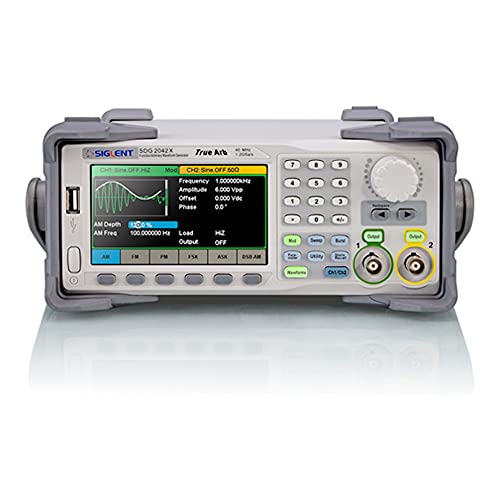
- Dual-channel 40 MHz sine output
- 16-bit touchscreen control
- Modulation, sweep, burst, USB, and LAN
Best For: Feature-focused bench testing and waveform development
High-Frequency Value
Koolertron 60 MHz DDS Generator

- Dual-channel output up to 60 MHz
- 200 MSa/s and 14-bit resolution
- Sweep, measurement, storage, and custom waveforms
Best For: Labs and production work needing broad DDS functionality
Best All-Around Lab Choice
Rigol DG1022Z 25 MHz Generator

- Dual-channel 25 MHz output
- 160 built-in waveforms and arbitrary output
- USB/LAN connectivity with broad modulation support
Best For: General electronics testing, education, and automated lab setups
Budget Lab Essential
Koolertron 15 MHz DDS Generator
- Dual-channel DDS with independent controls
- 200 MSa/s and 14-bit resolution
- Sweep, measurement, counting, and 99 saved states
Best For: Teaching, beginner electronics, and lower-frequency bench testing
Best Value Bench Generator

- Dual-channel DDS generation with 200MSa/s sampling
- 1μHz–60MHz frequency-counter range
- Multiple waveforms, modulation modes, and scan functions
Best For: Hobbyists, students, small labs, and audio or receiver testing
Best Portable 3-in-1 Tester
ZT-706S Signal Generator, Scope, and Multimeter

- Combines DDS generator, oscilloscope, and True RMS multimeter
- 50MHz dual-channel scope with up to 280MSa/s
- Battery-powered design for field and bench use
Best For: Portable troubleshooting, automotive testing, and electronics repair
Best Compact Dual-Channel Generator

- Dual-channel DDS output with a 20MHz range
- 32 arbitrary waveforms and storage for 50 custom sets
- USB communication with ASK, FSK, and PSK modulation
Best For: Waveform customization, education, and general electronics experiments
Versatile Dual-Channel Pick

- Dual-channel output with combining capability
- 30MHz range and 200MSa/s sampling
- Six modulation types plus arbitrary storage
Best For: Bench testing, audio work, education, and hobby projects
Portable DDS Workhorse

- Independent dual-channel parameter control
- 15MHz sine output with 200MSa/s sampling
- Stores states and 60 custom waveforms
Best For: Teaching, lab work, production testing, and portable use
Compact Low-Frequency Module

- 0.01Hz-to-500kHz sine-wave range
- Adjustable amplitude, DC bias, and filtering
- Tiny 8.1-ounce design with battery support
Best For: Audio testing, circuit debugging, and oscilloscope calibration
Premium Dual-Channel Pick – Siglent SDG2042X 40 MHz Generator
Siglent Technologies SDG2042X Arbitrary Waveform Function-Generators, 40 MHz, Grey
Check Price On AmazonThe Siglent SDG2042X is a strong choice among function signal generators when you need dual-channel output, a 40 MHz sine-wave range, and convenient bench controls. Its touchscreen, modulation tools, and USB/LAN connectivity suit both hands-on lab work and computer-assisted testing.
Best For: Bench users who want a capable dual-channel generator with touchscreen operation and connectivity options.
Pros:
- Dual-channel output with 40 MHz sine-wave capability
- 16-bit vertical resolution and touchscreen display
- Supports modulation, sweep, burst, TrueArb, and Easy Pulse functions
- Includes a frequency counter plus USB and LAN interfaces
Cons:
- GPIB connectivity requires an optional adapter
- Its broader feature set may be more than basic signal testing requires
Choose this model if you value waveform flexibility and a modern control interface. It is especially practical for users who expect to integrate the generator into a networked or USB-connected setup.
High-Frequency Value – Koolertron 60 MHz DDS Generator
The Koolertron 60 MHz model is one of the more versatile function signal generators for users who need a high sine-wave frequency limit and independent dual-channel settings. It combines DDS output with measurement, sweep, storage, and user-defined waveform functions.
Best For: Electronics labs, teaching, production work, and users who need 60 MHz sine output with extensive saved settings.
Pros:
- Dual-channel output with sine-wave frequency up to 60 MHz
- 200 MSa/s sampling rate and 14-bit vertical resolution
- Includes sine, square, triangle, sawtooth, pulse, noise, and custom waveforms
- Offers sweep, measurement, counting, and storage for 99 instrument states
Cons:
- Its 2.2-pound weight and larger package may be less convenient for portable use
- The many settings may require more setup time than a basic generator
This is a practical pick when frequency range and feature breadth matter more than simplicity. Independent channel control and stored configurations make it useful for repeatable lab and production tasks.
Best All-Around Lab Choice – Rigol DG1022Z 25 MHz Generator
The Rigol DG1022Z is a well-rounded option among function signal generators, pairing dual-channel 25 MHz output with 160 built-in waveforms and arbitrary-waveform capability. USB and LAN interfaces also make it suitable for PC control and automated test setups.
Best For: Education, research and development, repair, embedded design, and general electronics testing.
Pros:
- Dual-channel generation up to 25 MHz
- 200 MSa/s sampling rate with 14-bit vertical resolution
- Provides 160 built-in waveforms plus arbitrary output
- Supports AM, FM, PM, FSK, ASK, PWM, sweep, burst, and harmonic functions
Cons:
- Its 25 MHz range is lower than the 40 MHz and 60 MHz alternatives here
- The supplied dimensions appear incomplete, so bench-space planning may require verification
For general-purpose testing, the DG1022Z offers a strong balance of waveform variety, modulation functions, and connectivity. It is a sensible choice when automated control and a broad built-in waveform library are priorities.
Budget Lab Essential – Koolertron 15 MHz DDS Generator
The Koolertron 15 MHz model is a practical entry point into function signal generators for basic electronics work, teaching, and production testing. It provides dual-channel DDS output, independent channel settings, sweep functions, measurements, and custom waveform storage.
Best For: Beginners, classrooms, and labs that need stable dual-channel output without a higher-frequency range.
Pros:
- Dual-channel DDS output with independent parameter control
- Supports sine, square, triangle, sawtooth, pulse, noise, and custom waveforms
- 200 MSa/s sampling rate and 14-bit vertical resolution
- Includes sweep, measurement, counting, and storage for 99 instrument states
Cons:
- 15 MHz sine-wave output is the lowest frequency range among these options
- Its feature set may be more extensive than needed for simple waveform generation
This model makes sense when your projects stay within a 15 MHz sine-wave range and you still want dual-channel flexibility. Its saved states and measurement functions add useful value for repeatable classroom or bench work.
Best Value Bench Generator – UNI-T UTG962E
The UNI-T UTG962E is a versatile choice among function signal generators for bench testing, audio work, and electronics education. Its dual channels, broad waveform selection, 200MSa/s sampling rate, and 1μHz–60MHz frequency-counter range give hobbyists and small labs useful flexibility without an overly complex setup.
Best For: Hobbyists, students, ham-radio alignment, pro-audio measurements, and small-lab circuit testing.
Pros:
- Dual channels support Ch1–Ch2 combining and multiple test setups.
- Generates sine, square, pulse, ramp, noise, DC, and arbitrary waveforms.
- Offers AM, FM, PM, FSK, linear, and logarithmic modulation, plus frequency scanning.
- Includes 24 groups of nonvolatile arbitrary-waveform storage and a 6-digit frequency counter.
Cons:
- The 1.81-pound unit is suited primarily to bench use rather than field portability.
- Its feature set may be more than needed for very basic signal-output tasks.
With DDS generation, 14-bit vertical resolution, TTL compatibility, and useful accessories included, the UTG962E is a well-rounded, budget-friendly bench instrument for users who want broad functionality and straightforward operation.
Best Portable 3-in-1 Tester – ZT-706S Signal Generator, Scope, and Multimeter
The ZT-706S combines function signal generators with a dual-channel oscilloscope and a high-count multimeter in one portable instrument. It is a practical option when circuit troubleshooting requires waveform output, signal observation, and electrical measurements without carrying three separate tools.
Best For: Field service, automotive and ECU testing, electronics repair, DIY projects, and portable bench work.
Pros:
- Three-in-one design includes a DDS generator, oscilloscope, and 66,000-count True RMS multimeter.
- Dual-channel scope provides up to 50MHz bandwidth and 280MSa/s in high-speed mode.
- Generates six waveform types, including sine, square, triangle, half-wave, full-wave, and sawtooth.
- Rechargeable replaceable battery supports up to six hours of continuous operation according to the supplied notes.
Cons:
- Signal output tops out at 10MHz for sine waves, with lower limits for other waveforms.
- Oscilloscope operation reduces battery runtime compared with the stated standby time.
- The integrated format may be less convenient than a dedicated bench generator for extended laboratory work.
This is the most flexible choice for users who value portability and tool consolidation. Its generator is aimed at practical debugging and simulation rather than high-frequency signal generation, but the added oscilloscope and multimeter functions significantly broaden its usefulness.
Best Compact Dual-Channel Generator – YERTAI ET3320C DDS Generator
The YERTAI ET3320C is a compact option among function signal generators, offering dual channels, DDS output, arbitrary-waveform editing, and USB communication. Its 20MHz frequency range and 200MSa/s sampling rate suit routine electronics experiments, waveform development, and educational bench work.
Best For: Students, hobbyists, and users who need dual-channel output with customizable stored waveforms.
Pros:
- Dual-channel design supports flexible signal-generation setups.
- Includes five basic waveforms and 32 arbitrary waveforms.
- Stores up to 50 sets of customized edited waveforms internally.
- Provides ASK, FSK, and PSK modulation, USB communication, and a built-in 100MHz frequency counter.
Cons:
- The 20MHz generator range is narrower than some higher-frequency bench generators.
- The arbitrary-waveform editing software must be obtained from the manufacturer.
- The supplied notes list only a US power cord and manual as included accessories.
Choose the ET3320C when waveform storage and customization matter more than maximum output frequency. Its small footprint, clear 2.4-inch display, and dual-channel architecture make it a practical starter or secondary generator for general-purpose signal work.
Versatile Dual-Channel Pick – UNI-T UTG932E
The UNI-T UTG932E is a flexible choice among function signal generators for users who need dual-channel output, broad waveform support, and advanced modulation. Its 200MSa/s sampling rate, 30MHz output range, and built-in frequency counter suit bench testing, audio work, and educational projects.
Best For: Hobbyists, students, small labs, ham radio alignment, pro audio measurements, and general circuit testing.
Pros:
- Dual channels with Ch1-Ch2 combining capability
- Supports sine, square, pulse, ramp, noise, DC, and arbitrary waveforms
- Offers AM, FM, PM, FSK, Line, and Log modulation
- Includes useful accessories such as BNC cables, USB cable, and power adapter
Cons:
- Its feature set may be more than needed for very basic signal tasks
- The supplied notes do not specify display size or maximum arbitrary-waveform length
With 24 groups of non-volatile arbitrary waveform storage and 1Hz full-band resolution, the UTG932E is a well-equipped general-purpose generator. It is especially appealing when modulation and dual-channel flexibility matter.
Portable DDS Workhorse – SEESII JDS6615
The SEESII JDS6615 is a practical option among function signal generators for users who want dual-channel DDS output, waveform storage, and measurement functions in a compact instrument. It reaches 15MHz for sine waves and includes sweep, counting, and frequency-measurement capabilities.
Best For: Electronic engineering, laboratories, teaching, production-line work, and users who need portable dual-channel testing.
Pros:
- Dual channels can be configured independently, including separate duty-cycle adjustment
- Stores 99 instrument states and 60 user-defined waveforms
- Provides sine, square, triangle, sawtooth, pulse, white-noise, and custom waveforms
- Includes frequency, period, pulse-width, counting, and sweep functions
Cons:
- Sine-wave output is limited to 15MHz
- Its software workflow may require a computer to create custom waveforms
The JDS6615 stands out for repeatable setups and custom-waveform work, while its frequency counter and sweep modes add useful diagnostic capability. It is a sensible middle ground for learners and working technicians.
Compact Low-Frequency Module – FG-200 DDS Signal Generator
The FG-200 is a small, focused choice among function signal generators for low-frequency circuit testing, audio measurements, and oscilloscope calibration. Its DDS design covers sine waves from 0.01Hz to 500kHz, with square and sawtooth output, adjustable amplitude, DC bias, filtering, and saved settings.
Best For: Electronics debugging, audio-amplifier testing, oscilloscope calibration, probe adjustment, and battery-powered setups.
Pros:
- Very compact 8.1-ounce module for portable projects
- Offers 0.01Hz-to-500kHz sine-wave frequency range
- Includes adjustable amplitude, DC offset up to ±10V, and selectable filtering
- Settings can be saved, and operation supports DC4-9V adapters or a 3.7V lithium battery
Cons:
- Other waveforms are specified for 0.01Hz-to-100kHz operation
- It is a module rather than a full-size bench instrument
- Sine-wave amplitude decreases as frequency approaches and exceeds the upper range
The FG-200 is best viewed as a lightweight signal source for targeted test work rather than an all-purpose bench generator. Its low starting frequency, filtering, and DC-bias controls make it useful for audio and oscilloscope-related applications.
How We Picked the Best Function Signal Generators
We evaluated these Function Signal Generators against the specifications that matter most on a real electronics bench: maximum frequency, waveform selection, arbitrary-waveform support, channel count, frequency resolution, display and controls, connectivity, and portability. We also considered whether a unit is best suited to basic signal injection, educational work, repair, or more demanding development tasks.
Because the list includes both standalone generators and multifunction instruments, we separated headline specifications from practical versatility. A compact generator may be ideal for simple tests, while a bench unit with dual channels, USB communication, or broader arbitrary-waveform control can support more advanced workflows.
Quick Comparison
- Highest bandwidth options: The 60 MHz Koolertron model and 50 MHz ZT-706S are suited to users who need more headroom than entry-level generators provide.
- Balanced bench instruments: The Siglent SDG2042X, Rigol DG1022Z, and UNI-T models offer a stronger feature set for laboratory, engineering, and classroom use.
- Budget-friendly choices: The 15 MHz DDS units and FG-200 are appropriate for basic sine, square, and sawtooth signal generation.
- Extra functionality: The ZT-706S combines signal generation with oscilloscope and multimeter functions, while several models include frequency-counter capabilities.
Key Buying Factors for Function Signal Generators
Bandwidth and Frequency Range
Choose a generator whose maximum frequency comfortably exceeds the signals you expect to test. More bandwidth provides useful headroom, but it does not automatically improve every low-frequency application. Check whether the quoted specification applies to every waveform or only to sine waves.
Waveforms and Arbitrary-Waveform Control
Most units generate sine, square, and ramp or sawtooth signals. If you need custom pulses, modulation, simulated sensor outputs, or nonstandard waveforms, prioritize arbitrary-waveform memory, sampling rate, vertical resolution, and editing software rather than relying only on the frequency rating.
Channels, Synchronization, and Controls
Dual-channel generators can produce two related signals for differential, timing, phase, or comparison tests. Look for independent frequency and amplitude control, phase adjustment, synchronization, and a display that makes settings easy to verify.
Connectivity and Measurement Features
USB or computer communication can simplify automated testing and saved setups. A built-in frequency counter, oscilloscope, or multimeter may reduce the number of separate instruments required, but confirm the specifications and limitations of each integrated function before treating it as a replacement for dedicated equipment.
Output Quality and Safety
Check output amplitude range, impedance, DC offset, modulation options, and protection features. Use suitable cables and termination, and verify the required load before connecting a signal to sensitive circuitry.
Who Should Buy Which Function Signal Generators?
Students and beginners should look for straightforward controls, common waveforms, dual channels, and a useful frequency range without paying for advanced features they will not use. Repair technicians may prefer a compact DDS generator or a multifunction model with a counter and oscilloscope. Engineers and lab users should prioritize bandwidth headroom, arbitrary-waveform flexibility, stable output, synchronization, and computer control. Hobbyists on a tight budget can start with a simple 15 MHz or FG-200-style generator for audio, low-frequency, and basic digital-circuit testing.