Finding the right digital moisture balance means matching measurement resolution, drying performance, sample capacity, and workflow features to the materials you test. The models in this roundup cover compact benchtop analyzers, touchscreen systems, and instruments with USB or RS232 connectivity.
Use the comparisons below to narrow your choices, then review the buying guide for practical advice on accuracy, heating control, usability, maintenance, and value.
Best 10 Digital Moisture Balances Picks for 2026
Best All-Around Digital Moisture Balance
120g Halogen Moisture Analyzer
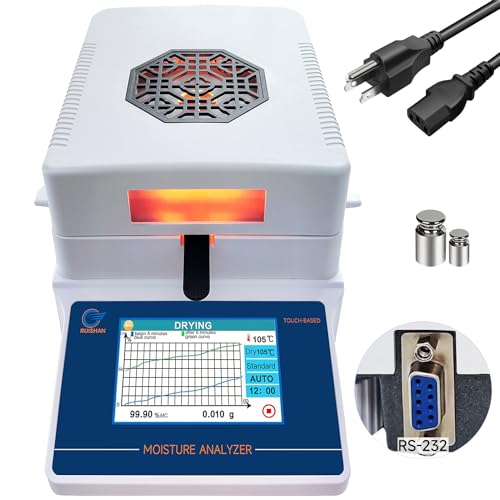
- 0.001 g readability with 120 g capacity
- Three drying modes and 32 stored methods
- RS232 output plus calibration accessories
Best For: Labs testing varied materials and repeatable methods
Best Premium Digital Moisture Balance

- 90 g capacity with 0.01% readability
- 4.3-inch color touchscreen
- Custom halogen heating system
Best For: Laboratories testing food, pharmaceuticals, and chemicals
Best Value Digital Moisture Balance

- 40–160°C adjustable heating
- Stores 20 historical test results
- Includes 20 pans and calibration weight
Best For: Fast routine testing across materials and production samples
Best Touchscreen Digital Moisture Balance
U.S. Solid 110g Moisture Analyzer

- 0.005 g weighing and 0.05% moisture readability
- Three drying modes up to 160°C
- 5-inch touchscreen with 20 stored methods
Best For: Labs needing flexible touchscreen testing and reporting
High-Capacity Touchscreen Pick
UXILAII 200g Halogen Moisture Analyzer

- 200g capacity with 0.001g weight readability
- 32 stored methods and RS232 connectivity
- Five-inch touchscreen with three drying modes
Best For: Labs needing high capacity and programmable testing
Compact Data-Logging Choice
ATS120 Compact Moisture Analyzer

- 120g capacity with 0.01% moisture resolution
- Four drying profiles and 20 memory locations
- USB interface for PC data analysis
Best For: Powder testing in space-conscious laboratories
Pre-Calibrated Production Pick
FLB 110g Halogen Moisture Analyzer

- 0.001g readability and 40–180°C heating range
- 34 programmable memory programs
- RS232, touchscreen controls, and included calibration weights
Best For: Connected quality inspection across multiple industries
Best with Extra Features
U.S. Solid Halogen Moisture Analyzer
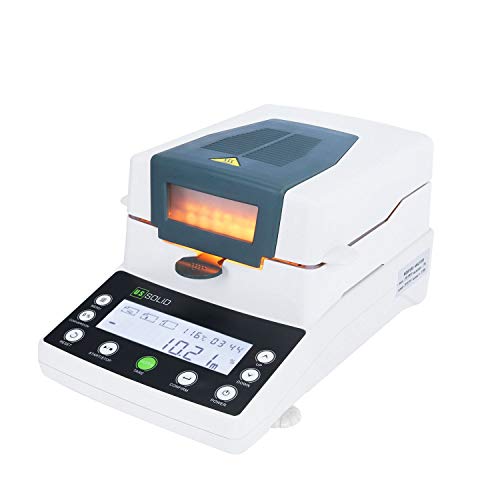
- 110 g capacity with 5 mg readability
- Three drying modes up to 199°C
- Includes 50 pans and RS-232 output
Best For: General-purpose food, grain, chemical, and laboratory testing
Best Heavy-Duty Pick
Halogen Moisture Analyzer HC-152
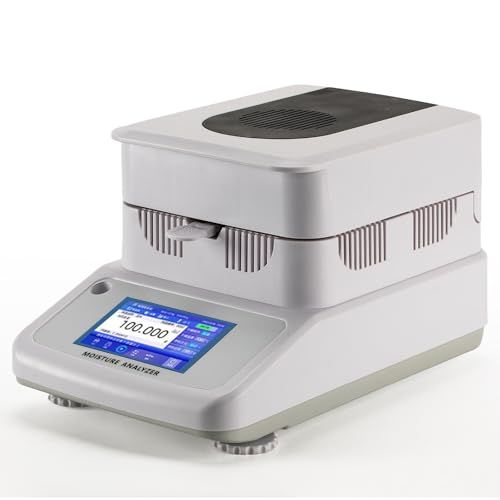
- 0.002 g weight and 0.01% moisture readability
- 5-inch touchscreen with four drying programs
- Stores up to 100 records with RS-232 output
Best For: Laboratory and industrial testing with digital record management
Best for Rapid Testing
GS110 Halogen Moisture Analyzer
- Rapid halogen heating with real-time monitoring
- 40–160°C range with 1–99 minute timing
- Includes 20 pans and stores 20 test records
Best For: Fast moisture checks across food, plants, materials, and chemicals
Best All-Around Digital Moisture Balance – 120g Halogen Moisture Analyzer
This digital moisture balance is a practical choice for labs and production settings that need rapid, repeatable moisture testing across materials such as food, grain, soil, wood, paper, and textiles. Its 5-inch touchscreen, multiple drying modes, and programmable methods make routine testing easier to manage.
Best For: Users who want broad sample compatibility, quick halogen drying, and flexible testing controls.
Pros:
- 120 g capacity with 0.001 g readability and moisture measurement from 0–100%.
- Three drying modes, automatic or timed ending modes, and adjustable 50–180°C heating.
- Stores up to 32 methods and supports RS232 data output to a printer or computer.
- Includes calibration weights, a pan holder, pan remover, and 10 disposable aluminum pans.
Cons:
- Its 3.3 kg size and laboratory-oriented design are less convenient for portable use.
- The package includes fewer sample pans than some competing options.
With durable aluminum, stainless steel, and ABS construction plus a high-efficiency halogen lamp, this analyzer offers a well-rounded feature set for frequent moisture testing. It is particularly appealing when method storage and connectivity matter as much as speed.
Best Premium Digital Moisture Balance – OHAUS MB90 Moisture Analyzer
The OHAUS MB90 is a focused digital moisture balance for users who prioritize a recognized laboratory platform, intuitive controls, and halogen heating. Its color touchscreen and custom heating system are designed to streamline moisture analysis for applications including food, pharmaceuticals, and chemicals.
Best For: Laboratories seeking a purpose-built moisture analyzer with touchscreen operation and a custom heating system.
Pros:
- 90 g maximum capacity with 0.01% moisture readability.
- 4.3-inch TFT color touchscreen provides an intuitive operating interface.
- Custom heating system supports controlled halogen moisture analysis.
- Listed for food, pharmaceutical, and chemical testing applications.
Cons:
- The supplied notes do not specify drying temperature range, method storage, or connectivity features.
- Its 90 g capacity is lower than several other analyzers in this roundup.
The MB90 is best considered when interface design and laboratory-focused construction are more important than the highest capacity or the most extensively documented automation features. Confirm the included accessories and specifications for your workflow before purchasing.
Best Value Digital Moisture Balance – GS110 Halogen Analyzer
This digital moisture balance is built to replace slower oven-drying workflows with automated halogen heating and real-time weight monitoring. Its straightforward controls, broad sample compatibility, and historical data storage suit labs and production environments that need results in minutes.
Best For: Users who need fast moisture determination for food, plants, chemicals, and building materials without a complicated operating process.
Pros:
- Adjustable 40–160°C temperature range with 1°C increments and 1–99 minute heating times.
- Precision sensors monitor weight changes while the halogen lamp dries the sample.
- Stores up to 20 historical test results and includes a printer interface with adjustable baud rates.
- Package includes 20 aluminum pans, a 100 g calibration weight, wind cover, and tray accessories.
Cons:
- The supplied details do not state a specific moisture-percentage readability.
- Its listed maximum capacity of 8.8 pounds may be presented differently from typical laboratory balance specifications.
The GS110 emphasizes efficient operation and documentation, making it a useful option for routine testing where quick results and record handling are central requirements. Its compact countertop format also helps conserve workspace.
Best Touchscreen Digital Moisture Balance – U.S. Solid 110g Moisture Analyzer
The U.S. Solid moisture analyzer combines 0.005 g weighing readability with 0.05% moisture readability, giving users a capable digital moisture balance for laboratory and scientific applications. Its 5-inch color touchscreen, preset methods, and multiple result views make daily testing straightforward.
Best For: Labs testing food, grain, plastics, textiles, or chemicals that want touchscreen controls and flexible result reporting.
Pros:
- 110 g capacity with 0.005 g weighing readability and 0.05% moisture readability.
- 250 W halogen heating adjusts up to 160°C with standard, fast, and soft drying modes.
- Stores up to 20 test methods and offers automatic, manual, or timed ending modes.
- Includes RS232 connectivity, manual calibration, and 50 sample pans.
Cons:
- Its maximum heating temperature is lower than the 180°C option offered by some competitors.
- The supplied notes do not specify a moisture measurement range.
This model stands out for balancing useful precision with a user-friendly touchscreen interface. The three display options—moisture percentage, dry weight, and dry-weight percentage—also make it adaptable to different reporting preferences.
High-Capacity Touchscreen Pick – UXILAII 200g Halogen Moisture Analyzer
For labs that need flexible digital moisture balances, the UXILAII combines a 200g capacity with 0.001g weight readability and 0.01% moisture readability. Its halogen heater, touchscreen controls, stored methods, and RS232 connectivity make it suited to repeatable testing across several industries.
Best For: Food, agriculture, chemical, and pharmaceutical laboratories that need high capacity and programmable workflows.
Pros:
- 200g maximum capacity with 0.001g weight readability.
- Three drying modes and three ending modes support different sample routines.
- Stores up to 32 methods and connects to a printer or computer through RS232.
- Five-inch color touchscreen and included calibration weights simplify operation.
Cons:
- The heating unit and sample container become hot after testing and require careful handling.
- Calibration with weights is required before testing.
- Aluminum pans are not listed among the included components.
The UXILAII stands out when capacity, touchscreen usability, and method storage matter as much as measurement resolution. It is a feature-rich choice for users who want connected, repeatable moisture testing.
Compact Data-Logging Choice – ATS120 Compact Moisture Analyzer
The ATS120 is a compact option among digital moisture balances, offering 120g capacity, 0.01% moisture resolution, and drying temperatures up to 160°C. Its graphical LCD, custom parameter memory, and USB interface suit routine testing where bench space and computer analysis are priorities.
Best For: Powder testing and laboratories that want a small-footprint analyzer with PC data collection.
Pros:
- Compact design helps conserve workspace.
- Four drying profiles—Standard, Slow, Step, and Fast—support varied samples.
- Twenty memory locations reduce repeated setup of custom parameters.
- USB connectivity allows data collection, plotting, and analysis on a PC.
Cons:
- Its 120g capacity is lower than some higher-capacity analyzers.
- Maximum drying temperature is 160°C.
- The listed moisture resolution is 0.01%, rather than 0.001%.
The ATS120 is a practical fit for routine powder work and space-limited benches. Choose it when USB-based analysis and flexible drying profiles are more important than maximum capacity or finer stated moisture resolution.
Pre-Calibrated Production Pick – FLB 110g Halogen Moisture Analyzer
For production and laboratory users comparing digital moisture balances, the FLB offers 110g capacity, 0.001g readability, and a 40–180°C heating range. Its touchscreen, programmable memory, RS232 interface, and included calibration weights support repeatable moisture checks across multiple sample types.
Best For: Food, agricultural, chemical, and pharmaceutical quality inspection requiring connected, repeatable measurements.
Pros:
- 0.001g readability with a 110g maximum weighing capacity.
- Stores 34 programmable memory programs for frequently used test settings.
- Offers manual, automatic, and timed operation with gentle and rapid drying options.
- Includes RS232 connectivity, calibration weights, and a one-year manufacturer warranty.
Cons:
- Its 110g capacity is lower than the 200g UXILAII analyzer.
- The unit weighs 11 pounds, which may limit portability.
- Testing requires attention to the hot heating area and sample container.
The FLB is a strong middle-capacity choice for users who value pre-calibration, extensive program storage, and broad application coverage. Its CE certification and data connectivity further suit structured quality-control workflows.
Best with Extra Features – U.S. Solid Halogen Moisture Analyzer
For routine digital moisture balances testing across food, grain, chemical, and laboratory samples, this U.S. Solid analyzer combines a 110 g capacity with 5 mg weight readability and 0.1% moisture readability. Its halogen heater, stored methods, and included sample dishes make it a practical option for repeated measurements.
Best For: Laboratories and production settings needing versatile moisture testing with PC or printer connectivity.
Pros:
- 110 g capacity with 5 mg weight readability and 0.1% moisture readability
- 450 W halogen heating with standard, fast, and soft drying modes up to 199°C
- Stores up to 15 method groups and displays moisture, dry weight, or dry-weight percentage
- Includes 50 sample pans and an RS-232 interface
Cons:
- Uses manual calibration with a 100 g weight
- Maximum moisture readability is 0.1%, less precise than some specialized analyzers
This model stands out as a flexible general-purpose choice, particularly when included pans and multiple reporting formats are useful. The RS-232 port adds convenient data export for connected workflows.
Best Heavy-Duty Pick – Halogen Moisture Analyzer HC-152
This HC-152 is a strong choice among digital moisture balances when precision and on-device recordkeeping matter. It offers 0.002 g weight readability, 0.01% moisture readability, a 5-inch touchscreen, and a database for storing up to 100 test records.
Best For: Laboratory and industrial users who want touchscreen controls, multiple drying programs, and internal data storage.
Pros:
- 120 g capacity with 0.002 g weight readability and 0.01% moisture readability
- 5-inch full-color touchscreen provides accessible control of temperature, timing, and drying modes
- Stores up to 100 test records and supports RS-232 data output
- Offers standard, mild, fast, and slow programs from 40°C to 180°C
Cons:
- Only one sample tray is listed in the packing contents
- An external printer is optional rather than included
With its higher stated precision and larger record database, this analyzer is suited to users who need more structured digital workflows. The touchscreen and selectable heating programs also help accommodate different sample types.
Best for Rapid Testing – GS110 Halogen Moisture Analyzer
The GS110 is designed for users who want faster alternatives to traditional oven-drying workflows. This digital moisture balance monitors weight changes during halogen heating, supports adjustable temperatures from 40°C to 160°C, and can complete measurements in minutes according to the supplied specifications.
Best For: Food, plant, grain, soil, construction-material, chemical, wood, paper, and textile testing where rapid results are useful.
Pros:
- Rapid halogen heating with real-time weight monitoring
- Temperature adjusts from 40°C to 160°C in 1°C increments
- Supports heating durations from 1 to 99 minutes and stores up to 20 historical records
- Includes 20 aluminum weighing pans, a calibration weight, and a printer interface
Cons:
- Maximum temperature is lower than some competing analyzers
- Stores up to 20 records, fewer than the 100-record HC-152
- Supplied notes list 5 mg readout accuracy without a separate moisture-readability figure
This analyzer emphasizes straightforward, repeatable testing with flexible timing and temperature controls. Its historical-data storage and printer interface are useful for documenting results across laboratory or production tasks.
How We Picked These Digital Moisture Balances
We focused on the specifications that most directly affect moisture testing: readability, maximum capacity, drying-temperature range, heating method, operating controls, sample-pan size, and data connectivity. The selected analyzers include halogen-heated models with resolutions ranging from 0.001 g to 0.005 g and moisture readability from 0.01% to 0.1%.
We also considered practical laboratory features such as programmable drying modes, built-in databases, graphical displays, touchscreens, USB or RS232 interfaces, included sample dishes, and compact designs. Because application needs vary, no single specification determines the best choice for every laboratory.
Quick Comparison
| Feature | What to compare | Why it matters |
|---|---|---|
| Capacity | 110 g to 200 g | Determines the largest sample load the balance can handle. |
| Weight readability | 1 mg to 5 mg | Influences weighing precision and repeatability. |
| Moisture readability | 0.01% to 0.1% | Indicates how finely moisture changes are displayed. |
| Heating range | Up to 160°C or 199°C | Must suit the thermal stability of the sample. |
| Connectivity | USB, RS232, or none listed | Supports reporting, exports, and integration with laboratory workflows. |
Key Buying Factors for Digital Moisture Balances
Accuracy, Readability, and Repeatability
Do not treat readability as the same as overall accuracy. A 0.001 g display can show fine changes, but real-world results also depend on calibration, sample preparation, temperature stability, and consistent testing procedures. Choose the resolution your method requires rather than automatically selecting the smallest number.
Capacity and Sample Size
Most listed models handle approximately 110 g to 120 g, while some offer 200 g capacity. Confirm that the usable capacity includes the sample container and that your typical sample mass will not approach the limit. A larger pan can be useful for uneven or bulky materials, but it may require more space.
Heating Control and Drying Method
Halogen heating can shorten drying cycles, but fast heating is not always better. Temperature-sensitive samples may need gradual ramps, lower setpoints, or multiple drying programs. Look for adjustable ranges, selectable drying modes, and clear endpoint controls. Always verify that the available temperature range suits the sample and your validated method.
Controls, Data, and Maintenance
Touchscreens and graphical displays can simplify setup, while physical controls may be preferable in dusty or busy environments. USB and RS232 ports are valuable when results must be documented or transferred. Also check pan cleaning, calibration access, replacement-dish availability, ventilation requirements, and the clarity of the user manual.
Who Should Buy Which Digital Moisture Balances?
Choose a high-resolution 0.001 g model when small weight changes and tighter process control are central to your testing. Choose a touchscreen model if multiple operators need guided setup and easy program selection. Choose a model with USB or RS232 when you need electronic records, printer support, or data transfer.
Choose a higher-capacity analyzer for larger samples or workflows that benefit from a generous weighing range. For occasional testing or limited bench space, a compact analyzer with a backlit display and straightforward drying programs may offer the better balance of cost and usability. Before buying, confirm electrical requirements, calibration support, included accessories, and compatibility with your laboratory’s testing method.