Pocket Kids Microscope review readers are usually looking for one thing: a simple way to turn curiosity into real observation.
This model is built for that exact job, with a palm-sized design, a screen, and easy controls.
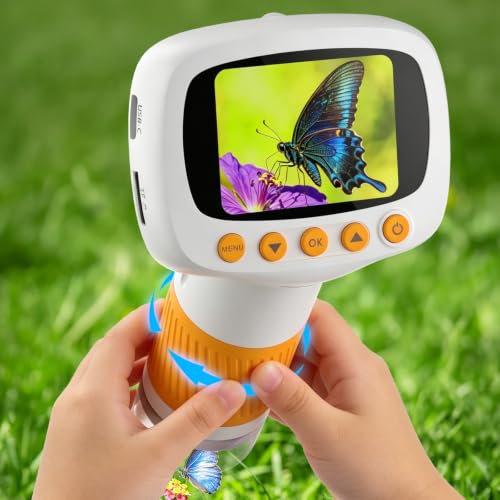
Pocket Kids Microscope Review Summary
The Pocket Kids Microscope is best for families who want an approachable first microscope rather than a fragile desktop setup.
Its strongest appeal is the combination of a built-in 2-inch IPS screen, handheld portability, and straightforward operation that should feel manageable for young children with supervision.
This is not a lab instrument and it should not be judged like one.
It is a kid-focused discovery tool: something that can make leaves, fabric, insects, and small objects feel exciting without forcing a child to work through complicated setup steps.
If you want a microscope that can travel, store easily, and keep a child engaged with a visible screen instead of an eyepiece, this one is aligned with that use case.
Review Scorecard
| Category | Score | Why it scores this way |
|---|---|---|
| Child usability | 9/10 | Long-press power, knob focus, and a simple handheld form are well matched to younger users. |
| Portability | 9/10 | Palm-sized body and lanyard design make it easy to carry outside or between rooms. |
| Observation experience | 8/10 | The 2-inch IPS screen and 50x-1000x range support vivid close-up viewing for small specimens. |
| Learning value | 9/10 | The built-in screen, recording features, and computer connection support active science exploration. |
| Low-light performance | 8/10 | Eight LED lights with six brightness levels should help in indoor and dim conditions. |
| Family sharing | 8/10 | USB viewing to Windows or Mac makes parent-child observation easier than screen-only toys. |
| Everyday practicality | 7/10 | Storage and TF card support help, but this is still a toy-like educational tool rather than a rugged field instrument. |
Key Features and Specifications of Pocket Kids Microscope
The product data points to a microscope designed around usability first.
It is intended for children over 3 years old, and the listing emphasizes a palm-sized body, anti-lost lanyard, and a very simple control flow: long press to power on, then use a knob to focus.
The core viewing experience centers on a 2-inch IPS digital screen.
That matters because it gives kids a direct image without requiring them to line up an eye with an eyepiece.
For many families, that is the practical difference between a device that gets used repeatedly and one that gets abandoned after the first learning curve.
The listing also specifies a 50x to 1000x magnification range.
That is broad enough to support different kinds of exploration, from larger surface textures to more detailed close-ups of insect wings and plant material.
The product copy also highlights fine and coarse focusing, which should help users move from rough framing to sharper inspection.
Other listed features are aimed at making the microscope feel like a real discovery device rather than a one-off novelty:
- Built-in storage for photos
- TF card expansion for video recording
- Eight LED lights arranged in a ring
- Six brightness levels
- USB connection to Windows and Mac computers
- Real-time screen mirroring to a larger display
For a children’s microscope, that feature set is sensible.
It gives the product enough flexibility for indoor projects, backyard finds, and simple classroom-style demonstrations without depending on a phone app or a complicated accessory stack.
Pros and Cons of Pocket Kids Microscope
Pros
- The handheld format is easy for small hands to manage.
- The built-in screen reduces friction compared with eyepiece-only microscopes.
- The focus controls sound beginner-friendly rather than technical.
- LED lighting and adjustable brightness should help with visibility.
- Photo, video, and computer viewing features make it more useful than a basic toy microscope.
- The age target starts early, which is useful for curiosity-driven learning.
Cons
- The product is clearly aimed at kids, so serious hobbyists may outgrow it quickly.
- A 2-inch screen is practical, but still small for extended group viewing.
- The listing is educational and playful, not precision-focused.
- The maximum usefulness will depend on whether the child or parent is willing to guide specimen preparation.
Who Should Buy Pocket Kids Microscope?
This is a good fit for parents, grandparents, and gift buyers who want an accessible microscope for a child who is just starting to explore science.
It also makes sense for families that want a screen-based device that can be used without immediately learning the mechanics of a traditional microscope.
It is especially appealing if the goal is hands-on curiosity, not academic lab work.
The listed features support observation, recording, and sharing, which makes it useful for nature walks, simple home experiments, and science gifts that feel interactive.
You should probably skip it if you want:
- A serious biology microscope for older students
- A high-end field scope with advanced optics
- A large shared classroom device
- A product that assumes the user already understands microscope handling
In other words, this is for early exploration.
It is less about exact scientific analysis and more about making observation feel immediate and fun.
How the Pocket Kids Microscope Fits Real Use
Built for Immediate Observation
The strongest design choice here is the screen-first approach.
Young children usually do better when they can see results right away, and a 2-inch IPS display removes the alignment problem that often frustrates beginners using traditional eyepieces.
Lighting and Focus Matter More Than Hype
The eight LED lights and six brightness levels are the kind of detail that actually affects day-to-day use.
Kids will try different objects, lighting conditions, and distances, so the ability to adjust illumination and focus is more important than marketing language about magnification alone.
Recording Adds Educational Value
Photo storage and TF card video support give the microscope a second life after the first look.
A child can capture a leaf vein, a piece of fabric, or a bug wing, then review it later or show it to someone else.
That turns the device into a small learning archive, not just a one-time toy.
Computer Connection Helps Families Share the Experience
The USB connection to Windows and Mac is useful because it turns solo discovery into a shared activity.
Parents can sit with a child, compare what is visible on screen, and talk through what they are seeing.
That makes the device more educational than a standalone gadget.
Alternatives to Pocket Kids Microscope
If you want a comparable kids microscope, look at NATIONAL GEOGRAPHIC microscope search on Amazon for educational models with a more established science-toy positioning.
If you want a small digital microscope with broad beginner appeal, see Elikliv microscope search on Amazon, which often shows up in portable digital microscope searches.
If you want a more traditional beginner microscope path, browse AmScope microscope search on Amazon for student-oriented options that lean more toward standard microscope setups.
If you want a screen-based portable unit but with a different brand ecosystem, consider BEBANG microscope search on Amazon for similar handheld digital microscope listings.
Is Pocket Kids Microscope Worth It?
Yes, if your goal is to give a young child a simple, screen-based microscope that encourages exploration.
The Pocket Kids Microscope makes sense as an educational gift because it is portable, easy to start, and built around features kids are likely to notice immediately.
It is less compelling if you want technical accuracy or a long-term hobby instrument.
But for early science discovery, photo and video capture, and family-friendly observation, it offers a practical feature set that matches its audience.
For most buyers shopping in this category, the answer is straightforward: worth it for young beginners, not for advanced users.