Choosing among four channel oscilloscopes means balancing bandwidth, sampling rate, memory depth, and usability for the kind of troubleshooting you actually do.
Whether you need a budget bench scope, a portable field unit, or a higher-resolution model for mixed-signal work, the right pick can save time on every measurement.
Best 10 Four Channel Oscilloscopes Picks for 2026
Bench-Friendly 4-Channel Scope
Siglent SDS1104X-E 100MHz Digital Oscilloscope
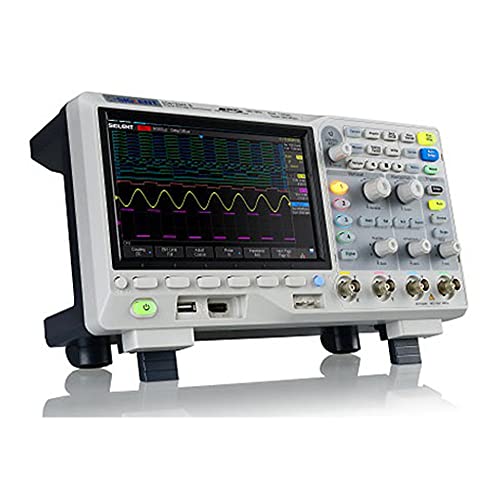
- 4 channels with 100MHz bandwidth
- Standard decoder for Iic, Spi, Uart/Rs232, Can, and Lin
- Includes 4 passive probes and USB cable
Best For: A bench user who wants serial decoding in a 4-channel scope
Compact PC-Connected 4-Channel Scope
Hantek 6074BC 70MHz 4-Channel Oscilloscope Set

- 4 analog channels with 70MHz bandwidth
- 1GSa/s sampling and waveform record/replay
- Works with Windows, Android, Linux, and OSX
Best For: Anyone who wants a compact, software-driven 4-channel scope
High-Resolution 4-Channel Bench Scope
Siglent SDS1204X-E 200MHz 4-Channel Oscilloscope

- 200MHz bandwidth with 4 channels
- 7-inch TFT-LCD display and 14MB memory
- Broad intelligent trigger set
Best For: Users who want higher bandwidth and a larger bench display
Automotive Diagnostic 4-Channel Scope
TOPDON Phoenix Scope 4-Channel Oscilloscope

- 4-channel scope designed for automotive diagnostics
- 50M memory depth with waveform record and playback
- Works only with compatible Phoenix diagnostic tools
Best For: Automotive technicians using compatible Phoenix tools
Compact 70MHz 4-Channel Detail Picker
RIGOL DHO804 Portable Digital Oscilloscope

- 70 MHz, 4 analog channels, 1.25 GSa/s
- 12-bit resolution with up to 25 Mpts memory
- UltraAcquire, search, and serial decode support
Best For: embedded bring-up, ripple/noise checks, and protocol troubleshooting
Mixed-Signal Expansion Pick
Siglent SDS814X HD 4-Channel Oscilloscope

- 100 MHz, 4 analog channels, 2 GSa/s
- 12-bit resolution with 50 Mpts memory
- Optional 16 digital channels with add-on probe
Best For: mixed-signal debugging and future digital-channel expansion
Higher-Bandwidth Portable Pick
RIGOL DHO814 Portable Digital Oscilloscope

- 100 MHz, 4 analog channels, 1.25 GSa/s
- 12-bit resolution with up to 25 Mpts memory
- UltraAcquire capture plus serial decode support
Best For: portable 4-channel measurement with more bandwidth
Portable 4-in-1 Bench-Plus Scope
FNIRSI DPOS350P 350MHz 2-Channel Oscilloscope

- 350 MHz bandwidth, 1 GSa/s sampling
- FFT, FRA, and DDS generator built in
- 7-inch touchscreen with 8000 mAh battery
Best For: portable advanced testing with analysis tools
Four-Channel Portable Workhorse
HANMATEK DOS1104 110MHz 4-Channel Oscilloscope

- 110 MHz bandwidth with 1 GS/s sampling
- 4 channels plus 7-inch color display
- USB storage and SCPI/LABVIEW support
Best For: general troubleshooting and portable bench use
Best-Value Bench 4-Channel Scope
Rigol DS1054Z 50MHz 4-Channel Oscilloscope

- 4 analog channels with 1 GSa/s single-channel sampling
- Up to 24 Mpts memory depth and 30,000 wfms/s
- UART, I2C, and SPI decode support
Best For: budget bench debugging and teaching labs
Bench-Friendly 4-Channel Scope – Siglent SDS1104X-E 100MHz Digital Oscilloscope
Siglent Technologies SDS1104X-E 100Mhz Digital Oscilloscope 4 Channels Standard Decoder, Grey
Check Price On AmazonIf you’re comparing four channel oscilloscopes for general electronics work, the Siglent SDS1104X-E is built around a straightforward bench setup with 100MHz bandwidth and 4 channels. It includes a standard decoder for Iic, Spi, Uart/Rs232, Can, and Lin, which can make protocol troubleshooting more convenient when you need more than basic wave tracing.
Best For: Users who want a 4-channel bench oscilloscope with built-in serial decoding support.
Pros:
- 4 channels with 100MHz bandwidth for everyday scope work
- Standard decoder supports Iic, Spi, Uart/Rs232, Can, and Lin
- Includes 4 passive probes, USB cable, quick start, and calibration certificate
- Compact bench dimensions and FCC specification met
Cons:
- MSO digital channels are optional and limited to the four-channel series
- USB AWG module is also optional
For buyers prioritizing a practical four channel oscilloscope with decoder support, this model covers a lot of common lab and debugging needs without extra add-ons. Its included accessories make it ready to set up, while the options for additional modules leave room to expand later.
Compact PC-Connected 4-Channel Scope – Hantek 6074BC 70MHz 4-Channel Oscilloscope Set
For shoppers looking at four channel oscilloscopes with a computer-based workflow, the Hantek 6074BC offers 4 analog channels, 70MHz bandwidth, and a 1GSa/s sampling rate. Its software support spans Windows, Android, Linux, and OSX through virtual machine use, making it a flexible option if you prefer testing from a connected device.
Best For: Users who want a compact 4-channel oscilloscope that works with multiple operating systems.
Pros:
- 4 analog channels with 70MHz bandwidth
- 1GSa/s sampling rate for signal capture
- Supports Windows, Android, Linux, and OSX via virtual box/machine
- Includes pass/fail test, waveform record and replay, and cursor tracking
Cons:
- Requires a computer-connected workflow rather than a standalone bench display
- Lower bandwidth than higher-end 4-channel bench scopes in this roundup
This is a practical pick if portability and software compatibility matter more than a traditional standalone instrument. The compact case and included development examples also make it easier to fit into a lab, classroom, or development setup.
High-Resolution 4-Channel Bench Scope – Siglent SDS1204X-E 200MHz 4-Channel Oscilloscope
Among four channel oscilloscopes, the Siglent SDS1204X-E stands out for its 200MHz bandwidth, 4 channels, and 1GSa/s sampling rate. It also adds a large 7-inch TFT-LCD display and 14MB memory, which can help when you need more screen space and deeper capture for signal review.
Best For: Buyers who want a 4-channel bench oscilloscope with higher bandwidth and a larger display.
Pros:
- 200MHz bandwidth with 4 channels
- 1GSa/s sampling and 14MB memory
- 7-inch TFT-LCD display with 800 x 480 resolution
- Intelligent trigger modes including edge, slope, pulse width, window, runt, interval, timeout, and pattern
Cons:
- Bulkier than compact PC-connected scopes
- Focused on bench use rather than portable workflows
If you want more bandwidth in a four channel oscilloscope, this model offers a strong step up while keeping the interface readable and the trigger tools broad. The low background noise and flexible voltage scales make it a capable choice for detailed waveform work.
Automotive Diagnostic 4-Channel Scope – TOPDON Phoenix Scope 4-Channel Oscilloscope
If your search for four channel oscilloscopes is really about vehicle diagnostics, the TOPDON Phoenix Scope is designed for automotive electronics and wiring work. It captures and replays waveforms, offers 50M memory depth, and supports a range of automotive tests, making it more specialized than a general-purpose lab scope.
Best For: Technicians using Phoenix diagnostic tools for automotive waveform testing.
Pros:
- 4-channel oscilloscope built for automotive diagnostics
- 50M memory depth with global and detailed waveform views
- Waveform recording, playback, and advanced math analysis including FFT
- Supports 23 auto measurements and multiple automotive test types
Cons:
- Works exclusively with Phoenix Max / Smart / Elite / Lite 3 / Lite 2 / Plus / Plus 2 tools
- Does not work independently of those diagnostic tools
This is the most specialized option here, and that focus is the main reason to choose it. For technicians already using compatible Phoenix tools, the scope features are tailored to faster signal inspection, storage, and analysis in an automotive setting.
Compact 70MHz 4-Channel Detail Picker – RIGOL DHO804 Portable Digital Oscilloscope
If you want one of the more practical four channel oscilloscopes for mixed analog and digital troubleshooting, the RIGOL DHO804 focuses on clear small-signal visibility, fast capture, and everyday bench convenience. Its 70 MHz bandwidth, 12-bit resolution, and 4-channel layout make it a solid fit for checking multiple rails, timing lines, and serial buses without jumping up to a larger platform.
Best For: Embedded bring-up, power ripple checks, and protocol troubleshooting where higher vertical detail matters.
Pros:
- 70 MHz bandwidth with 4 analog channels and 1.25 GSa/s sampling for multi-signal correlation.
- 12-bit vertical resolution and up to 25 Mpts memory depth for finer detail on small signals.
- UltraAcquire up to 1,000,000 wfms/s plus waveform search/navigation for spotting intermittent glitches.
- Built-in serial trigger/decode for CAN, RS232/UART, I2C, SPI, and 4-bit parallel signals.
Cons:
- Lower bandwidth than the 100 MHz model in this roundup.
- Focuses on analog channels rather than expanded mixed-signal input from a logic probe option.
Overall, the DHO804 is the most compact pick here for users who value precision over raw bandwidth. It stands out when you need a portable four channel oscilloscope with strong visibility into glitches, noise, and serial communication.
Mixed-Signal Expansion Pick – Siglent SDS814X HD 4-Channel Oscilloscope
For buyers comparing four channel oscilloscopes that can stretch beyond basic analog work, the Siglent SDS814X HD adds mixed-signal flexibility and a high-resolution front end. It combines 100 MHz bandwidth, 12-bit acquisition, and a 7-inch touchscreen with an optional digital channel upgrade, making it a practical choice when you want room to grow into more complex debugging.
Best For: Mixed-signal debugging and users who may want digital-channel expansion later.
Pros:
- 100 MHz bandwidth with 4 analog channels and 2 GSa/s sampling.
- 12-bit resolution and 50 Mpts memory depth for detailed captures.
- Waveform capture rate up to 80,000 wfm/s in normal mode and 500,000 wfm/s in sequence mode.
- Optional 16 digital channels available with the SDS800XHD-16LA logic probe kit.
Cons:
- Digital channels require an added option and separate logic probe.
- Heavier than the portable RIGOL models in this roundup.
The SDS814X HD is the most expansion-friendly option here, especially if your lab work may eventually need digital timing capture alongside analog measurements. It is a strong fit for users who want a capable four channel oscilloscope with a path toward mixed-signal analysis.
Higher-Bandwidth Portable Pick – RIGOL DHO814 Portable Digital Oscilloscope
If you need four channel oscilloscopes with a little more bandwidth headroom, the RIGOL DHO814 steps up to 100 MHz while keeping the same portable form factor and 12-bit detail. It is aimed at users who want a bench-friendly scope for multi-rail correlation, embedded bring-up, and everyday signal work without giving up clear small-signal visibility.
Best For: Users who want portable 4-channel measurement with higher bandwidth than the 70 MHz model.
Pros:
- 100 MHz bandwidth with 4 analog channels and 1.25 GSa/s sampling.
- 12-bit vertical resolution and up to 25 Mpts memory depth for clearer low-level detail.
- UltraAcquire up to 1,000,000 wfms/s plus waveform search/navigation for intermittent events.
- Standard serial trigger/decode for CAN, RS232/UART, I2C, SPI, and 4-bit parallel signals.
Cons:
- Does not add mixed-signal digital channels like the Siglent option.
- Same compact platform as the DHO804, so it is still a general-purpose portable scope rather than a larger lab system.
Among portable four channel oscilloscopes, the DHO814 is the better pick when bandwidth is the priority but you still want the same 12-bit workflow and compact footprint. It makes sense for users who need a stronger all-around bench scope for faster edges and broader signal coverage.
Portable 4-in-1 Bench-Plus Scope – FNIRSI DPOS350P 350MHz 2-Channel Oscilloscope
If you want four channel oscilloscopes for a lab-style feature set in a portable form, the FNIRSI DPOS350P is a different kind of pick: it is a 2-channel handheld scope with a 350 MHz bandwidth and a broad mix of tools built in. The 7-inch touchscreen, digital phosphor display, FFT spectrum analysis, frequency response analysis, and DDS signal generator make it useful when you need more than just basic waveform viewing.
Best For: Engineers and advanced hobbyists who want a portable oscilloscope with analysis and signal-generation tools in one unit.
Pros:
- 350 MHz bandwidth with 1 GSa/s sampling and 50,000 wfms/s refresh.
- Built-in FFT spectrum analysis, frequency response analysis, and DDS signal generator.
- 7-inch touchscreen, X-Y mode, cursor tools, and 12 auto measurements.
- Large 8000 mAh battery with USB-C charging for field use.
Cons:
- Only 2 channels, so it does not match true four channel oscilloscopes.
- 47 Kpts memory depth is modest compared with deeper bench scopes.
- Heavier than compact pocket scopes at 3.56 pounds.
This is the most feature-packed portable option in the group, especially if you value spectrum and frequency-response testing. It is less suitable if your workflow specifically requires four simultaneous analog channels.
Four-Channel Portable Workhorse – HANMATEK DOS1104 110MHz 4-Channel Oscilloscope
Among four channel oscilloscopes, the HANMATEK DOS1104 stands out as a practical all-rounder with 110 MHz bandwidth, 1 GS/s real-time sampling, and a 7-inch color display. It is aimed at users who want straightforward bench capability plus portability, with enough channel count and capture tools for mixed-signal troubleshooting.
Best For: Users who need a genuine 4-channel scope for general troubleshooting, lab work, and portable bench setups.
Pros:
- True 4-channel design with 110 MHz bandwidth and 1 GS/s sampling.
- 7-inch TFT LCD with cursor measurement and automatic range support.
- At least 20K sample storage depth and storage for 16 waveform groups.
- USB host/device support, U disk storage, and SCPI-compliant workflow support.
Cons:
- Bandwidth is lower than premium 4-channel scopes like the Rigol DS1054Z.
- Memory depth is listed as at least 20K points, which is modest for long captures.
- Powered by DC, so it is less independent than battery-powered portable units.
The DOS1104 is a sensible choice if your priority is a real four-channel layout with good everyday utility rather than top-end performance. Its mix of storage, measurement, and interface features makes it useful for hands-on troubleshooting.
Best-Value Bench 4-Channel Scope – Rigol DS1054Z 50MHz 4-Channel Oscilloscope
If you are comparing four channel oscilloscopes for bench use, the Rigol DS1054Z is the classic value pick. It offers 50 MHz bandwidth, 1 GSa/s on a single channel, deep memory, and strong capture performance, which makes it a dependable choice for electronics debugging and teaching labs.
Best For: Budget-conscious users who want a proven 4-channel bench oscilloscope with strong capture tools.
Pros:
- 4 analog channels with up to 1 GSa/s sampling on a single channel.
- Up to 24 Mpts memory depth for long captures.
- UltraVision features with up to 30,000 wfms/s capture rate.
- Serial trigger and decode support for RS232/UART, I2C, and SPI.
Cons:
- 50 MHz bandwidth is limited for higher-frequency work.
- Memory depth drops in multi-channel use compared with single-channel operation.
- It is a heavier bench unit at 6.6 pounds.
The DS1054Z remains appealing because it balances channel count, deep memory, and useful trigger tools at a straightforward spec level. It is best suited to users who want a reliable four-channel scope for everyday troubleshooting rather than maximum bandwidth.
How We Picked the Best Four Channel Oscilloscopes
We focused on Four Channel Oscilloscopes that offer the best mix of channel count, bandwidth, sample rate, memory depth, triggering features, display quality, and real-world value. We also considered how well each model fits common jobs like embedded debugging, power electronics, automotive diagnostics, and general electronics repair.
Because buyers use oscilloscopes differently, we gave extra weight to usability features such as portability, interface speed, bundled probes or accessories, and software or protocol decoding support.
Quick Comparison: What Matters Most
At a glance, bandwidth tells you how fast a signal you can measure accurately, while sample rate affects waveform detail and capture reliability. Memory depth matters when you need to zoom in after capturing a long event. For Four Channel Oscilloscopes, it is also important to check whether all channels can be used at full speed together, since some models reduce performance when multiple channels are active.
If you work on digital circuits, decoding and trigger tools may matter more than raw bandwidth. If you handle analog, RF-adjacent, or power-supply signals, prioritize bandwidth and resolution first.
Key Buying Factors for Four Channel Oscilloscopes
Bandwidth and Rise-Time Headroom
Choose more bandwidth than your signal strictly requires. That extra headroom helps preserve signal edges and reduces the chance of misleading readings, especially on fast digital buses and switching waveforms.
Sampling Rate and Memory Depth
A higher sample rate improves detail, but deep memory is what lets you inspect rare glitches across longer captures. For Four Channel Oscilloscopes, the ideal balance depends on whether you are chasing intermittent faults or viewing repetitive signals in real time.
Resolution and Display Behavior
Higher-resolution scopes can make small signal changes easier to see, especially in noisy environments or analog measurements. A clear screen, responsive controls, and fast waveform updates also matter more than many buyers expect.
Portability, Connectivity, and Included Accessories
Bench scopes usually offer the best overall experience, while portable models are better for mobile diagnostics. Check for USB, LAN, decoding options, and whether the package includes enough probes and leads to get started without extra purchases.
Who Should Buy Which Four Channel Oscilloscopes?
If you want the best value for general lab and repair use, a midrange benchtop model is usually the safest choice. If you need advanced signal visibility or higher resolution, step up to a better display and deeper memory. If portability matters most, pick a compact scope with a sturdy housing and an interface you can use quickly in the field.
For beginners and budget-focused shoppers, prioritize ease of use and a known-good feature set over maximum specs. For professionals, the right four channel oscilloscope is the one that fits your workflow, not just the one with the highest advertised numbers.