Choosing the right stereo microscope can make close-up work faster, safer, and far more precise. Whether you solder tiny components, inspect parts, or work on delicate repairs, the right setup matters.
Below, we focus on the best options for clarity, working distance, lighting, and versatility so you can choose with confidence.
Best 10 Stereo Microscopes Picks for 2026
Classic Bench Inspection Pick

- Fixed 20X, 40X, and 80X stereo magnification
- Widefield optical glass with binocular head
- Top and bottom built-in illumination
Best For: General inspection work and hobby bench use
Repair Bench All-in-One

- 7X-50X continuous zoom with WF10x23 eyepieces
- Trinocular head supports camera use without losing the left eyepiece view
- Includes LED ring light and solder fume exhaust fan
Best For: Soldering, electronics repair, and camera-assisted inspection
Cordless Bench-Friendly Pick

- Cordless battery-powered stereo microscope
- 20X and 40X fixed magnification settings
- LED incident and transmitted lights
Best For: Portable inspection on a cluttered bench
Expanded Repair Station Option
Kaisi TX350E Trinocular 7X-50X

- Continuous 7X-50X zoom with WF10x23 eyepieces
- Trinocular design supports camera use
- LED ring light, exhaust fan, and large work floor
Best For: Dedicated electronics repair benches with extra workspace
Bench-Ready Pick
AmScope SE306R-P20 Forward-Mounted Binocular Stereo Microscope

- 40X and 80X stereo magnification
- Built-in incident and transmitted lights
- Sturdy pillar stand with metal framework
Best For: Routine inspection work with simple dual-light viewing
Versatile Zoom Choice
SWIFT Trinocular Stereo Zoom Microscope with LED Ring Light
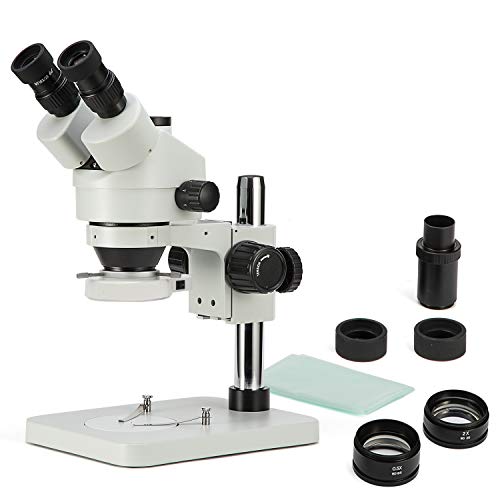
- 3.5X-90X magnification with zoom objective
- 56-bulb LED ring light for shadow-free light
- Trinocular port supports camera attachment
Best For: Detailed inspection and documentation with a wide zoom range
High-Value Inspector
AmScope 3.5X-45X Inspection Zoom Stereo Microscope

- 3.5X-45X zoom magnification
- 8-inch working distance for hands-on tasks
- 64-LED ring light with dimmer
Best For: Inspection and dissecting with strong light and extra workspace
Trinocular 3D Zoom for Precision Work
3.5X-90X Trinocular Stereo Zoom Microscope

- Trinocular head supports camera connection
- 0.7X-4.5X zoom reaches 3.5X-90X total
- 18 lb steel base helps reduce vibration
Best For: inspection, teaching, jewelry, and documentation
Starter Stereo Kit with Specimens
20X/50X Binocular Stereo Microscope

- Includes slides, insect specimens, and minerals
- Battery-powered LED light supports portability
- Long working range fits larger samples
Best For: beginners, students, and hobby specimen viewing
Heavy-Duty Trinocular Zoom System
3.5X-90X Stereo Zoom Microscope
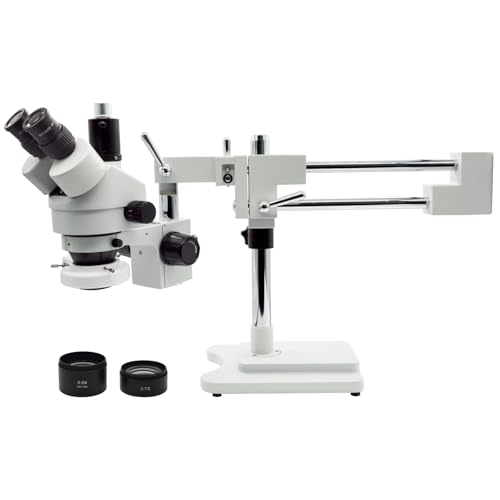
- Trinocular port supports camera and eyepiece use
- 0.7X-4.5X zoom expands to 3.5X-90X
- 18 lb steel base and boom arm add stability
Best For: professional inspection and camera-assisted viewing
Classic Bench Inspection Pick – AmScope SE306R-PZ 20X-80X
If you want stereo microscopes for general bench work, the AmScope SE306R-PZ is a straightforward pick with fixed 20X, 40X, and 80X viewing options. Its forward binocular head, widefield glass optics, and dual incident/transmitted lighting make it a practical fit for inspecting small parts with solid depth and clarity.
Best For: Hobbyists, classrooms, and users who want a simple all-metal stereo microscope with top and bottom illumination.
Pros:
- 20X, 40X, and 80X stereo magnification settings cover common inspection needs
- Widefield optical glass lenses and forward binocular head support comfortable viewing
- Built-in incident and transmitted lights help with reflective or translucent samples
- All-metal pillar stand adds a sturdy feel for bench use
Cons:
- Uses halogen lighting rather than LED
- Fixed magnification steps are less flexible than zoom models
- Designed more for inspection than advanced imaging workflows
Overall, this AmScope model is a dependable entry-level option if you want a traditional stereo microscope with simple operation and dual lighting. It keeps the feature set focused on practical viewing rather than extras.
Repair Bench All-in-One – Kaisi TX Trinocular 7X-50X
Among stereo microscopes for soldering and repair, the Kaisi TX stands out for its trinocular design and built-in workflow extras. The 7X-50X zoom range, WF10x23 eyepieces, LED ring light, and solder fume exhaust fan are aimed at making close-up electronics work easier and more comfortable.
Best For: Electronics repair, soldering, and users who want trinocular viewing with camera support.
Pros:
- Continuous 7X-50X zoom helps adjust quickly for different repair tasks
- WF10x23 eyepieces offer a wider field of view than standard WF10x20 designs
- Trinocular head is designed to avoid losing the left eyepiece view when using a camera
- Includes an LED ring light and soldering exhaust fan for cleaner, brighter work
Cons:
- Requires careful setup of working distance for clear focus
- Bulky workstation design is more specialized than a basic microscope stand
- Best suited to repair benches rather than casual sample viewing
This Kaisi model is built like a dedicated repair station, not just a microscope. If your priority is soldering visibility, camera compatibility, and onboard accessories, it has a strong feature mix for the job.
Cordless Bench-Friendly Pick – AmScope SE306R-P-LED 20X-40X
If you need stereo microscopes that are easier to place on a crowded bench, the AmScope SE306R-P-LED is built around cordless battery power and dual LED lighting. Its 20X and 40X magnification settings, forward binocular head, and all-metal pillar stand make it a simple inspection tool for small parts and components.
Best For: Users who want a portable, battery-powered stereo microscope with top and bottom LED lighting.
Pros:
- Battery-powered cordless design gives more freedom on the work surface
- 20X and 40X magnification is easy to use for basic inspection tasks
- LED incident and transmitted lights help illuminate different sample types
- Widefield binocular head and optical glass lenses support clear viewing
Cons:
- Only offers two fixed magnification settings
- Less flexible than zoom-based stereo microscopes
- Battery operation may not suit users who prefer constant corded power
This AmScope model is a good fit if you want a tidy, cordless setup with standard stereo viewing. It focuses on portability and simple illumination rather than advanced controls.
Expanded Repair Station Option – Kaisi TX350E Trinocular 7X-50X
The Kaisi TX350E is one of the more specialized stereo microscopes here for electronics work, combining trinocular viewing with a continuous 7X-50X zoom range. It also includes a WF10x23 eyepiece pair, LED ring light, and soldering exhaust fan, which makes it a strong fit for detailed repair tasks where visibility matters.
Best For: Electronics repair users who want a trinocular microscope with a larger work floor and integrated accessories.
Pros:
- 7X-50X zoom range supports flexible close-up inspection
- WF10x23 eyepieces provide a wider field of view than conventional WF10x20 designs
- Trinocular layout is built for camera use without losing the left eyepiece view
- Includes an LED ring light, exhaust fan, and a sizable adjustable work floor
Cons:
- Requires correct working-distance setup to focus properly
- Large workstation footprint takes more space than a basic microscope
- More specialized than a general-purpose stereo microscope
For users building a serious repair station, the TX350E puts the emphasis on usability and workspace support. It’s a practical choice when you want a microscope that handles soldering tasks and camera monitoring together.
Bench-Ready Pick – AmScope SE306R-P20 Forward-Mounted Binocular Stereo Microscope
If you want a straightforward stereo microscope for general inspection work, the AmScope SE306R-P20 focuses on practical basics: 40X and 80X magnification, a forward-mounted binocular head, and both incident and transmitted lighting. It’s a solid fit when you need a compact setup with standard stereo viewing and built-in illumination for different specimen types.
Best For: Users who want a simple binocular stereo microscope with dual lighting for basic inspection tasks.
Pros:
- Offers 40X and 80X stereo magnification settings.
- Includes built-in incident and transmitted lights.
- Uses widefield optical glass lenses for clearer viewing.
- Sturdy pillar stand with a metal framework.
Cons:
- Maximum magnification is limited compared with zoom models.
- Halogen lighting may be less convenient than LED.
- Less flexible for documentation since it is not a trinocular design.
Overall, this is a practical entry-level choice among stereo microscopes when you value simple operation and dual lighting over advanced zoom range. The forward binocular head and stable stand make it easy to use for routine inspections.
Versatile Zoom Choice – SWIFT Trinocular Stereo Zoom Microscope with LED Ring Light
For buyers comparing stereo microscopes with more flexibility, the SWIFT trinocular model stands out with a wide zoom range, additional objectives, and a bright 56-bulb LED ring light. It is aimed at detailed inspection and documentation work where you may want both comfortable viewing and a photo port for capture.
Best For: Researchers, technicians, and hobbyists who need zoom flexibility plus camera attachment support.
Pros:
- Wide 3.5X-90X magnification range with included additional objectives.
- Trinocular head includes a vertical port for camera attachment.
- 56-bulb LED ring light provides bright, shadow-free illumination.
- 45-degree angled head and 360-degree rotation support more comfortable viewing.
Cons:
- More complex than a basic binocular inspection scope.
- Larger, heavier setup than simpler pillar-stan models.
- Higher magnification range may be more than needed for casual use.
This is a strong option if you want stereo microscopes that can handle both observation and image capture. The zoom range, long working distance, and included lighting make it especially practical for precision tasks.
High-Value Inspector – AmScope 3.5X-45X Inspection Zoom Stereo Microscope
This AmScope stereo microscope is built for inspection and dissecting tasks, with a 3.5X-45X zoom range, super widefield optics, and a generous 8-inch working distance. The included 64-LED ring light with dimmer makes it a practical pick when you need strong illumination and room to work under the scope.
Best For: Users who want a dependable zoom stereo microscope with long working distance for inspection and dissecting.
Pros:
- 3.5X-45X zoom magnification covers a useful inspection range.
- 8-inch working distance leaves plenty of room for tools and specimens.
- 64-LED ring light includes a dimmer for adjustable illumination.
- All-metal pillar stand adds stability.
Cons:
- Not as much top-end magnification as some trinocular zoom models.
- Fixed inspection-style setup may be less versatile for imaging.
- Bulky ring-light configuration may not suit minimal workspaces.
For buyers who prioritize working distance and bright lighting, this is one of the more practical stereo microscopes in the group. It balances zoom capability with a sturdy build, making it useful for hands-on inspection tasks.
Trinocular 3D Zoom for Precision Work – 3.5X-90X Trinocular Stereo Zoom Microscope
If you need a stereo microscope for inspection, assembly, or detailed hands-on work, this trinocular zoom model gives you a practical mix of 3D viewing, long working distance, and camera-ready flexibility. The 0.7X-4.5X zoom system expands to 3.5X-90X with auxiliary lenses, making it versatile for everything from jewelry checks to teaching demonstrations.
Best For: Users who want a stable trinocular stereo microscope for inspection, dissection, jewelry, and documentation.
Pros:
- Trinocular head supports both live viewing and external camera use.
- 3.5X-90X total magnification covers a wide range of precision tasks.
- Heavy 18 lb steel base and boom arm improve stability during work.
- Includes a 56-LED ring light and accessory set for immediate setup.
Cons:
- Single-arm boom design may not suit every workspace layout.
- Higher magnification depends on included auxiliary lenses.
- Best suited to mounted use rather than quick portable inspection.
Overall, this is a strong choice if you want a capable stereo microscope that balances viewing comfort, imaging support, and a stable platform. Its feature set is especially appealing for users who need both observation and recording in one setup.
Starter Stereo Kit with Specimens – 20X/50X Binocular Stereo Microscope
This stereo microscope is aimed at beginners who want an easy setup for viewing insects, rocks, slides, and small parts at home or in class. It offers 20X and 50X magnification with WF10X and WF25X eyepieces plus a 2X objective, along with a longer working range that helps when examining larger specimens.
Best For: Students, hobbyists, and beginners who want a simple binocular stereo microscope with specimen extras.
Pros:
- Includes insect specimens, 10 slides, and 12 mineral specimens.
- Battery-powered LED light makes it easier to move and use cord-free.
- Binocular design and adjustable interpupillary distance improve comfort.
- Long working range suits rocks, stamps, circuits, and larger samples.
Cons:
- Maximum magnification is limited compared with zoom stereo microscopes.
- Batteries are not included with the LED light.
- More of an entry-level model than a heavy-duty inspection tool.
For newcomers to stereo microscopes, this package stands out because it combines viewing capability with ready-to-use learning materials. It is a practical pick when convenience, portability, and basic specimen viewing matter more than advanced optical range.
Heavy-Duty Trinocular Zoom System – 3.5X-90X Stereo Zoom Microscope
For buyers comparing stereo microscopes for inspection and camera-assisted observation, this trinocular zoom model focuses on stability, flexibility, and comfortable viewing. It combines a 0.7X-4.5X zoom objective with included 0.5X and 2X auxiliary lenses to reach 3.5X-90X, while the trinocular head supports both eyepiece viewing and digital imaging.
Best For: Professionals who want a stable trinocular stereo microscope with camera support and a wide zoom range.
Pros:
- Trinocular head includes two adapter configurations for camera or electronic eyepiece use.
- 3.5X-90X magnification range covers detailed inspection tasks.
- Heavy 18 lb steel base and ball-bearing boom improve stability and movement.
- 56S LED ring light includes dimming for shadow-free illumination.
Cons:
- Large boom stand and steel base take up substantial bench space.
- Designed more for stationary work than quick grab-and-go use.
- Feature set may be more than casual users need.
This is a strong fit if you want a more professional stereo microscope setup with smooth arm travel and built-in support for documentation. The combination of stable mechanics and adjustable illumination makes it well suited to detailed bench work.
How We Picked These Stereo Microscopes
Our shortlist emphasizes the features that matter most in real workshop use: usable magnification, stable optics, comfortable working distance, dependable lighting, and build quality. We also favored models that suit common buyer needs such as soldering, inspection, dissection, and bench repair.
Quick Comparison: What to Expect
Among Stereo Microscopes, fixed-power binocular models are usually the simplest and most affordable, while zoom trinocular models offer more flexibility and are better for photography or video capture. LED ring lighting improves visibility, but the quality of the optics and the working distance still matter more than raw magnification numbers.
Key Buying Factors for Stereo Microscopes
Magnification Range
For electronics and general inspection, moderate magnification with a wide field of view is often more useful than extreme power. Higher zoom is helpful for detail work, but too much magnification can reduce working distance and make tasks harder.
Working Distance
A generous working distance is essential if you need room for tools, tweezers, soldering irons, or specimen manipulation. If you will work directly under the lens, prioritize models that leave enough clearance for your hands and tools.
Optical Design
Binocular Stereo Microscopes are great for straightforward viewing, while trinocular versions add a third port for cameras. Zoom optics are more versatile than fixed eyepieces, especially if your work changes from broad inspection to detailed examination.
Lighting and Accessories
Integrated LED lighting is a major advantage for bench work because it improves contrast and reduces shadows. Look for useful accessories such as auxiliary lenses, eyepieces, or camera-ready ports if you want to expand the system later.
Who Should Buy Which Stereo Microscopes?
If you want a simple, durable bench tool for soldering and repairs, a binocular model with solid lighting is usually the best value. If you plan to capture images or video, choose one of the trinocular Stereo Microscopes. If you need more flexibility across different tasks, a zoom model with adjustable magnification is the smartest pick. For hobbyists and students, a more compact or portable option may be enough, but for frequent shop use, prioritize comfort, optics, and stability over extras.