4.3″ LCD Digital Coin Microscope review is about a very specific kind of convenience: seeing tiny details immediately on a built-in screen instead of depending on a phone, laptop, or external monitor.
For coin collectors, jewelers, and watch repair hobbyists, that direct workflow is the main appeal.
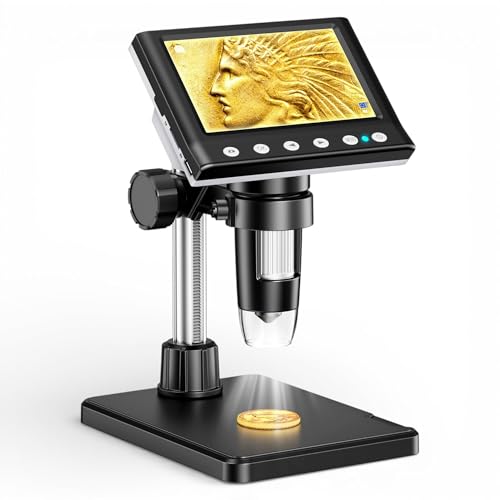
4.3″ LCD Digital Coin Microscope Review Summary
If you want a compact inspection tool for dates, mint marks, error checks, surface texture, and other close-up work, this 4.3″ LCD digital coin microscope is aimed at exactly that use case.
The listing emphasizes standalone viewing, adjustable LED lighting, a weighted base, and a focus wheel that should make it easier to work at a bench without constantly juggling accessories.
Best fit: buyers who care more about fast, localized inspection than full-object viewing.
Less suitable: anyone expecting a general-purpose imaging setup for larger subjects or computer-connected workflow.
Review Scorecard
| Category | Score | Rationale |
|---|---|---|
| Standalone usability | 9/10 | Built-in 4.3-inch LCD keeps inspection self-contained. |
| Close-detail focus | 8/10 | Listing highlights 50X to 1000X range for tiny features. |
| Lighting control | 8/10 | Eight dimmable LED ring lights support reflective surfaces. |
| Stability for bench work | 8/10 | Weighted base and rotary focus should reduce fuss. |
| Portability | 7/10 | Compact and self-contained, but still a bench tool. |
| Versatility | 6/10 | Strong for coins and small objects, narrower for broader tasks. |
| Value for target buyers | 8/10 | The feature set matches the specialized hobby workflow well. |
Bottom line: this looks like a practical, purpose-built microscope for collectors and small-item inspectors who value speed, direct viewing, and simple setup over a more flexible imaging system.
Key Features and Specifications of 4.3″ LCD Digital Coin Microscope
The listing positions this microscope as a standalone observation system with a 4.3-inch LCD screen, so the biggest functional difference is not raw magnification alone, but the fact that you can inspect details directly on the device.
That matters when you are checking a coin tray, sorting a collection, or moving between bench tasks and do not want to keep reconnecting equipment.
The magnification range is listed as 50X to 1000X.
In practical terms, that suggests the microscope is designed for extremely close inspection of small details such as mint marks, surface defects, watch components, jewelry textures, and other microscopic features.
Buyers should read that range as a specialty tool for localized detail, not as a promise of easy full-frame views of large objects.
The lighting setup is another key part of the design.
The product includes 8 dimmable LED ring lights, and the listing specifically calls out anti-glare illumination for reflective surfaces.
That is important for metal coins, polished watch dials, and jewelry, where harsh reflections can hide the very imperfections you are trying to see.
The base and focus controls are also relevant.
The weighted base and smooth rotary focus wheel are meant to support stable viewing and precise distance control.
For delicate inspection work, stability matters as much as magnification, because a shaky platform makes it harder to lock onto fine detail.
The included starter package is straightforward: the listing mentions a charging cable and user manual.
It also notes a pre-installed clear protective cover on the lens that should be removed before use.
That is a small detail, but it matters because new users can easily mistake protective film for a defect if they do not notice it.
Useful buyer takeaways from the listing:
- 4.3-inch integrated LCD display for direct viewing
- 50X to 1000X magnification range
- 8 dimmable LED ring lights
- Weighted base for steadier observation
- Rotary focus wheel for fine adjustment
- Intended for coins, jewelry, watch work, and similar small objects
- Protective lens cover must be removed before use
Pros and Cons of 4.3″ LCD Digital Coin Microscope
Pros
- Standalone viewing is the biggest advantage. You do not need to route images through a computer just to inspect a coin or component.
- The lighting setup looks well matched to reflective subjects. Coins and polished surfaces often need adjustable illumination more than raw magnification.
- The product is clearly specialized. That is a strength if you want a tool that is oriented around one job rather than a vague all-purpose microscope.
- The weighted base and focus wheel suggest a more controlled workflow. That matters for detailed inspection where minute movement can interrupt the view.
Cons
- The 4.3-inch screen is compact. It is useful for local inspection, but it is not the same thing as a large monitor for prolonged viewing.
- The product is intentionally narrow in scope. Buyers looking for a broader lab-style microscope may find the coin-focused design limiting.
- The listing does not provide enough detail on connectivity or imaging workflow. If you need advanced documentation features, you should verify those separately.
- The very high magnification claim can be misleading if taken literally. At this class of product, practical usefulness depends heavily on stability, distance, and lighting, not the headline number alone.
Who Should Buy 4.3″ LCD Digital Coin Microscope?
This product makes the most sense for people who want a simple inspection station rather than a full photography or lab setup.
Coin collectors who want to check mint marks, dates, and small surface flaws will likely get the clearest benefit.
Jewelers and watch hobbyists who need to look closely at textures, settings, or small parts can also use the direct-screen format efficiently.
It is also a sensible fit for anyone with limited bench space.
Because the display is built in, the microscope can stay self-contained, which reduces cable clutter and setup friction.
You should probably skip it if you need:
- a wide-field microscope for larger objects
- advanced image capture and editing workflows
- a premium viewing experience on a large external display
- a general-purpose scientific microscope rather than a hobby inspection tool
In other words, this is a specialist instrument.
Buyers who know exactly why they want a digital coin microscope are the right audience.
Buyers still comparing different microscope categories should keep looking.
Detail Inspection and Bench Use
Why the Built-in Screen Matters
The main reason to consider this model is workflow simplicity.
A built-in LCD means you can place a coin or small part on the stand, focus, and inspect without creating a second setup around a phone or computer.
For repetitive tasks, that reduction in friction is a real benefit.
How the Lighting Helps on Reflective Surfaces
Coins, polished metal, and jewelry often create bright hotspots that hide small marks.
The listing’s dimmable ring lighting is a sensible answer to that problem because it lets the user tune brightness rather than accept one fixed glare-heavy mode.
Stability and Focus in Daily Use
The weighted base and rotary focus wheel are important because close inspection is unforgiving.
Small shifts can blur a mint mark or scratch line, so a steadier stand and finer focus control are not luxury features here.
They are core usability features.
What the Magnification Range Suggests
The 50X to 1000X claim tells you the microscope is meant for tiny details, but buyers should think about that range as task-specific rather than universal.
It is best suited to inspecting a small area carefully, not scanning large objects from edge to edge.
Alternatives to 4.3″ LCD Digital Coin Microscope
If you want alternatives that are more established in the same general category, look at Amazon searches for the Teslong digital microscope, Andonstar microscope, and Celestron digital microscope.
Those lines are commonly associated with hobby inspection, bench work, and compact digital viewing.
If your main need is coin-focused inspection, a search for coin microscope can also surface similar standalone models with built-in screens and lighting.
The right choice depends on whether you care more about screen size, stand stability, lighting flexibility, or how specialized the device is for numismatic work.
Is 4.3″ LCD Digital Coin Microscope Worth It?
Yes, if your main use is close inspection of coins, jewelry, watch parts, or other tiny surfaces.
The combination of a built-in LCD, adjustable LED lighting, a stable base, and a focus wheel makes the product easy to understand and easy to justify for the right buyer.
It is not the right pick if you want a general-purpose microscope, a large display, or a richer imaging workflow.
But if you want a compact, purpose-built inspection tool that keeps the process simple, this 4.3″ LCD digital coin microscope looks worth considering.